Sir
George Rawdon
The founder of Ballynahinch, according to the history
books, was Sir George Rawdon, who acquired the district
from the McCartens in about 1660. The McCartens came
into military contact with the English around 1641,
following which they suffered dispossession of their
lands and their goods. It’s said that Sir George
acquired the district from the McCarten’s by legal
purchase, but it’s debatable whether or not this
was a voluntary transaction. It was between 1660 and
1683, when Sir George received the patent from Charles
II, that he laid out the streets of modern Ballynahinch.
He started with the focal-point of the square, and it
was here that he established the regular Thursday market
where it is still held today.
The Earls of Moira
Sir George’s descendents, known as the
Earls of Moira lived in Ballynahinch until 1800 and
most of the historical buildings in the town can be
attributed to them. These include Montalto House built
in 1760, Magheradroll Parish Church in 1772, Ballynahinch
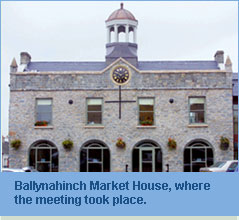
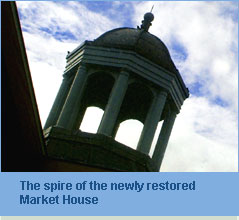
windmill in 1773, and the Market house in 1792, all
of which are still in use today. Montalto House is still
in private ownership, the market house was beautifully
restored in 2002, and a few years ago the windmill was
dramatically saved by the developers and transformed
into a public park complete with walkways and a bench
on which to sit and reflect on the view of the town.
Francis Rawdon
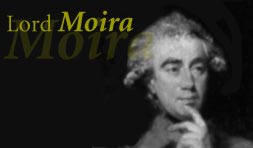
The most famous of Rawdon’s descendents
was perhaps Francis Rawdon, the second Earl of Moira,
also known as the Marquis of Hastings. He had a very
long and distinguished career as a diplomat and soldier.
He fought against the American colonist in the American
war of Independence and against the French revolutionary
armies in the low countries in 1793. He was Commander
and Chief in Scotland and Constable of the Tower of
London. He was a very close friend of the Prince Regent,
who in 1812, gave him a shot at being Prime Minister
in London. Unfortunately at this stage, he was unable
to form a ministry and so as a consolation prize, he
was sent to India in 1813 to act as Governor General
and Commander of one section of the growing British
empire. Even in his sixties, he was an active soldier,
fighting against the Gurkhas in Nepal and against the
Mahrattas in central India. Victorious in both, he added
large chunks of central India to the British empire.
|
|



 print version





















 POST
A COMMENT ON THIS ARTICLE
POST
A COMMENT ON THIS ARTICLE