page 3
|
|
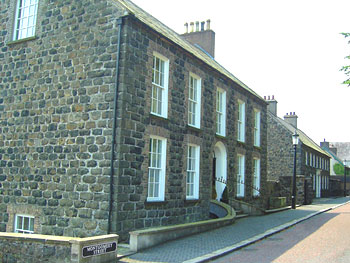
The beautifully maintained
Georgian houses of Gracehill
|
The Moravian intention was that the settlement should
be self-sufficient and support its local evangelical
work. The community here was indeed largely self
sufficient. Services such as manufacturing, food
production and even medicine were provided from within
the village.
The residents followed
trades and crafts (such
as lacework, line-weaving,
carpentry, baking
etc..) for the benefit of the group and in return
were provided with a home and the essentials of
life.
The final buildings to
complete the society were:
a farm, a shop, an inn (to provide accommodation
for parents conveying their children to and from
the boarding schools), and, of course, the burial ground.
Many of the stone buildings, dating from 1768-92
boast unusual details such as galleting, where a
decorative line of small stones are pressed into
the joints between basalt courses.
The influence of a Moravian education is impressive.
In Ireland the school at Gracehill was famous. The
pupils came from the highest ranks of society, and,
at one time, it was said that the mere fact that
a boy or girl had been educated at Gracehill, was
a passport to the best in life. Boys and girls were
educated to equal standards.
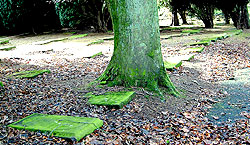
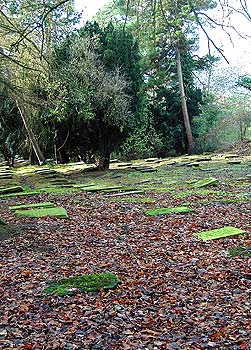
Because they lie so flat to
the ground, many of the headstones here in
Gracehill are covered with moss and hard to
read. Some cannot be read at all. The average
size of a headstone is only 20x35cm... roughly
the size of an A4 page.
Roberta Thompson says that she is often asked
by visitors; "Are
the bodies buried standing up?" They ask
this because of the small headstones. The truth
is that they aren't. The bodies are buried
in the conventional way.
One major difference to most other graveyards
though is that there is only one body and one
name to each grave. Another notable difference
around "God's Acre" is the absence of grandiose
mausolea and tombs housing the bodies of wealthy,
important
or
influencial families. In the belief that in
death all are equal, you will find only plain
simple headstones here no matter who is buried
beneath. |
|
There are just a couple of exceptions to the single
name policy on headstones. One of these commemorates
James Thompson and his two sons, Scott and Charles.
Charles was
lost on HMS Vanguard in July 1917 and Scott fell
in France the following month. Niether of the sons
have a proper grave and so it was thought appropriate
that they should be remembered on their father's
headstone.
Another headstone which breaks with the tradition
belongs to two sisters who died within a few days
of each other in the 1860s. Their deaths caused some
excitement in the village and rumours went around
that they had been poisoned by the village doctor
who had his eye on their house!
Their bodies were
exhumed
(which only happened at night by candlelight) and
organs were sent to Belfast for examination. The
report that came back confirmed that poison had
indeed been found in the bodies. Both the doctor
and his
servant were tried for murder but they were acquitted.
If you enjoyed this article you may like to read
some of the others in this series, exploring
community history through headstones... click
here
Relevant weblink:
History from Headstones: http://www.historyfromheadstones.com/
|



 print version