page 2
"In all essentials - Unity,
In non essentials - Liberty,
In all things - Charity"
This is the Moravian Motto. Roberta Thompson explains
the meaning and reasons for segragating the community
into sections or "choirs" as they were called. Dr.
David Johnston discusses Moravian traditions and
how they
were
received
by
the local people in Northern Ireland. Some found
it an attractive alternative as a way of worship...
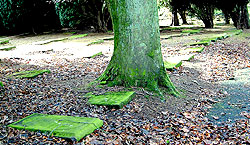
An unusual feature of the burial
ground here in Gracehill is that is is sited
on a hill. Most graveyards are on flat land.
In one particular place you will find all of
the headstones have been moved from their original
locations and placed side by side along the
edge of the path. Don't be tempted to assign
any religious or social reason to this....
In the 1950's it is recorded that an impatient
gardener was fed up having to cut the grass
in and around the maze of headstones at Gracehill.
His solution was to lift all of the heavy sandstone
tablets, placing them at the edge of the path,
as he happily went about his work.
As well as various ministers of the church,
some notable and influential people are buried
here. One such is Elizabeth Mary Bates who
was a very wealthy and well connected lady
who
frequently donated money to the church.
Elizabeth Bates made
an offer to the brothers that she would either
re-slate all of the houses in Gracehill
or build a brand new Brethren home for them.
The elders opted for the latter and so the
foundation stone was laid in 1819. |
 |
Roberta Thompson explains here how the 'choirs'
were made up and how a system of coloured ribbons
was used to denote which women were married, were
unmarried or were widows.
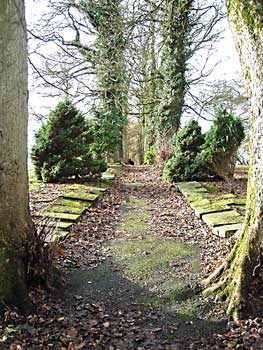
Moravian funerals are conducted in their own distinctive
way and some of the practices are quite unusual.
If it is a sister who has died, her coffin will be
taken into and out of the church by the sisters'
door. Likewise the brothers will be carried only
through their designated door, a tradition also observed
by the living. The coffin is then carried
along
a central
path through
the burial ground and men are buried to the left
and women to the right.
All
the
headstones
are
of the
same shape and design, in accordance with the Moravians'
belief that everyone is equal in death. The headstones
are laid almost
flat on the ground. No one can stand taller than
the others.
The well known hymn writer James Montgomery has
connections with Gracehill. Both his mother and father
came from here and James was born in Scotland whilst
his father, a Moravian minister, was serving the
church in Ayrshire. The family returned to Gracehill
when young James was five years old. Just a year
later his father was invited to go to Barbados as
a missionary. James became a journalist, going on
to write hymns such as "Angels in the realm
of Glory"
and "Lift up your heads oh ye gates".
|



 print version