Casting
the Net - page 3
A THREATENED SPECIES?
 |
| The
approximate location and size of
the Sargasso Sea |
|
European eels spawn
in the Sargasso Sea in the Caribbean.
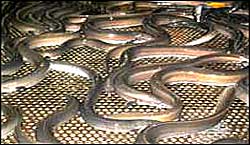
Their young – known as elvers, or glass
eels because they’re transparent, are
brought to Europe’s river mouths by the
Gulf Stream.
If the elvers are left to grow to maturity
they become brown eels. When they are ready
to spawn, they turn silver and migrate in autumn
back down the rivers by the dark phase of the
moon and return to the Sargasso Sea.
|
Around 20 years ago, there was a dramatic and unexplained
drop in the numbers of elvers arrriving in estuaries
across Europe. In 1983 Lough Neagh saw the annual
recruitment of elvers fall from 8 million to just
726,000 - just 10% of what it ought to be.
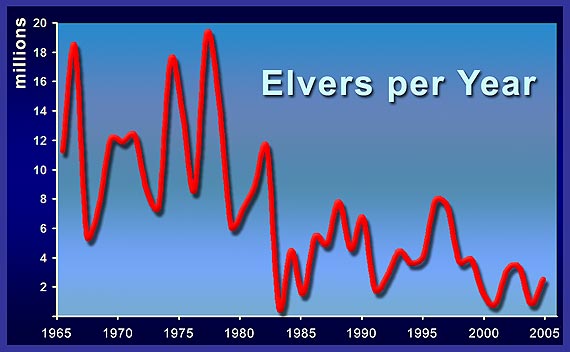
Since then there has been an improvement, but it
has never recovered to its original level. To remedy
the situation, the co-operative has bought in about
75 million elvers from the Severn estuary at a cost
of about £1.5 million. It's used the profits
from the catch of silver eels, caught in traps on
the Bann in autumn, as they migrate to the sea to
breed. But with catches dwindling, the co-operative
is less able to afford this so it's asked for a government
grant. So far, it's been refused.
Biologists believe the drastic drop in the eel population
is due to a range of factors, including pesticides
and fertilisers leaching into rivers and lakes, the
installation of hydro-electric dams on rivers across
Europe, and a change in the ocean currents bringing
the eels back from the Sargasso Sea to Europe. European
Union biologists now regard the eel as an endangered
species. While experts don't think the eel will die
out, they are predicting the end of eel fishing as
a commercial venture, and of the culinary culture
which has grown up around the eel in Holland, Germany
and beyond.
. . .
THE FISHERMEN
Archaeologists believe that commercial eel fishing
on Lough Neagh goes back to the Bronze Age: Skeletal
remains of eels have been uncovered when excavating
settlements dating back 3-4,000 years. Nowadays, some
150 fishing families live around the shore of the
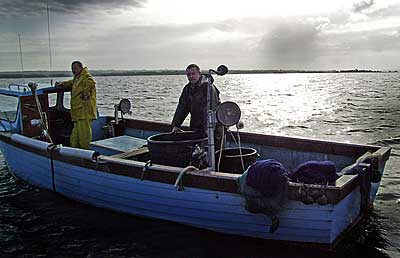
lough. Fishermen either fish using a draft net
which is set out in a half-moon shape and sinks to
the bottom before being winched back up again; or
they use a long line. Those who choose this
method spend hours each day attaching bait to the
1,200 hooks which are strung along the line.
|
| A typical
fishing day starts at around 4am, returning
to shore at about 10am. |
The life of an eel fishermen is harsh: throughout
the summer they go out at three or four in the morning
and fish till around 10am. Then they take their catch
to the co-operative to be graded. There's time for
a couple of hours' sleep before they're out again
at 4pm, and they'd finally come ashore at 9.30pm.
The fishing season usually lasts from May to October;
in the winter, the fishermen take jobs labouring or
driving taxis.
In the olden days, eel fishermen were extremely
superstitious: they believed women, especially red-headed
women, brought bad luck. Women were strictly forbidden
from setting foot in the fishing boats. Today, that's
changed. "But there are still some who'd
turn around and come home again if they saw a red-headed
woman as they were going down to the shore,"
explained one fisherman.
Nowadays, fishermen's sons are turning away from
a trade which is hard with scant financial reward.
They're going to university or learning more lucrative
trades and becoming plumbers, electricians or plasterers.
If the European Union imposes stringent quotas on
the eel catch across Europe, it will spell the end
for the Lough Neagh fishermen. Biologists are pressing
for Lough Neagh to be exempted from any such legislation
because in contrast to fisheries in other parts of
Europe, its stewardship of the fishery has been responsible
and far-sighted. But it's thought that today's fishermen
could well be the last in a line of eel fishermen
going back to 2,000 BC.
Laura Haydon
is a linguist turned radio and print journalist.
Her radio career began in 1994 as a trilingual
journalist with the Swiss Broadcasting Corporation.
She has also worked for Deutsche Welle, Radio
Netherlands, NPR, MSNBC.com, BBC World Service,
Radio 4 and The Guardian newspaper. She has also
become a familiar voice on BBC Radio Ulster, as
a news reporter. Laura has made several radio
documentaries for the BBC and Radio Netherlands.
She now produces features for BBC Radio Ulster's
award-winning Sunday Sequence programme,
and for Radio 4's You and Yours. She
holds a BA in Linguistics from the University
of York and an MA in Medieval Studies from Birkbeck
College, London.
relevant web-links:
http://news.bbc.co.uk/1/hi/northern_ireland/4000527.stm
http://news.bbc.co.uk/1/hi/sci/tech/1180973.stm
http://www.bbc.co.uk/radio4/science/nature_20040126.shtml
http://www.bbc.co.uk/northernireland/yourplaceandmine/topics/land/lough_neagh.shtml
|



 print version