Casting
the Net - page 2
HOLLAND - AKERSLOOT
Displaying entrepreneurial skills unexpected in a
man of the cloth, Father Kennedy set to work expanding
the market for his eels. Smoked eels are eaten by
the tonne as a delicacy in Holland, where they’re
big business. Hundreds of people are employed gutting,
smoking and selling eels. Once, Holland had its own
wild eel fishery, the Eiselmeer. In contrast
to Lough Neagh, fishing in the Eiselmeer went unregulated
and fishermen didn't restock the lake with elvers.
So when European eel stocks crashed, fishing there
practically vanished overnight. Father Kennedy was
quick to exploit the new opening. "Lough
Neagh eels are accepted in Holland as having the best
fat content for smoking so that the Dutch will buy
Lough Neagh eels in preference to anything else,"
he explains. "The operation is such that
eels that are caught on the lough this morning are
packed, sent out by air, and will be in Holland by
10.30pm. They'll be smoked overnight and be on sale
in Holland as smoked eels the next day. It is a fast
turnaround operation.”
|
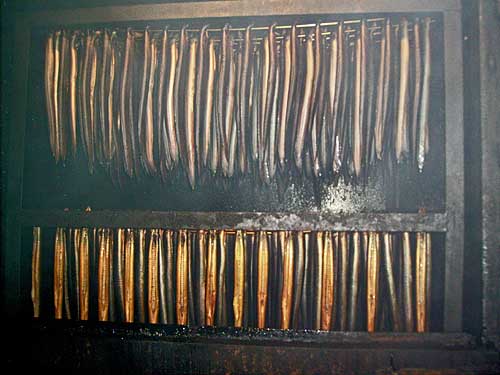
| A typical
Dutch smokery burns Willow or Poplar wood -
the same wood used to make clogs - in a smoking
cupboard. The eels are impaled on a metal shaft
to keep them straight, and hung above the glowing
embers until they colour and cook through -
a process which takes about two and a half hours. |
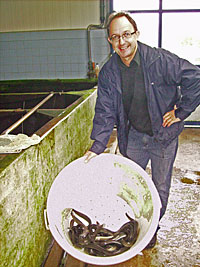 |
| Hein
Dil, eel processor, Akersloot. |
|
Hein Dil's
family firm in the Dutch village of Akersloot
has been processing and distributing eels for
100 years. His family has been trading with
Father Kennedy since the early 1970s. Several
times a week, he takes delivery of crates of
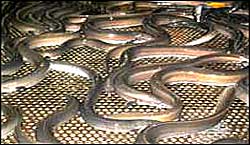
Lough Neagh eels which his firm processes and
then distributes to villages all over Holland
and beyond. Though they've been out of the water
for 24 hours, they're still alive and wriggling.
"The eel is breathing 70% through its
skin, so an eel can survive for a long time
without water - it just has to be moist."
Here the eels are cleaned and gutted, and some
are smoked.
Smoked Irish eels are in big demand in the
summer months at fairs across southern Holland
where they're sold in huge quantities. But recently
the poor catch on Lough Neagh has been causing
anxiety for Hein Dil's clients. In June 2005
they were getting 75 cartons a day. In June
2006 it was down to just 24. The scarcity -
and the quality - have pushed up the price:
"Father Kennedy gets the highest price
ever paid for eels. It's the Rolls Royce of
the eel, so with the Rolls Royce they say after
two years you forget what you paid for it. It's
the same with eels: when you've eaten a smoked
Irish eel then one hour later you forget what
it cost but you are happy that you ate it,"
explains Hein Dil.
|
|
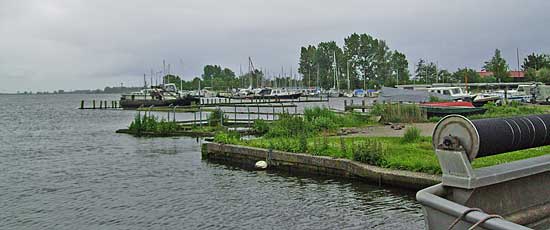
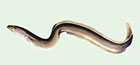
| The
lake at Akersloot, where small quantities of
eels are still caught, sits next to the eel
factory . |
. . .
HOLLAND - HARDERWIJK
Harderwijk is a village on the edge of
the Eiselmeer where eels have been smoked and sold
for generations. It's a popular holiday resort for
the Dutch who come here from miles around. Sitting
down with a plate of eels and a glass of beer is a
traditional pastime. Many of Hein Dil's clients have
their stalls and smokeries here. Now that the Eiselmeer
eel fishery is in crisis, Lough Neagh eels have become
essential to keep local businesses going. Traders
here do sell farmed eels, but their quality is significantly
lower.
John Kok's family have been in the eels
trade for generations. His business, close to the
water's edge, used to be a smokery - the chimney is
still in place - but nowadays it houses a cafe and
eel stall.
John Kok's grandfather
started trading with Father Kennedy in the early
70s, around the time the co-operative started.
"Back then, the Lough Neagh fishermen
were very very poor and he helped them to get
a living. It's very hard work in those small
boats with wind and weather," he explains.
"The best thing Father did in the '80s
and '90s was to buy glass eels and put them
into Lough Neagh. Here in Holland for 10-15
years, they put OUT the glass eels and the fishermen
here made their own grave - they took all the
young eels out and sold them to eel farms, while
Father was doing the reverse. That's why Lough
Neagh is the place where you get the best catch."
But the drastic decline in the eel population
means a new crisis is looming for the Lough
Neagh eel fishery. |
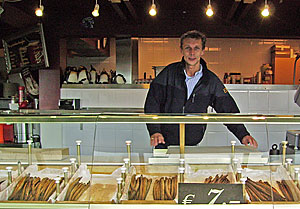 |
John Kok at the counter
of his eel stall in Harderwijk. |
|
|



 print version