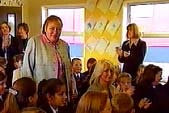
Secretary
of State Mo Mowlam visits Ulidia Integrated College
The
Good Friday Agreement contains a specific pledge "to facilitate and encourage integrated education and mixed housing" as an essential element in the process
of reconciliation and the creation of "a culture of tolerance at every level of society".
Primary and secondary school education in Northern Ireland is segregated. Ninety-five per cent of the school-age population attend either a Protestant or a Catholic school. The link between religious and community identity and school is so strong that knowing which school a pupil attends is a good indicator of the religious denomination of the child. Protestant children attend state or controlled schools while Catholic children attend maintained schools. Opposition to integrated education has its roots in the formation of the Northern Ireland state in 1921. The state's first Minister of Education Lord Londonderry had wanted to set up an integrated primary school system but both the Protestant and Catholic churches campaigned vigorously for segregated education.
Logo
of Northern Ireland Council for Integrated Education
When
the Troubles broke out in 1969 sectarian violence forced Catholics and Protestants
to live in segregated communities physically cut off from each other by
the incongruously named peace-line, a wall separating Catholic and Protestant
housing estates. In the 1970s a group of parents, known a s
All Children Together (ACT), began to foster the idea of integrated education
as a way of breaking down the barriers between Catholics and Protestants.
Their proposals had the support of the Minister for Education in the short-lived
1974 power-sharing Executive.
In 1981, despite opposition from politicians and church leaders, ACT set up Lagan College, Northern Ireland's first integrated school. It brought together pupils, staff and governors in roughly equal numbers from both Protestant and Catholic traditions.
Currently there are 45 integrated schools scattered throughout Northern Ireland and attended by over 13, 000 pupils, four per cent of the school population. In 1987 the Northern Ireland Council for Integrated Education was established to assist and promote parents' efforts to open new integrated schools.
When the new Northern Ireland Minister for Education, Martin McGuinness, was appointed in December 1999 he indicated his support for integrated education and in January 2000 his department announced conditional approval for two more integrated schools. A Belfast Telegraph opinion poll in March 2000 showed that 85 per cent of people between the ages of 25 and 44 wanted integrated schools for their children.