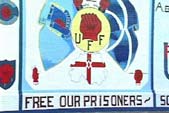
Loyalist
mural calling for the release of their political prisoners |
In early
1999, both Labour and Conservative politicians called for the suspension
of early release because republicans and loyalist continued to exercise
control over their communities through punishment beatings. Each time a
high profile terrorist was released public opinion hardened against the
scheme. When Patrick Magee, the man responsible for the 1984 Brighton bombing
that killed five people at a Conservative Party Conference, was set free
on 22 June 1999, the Prime Minister Tony Blair admitted the releases were
"very hard to stomach". By September 1999, a Belfast Telegraph
opinion poll saw a significant drop in public support for prisoner releases. |
|
|
| The
Irish government, one of the signatories to the Agreement, was accused of
hypocrisy and double standards when it refused to release under the terms
of the Agreement the IRA men convicted of the murder of Garda detective
Gerry McCabe. Unionists asked why the British government was releasing IRA
men who killed RUC officers when the Irish government refused to release
those who killed its police officers.
Under
the Agreement both the Irish and British governments are committed
to the reintegration of paramilitary prisoners into society. The Agreement
states that the "Governments continue to recognise the importance
of measures to facilitate the reintegration of prisoners into the community
by providing structural support both prior to and after release, including
assistance directed towards availing of employment opportunities, re-training
and/or re-skilling, and further education."
A
support infrastructure to facilitate this reintegration is being financed
by a £1.25 million grant from the European Union Peace and Reconciliation
Fund, which was established in 1998 by the European Union to support the
peace process. The Belfast-based Northern Ireland Voluntary Trust is managing
the money.
There
are over 26 community-based ex-prisoner projects spread throughout Northern
Ireland and many of them provide projects which include education, job
skills programs, financial and welfare advice, housing, and accommodation
and family-orientated counselling.
Four
paramilitary groups are excluded from the early release scheme. They are:
the Continuity IRA, the Real IRA, the Red Hand Defenders and the Orange
Volunteers. The INLA and the LVF both announced cease-fires in order to
take advantage of the early release scheme.
|
|
|