The
First and Deputy First Ministers announced the membership of the Forum on
25 September 2000. Chris Gibson who has been involved in the Confederation
of British Industry and the Industrial Development Board was appointed the
Forum Chairman for a three-year period. Forum members will appoint two vice-chairs.
The Office of the First and Deputy First Minister is responsible for the
forum and will provide its administrative, secretarial and other operating
expenses including members' expenses and consultancy fees.
The
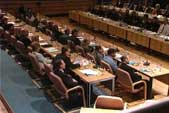
first meeting of the Civic Forum at the Waterfront Hall, Belfast,
9 October 2000
The
inaugural meeting of the Forum took place at the Waterfront Hall in Belfast
on 9 October 2000. Anti-Agreement unionists who are opposed to the Forum
criticised it for not fairly representing their views. Forum membership
was also criticised by the Women's Coalition who felt it did not meet the
degree of gender balance promised by the Agreement. Only 22 of the 60 members
are women.
The
Forum will meet four times a year at different locations around Northern
Ireland. Its first task is to present the Assembly with guidelines on
how it plans to operate. At the inaugural meeting, Chairman Chris Gibson
said that university professors, farmers, athletes, Protestant pastors
and Catholic priests would be given a blank sheet of paper and 100 days
to draw up a strategy. The Forum must report back to the Assembly every
twelve months.
The
Good Friday Agreement's inclusion of civil society into the new political structures
in Northern Ireland through the Civic Forum combines the politics of representation
with the politics of participation. This new model of governance captured
the public imagination and generated hundreds of unsolicited submissions.
Many
elected politicians, however, are reluctant to welcome the role the Agreement has given civil society. This stems from the view that democracy
belongs to politicians whose power is validated by the "will of the
people" every four or five years. But as society becomes more complex
the concept of representative democracy is being challenged by the more
inclusive concept of participatory democracy. An essential element of this
approach to governance is the social partnership model pioneered by the
European Union.