The
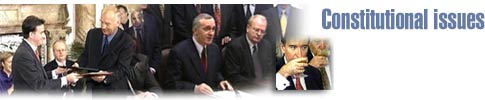
Irish referendum result is announced at Dublin Castle, 22 May 1998
The
Irish government fulfilled its pledge under the Good Friday Agreement and called
a referendum to amend Articles 2 & 3 of its Constitution whose terroritorial
claim over Northern Ireland had long been described by unionists as "illegal
and repugnant". Article 2 was reworded replacing the definition of
Irish national territory with one of the Irish nation that recognises the
right of everyone born on the island of Ireland to be a member of that nation.
The
amendments, in effect, no longer regard unification as "a constitutional
imperative" as determined by the Irish Supreme Court in the case McGimpsey
v An Taoiseach (1990). During the referendum campaign, the Taoiseach, Bertie
Ahern, said the proposed changes to Articles 2 & 3 would bring the immense
psychological gain of "defining our nation in generous and inclusive
32-county terms by putting people before territory".
The
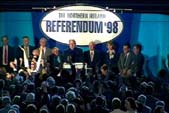
Northern Ireland referendum result is announced at the King's Hall,
Belfast, 22 May 1998
The
constitutional changes however, do not mean the Republic has abandoned its
political belief in Irish unification. Indeed, the New Article 3 states
it is "the firm will of the Irish nation, in harmony and friendship,
to unite all the people who share the territory of the island of Ireland,
in all the diversity of their identities and traditions, recognising that
a united Ireland shall be brought about by peaceful means with the consent
of a majority of the people expressed, in both jurisdictions in the island".
The
referenda north and south on 22 May 1998 ratified the Agreement and in the
Republic it also affirmed the changes to the Constitution. These changes
only became operative on 2 December 1999 when the Irish government was content
that the other elements of the Good Friday Agreement were being implemented.