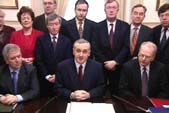
Taoiseach
Bertie Ahern surrounded by his cabinet after amending Articles 2 &
3 of the Irish Constitution, 2nd December 1999
The
Good Friday Agreement radically transforms the institutional and constitutional
arrangements the UK and Irish governments have with Northern Ireland.
Under the terms of the Agreement both governments made constitutional
and legislative changes to alter their expressions of sovereignty over
Northern Ireland. In exchange for the Republic's agreement to amend Articles
2 & 3, the British government repealed the Government of Ireland Act
1920. This took effect when the Northern Ireland Act 1998, which implemented
the Agreement, became law on 19 November 1998.
The
Agreement mandated new institutional arrangements to reflect the British
and Irish governments' altered expressions of sovereignty over Northern
Ireland. These were: the North-South Ministerial Council; the implementation
bodies; the British-Irish Council and the British-Irish Intergovernmental
Conference. The Minister for Foreign Affairs David Andrews and the Secretary
of State for Northern Ireland Dr Mo Mowlam signed the treaties regulating
these bodies in Dublin on 8 March 1999.
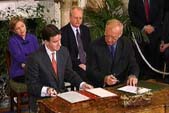
Northern Ireland Secretary Peter Mandelson and Irish Foreign Affairs
Minister David Andrews signing the new British-Irish Treaty in Dublin,
2 December 1999
The
treaties, however, could only take effect once an Executive had been established
in Northern Ireland. At midnight on 1 December 1999 twenty-seven years of
direct rule came to an end when power was formally devolved to the new Northern
Ireland Assembly. The following day power was devolved to the North-South
Ministerial Council and the British-Irish Council when the Irish Foreign
Minister David Andrews and the Secretary of State for Northern Ireland Peter
Mandelson signed commencement orders for the new British-Irish Agreement
in Iveagh House, Dublin. An hour later Taoiseach Bertie Ahern signed a declaration
formally amending Articles 2 & 3 of the Irish Constitution that had
claimed sovereignty over Northern Ireland. Later the same day Northern Ireland's
power-sharing Executive met for the first time.
English
and Irish versions of the Good Friday Agreement
At the
heart of the Agreement is the recognition by both governments that Northern
Ireland remains part of the UK until a majority of its people decide otherwise.
Moreover, the UK and the Republic agreed "that it is for the people
of the island of Ireland alone, by agreement between the two parts respectively
and without external impediment, to exercise their right of self-determination
on the basis of consent, freely and concurrently given, north and south,
to bring about a united Ireland, if that is their wish, accepting that this
right must be achieved and exercised with and subject to the agreement and
consent of a majority of the people of Northern Ireland."
That
consent is to be tested in a border poll at intervals of no less than seven
years to ascertain whether Northern Ireland wants to remain part of the
UK or be absorbed into the Republic. The seven yearly interval is only triggered
when the first such poll is held. The decision to hold the first poll in
2005 will be taken by the Secretary of State. Should a majority favour union
with the Republic, the UK government is committed to implement the necessary
legislative change.