Summary

  • Berlin has not decided whether it will allow German-made tanks to be sent to Ukraine

  • A major meeting of Western allies to arrange support for Ukraine is taking place in Germany

  • But at a news conference, US Defence Secretary Lloyd Austin says Germany has not made a decision yet

  • Germany needs to approve the export of its tanks, even if they are owned by other countries

  • Poland's foreign minister is "shocked" by Germany's apparent reluctance to allow the export

  • Germany's new defence minister Boris Pistorius says Berlin is not unilaterally preventing the delivery

  • Russia has warned Western countries that providing tanks would mark an "extremely dangerous" escalation

  1. Meeting focused on 'air defence and armour'published at 16:12 GMT 20 January 2023
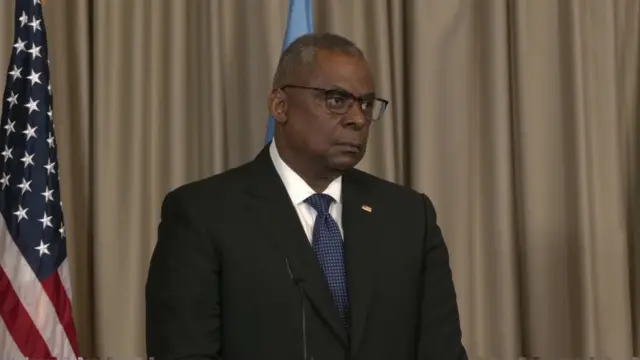
    Lloyd Austin

    Austin says his meetings with Ukrainian Defence Minister Yevhen Moisiuk focused on "air defence and armour".

    He says all of the efforts from all sides show "how much nations of good will" can achieve when they work together.


  2. 'We work together for Ukraine's self defence'published at 16:11 GMT 20 January 2023

    Following a day of negotiations, US Secretary of Defense Lloyd Austin opens by saying it was "great to start the new year by deepening coordination".

    "We work together for Ukraine's self defence," he says.

    He says Ukraine's partners from around the world are determined "to meet the moment".

  3. US defence minister speaking at news conferencepublished at 16:08 GMT 20 January 2023

    US Defense Secretary Lloyd Austin is speaking now at a news conference at the US Ramstein Air Base in Germany.

  4. No decision taken on sending Leopard tanks to Ukrainepublished at 15:55 GMT 20 January 2023
    Breaking

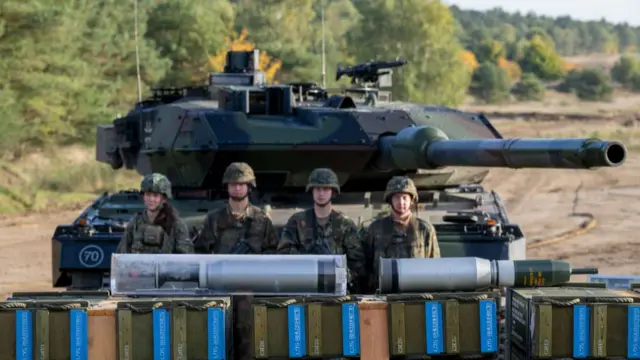
    No decision on supplying Leopard 2 tanks to Ukraine has been reached at a meeting of allies at the US Ramstein Air Base in Germany.

    Poland's defence minister said he remained optimistic that efforts to provide them would end in success.

    "Defence ministers of 15 countries met on the sidelines of today's conference and we talked about this topic," said Mariusz Blaszczak.

    "I am convinced that coalition building will end in success."

  5. Analysis

    Is sending tanks to Ukraine an escalation?published at 15:36 GMT 20 January 2023

    Frank Gardner
    BBC News, Security Correspondent

    Ukraine already has tanks, but they are old, Soviet-era machines, prone to breaking down and without the upgraded armour and sophisticated laser range-finders found on modern Nato tanks.

    Ukraine knows that its best, perhaps only, chance of fending off the massed assault Russia is expected to launch in the coming months is fielding a sizable force of western-supplied armour.

    Hence the urgency demanded by Kyiv.

    No surprises, then, that Russia is trying hard to discourage the West from releasing these tanks to Ukraine.

    Ahead of today’s crucial meeting in Ramstein to discuss what to send to Kyiv, Russia has warned that sending tanks would be "an extremely dangerous escalation".

    But ever since Russia invaded Ukraine 11 months ago, its actions there have been triggering ever greater weapons supplies from Nato, including powerful, long-range artillery.

    Intelligence analysts have largely concluded that President Putin’s veiled threats to do something with his massive nuclear arsenal are just bluff.

    Nonetheless on Nato allies' minds today will be the question: ‘how much can we afford to send to Ukraine without provoking a Russian retaliation of some sort?’.

  6. Why does Ukraine want German tanks?published at 15:19 GMT 20 January 2023

    With all of the focus on if - and when - Germany will deliver tanks to Ukraine, it's easy to overlook why Ukraine particularly wants Leopard 2 tanks.

    As our correspondent James Waterhouse explained earlier, there are three main reasons:

    • Firstly, there are plenty of them. Around 3,000 in different countries according to military experts. Ukraine’s commander-in-chief, Valery Zaluzhnyy, thinks they currently need 300 tanks to beat their enemy.
    • Secondly, they’re relatively easy to maintain. Leopards are currently in service in 13 European countries, meaning it will be simpler to get hold of spare parts and ammunition.
    • Finally, although they were designed in the Cold War, Ukraine wants to use them to compete with the Russian T-90 tank, which is still being used by invading forces.

    The West still seems united in the desire to help Ukraine, says James. It’s the "how" which is proving to be the sticking point.

  7. Germany denies unilaterally blocking tanks to Ukrainepublished at 15:04 GMT 20 January 2023

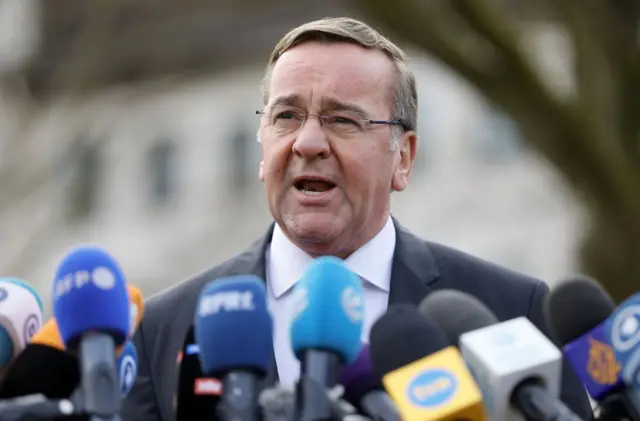
    Germany's newly-appointed defence minister has denied Berlin is unilaterally blocking the delivery of Leopard tanks to Ukraine.

    A day after taking office, Boris Pistorius told reporters at US Ramstein air base that no decision on sending Leopard 2 tanks to Kyiv had been taken so far.

    "None of us can say today when there will be a decision for Leopard tanks and what the decision may look like," he said.

    But he added: "When a decision is made, in one week or two, or in one day, I want to be able to act quickly.

    "That’s why this morning I told my ministry to make an inventory of the different types of Leopard tanks we have within our military, but also within the industry" - suggesting the sending of tanks has not been ruled out.

    Pistorius reiterated that Germany continues to support Ukraine.

    "We will support Ukraine so long as it is necessary and the war is over," he said.

    Boris Pistorius appearing before microphones, appearing to be speakingImage source, EPA
    Image caption,

    Boris Pistorius was speaking to reporters at the US Airbase in Ramstein

  8. German MP confident of tank delivery to Ukrainepublished at 14:27 GMT 20 January 2023

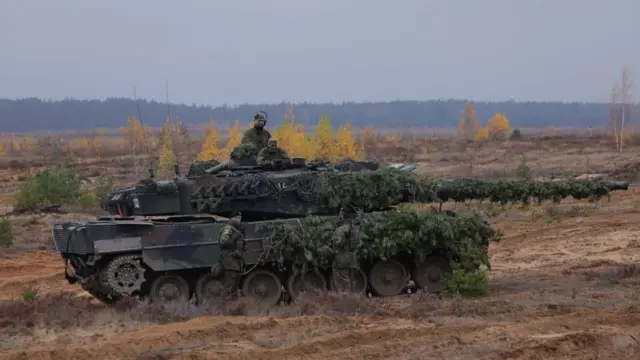
    A German Leopard tank during exercisesImage source, Getty Images
    Image caption,

    A German Leopard tank during exercises

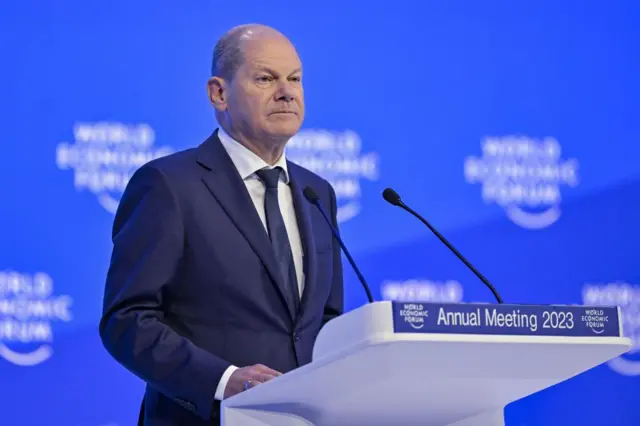
    As we have been hearing, Chancellor Olaf Scholz is facing mounting pressure to authorise exports of German-made Leopard tanks.

    And there are even divisions on the issue within the German government.

    Speaking to the BBC earlier, Alexander Muller, a German MP from the liberal FDP party - which is part of the country's coalition government - said he was confident that the delivery of tanks to Kyiv will be authorised by Berlin.

    "I hope so," he said. "Greens and Liberals are a long time in favour of sending main battle tanks."

    "Our Social Democrats have a lot of pacifistic people within them and they have a great historical Russian-friendliness within them, but they see the pictures of the war and a lot of them change their minds."

    "He [Scholz] always said we [Germany] want... to act in common with our partners, and he cannot be the single guy that blocks everything."

  9. Germany won't stop other countries from sending tanks - Estonian ministerpublished at 14:04 GMT 20 January 2023

    Estonia's Defence Minister Hanno Pevkur says he is "more than sure" Germany will not stop the sending of Leopard tanks to Ukraine "either today or in the coming days".

    “I am more than sure that Germany will not stop any other country who is ready to contribute with the tanks, that they have to approve," he told BBC Radio 4's World At One.

    "We will not see any obstacles in getting the approval of the sending of the tanks to Ukraine," said Pevkur.

    However, he said he was not sure whether Germany would be forthcoming with an answer today.

    European leaders have urged Berlin to give the green light to the re-export of the German-made tanks, with talks taking place among delegates of some 50 countries at the US Ramstein airbase on Friday.

  10. Finland donates more than 400m euros to Ukrainepublished at 13:48 GMT 20 January 2023

    Finland has announced that they will make a new donation of more than 400m euros ($434 million) in defence equipment for Ukraine.

    This does not include the Leopard 2 tanks, which the country says it could send, once agreed with allies.

    This donation would triple the value of Finland's defence aid to Ukraine, whose total would equal 590m euros, according to the Defence Ministry.

    "This package does not include Leopard tanks. It consists of heavy weaponry and ammunition," said Miika Pynnonen, special adviser to Finland's defence minister.

    The ministry has indicated Finland and Sweden's defence ministers will sign a Statement of Intent (SoI) in support of Ukraine in Ramstein on Friday.

  11. Analysis

    Why do countries need German permission to send Leopard tanks to Ukraine?published at 13:33 GMT 20 January 2023

    Frank Gardner
    BBC News, Security Correspondent

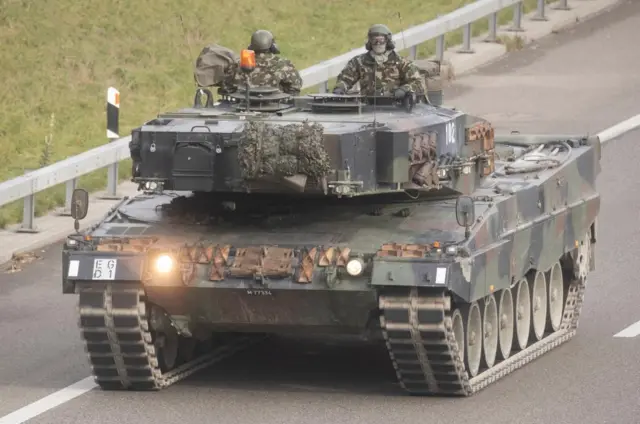
    Soldiers of the Swiss Army are seen in a Leopard 2 tank on a training exercise in SwitzerlandImage source, Reuters
    Image caption,

    A Leopard 2 tank, on a training exercise in Switzerland last November

    Germany’s Leopard 2 main battle tank, produced by Rheinmetall, is Europe’s most popular tank.

    It’s been bought by more than a dozen nations, some of whom - namely Poland and Finland - are ready to send theirs to Ukraine right now.

    But there’s a problem.

    Under Germany’s export regulations, countries buying its tanks need a re-export licence from the German government before passing them on to anyone else.

    The US has similar restrictions.

    The Ukrainians can barely contain their frustration at this, as they say they need at least 300 modern, western tanks immediately if they are going to have any chance of repelling the coming spring offensive by Russia.

    But Olaf Scholz’s government is wary of antagonising Russia and does not want to be seen to be out of step with its allies.

    It has indicated that it first needs the US to give a green light to sending its own advanced M1 Abrams tanks and that is not something Washington is yet ready to do.

  12. German tanks still part of consultations - Nato chiefpublished at 13:25 GMT 20 January 2023

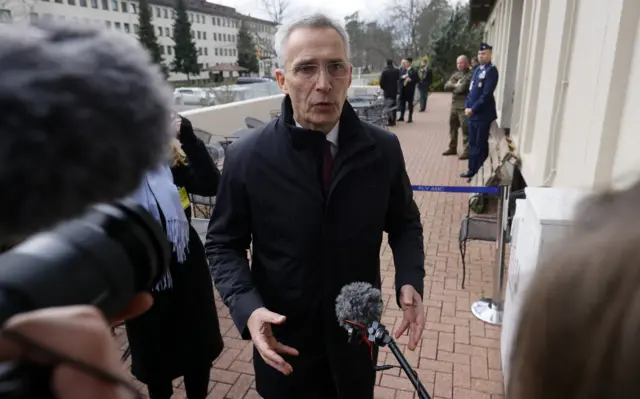
    Nato Secretary-General Jens Stoltenberg speaks to the mediaImage source, EPA

    We're hearing more details now from Nato Secretary-General Jens Stoltenberg.

    Speaking in Ramstein, Stoltenberg said the German-made Leopard 2 tanks "are still part of the consultations" that are ongoing with nations backing Ukraine.

    Nato is providing significantly more heavy weapons and other military aid to Ukraine, he added.

    Asked if Ukraine will become a Nato member, he said the group's position is "unchanged" but its focus is now on "how to ensure Ukraine will prevail as a sovereign, independent nation in Europe".

    He said Ukraine also needs support in maintaining older equipment it already has to make sure they "function as they should".

  13. Germany's Scholz cautious as he eyes opinion polls at homepublished at 13:14 GMT 20 January 2023

    Jenny Hill
    Reporting from Berlin

    German Chancellor Olaf Scholz has his eye on opinion polls; as a senior government source put it to me, he believes voters favour his cautious approach.

    A survey published today by the national broadcaster shows Germans are divided over the delivery of tanks to Ukraine - a slim majority of 46% is in favour, with 43% against.

    Sending tanks would mark a major shift for Germany, which has long pushed the pacifist line - favouring diplomacy and trading relations over military might.

    But that shift is already under way. Germany is supplying, or has pledged to supply, weapons and armoured vehicles to Ukraine.

    Scholz has expressed his ambition for Germany to take a greater military role on the world stage. His allies are clamouring for it to do so.

    The Leopard 2 battle tank is fast becoming a symbol of his country’s struggle to reconcile its peaceful instincts with its international responsibilities.

  14. Why are we seeing German hesitation?published at 13:01 GMT 20 January 2023

    It’s important for all the countries taking part in talks to increase weapon supplies to Ukraine to reach a unanimous decision according to Thomas Kleine-Brockhoff, a senior analyst at a US think tank.

    "The United States created this coalition meticulously six months before the invasion, they started doing so and I would be surprised if they wouldn't do their utmost to keep it together," he says.

    Asked why we’re seeing hesitation from Germany with regards to tanks being sent to Ukraine and why we haven't seen more action from the US, Kleine-Brockhoff said: "The German position has been pretty clear from the beginning.

    Olaf Scholz said that he doesn't want to lead militarily on Ukraine, he wants to be a good ally, be part of the group, but doesn't want to be the first. Being first means being ahead of the United States."

    Kleine-Brockhoff also says Scholz has put himself in "a very difficult position" in terms of relations with other European countries who, he says, have long been ready to move on Leopard tanks.

  15. German tanks are key to forcing Russia outpublished at 12:47 GMT 20 January 2023

    James Waterhouse
    Kyiv correspondent, BBC News

    The crew of a main battle tank Leopard 2Image source, Getty Images
    Image caption,

    Army crew with a German-made Leopard 2 tank

    Kyiv doesn’t just want tanks, it wants a lot of them - to force Russia out completely.

    While the UK’s promise of 14 Challenger 2 tanks has been welcomed, the tanks have also been deemed “insufficient” by Ukraine's government.

    What it’s really hoping for is Germany’s Leopard 2 model, for three reasons:

    Firstly, there are plenty of them. Around 3,000 in different countries according to military experts. Ukraine’s commander-in-chief, Valery Zaluzhnyy, thinks they currently need 300 tanks to beat their enemy.

    Secondly, they’re relatively easy to maintain. Leopards are currently in service in 13 European countries, meaning it will be simpler to get hold of spare parts and ammunition.

    Finally, although they were designed in the Cold War, Ukraine wants to use them to compete with the Russian T-90 tank, which is still being used by invading forces.

    The West still seems united in their desire to help Ukraine. It’s the “how” which is proving to be the sticking point.

  16. Who is winning the war in Ukraine?published at 12:41 GMT 20 January 2023

    Marita Moloney
    BBC News Live reporter

    Next month will mark a year since Russia invaded Ukraine. Here's where things stand currently in the war:

    Winter stalemate

    • Analysts had anticipated that the fighting in Ukraine would slow during the winter months, with both militaries looking to prepare for any counter-offensive in the spring
    • In November, Ukrainian troops won a major victory against Russia by taking control of the western Kherson region, However, no major gains for Ukraine have followed since
    • A helicopter crash in Kyiv on Wednesday, which killed 14 people, marked the country's highest-profile casualty since the war began

    Over in the east

    • Russian forces are currently targeting the town of Bakhmut, Russia's main target in Donetsk province. The Russian push follows a major defeat in the east in September when Russian units were forced back in the Kharkiv region

    The battle to come

    • Both Ukraine and Russia appear to be preparing for new offensives in the spring, with Moscow bolstering troop numbers
    • The head of the Ukrainian military intelligence agency told the BBC that Ukraine will ultimately retake all the territory now under occupation, including Crimea, seized by Russia in 2014
    • The US may be starting to concede, external that Kyiv may need the power to strike the Russian sanctuary of Crimea, where Russian military units and thousands of troops are based

    Arms, arms, arms

    • Western officials see a potential "window of opportunity" in the coming weeks for Ukraine to push Russian forces back ahead of Spring
    • Yesterday, nine Western nations pledged to send more vehicles, artillery and munitions to Ukraine and the US committed a further package worth $2.5bn (£2bn)
    • President Zelensky is seeking tanks from Western nations, with Germany's Leopard tanks seen as key
  17. Germany should decide if it wants to be a leader in Europe - security expertpublished at 12:30 GMT 20 January 2023

    We're now hearing from Dr Patrick Bury, a senior lecturer in security at the University of Bath who has been speaking to the BBC.

    He says Germany's hesitancy is associated with the governing party's (SPD) history of non-militarism.

    But he would hope that "at the very least", Germany waives its export control to other countries.

    The aid announced from international powers during the last couple of hours is "the biggest amount of aid that's been announced since the start of the war," Bury says.

    He tells the BBC that "Germany has a choice of whether it wants to be a leader in Europe," or if "it wants to be constantly looking to the United States for security".

    "The weapons going in [to Ukraine] now are about the summer, and Ukraine's ability to launch successful counter attacks," he adds.

    Asked about Russia's position in the war Bury says that although Russia has a relatively weak economy, over time it has a big productive capacity.

    "We know it's [Russia] running low on precision guided ammunition, Iran is helping, it's starting to put in more kit."

    "China may well be supplying them with microchips, there's a question mark there," but Bury adds that overtime Russia - if it gets its defence industrial base going - has the materials and machining capabilities to produce weapons.

  18. Poland 'shocked' by Germany's hesitancy on tank deliverypublished at 12:19 GMT 20 January 2023

    Lukasz Jasina, a spokesperson for the Ministry of Foreign Affairs in Poland, says his government is "shocked" by Germany's apparent reluctance to allow Leopard tanks to be sent to Ukraine.

    "Helping Ukraine is the most important issue for everyone of us - especially for Poles, for our nation and for our government," he tells the BBC.

    "We are very shocked because of the position of Germany, which is preventing anything from happening."

    Jasina tells the BBC he anticipates "good communication" at today's meeting in Ramstein, where defence ministers from some 50 countries are gathered, and "the sending of Leopards will happen".

    "I hope that our German friends and allies will change that position at last," he adds.

  19. German leader Olaf Scholz's 'dithering' frustrates alliespublished at 12:11 GMT 20 January 2023

    Jenny Hill
    Reporting from Berlin

    Olaf ScholzImage source, EPA

    Olaf Scholz cuts an increasingly isolated figure.

    It’s not just Ukraine’s international allies who are intensifying their demands that the German Chancellor approve the delivery of tanks.

    At home, senior military and political figures (including his coalition partner) are practically howling with frustration at his cautious approach.

    So why is Scholz dithering over delivery of tanks?

    Germany worries about escalation; how Vladimir Putin would react to the supply of offensive weapons. It’s a reasoning which many experts perceive to be unjustified.

    The concept of German tanks on Ukrainian soil resonates uncomfortably in Berlin where this country’s WW2 history casts a long shadow.

    Chancellor Scholz may have declared a Zeitenwende (or sea-change) in Germany’s defence and military policy last year but he’s still mindful that, less than a year ago, the idea of the German government supplying arms to an active conflict would have been unthinkable.

  20. Tanzanian man killed in Ukraine fighting for Russiapublished at 12:01 GMT 20 January 2023

    Alfred Lasteck & Munira Hussein
    reporting from Dar es Salaam, Tanzania

    Nemes Tarimo died fighting with the Wagner Group in Ukraine last October, his family has learntImage source, FACEBOOK

    In Tanzania, the family of a 33-year-old who agreed to fight with Russian forces, is in mourning after he died in combat.

    Nemes Tarimo had been studying in Moscow at the Russian Technological University, but was subsequently imprisoned for what were described as drugs-related offences.

    His family told the BBC they warned him against joining Russian mercenaries last October. It was the last they heard from him.

    "Nemes informed me and some other family members about joining Wagner, and we advised him not to," the family member, who did not want to give their name, told the BBC.

    But for the young man, who relatives describe as polite, God-fearing and supportive, it was a lucrative offer that was hard to resist.

    Now, in the city of Dar es Salaam, exhausted relatives wait for his body to come home.

    Read more