Summary

  • Thousands of Palestinians have begun returning to Gaza's north, as Israeli Prime Minister Benjamin Netanyahu thanks Donald Trump for securing a ceasefire

  • Those returning to Gaza City say they are driven by desperation rather than confidence that it is safe, with many already told their homes no longer exist, writes Rushdi Abualouf

  • It comes as forces have pulled back to the lines agreed under Trump's plan, the IDF says, but will continue to "remove any immediate threat

  • Hamas has until 12:00 local time (10:00 BST) on Monday to release all Israeli hostages, while Israel will release hundreds of Palestinian detainees - here's what's meant to happen next

  • Israel has published a list of 250 Palestinian prisoners it will release in exchange for the hostages but the BBC understands Hamas is pushing for more to be freed

  • It comes after the Israeli government approved the first phase of Trump's ceasefire and hostage return deal

  1. 24 hours on the path to peacepublished at 04:26 BST 10 October 2025

    Roughly 24 hours have seen major diplomatic progress and widespread jubilation as Hamas and Israel agreed to Trump's plan for a ceasefire and the release of the hostages. But how did it all play out?

    A scrawled note and a whisper were the first signs of new developments in resolving the conflict. Secretary of State Marco Rubio delivered both to Trump at around 23:45pm (BST) on Wednesday. The president told reporters the note had informed him “We are very close to a deal.”

    Just before midnight (BST), the announcement that “Israel and Hamas have both signed off on the first Phase of our Peace Plan” came from Trump’s Truth Social. This plan included: a swap of hostages and bodies, a ceasefire in Gaza, for Israeli troops to withdraw from Gaza and aid to be delivered there.

    Photos of joy on Gaza’s rubble-strewn streets and in Israel’s Hostages Square soon spread online though many questions remained about the implementation of Trump’s plan, the BBC’s chief international correspondent Lyse Doucet noted.

    On Thursday, Israel’s cabinet met and confirmed it had approved a hostage release plan just before 23:30pm (BST).

    It is not clear if fighting has yet ceased though.

  2. What we know about where Israeli forces will remain in Gazapublished at 03:30 BST 10 October 2025

    Benedict Garman
    BBC Verify senior journalist

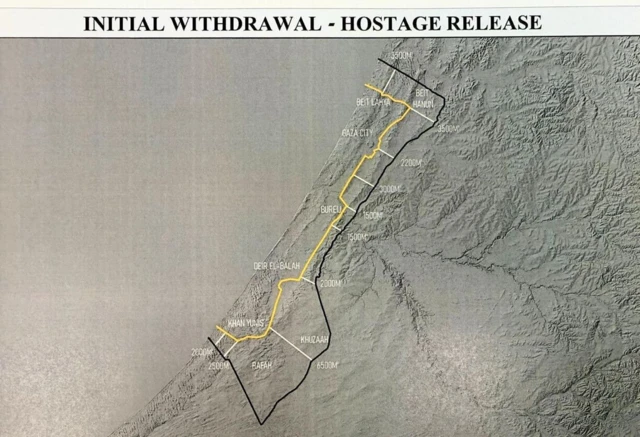
    A map of Gaza with a yellow line running through it. In the North it runs from east the Mediterranean sea to Beit Hanoun, then heads south through Gaza City, Bureiji, Deir El-Balah and Khan Younis to Rafah, were it heads west back to the Mediterranean Sea.Image source, White House

    An Israeli government spokeswoman has suggested its military will withdraw to an area of the Gaza Strip shown on a "widely reported” map if the ceasefire and hostage release deal comes into effect.

    While Shosh Bedrosian didn't show the map at a news conference, two versions have been shared by the White House in recent weeks that show an area of Gaza marked with a yellow line indicating initial withdrawal positions for Israeli forces.

    Bedrosian said that the first phase of the ceasefire deal would leave the Israel Defense Forces (IDF) in control of “about 53%” of Gaza. This proportion broadly matches with our earlier assessment.

    Based on BBC Verify analysis of the White House maps the first withdrawal phase would effectively reverse Israeli advances made over the past month in Gaza City. It would retain control over most of the eastern neighbourhood of Shejaiya.

    The IDF would also hold on to about a third of the Netzarim Corridor in central Gaza, a road created by Israel in early 2024 and used to separate the north and south of the territory to control population movement.

    In southern Gaza the withdrawal lines appear to follow existing military partitions created earlier this year:

    • The Morag Corridor dividing Gaza between the regions of Rafah and Khan Younis
    • The Magin Oz Axis splitting the region (and city) of Khan Younis from east to west

    These military corridors already more or less demarcate the current extent of IDF control in southern Gaza, suggesting there would be no significant withdrawal there.

  3. 'We must seize this moment,' UN humanitarian chief sayspublished at 03:18 BST 10 October 2025

    Nada Tawfik
    Reporting from New York

    The UN’s Humanitarian Chief Tom Fletcher, who is currently in Riyadh, spoke remotely to reporters at the United Nations. He said President Trump’s peace plan must be the basis for live-saving work throughout the region and for saving tens of thousands of lives. “We must seize this moment with collective will, with determination and with generosity,” he said.

    Fletcher said humanitarians are currently allowed by Israel to deliver less than 20 percent of what they should be getting into Gaza. He says his reading of the peace agreement is that the UN will now have unimpeded access, meaning the blockade will be lifted and all crossings into the strip will be opened with secure routes to deliver aid.

    The task ahead is enormous. The UN has 170,000 metric tons of food, medicine and other supplies in place at the border and ready to go into Gaza to feed 2.1 million people. Not only are they trying to revert famine in areas where it has taken hold and prevent it in others, he said, they also are anxious to restore the decimated health system, water and sanitation, schools and provide thousands of tents every week for shelter.

  4. Which Palestinian prisoners will be released as part of the deal?published at 02:58 BST 10 October 2025

    As part of the agreement on Gaza reached overnight, 48 hostages still in captivity in Gaza will be released, of whom 20 are still believed to be alive.

    The deal will also see 1,700 Palestinian prisoners released by Israel. Our Gaza correspondent, Rushi Abualouf explains who they are in the video below.

    Media caption,

    Watch: BBC's Gaza correspondent explains how many Palestinian prisoners will be released

    logo
  5. Witkoff has played an outsized role on America's foreign policypublished at 02:52 BST 10 October 2025

    Anthony Zurcher
    North America correspondent

    I don't think since Henry Kissinger we've seen one person be so intimately involved in America's foreign policy as Steve Witkoff.

    For context, Witkoff has no diplomatic background. He's a businessman and a real estate investor that Donald Trump has entrusted with a huge diplomatic portfolio, perhaps a bigger diplomatic portfolio than Marco Rubio, who is the Secretary of State.

    Witkoff was charged with these negotiations even before Trump took office. During the transitional period after Trump's election, Witkoff was on the phone with Netanyahu asking about a ceasefire - and he pressured him pretty forcefully.

    It shows the trust Trump has in him. Now, he might turn around and get more involved in the Ukraine negotiation.

  6. The possible sticking points in the deal's later phasespublished at 02:38 BST 10 October 2025

    There are likely to be multiple points of contention during the negotiations over later phases of the deal.

    Hamas wants a Palestinian state

    Hamas has previously refused to lay down its weapons, saying it would only do so once a Palestinian state has been established.

    The group also made no mention of disarming in its initial response to the plan last weekend, fuelling speculation that its position has not changed.

    Hamas has also said it expects to have some future role in Gaza as part of "a unified Palestinian movement".

    Netanyahu doesn't want the Palestinian Authority involved

    And although Israel agreed to the plan in full, Israeli Prime Minister Benjamin Netanyahu appeared to push back on involvement of the PA in post-war Gaza even as he stood on the podium next to the president last week, insisting it would play no role in governing the territory.

    When will Israel fully withdraw?

    Israel says its first withdrawal will see it retaining control of around 53% of Gaza. The White House plan indicates further withdrawals to around 40%, then 15%.

    That final stage would be a "security perimeter" that would "remain until Gaza is properly secure from any resurgent terror threat".

    The wording here is vague and gives no clear timeline for full Israeli withdrawal - something Hamas is likely to want clarity on.

  7. It's our best chance at peace for decades, says former Oslo Accords negotiatorpublished at 02:22 BST 10 October 2025

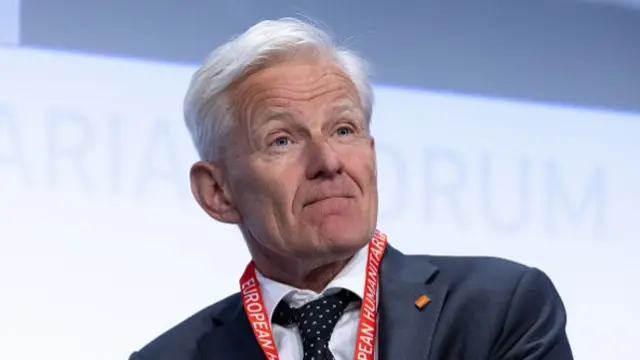
    A man with white hair and a suitImage source, Getty Images

    "The gravity of the moment can not be underestimated" says Jan Egeland, who currently heads the Norwegian Refugee Council. He also played a role in brokering the Oslo accords - a series of deals in the 1990s that established the Palestinian Authority and were meant to pave the way for lasting peace.

    He says his expectation is that, as soon as a ceasefire starts, his organisation can start sending hundreds of trucks of aid into Gaza every single day.

    Egeland says he has 65 staff inside Gaza who are ready to start distributions, of "hundreds in truckloads that have been stuck in Egypt for many months".

    For Egeland, getting this aid into Gaza is a crucial part of securing peace in the longer term: "Everything is connected to everything".

    "If there is no relief it would be nonsensical to believe there would be a political settlement," he says.

    He's feeling hopeful: "It's our best chance now for decades" he says, "since the Oslo agreement that I was part of in 1993, we haven't had such an opportunity to not only have a ceasefire that lasts, but also have peace."

  8. Has the ceasefire gone into effect?published at 02:14 BST 10 October 2025

    The Israeli government approved the ceasefire agreement a few hours ago, but it's not yet clear if the ceasefire has already gone into effect.

    In announcing that it had agreed to the deal, the Israeli government did not specify whether the ceasefire had officially started.

    Israeli Foreign Minister Gideon Sa'ar told Fox News earlier today that there would be a ceasefire "immediately after" the Israeli government makes its decision to approve the deal.

    But the Palestinian Information Centre has reported in the last hour that military activity in Gaza is continuing, including a launch of smoke bombs in the Al-Nasr neighbourhood of western Gaza and aircraft targeting in Gaza City.

  9. Watch: How Trump's close relations with Israel and Gulf leaders led to ceasefire dealpublished at 02:02 BST 10 October 2025

    Media caption,

    Watch: How Trump's relationships helped pull off a Gaza deal

    In this short video, listen to BBC's North America correspondent Anthony Zurcher explain how key events during Trump's first presidency and his current term influenced the US leader's ability to pressure Israel into a ceasefire deal.

    They include Trump's close relationship with Israeli Prime Minister Benjamin Netanyahu and moving the US embassy in Israel from Tel Aviv to Jerusalem.

    Trump's unconventional style of diplomacy and his close business ties with Qatar and UAE also played a part in the Gaza deal.

  10. Palestinian president hopeful about peacepublished at 01:51 BST 10 October 2025

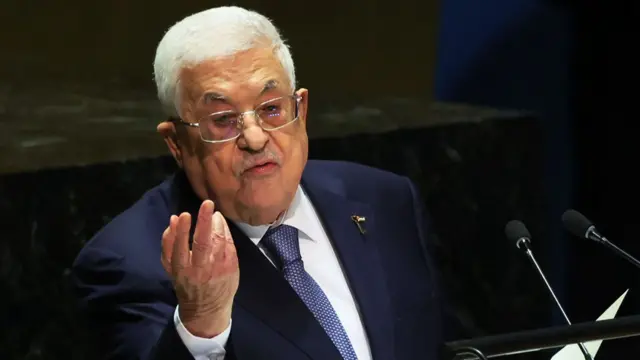
    Mahmoud Abbas speaks at a podiumImage source, Getty Images

    Palestinian President Mahmoud Abbas gave his first interview in years to Israeli media earlier today.

    He said he is hopeful about the ceasefire deal and wants lasting peace.

    "What happened today is a historic moment. We have been hoping - and continue to hope - that we can bring an end to the bloodshed taking place in our land, whether in the Gaza Strip, the West Bank, or East Jerusalem," he told Israel's Channel 12.

    "Today, we are very happy that the bloodshed has ceased. We hope it remains this way, and that peace, security, and stability will prevail between us and Israel."

    Abbas said the Palestinian Authority has been working with US President Donald Trump to launch some reforms.

    "Some have already been completed, and others are ongoing, until the PA becomes a model capable of continuing to lead the Palestinian people," Abbas said.

  11. Palestinian Authority preparing for a role in governance of Gaza - reportspublished at 01:44 BST 10 October 2025

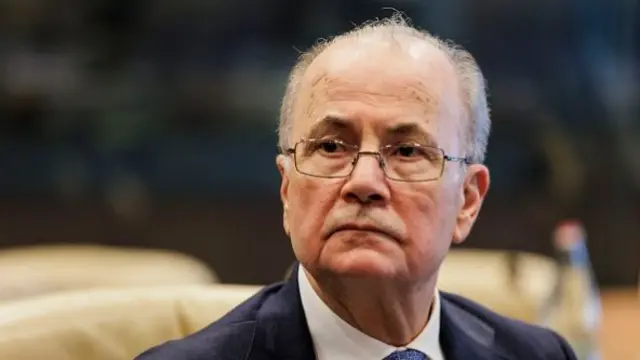
    A man with a blue suit and glassesImage source, Getty Images

    The Palestinian Authority is preparing for a role in the post-war governance of Gaza, according to reporting from the Reuters news agency.

    "We're already there," Prime Minister Mohammad Mustafa has told Reuters.

    • For context: the Palestinian Authority holds partial control over the Israeli-occupied West Bank. The West Bank is regarded by the international community as Palestinian territory.

    Currently, how the territory will be governed in the future is still unclear.

    Under Trump's plan, Gaza will be temporarily governed by a "technocratic, apolitical Palestinian committee", before being handed over to the Palestinian Authority.

    Netanyahu appeared to push back on this in his joint press conference last week with Trump, insisting it would play no role in governing the territory.

    In his comments to Reuters, Mustafa said that he had already nominated 5,500 Palestinians to be part of a new Gaza police force being trained by Egypt and that his goal is to train 10,000 people.

  12. Map shows how much of Gaza has been militarised or ordered to evacuatepublished at 01:39 BST 10 October 2025

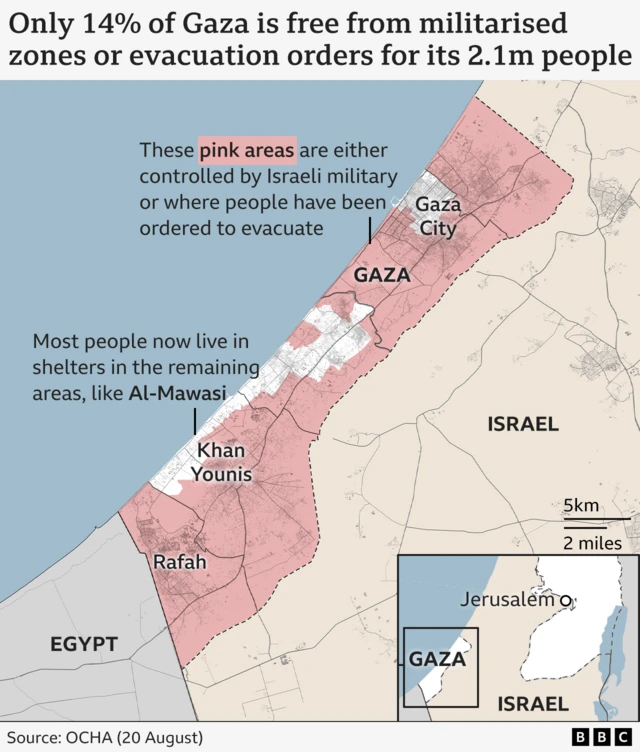
    The UN says that, as of 20 August, 86% of the Gaza Strip was in either a militarised zone or under evacuation orders.

    That means that only 14% of Gaza, which has a population of 2.1 million people, remains free from these zones, including in areas like Al-Mawasi on the coast in the south west of the territory where many people are living in shelters.

    Map of Gaza showing militarised zones and evacuation orders as of 20 August. It shows huge areas in pink which are either under Israeli military control or subject to evacuation orders.
    Image caption,

    The Israeli military either controls or has ordered evacuations in 86% of the Gaza Strip, according to the UN

  13. Map shows destruction of Gaza Strippublished at 01:29 BST 10 October 2025

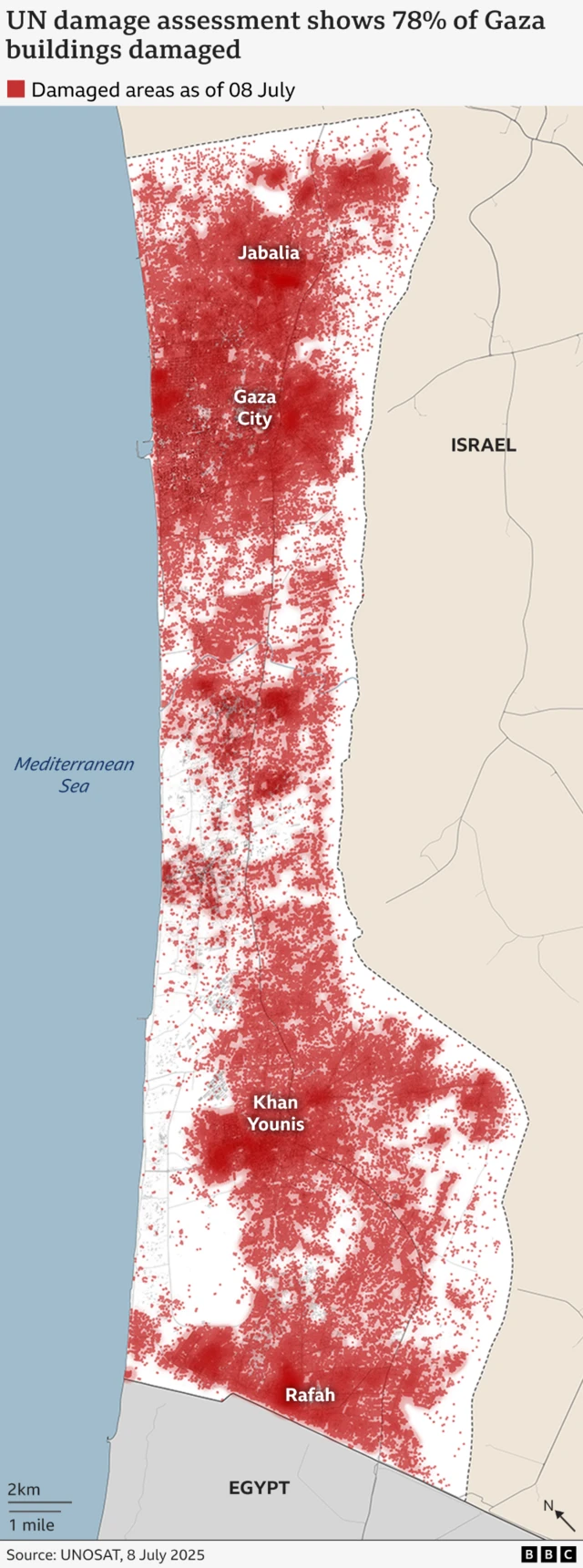
    The Gaza Strip has a long road to recovery and reconstruction. As of 8 July, the UN assessed that 78% of Gaza's buildings had been damaged since the start of the war almost two years prior.

    The below map shows the concentration of damage in different areas of the Gaza Strip using radar. While this can show clusters of destruction in the Strip, there may be incidents where houses have their windows or doors destroyed, but they are not picked up by radar as the main foundations are still standing.

    Map showing the concentration of damage in Gaza following 7 October. It is shown in red dots across the map, showing just how much destruction has occurred across Gaza.
    Image caption,

    The majority of buildings in the Gaza Strip have been damaged or destroyed

  14. Gaza mother describes joys and fear as ceasefire nearspublished at 01:15 BST 10 October 2025

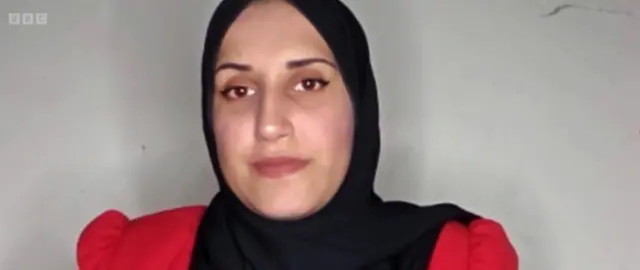
    Gaza mother Laila Ezzat Al Shana, 22, gave birth during the war and was sometimes nursing her son under heavy fire
    Image caption,

    Gaza mother Laila Ezzat Al Shana, 22, gave birth during the war and was sometimes nursing her son under heavy fire

    Gaza mother Laila Ezzat Al Shana, 22, has just been speaking to the BBC about her joy at the news that fighting may soon stop, but also said her family is mourning the attack on a residential flat that buried some 40 Palestinians beneath the rubble just a few hours ago.

    "Today it was so beautiful because they announced the ceasefire," she said.

    "The people were screaming. They were singing. Some people were shooting guns in the sky for the happiness. Some women cried."

    People were celebrating, she said, because "after two years we are alive! We survived this genocide".

    But she also accused Israel of committing a "massacre" in the final hours before the ceasefire begins. She says the sound of Israel's bombing has continued throughout the day.

    Al Shana gave birth during the war. During that time, many of her family members have died, including her father, her uncle and several cousins.

    She also described the scariest moment of her life, which she said came as she was nursing her new born inside her home as her neighbourhood came under bombardment.

    "Suddenly, we hear the huge bombing and we see the home filled with dust. And I can't see, I can't hear anything. I have my son and I stayed at my place.

    "Then I realized that it's inside the home. We survived by a miracle that night."

    She also said she has high hopes for the future, and called on all sides to open the Gaza-Egypt border to evacuate the wounded.

  15. What is next for Gaza?published at 01:02 BST 10 October 2025

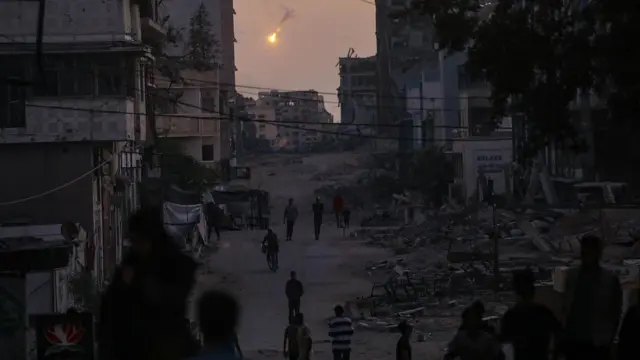
    Gaza City is shown from above, with several areas of rubble. In the sky above is an Israeli Army flare.Image source, EPA
    Image caption,

    Gaza City on 9 October

    If completed, the first phase of Trump's 20-point plan will be followed by negotiations over the details of the later phases – but many of these points could be hard to reach an agreement on.

    The proposal, which you can read in full here, says that if it is agreed by both sides, the war would "immediately end".

    It says Gaza would be demilitarised and all "military, terror and offensive infrastructure" would be destroyed.

    It also says Gaza would be governed by a temporary transitional committee of Palestinian technocrats - supervised by a "Board of Peace" headed and chaired by Donald Trump and involving former UK Prime Minister Tony Blair.

    Governance of the Strip would eventually be handed over to the Palestinian Authority, once it has been reformed.

    Hamas would have no future role in the governance of Gaza, directly or indirectly, according to the plan.

    Hamas members would be offered amnesty if they committed to peaceful co-existence or be provided safe passage to another country.

    No Palestinians would be forced to leave Gaza and those who wished to leave would be free to return.

    A "Trump economic development plan to rebuild and energise Gaza" would be created by a panel of experts.

    Read more about the agreement: What we know about the Gaza ceasefire deal

  16. The deal has been approved - here's what will happen in the coming dayspublished at 00:37 BST 10 October 2025

    Israel signing off on the ceasefire deal has set several things in motion - both in the short term and the long term.

    Here are four things that are expected to happen immediately now that the deal is done:

    1. A ceasefire in Gaza

    Now the agreement has been formally approved by the Israeli cabinet, a ceasefire is expected to take effect.

    Reports in Israeli media suggest this will happen immediately, although a spokesperson for the prime minister's office said it would begin within 24 hours of the cabinet's approval.

    2. Israeli troops will withdraw

    The Israeli military will withdraw to a line that will leave it in control of about 53% of the Strip, the spokesperson said. According to a map distributed by the White House last week, this is the first of three stages of Israeli withdrawal.

    3. A swap of hostages and bodies

    After this, a 72-hour countdown will begin, during which Hamas must release all 20 of the hostages believed to be alive. The return of the bodies of the 28 deceased hostages would follow, although it is not clear how long that could take.

    Israel would then release about 250 Palestinian prisoners serving life sentences in Israeli jails and 1,700 detainees from Gaza, a Palestinian source told the BBC.

    Israel will also return the bodies of 15 Gazans for the remains of each Israeli hostage, according to Trump's plan.

    4. Humanitarian aid would enter Gaza

    Hundreds of lorries carrying humanitarian aid will also start entering Gaza, where a famine was confirmed by UN-backed experts in August.

  17. Deal done after a day of celebrationpublished at 00:26 BST 10 October 2025

    Barbara Plett Usher
    Reporting from Jerusalem

    From the very beginning of Thursday, we had heard that this deal was made. Israelis and Gazans alike were both celebrating. However, it was just after midnight on Friday that the news became official.

    The Israeli cabinet approved the deal after an hours-long meeting which included lots of speeches being made, as well as the presence of two US envoys.

    Speeches also came from critics, including one far-right cabinet member who accused the Americans of "making peace with Hitler".

    The deal has passed, and that now clears the way for the ceasefire to take effect. This triggers a series of steps which should lead to the release of hostages in the next few days.

    Israel's military has withdrawn, but is still now in control of more than half of Gaza. Hamas is now beginning to transfer the hostages, and is preparing the bodies of the hostages who have died. Hamas is still looking for the bodies of some of those hostages, which are buried under rubble.

    Israel is preparing for the release of Palestinian prisoners, including several whose release has been very controversial.

    The UN will then surge in with a flood aid, which is also part of the first phase of Trump's ceasefire plan.

  18. 'We are at a momentous development', says Netanyahupublished at 00:20 BST 10 October 2025

    We can bring you more comments from Israeli Prime Minister Benjamin Netanyahu on the Gaza ceasefire deal, made before his government approved it a short while ago:

    "We are at a momentous development," he said in an address to government ministers.

    "We have fought during these two years to achieve our war aims, and one of the central aims is the return of the hostages - all of them, the living and the dead. And we are about to achieve that goal."

    He went on to thank the "extraordinary help of President Trump and his team - Steve Witkoff and Jared Kushner".

    He also praised the "courage of our soldiers who entered Gaza" and the "combined military and diplomatic pressure that isolated Hamas".

    On the ceasefire deal, he said Witkoff and Kushner worked around the clock to get the deal over the line.

    "We know this is for the benefit of Israel and the benefit of the United States, for the good of decent people everywhere, and for these families who will finally be able to reunite with their loved ones. I want to thank you both in their name, and on behalf of the people of Israel."

  19. Witkoff praises Netanyahu for making 'difficult calls'published at 00:11 BST 10 October 2025

    US special envoy Steve Witkoff addressed the cabinet during their meeting, before they approved the deal.

    "The hard job was the Prime Minister's," he said, referring to Israel's Benjamin Netanyahu.

    "He had the job of making tough choices - how tough to be with Hamas, when to be flexible, when not to be."

    Witkoff, who has been closely involved in negotiating the Gaza ceasefire deal, said US President Donald Trump believes that Netanyahu "made very difficult calls, and lesser people would not have made those calls".

    He added: "And here we are today because Hamas had to. They had to, they were backed up. And you have got the bigger army. You were making inroads and that's what led to this deal."

  20. US troops to oversee Gaza ceasefire dealpublished at 00:00 BST 10 October 2025

    Tom Bateman
    US State Department correspondent

    A multinational force of some 200 troops overseen by the US military will monitor the Gaza ceasefire, according to a senior US official.

    The force’s makeup is likely to include troops from Egypt, Qatar, Turkey and the UAE. The official said their role will be to “oversee, observe [and] make sure there are no violations or incursions” of the ceasefire in Gaza.

    A second senior US official said no US forces would be on the ground in Gaza, adding that the American role was to create the Joint Control Centre which will “integrate” the multinational force going in.

    The force is being established under the leadership of Adm. Brad Cooper, head of US Central Command (CENTCOM). Cooper joined the American delegation for part of the talks in Egypt, said the first official.

    The official said the multinational force will inform both the Israelis and Hamas via Egypt and Qatar of the situation on the ground and any potential violations of the truce.