Summary

  1. Why is the Strait of Hormuz important?published at 11:47 BST 22 April
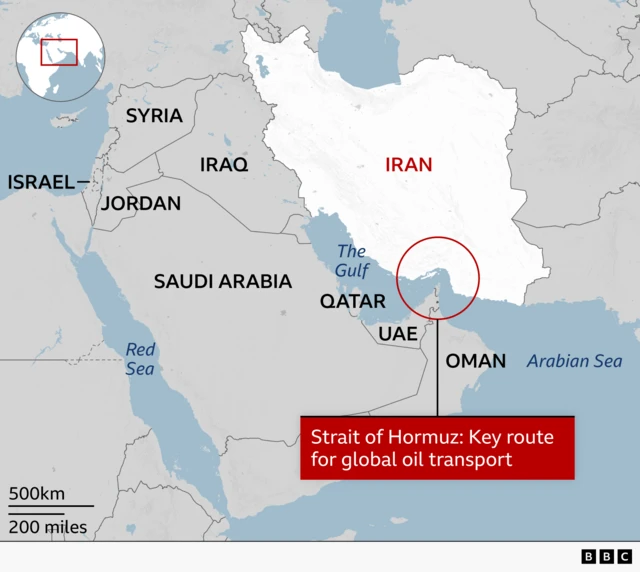
    Map showing where the Strait of Hormuz is in the Gulf of Oman, a key route for global oil transport. The strait lies between Iran and the peninsula of the United Arab Emirates and Oman. The map also shows countries in the wider Middle East region including Saudi Arabia, Iraq, Jordan and Israel

    A third ship has been hit by gunfire in the Strait of Hormuz, the world's busiest oil shipping channel, where sea traffic there has been significantly reduced.

    Tehran effectively stopped all traffic after the US and Israel attacked the country on 28 February, and the US then introduced a naval blockade on Iran's ports.

    US forces boarded an Iranian-flagged cargo ship on Sunday and the Pentagon said forces boarded a "sanctioned" tanker in the Indo-Pacific region linked to Iran yesterday. Iran described this as an act of "piracy".

    What has the US said?

    President Donald Trump says the US-Iran ceasefire was agreed on the condition that Tehran reopens the strait, and he claims his blockade of Iran's ports is costing the country $500m (£370m) per day.

    He said on Truth Social that the US was winning the war by "a lot" and that it will not lift its blockade on Iranian ports until a deal has been reached with Tehran.

    After days of uncertainty about whether Iran would attend negotiations as the ceasefire was coming to an end, Trump extended the truce until talks between the countries progress.

    What has Iran said?

    Senior Iranian lawmaker Ebrahim Azizi told the BBC Iran would "never" give up its control of the strait, and foreign ministry spokesperson Esmail Baghaei said the US blockade was "an act of aggression".

    Iran said it had reopened the strait for commercial vessels using designated safe lanes last week. However, when Trump said he would continue the naval blockade, Tehran again closed it.

  2. What has been happening in the Strait of Hormuz?published at 11:30 BST 22 April

    Three cargo ships have been attacked in the Strait of Hormuz by Iran's Islamic Revolutionary Guard Corps (IRGC), Iranian media say.

    Here is the latest on what we know:

    Attack one:

    The UK Maritime Trade Operations Centre (UKMTO) reported an IRGC "gun boat" opened fire on a container ship in the Strait of Hormuz, 15 nautical miles northeast of Oman causing heavy damage to the vessel's bridge. The vessel involved was the Epaminondas, owned by a Greek company.

    Attack two:

    The Panama-flagged Euphoria, which is owned by a UAE-based company, also came under attack eight nautical miles west of Iran, according to Vanguard and the UKMTO. The crew are said to be safe and no damage is reported to the vessel.

    Attack three:

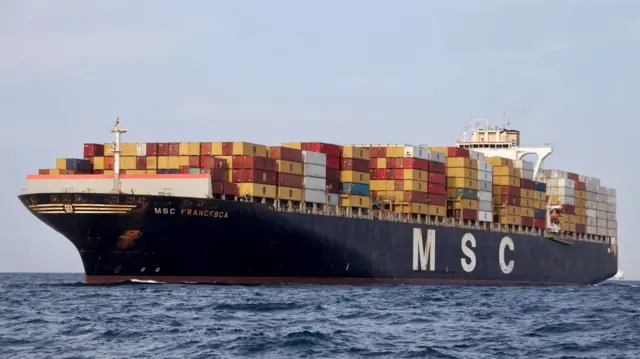
    The Panama-flagged MSC Francesca was targeted about six nautical miles off the coast of Iran while it was heading south out of the Strait and into the Gulf of Oman, maritime intelligence firm Vanguard told BBC Verify. The ship has reported "damage to the hull and accommodation".

    The IRGC Navy says the MSC Francesca and Epaminondas were "seized" and directed towards the Iranian coast, alleging they were "operating without the necessary permits and tampering with navigation systems".

  3. Three vessels hit, two seized by IRGC, Iranian media saypublished at 10:59 BST 22 April

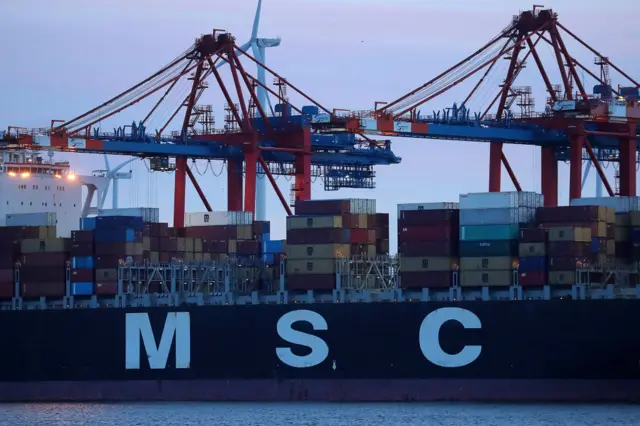
    A shipping container with MSC on the side has containers onboardImage source, Getty Images
    Image caption,

    The MSC Francesca pictured in 2018 in Germany

    Iranian media are reporting that the Islamic Revolutionary Guard Corps (IRGC) targeted the three ships hit in the Strait of Hormuz.

    IRGC-affiliated Fars news agency says a ship called Euphoria was targeted and is now grounded off the coast of Iran.

    Iranian media say the MSC Francesca and Epaminondas were "seized" and directed towards the Iranian coast, citing a statement from the IRGC Navy.

  4. Ship was given warning before IRGC fire - Iranian mediapublished at 10:50 BST 22 April

    We can bring you an update now on the first reported incident involving a vessel in the Strait of Hormuz.

    As a reminder, the UK Maritime Trade Operations Centre (UKMTO) said an Islamic Revolutionary Guard Corps (IRGC) "gun boat" fired on a container ship in the Strait of Hormuz. The ship involved is the Greek-flagged Epaminondas, BBC Verify understands.

    Nour News, affiliated with Iran's Supreme National Security Council, disputes an account given by the master of the ship to the UKMTO that no radio warning was given to the vessel.

    Instead, it says the ship had "ignored warnings" from the Iranian armed forces.

    UKMTO says the incident took place 15 nautical miles northeast of Oman and caused heavy damage to the bridge of the ship.

  5. BBC Verify

    Third ship hit in Strait of Hormuz this morning, Vanguard sayspublished at 10:33 BST 22 April
    Breaking

    By Kayleen Devlin and Paul Brown

    A third cargo ship has been attacked while attempting to transit the Strait of Hormuz, maritime intelligence firm Vanguard has told BBC Verify.

    The ship, Panama-flagged MSC Francesca, was targeted about six nautical miles off the coast of Iran while it was heading south out of the Strait and into the Gulf of Oman.

    Vanguard says the MSC Francesca was hailed by the Islamic Revolutionary Guard Corps and “instructed to drop anchor”.

    The ship has reported “damage to the hull and accommodation”, no further information is currently available.

    A file photo of the Panama-flagged MSC Francesca floating on top of the ocean laden with containers and the letters 'MSC' on the side against a grey skyImage source, Agustin Alapont via Marine Traffic
    Image caption,

    A file photo of the Panama-flagged MSC Francesca

  6. Analysis

    Worst crisis Gulf has known since 1990published at 10:23 BST 22 April

    Frank Gardner
    Security correspondent

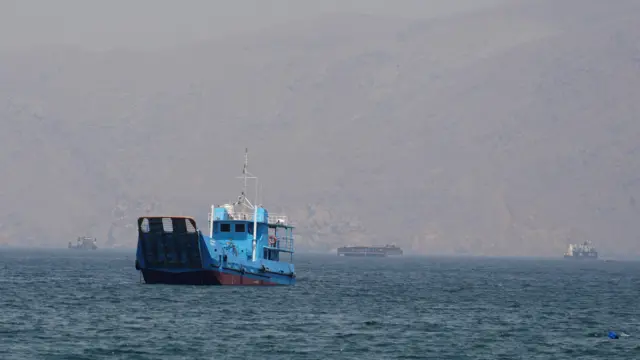
    A blue shipping vessel sits in waterImage source, Reuters

    The Iran-US conflict is now in a dangerous state of limbo.

    Dangerous, because neither side trusts the other and Iran is poised, believing Donald Trump is simply playing for time before launching a surprise attack.

    In limbo, because Iran refuses to come to peace talks while the US naval blockade is still in place. So although the ceasefire has been indefinitely extended this is still a highly unsatisfactory situation all round.

    The Strait of Hormuz is now too dangerous for all but a trickle of traffic. Iranian gunboats have fired on vessels trying to get through while the US says its forces have turned back more than 20 vessels travelling to or from Iranian ports.

    The net result is deeply damaging for both Iran and the global economy.

    The longer this standoff continues the worse the effect on the global economy and the greater the risk that a spark will reignite a full-scale war in the Gulf, with the US carrying out its threat to hit Iran’s power plants and Iran retaliating against its neighbouring Arab Gulf states.

    This is the worst crisis the Gulf has known since Iraq invaded Kuwait in 1990.

  7. BBC Verify

    Second ship hit this morning is owned by UAE - BBC Verifypublished at 10:06 BST 22 April

    By Kayleen Devlin and Paul Brown

    BBC Verify understands that the cargo ship targeted this morning is the Panama-flagged Euphoria, owned by a UAE-based company.

    AIS data from Kpler shows the vessel began transiting the strait at 01:10 UTC (2:10 BST) on 22 April, with Jeddah, Saudi Arabia listed as its destination.

    Reports from both the UK Maritime Trade Operations Centre and Vanguard indicate that the ship came under attack eight nautical miles west of Iran at 06:38 UTC (07:38 BST). The vessel’s master brought the ship to a halt. The crew are said to be safe, and no damage is reported to the vessel.

    It's the second ship to be fired on this morning in the Gulf. Earlier, it was reported a Greek-owned ship was fired on by the Islamic Revolutionary Guard Corps.

  8. Iran war pushes up prices in the UK, latest inflation figures showpublished at 09:41 BST 22 April

    A woman in a grey checked shirt fills up a car at a petrol station.Image source, Getty Images

    The war in Iran is not just affecting the Middle East - it's been pushing up fuel prices.

    In the UK, data released on Wednesday shows inflation has risen to 3.3% in March, largely driven by this rise in oil and gas prices.

    The Office for National Statistics chief economist Grant Fitzner says fuel prices in the year to March “saw their largest increase for over three years”.

    "This is not our war, but it is pushing up bills for families and businesses," Chancellor Rachel Reeves says in response.

    There are warnings that food prices will rise too, but this could take months to be shown on supermarket shelves.

  9. Second ship fired on in Strait of Hormuz - UKMTOpublished at 09:10 BST 22 April

    The UK Maritime Trade Operations Centre (UKMTO) is reporting that a second vessel has been fired upon in the Strait of Hormuz.

    The British Royal Navy-led UKMTO says that an outbound cargo ship reported being fired on eight nautical miles west of Iran and is now stopped in the water.

    It says there is no damage and the crew are "safe and accounted for".

    The statement adds: "UKMTO is aware of high levels of activity in the SoH [Strait of Hormuz] area and encourages vessels to report any suspicious activity."

    It follows an attack on a container ship 15 nautical miles northeast of Oman by an Islamic Revolutionary Guard Corps (IRGC) "gun boat" that caused heavy damage to the bridge, according to the UKMTO.

  10. BBC Verify

    Container ship fired at by IRGC is owned by Greek company, BBC understandspublished at 08:53 BST 22 April

    By Kayleen Devlin

    BBC Verify understands that the container ship targeted by the Islamic Revolutionary Guard Corps (IRGC) this morning is the Epaminondas.

    The vessel is owned by a Greek company and, according to AIS data from Marine Traffic, was not transmitting a detectable signal while crossing the strait.

    Reports from both the UK Maritime Trade Operations Centre and Vanguard indicate that the ship’s master had been told the vessel had permission to transit the strait.

    However, it was approached by an IRGC gunboat, which opened fire and caused significant damage to the bridge.

  11. Iranian adviser says Trump ceasefire means 'nothing'published at 08:29 BST 22 April

    A senior Iranian adviser says US President Donald Trump's ceasefire extension means "nothing" and is "certainly a ploy to buy time for a surprise strike".

    Mahdi Mohammadi is an adviser to the Iranian parliament speaker, Mohammad Bagher Ghalibaf.

    In a post in Persian on X, Mohammadi says the continuation of Trump's "siege" is "no different from bombardment" and must be "met with a military response". He adds: "The time for Iran to take the initiative has come."

    The US Navy has been blockading the Strait of Hormuz and its forces boarded an Iranian-flagged cargo ship on Sunday, after Iran had effectively closed the busy shipping channel for weeks.

  12. China lowers petrol pricespublished at 08:12 BST 22 April

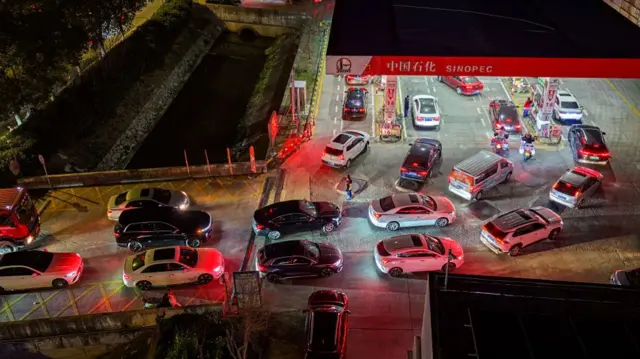
    China is lowering prices of petrol and diesel at the pump for the first time since the Iran war started to reflect changes in global oil markets, according to the National Development and Reform Commission.

    The commission, which acts as China's top economic planner, sets petrol prices every 10 working days, based on international crude oil figures.

    The price drop will save drivers about $3 (£2.22) to fill a 50-litre tank of 92-octane petrol.

    Beijing has raised the maximum retail prices for petrol and diesel multiple times since the start of the war, which has sent the value oil soaring.

    Dozens of cars queue at a Sinopec station in China at nightImage source, Getty Images
  13. IRGC 'gun boat' fires at container ship in Strait of Hormuz - UKMTOpublished at 07:28 BST 22 April

    The Islamic Revolutionary Guard Corps (IRGC) has reportedly fired at a container ship in the Strait of Hormuz, according to the UK Maritime Trade Operations Centre (UKMTO).

    The British Royal Navy-led UKMTO says the incident took place 15 nautical miles northeast of Oman.

    It says an IRGC "gun boat" approached the vessel, there was "no VHF challenge", meaning there was no radio warning or hail, and then the gun boat "fired upon the vessel", causing "heavy damage to the bridge".

  14. Lebanese state media say one killed in Israeli strikepublished at 07:08 BST 22 April

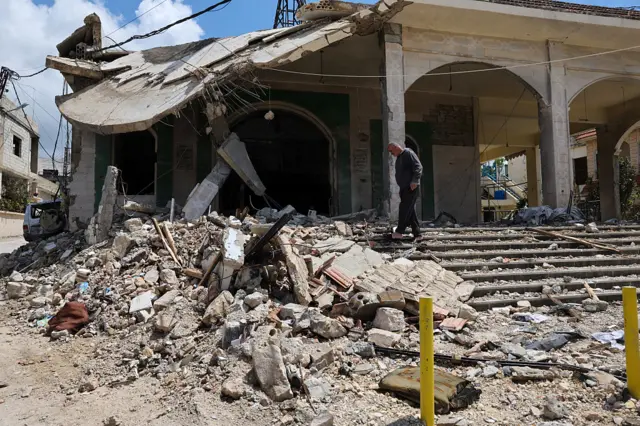
    A man inspects the damage at a mosque that was targeted in an Israeli strike in the southern Lebanese village of Kfar Sir on April 21, 2026Image source, AFP via Getty Images
    Image caption,

    An Israeli strike on a village in southern Lebanon yesterday damaged a mosque

    One person has been killed and two others wounded in an Israeli strike in Western Bekaa, around 25 miles (40km) south-east from Beirut and near the Litani River, according to Lebanese state-run National News Agency (NNA).

    The agency says the strike took place at dawn. A separate NNA article says Israeli forces are clearing roads in Wadi al-Salouqi and "demolishing" houses and shops in Aita al-Shaab, both in southern Lebanon.

    Yesterday, the Israel Defense Forces issued a warning to residents to stay away from the Litani River, Wadi al-Salouqi and Wadi al-Salhani, citing "ongoing terrorist activities of Hezbollah".

    Lebanon and Israel agreed to a ten-day ceasefire last week, and Washington is due to host ambassador-level talks on Thursday.

    The terms of the deal specify that Israel retains its "right to take all necessary measures in self-defence, at any time, against planned, imminent, or ongoing attacks" and that Lebanon must take "meaningful steps" to prevent Hezbollah and all other "rogue non-state armed groups" from carrying out attacks against Israeli targets.

    Last night, Hezbollah said it had fired rockets at northern Israel in response to ceasefire violations from the Israeli military, while Israel's ambassador to the US, Yechiel Leiter, accuses Hezbollah of violating the ceasefire agreement.

  15. Hopes of peace talks in Pakistan are fadingpublished at 06:38 BST 22 April

    Paul Adams
    Diplomatic correspondent in Islamabad

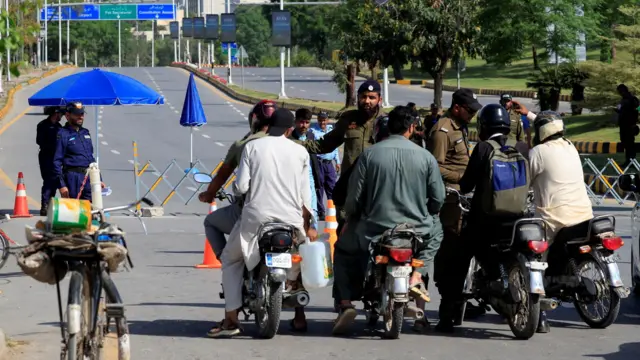
    Men on motorbikes on a streetImage source, Reuters
    Image caption,

    Road blocks have been set up around Islamabad in recent days amid preparations for possible peace talks

    Donald Trump has boasted of regime change in Tehran but is now dealing with what he himself is calling regime fracture.

    Now that so many of Iran’s top leaders are dead, the question of who’s in charge there is a real one, making the job of diplomacy that much more difficult. It’s probably a little early to gauge the impact of the president’s latest move, but the immediate signs from Tehran are not positive.

    An adviser to the speaker of parliament and lead negotiator Mohammad Bagher Ghalibaf, said Trump was buying time for another surprise attack.

    A military spokesman repeated a warning that Iran was willing to strike back if that happened.

    Here in Islamabad, arrangements remain in place for another round of talks, with parts of the city still sealed off. But hopes of a meeting this week appear, for now, to have faded.

  16. 'No decision' from Iran on joining next round of peace talks with US, spokesman sayspublished at 05:25 BST 22 April

    Media caption,

    'No decision' on joining Islamabad peace talks, says Iranian spokesman

    Before Donald Trump's announcement that he would be extending the ceasefire, Iran's foreign ministry told the BBC that Tehran has still not decided whether it will attend a new round of peace talks with the US later this week.

    In an interview with the BBC's chief international correspondent Lyse Doucet, spokesman Esmail Baghaei said Iran had gone into the first round of Islamabad talks "with good faith and sense of seriousness, but you have a negotiating party that has shown its lack of seriousness, lack of good faith".

    He also pointed to "flip flops, threats of war crimes" by the US, a reference to Trump's series of social media posts and interviews over the past two days where he again threatened to "knock out every single power plant, and every single bridge" if Iran did not accept what he called the US's offer of a "very fair and reasonable deal".

    The White House confirmed on Tuesday night that Vice-President JD Vance's trip to Pakistan for a second round of peace talks has been cancelled.

    Here's our full interview with Iran's foreign ministry spokesman.

  17. In just 24 hours, from the threat of renewed strikes to an extended ceasefirepublished at 04:23 BST 22 April

    Grace Eliza Goodwin
    Reporting from New York

    Another day, another unexpected development in the conflict in the Middle East.

    We began Tuesday here in New York expecting the US-Iran ceasefire to expire tomorrow, under the looming threat that the US would then resume its strikes on Iran.

    That all changed with an 11th hour post from President Trump announcing he'd be extending the ceasefire until Tehran could present a "unified proposal" to move peace negotiations forward.

    Here's what happened and where things stand now:

    • Earlier today, our White House correspondent said it was unclear when, and if, Vice President JD Vance and the rest of the US negotiating team would head to Islamabad for talks with their Iranian counterparts
    • Meanwhile, Iran had yet to decide whether to send a delegation to Pakistan for US talks, a foreign ministry spokesperson told the BBC
    • Iran’s UN Ambassador Amir Saeid said Tehran had received some signs that the US was ready to end its blockade of Iranian ports, adding that the next round of negotiations would only take place when that happens
    • In an interview with CNBC, Donald Trump said Iran has "no choice but to send" delegates to Pakistan, adding that he "expects to be bombing" if progress is not made
    • Then, with no sign of the US delegation was departing for Islamabad, the situation abruptly changed when Trump announced he'd be extending the ceasefire, and continuing the US navy blockade of Iranian ports until Iran's leaders can submit a "unified proposal" and discussions are concluded
    • Trump said he made the decision at the request of Pakistan, whose prime minister then thanked him for it
    • The White House confirmed that Vance's trip to Pakistan for peace negotiations has been cancelled

  18. BBC Verify

    Strait of Hormuz shutdown boosting demand for US oil, experts saypublished at 03:34 BST 22 April

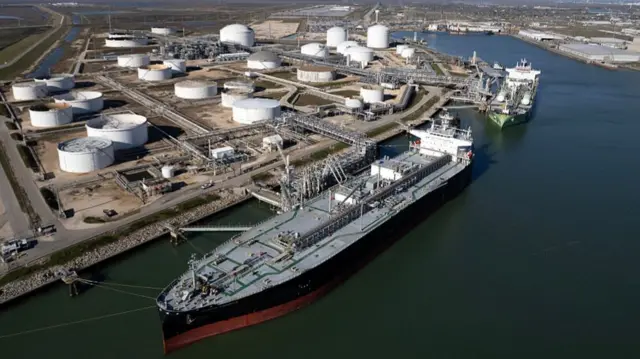
    Two oil tankers are seen docked at the Freeport oil terminal in the US (file pic)Image source, Getty Images

    By Marco Silva and Joshua Cheetham

    In a post on his Truth Social platform on Monday night, President Donald Trump said the Iranian leadership has “forced hundreds of ships” towards oil-rich US states, such as Texas, Louisiana, and Alaska.

    While it is unclear the type of ships he was referring to, shipping and trading analysts tell BBC Verify that the closure of the Strait of Hormuz by Iran has indeed driven a surge in demand for US crude oil.

    The strait is a critical transit chokepoint for Gulf oil, but shipping has been severely disrupted since the start of the US-Israel war with Iran on 28 February.

    Unable to access crude oil from the Middle East through the strait, importers have had to look for alternative suppliers.

    Data from marine analytics firm Kpler suggests 71 oil tankers known as Very Large Crude Carriers (VLCCs) are headed to the US to take on cargo compared with an average of 27 on any given day last year.

    “Buyers from Europe and Asia saw oil loading out of the Atlantic basin — including from the US Gulf coast — as an accessible, plentiful solution to fill the supply gap,” says David Haydon, head of US crude tanker freight pricing at Argus Media, a market intelligence firm.

    This appears to be driving an increase in US crude exports.

    Maritime research consultancy Drewry says that, in the week ending 10 April, shipments reached 5.2 million barrels per day - the highest level in seven months.

  19. Analysis

    A frantic day of diplomacy in Washingtonpublished at 02:58 BST 22 April

    Daniel Bush
    Washington correspondent

    Tuesday began as a frantic day of diplomacy in Washington, with Air Force Two ready to fly Vice President JD Vance to Islamabad for another round of peace talks between the US and Iran.

    Several hours later, Air Force Two hadn't taken off and the negotiations were postponed. President Donald Trump announced that he would extend the ceasefire with Iran, set to expire on Wednesday evening, to allow the regime more time to create a "unified proposal" to end the war.

    In between, Trump weighed his options as the world waited to see if the countries were any closer to ending the war. Trump's decision marked the second time in as many weeks that he has backed off a threat to escalate the war, buying himself more time to wind down a conflict as it approaches the two-month mark.

    Read more here.

  20. Oil prices fluctuate as status of peace talks remains unclearpublished at 02:05 BST 22 April

    Global oil prices fluctuated in early Asian trading on Wednesday as the status of peace talks between the US and Iran remains unclear.

    On Tuesday, US President Donald Trump said he will extend a ceasefire with Iran until talks between the two countries have progressed. He added that the US will continue to blockade Iran's ports until Tehran presents a "unified proposal".

    After opening higher, Brent crude dipped by 0.2% to $98.32 (£72.73) a barrel, while West Texas Intermediate was down by 0.3% at $89.41.

    Energy markets have been volatile since the US and Israel attacked Iran on 28 February and Tehran responded with threats to target shipping in the key Strait of Hormuz waterway.

    Read more here.