Summary

  1. Has the outbreak peaked?published at 12:05 GMT 20 March

    James Gallagher
    Health and science correspondent

    The honest answer is we do not know.

    It is only possible to say when the peak of an outbreak occurred long after it has passed.

    Two additional cases were reported today - that is lower than at any point since the weekend.

    Experts say this likely represents the tail end of infections linked to the epicentre of the outbreak at the nightclub Club Chemistry.

    However, the big unknown is whether people who caught the meningitis bacteria in that initial event have since spread the bacteria more widely.

    That is why antibiotics have been handed out to people potentially at risk, but more meningitis cases could still emerge in the coming days.

  2. The three scenarios being modelled by officialspublished at 11:54 GMT 20 March

    Simon Jones
    Reporting from the University of Kent

    Health officials in Kent are modelling three potential scenarios for the meningitis outbreak.

    • The first is it stays contained in Kent
    • The second - and most likely - is some people who were incubating the disease have left Kent, leading to sporadic household clusters
    • The third, said to be the worst case and highly unlikely, would see another cluster outside Kent

    Officials here say it’s too early to know whether we have reached the peak.

  3. 'Too early to say' whether national vaccine programme should be recommendedpublished at 11:53 GMT 20 March

    More now from the press conference, where Kent County Council's director of public health, Anjan Ghosh, has just responded to a question.

    Ghosh says he thinks it is "too early to say" whether a national vaccination programme should be recommended by the Joint Council of Vaccination and Immunisation (JCVI).

    "This has come up many times," he says, according to the PA news agency.

    "I'm sure they're going to look at this properly, already they are."

  4. Contact tracing carried out for more than 10,000, Kent health official sayspublished at 11:50 GMT 20 March

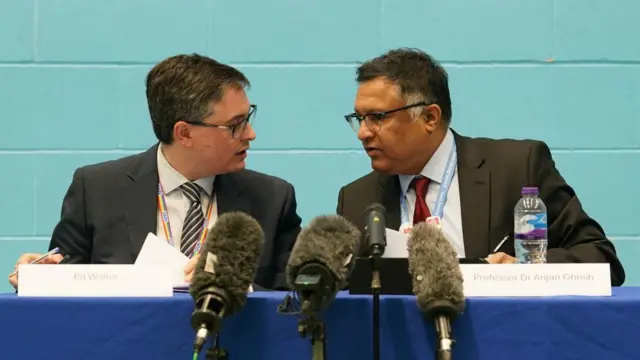
    Ed Waller (left), Deputy Chief Executive and Chief Commissioning Officer at NHS Kent and Medway, and Professor Dr Anjan Ghosh, Kent County Council Director of Public Health,Image source, PA Media

    A Kent public health official is encouraging people at risk of contracting meningitis to come forward and get vaccinated after contact tracing was carried out for more than 10,000 people.

    Contact tracing is a public health measure that involves identifying people who may have come in contact with an ill person to stop the spread of an outbreak.

    Kent County Council director of public health, Dr Anjan Ghosh, tells this morning's press conference that anyone showing symptoms associated with meningitis B should immediately seek help.

    "If you have had antibiotics in relation to this particular incident or are eligible for it you are also eligible for vaccination so do come forward," Ghosh says, according to the PA news agency.

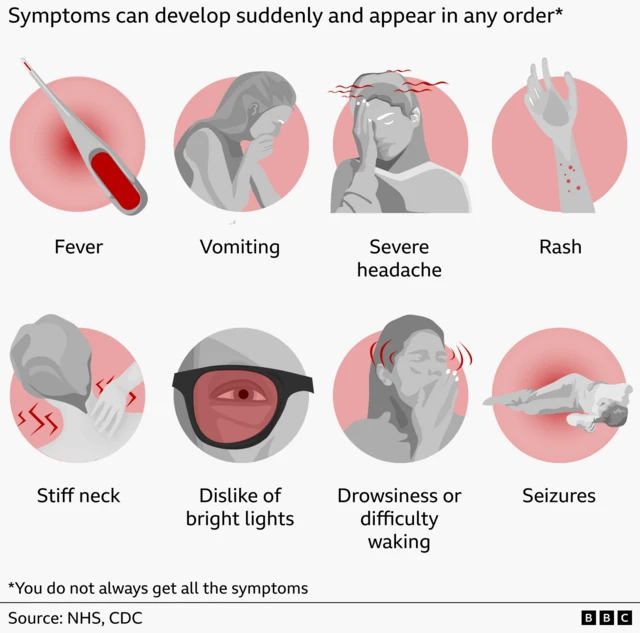
    An infographic titled “What are the signs of meningitis?” listing symptoms that can appear suddenly and in any order. It includes illustrations for: fever shown with a thermometer; vomiting depicted by a person leaning forward; severe headache shown with red lines around the head; a rash on an arm; a stiff neck illustrated by someone touching their neck; dislike of bright lights shown with an eye shielded by a dark band; drowsiness or difficulty waking shown with a person resting a head on a hand; and seizures illustrated by a figure lying on their side. Text at the bottom notes: “You do not always get all the symptoms.” Sources: NHS, CDC
  5. 'Fairly certain' the peak has passed - health expertpublished at 11:33 GMT 20 March

    Before we hear from the press conference in Kent, a health expert says he's "fairly certain" the peak from the initial "superspreading" event has passed - but warns there could be secondary cases from people not connected to Club Chemistry.

    Paul Hunter, professor in medicine at the University of East Anglia says: "The incubation period, though a little uncertain, ranges from two to 10 days so I think we can be fairly certain that the peak from the initial superspreading event will have already passed.

    "The question remains whether there will be any secondary cases i.e. any cases that didn't get their infection from the night club but from someone else who did attend.

    "Hopefully the antibiotic and vaccine will prevent those, but still a possibility. Even if we do see secondary cases, I doubt there will be as many as in the primary wave, though cannot be certain."

  6. Health officials are giving an updatepublished at 11:26 GMT 20 March
    Breaking

    Health officials are giving an update at the University of Kent following the MenB outbreak.

    We will bring you the latest lines.

  7. Babies have been eligible for MenB vaccine since Spring 2015published at 11:20 GMT 20 March

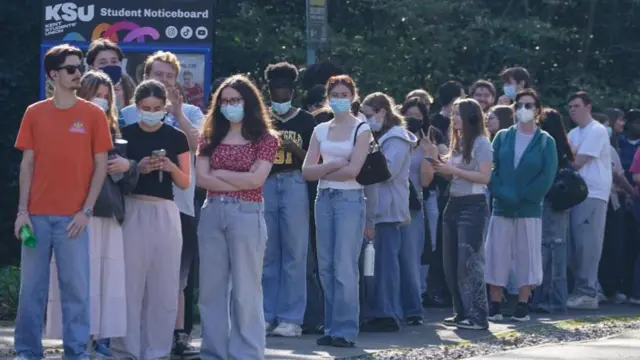
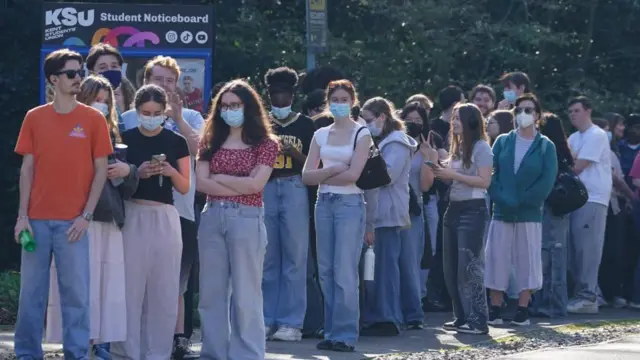
    Students queuing to receive vaccines and antibiotics at the University of Kent campus in CanterburyImage source, PA Media
    Image caption,

    The MenB vaccine was introduced on the NHS for babies in 2015, meaning most students are not vaccinated

    The MenB vaccine was introduced on the NHS for babies in 2015. If you were born before 1 May 2015, you won't have received it unless you had it privately.

    Babies now receive three doses of the vaccine, administered when they are eight weeks, 12 weeks and one year old.

    "It's best to have the MenB vaccines on time so children are protected when they're most at risk of getting MenB illnesses," the NHS says. But they can still have it up to the age of two, if they missed it.

    The MenB vaccine is different from the MenACWY vaccine, which is currently offered to teenagers and protects against other strains of the disease.

    • As a reminder, the family of an 18-year-old girl who died following a meningitis outbreak in Kent are calling for the MenB vaccine to be extended to teenagers and young adults on the NHS
  8. A timeline of the MenB outbreakpublished at 11:14 GMT 20 March

    The meningitis outbreak is thought to have started in a nightclub in Canterbury - here's a timeline.

    The family of a teen who died are calling for the government to go further and offer routine access to a vaccine to teenagers and young adults.

    This Flourish post cannot be displayed in your browser. Please enable Javascript or try a different browser.

  9. 'You've got to do all you can do to stay as protected as you can'published at 10:52 GMT 20 March

    Simon Jones
    BBC South East

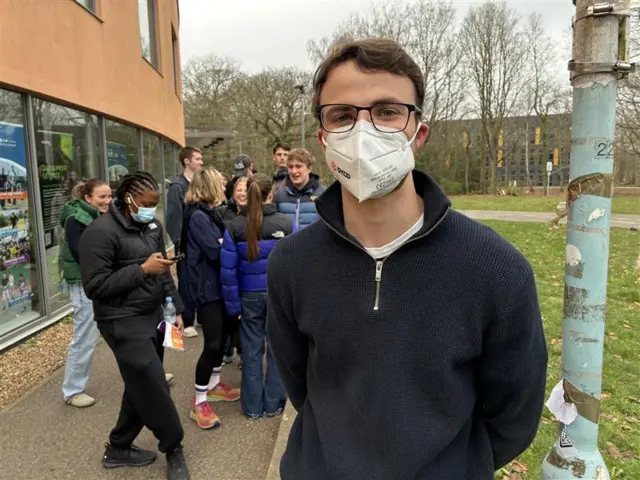
    Young man in a black hoodie poses for pic, He's wearing glasses and a face mask, he's standing in a queue outside on the side of a building

    Students in the queue have been telling me they are relieved to hear from health bosses that the vaccine should cover the strain of meningitis that has been circulating.

    One of them, Ollie, says: "That's certainly positive. I'd hoped that would be what they'd say.

    "You've got to do all you can do to stay as protected as you can."

    He says it was bringing back memories of Covid.

    The queue for vaccination is now huge - one staff member estimates it stretches for three quarters of a mile.

  10. Have questions about the outbreak? Get in touchpublished at 10:29 GMT 20 March

    You can get in touch in the following ways:  

    Please read our terms & conditions and privacy policy

    In some cases a selection of your comments and questions will be published, displaying your name and location as you provide it unless you state otherwise. Your contact details will never be published.  

    Your Voice banner
  11. Meningitis cases rise: What the UKHSA sayspublished at 10:20 GMT 20 March

    The UKHSA has released its latest update on the ongoing meningitis outbreak in Kent. Here's a quick breakdown of the data:

    • 29 cases of invasive meningitis with links to Canterbury, Kent, have been recorded as of lunchtime on 19 March
    • Of those, 18 are confirmed cases and 11 are probable. All have been hospitalised
    • 13 of the 18 confirmed cases are meningococcal group B (MenB)

    The UKHSA says cases number will continue to be recorded at 12:30 each day and figures - including confirmed or probable cases only - will be released the following day at 09:30.

    The agency adds that, as the outbreak remains a live incident, additional suspected cases notified to UKHSA will only be included in the confirmed or probable figure once "actively investigated" and corroborated as such.

  12. Long queues form outside vaccination centre in Ashfordpublished at 10:08 GMT 20 March

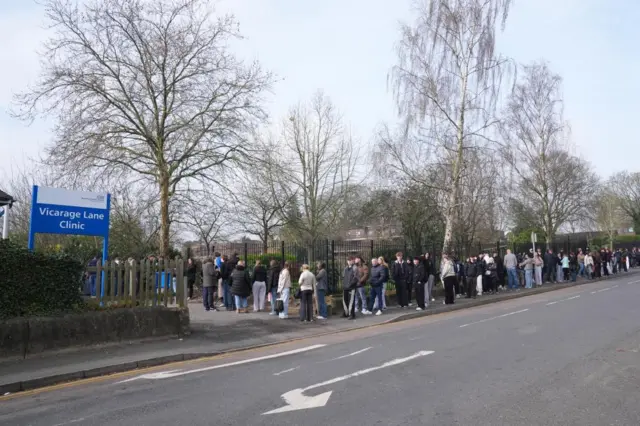
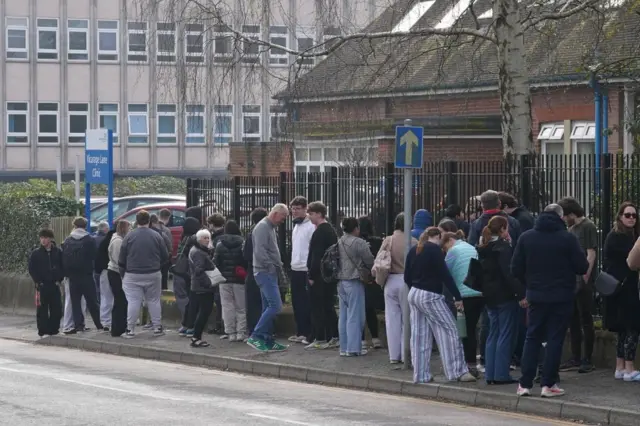
    We're now seeing some new images of long queues forming outside the Vicarage Lane Clinic in Ashford - one of the vaccination centres.

    Thousands more people are now eligible for vaccinations in the Canterbury area after the government expanded the list of those who qualify - here are the criteria.

    At some locations, people started queuing several hours ago.

    More than 100 students at the University of Kent were turned away on Thursday, as the queue became too long for everyone to be seen before staff left at 17:00 GMT.

    People wait in line outside a meningitis vaccination hub at the Vicarage Lane Clinic in Ashford, Kent.Image source, PA Media
    Close up shot as people wait in line outside a meningitis vaccination hub at the Vicarage Lane Clinic in Ashford, Kent.Image source, PA Media
  13. Analysis

    Scientists say current vaccine 'should provide protection' against MenB strainpublished at 10:02 GMT 20 March

    Hugh Pym
    Health editor

    Scientists at the UKHSA say they believe the vaccine will be effective against the strain of Meningitis B seen in Kent.

    But they add that more research is needed on why it spread so rapidly. Here’s what they say in today’s statement:

    "As part of investigations, UKHSA laboratories have completed an initial genetic analysis of a meningococcal strain isolated during this outbreak.

    "Results have confirmed that the Bexsero vaccine currently being offered in Kent should provide protection against the strain identified."

    According to the UKHSA "similar strains have been circulating in the UK for around five years but detailed analysis of the outbreak pathogen is required.

    "UKHSA is publishing the available data so that national and international partners can also carry out further scientific research."

  14. What do we mean by confirmed and suspected cases?published at 10:00 GMT 20 March

    Doctors will be diagnosing patients based on a list of signs and symptoms.

    If they suspect meningitis they will start treatment immediately, given how serious the disease can be.

    At this point, this is referred to as a "suspected" case.

    If a doctor suspects a patient has meningitis, they must also notify the public health protection team.

    This is so any patterns in linked cases can be tracked and contacts can be given the right advice and any treatment they need as quickly as possible.

    Cases are only "confirmed" after laboratory testing verifies they have the disease - this process is used in order to catch outbreaks just like this.

  15. Two new confirmed or probable cases recorded - UKHSApublished at 09:35 GMT 20 March
    Breaking

    We've just received an update from the UK Health Security Agency (UKHSA) on the latest number of cases linked to the outbreak in Kent.

    The agency says there are now 29 confirmed or probable cases of meningitis as of Thursday lunchtime, an increase of two compared to the day before.

    Of those, 13 of the 18 confirmed cases are meningococcal group B (MenB).

  16. Hundreds waiting patiently for their jabspublished at 09:30 GMT 20 March

    Simon Jones
    BBC South East

    The sports hall that has become a temporary vaccination clinic at the University of Kent opened 20 minutes early to try to cope with demand.

    And that demand is huge. Hundreds of people are waiting patiently in line for their jabs.

    Most are students from the University of Kent, some are staff who work on the campus, some are sixth-formers from schools where there have been confirmed cases, others had visited Club Chemistry.

    Everyone I have spoken to in the queue is backing the call by the family of Juliette Kenny for the vaccine to be rolled out to all teenagers and young adults. The government says that is being kept under review.

  17. New case figures expected shortlypublished at 09:22 GMT 20 March

    We're expecting the latest update on case figures from the UK Health Security Agency (UKHSA) shortly.

    Earlier this week Health Secretary Wes Streeting said that the numbers would be updated at 09:30 every day.

  18. Scenes outside clinic 'reminiscent of Covid' - but MenB is 'very different'published at 09:06 GMT 20 March

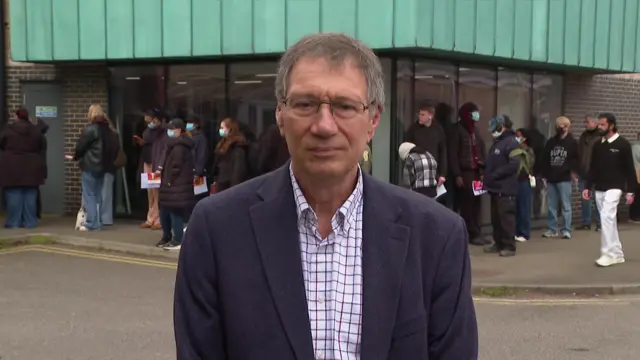
    University of Kent professor Dominic Abrams

    University of Kent professor Dominic Abrams has just spoken with BBC Breakfast.

    Standing outside a vaccination clinic with a queue behind him, he says the scenes are "very reminiscent of Covid", which is "somewhat traumatising for everybody". But this is a "very different" situation, he says, adding that MenB spreads differently to Covid.

    Abrams is a social psychology professor who led a major review of the long term social impact of the Covid pandemic. He says communications this time have been "much better".

    It is "really important" to give people information about what's happening in their immediate local context, he says. This time, the connection between what's happening at the national and local level is "clearer", he adds.

    "Understandably people are very concerned and anxious," but the situation is "more under control" than during the pandemic, in his view.

  19. Student returns to campus to receive meningitis jabpublished at 08:56 GMT 20 March

    Simon Jones
    BBC South East

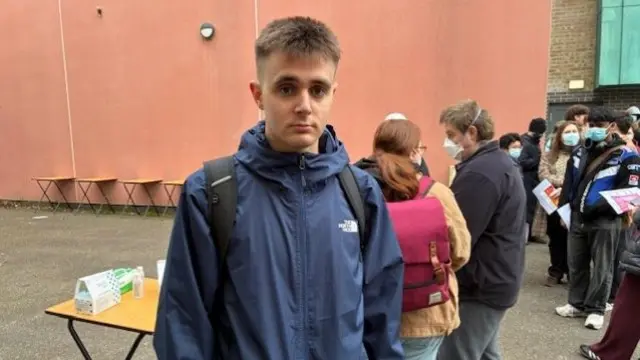
    Young man in dark blue rain jacket poses for camera in front of a small wooden table, people with face masks queueing outside a red building behind him

    The first person in the queue this morning was second-year University of Kent student James Thompson.

    He got his mother to drive him here from Ipswich at 4am - after he got an email yesterday which said he was eligible for the jab.

    "When the news broke on Sunday I wanted to get out of here because I didn't want to be surrounded by the threat of meningitis because it's a very scary disease," he says.

    But he was keen to return for the vaccine, describing today as a "big day".

    He is backing the call from the family of Juliette Kenny for the vaccine to be routinely rolled out to teenagers and young adults.

  20. Thousands of vaccines administered following Kent outbreakpublished at 08:39 GMT 20 March

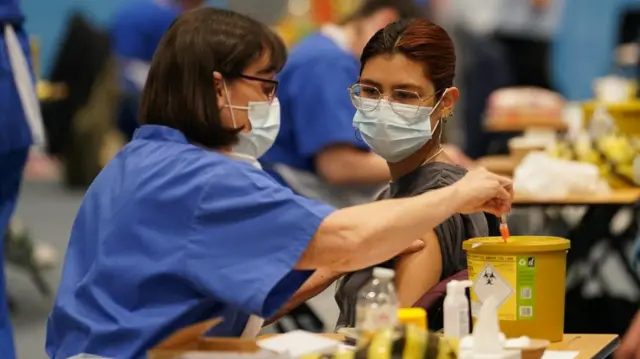
    As we've been reporting, thousands of vaccines and antibiotics have been handed out in response to the meningitis outbreak in Kent.

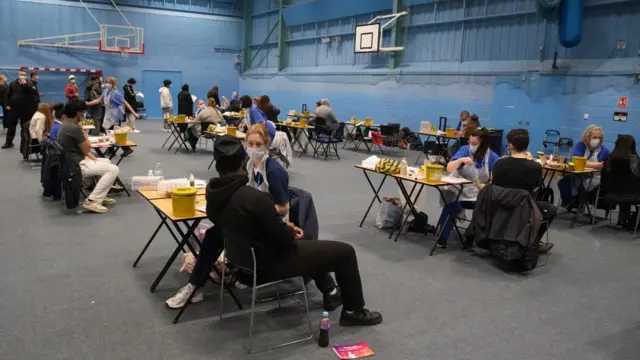
    These images from Thursday show the treatments being administered at the University of Kent, with more expected to be handed out on Friday.

    Students receiving vaccines and antibiotics from medical staff in the sports hall at the University of Kent campus in CanterburyImage source, PA Media
    A student receiving an injection in the sports hall at the University of Kent campus in Canterbury. A medical professional in scrubs and the student are both wearing masksImage source, PA Media
    Students queuing to receive vaccines and antibiotics at the University of Kent campus in Canterbury. A number are wearing masks. Students receiving vaccines and antibiotics from medical staff in the sports hall at the University of Kent campus in CanterburyImage source, PA Media