Summary

  1. 'There was a hive of military personnel' at bomb sitepublished at 16:52 BST 3 June

    Ushma Mistry
    in Coventry

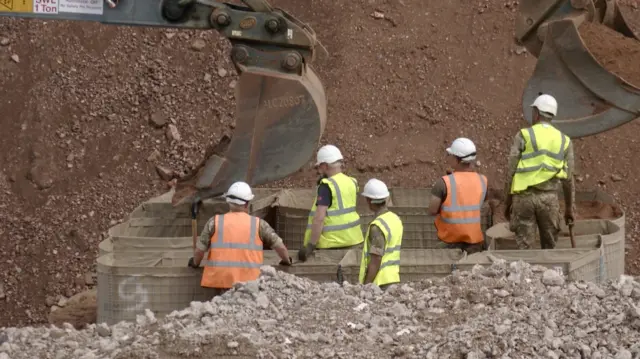
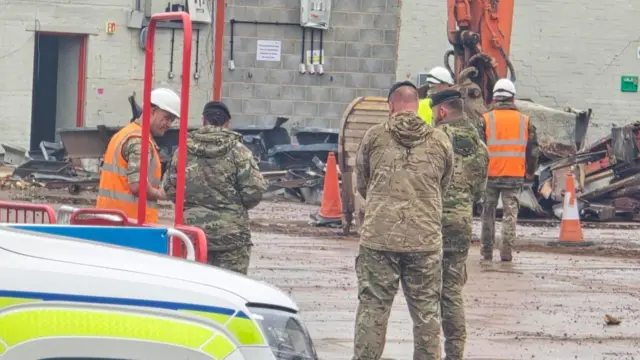
    Military personnel in hi-vis and hard hats at the site, surrounded by rubble

    I've been at the site of the Sandy Lane Business Park, where yesterday an unexploded World War Two device was found at the construction site.

    All day, until recently, there's been a hive of activity with military personnel from the bomb disposal unit and a police cordon in place.

    It's just been confirmed by West Midlands Police that the explosive ordnance disposal teams will be carrying out a controlled detonation later today.

    Once that's been done, residents will be allowed to return to their homes.

  2. Why so much sand?published at 16:36 BST 3 June

    Earlier we reported that the council had helped find 340 tonnes of sand for the Explosive Ordnance Disposal Team, to help them safeguard the site.

    Bomb disposal expert Steve Rimmer told BBC CWR that the idea was to use the weight of sand to direct most of the blast into the ground, during a controlled explosion.

    He said it would also help stop fragmented metal from the bomb.

  3. Site targeted in WW2 'because of war production'published at 16:20 BST 3 June

    Coventry historian Pete Walters says the Daimler factory at Sandy Lane was targeted because of its role in the war effort.

    He said: "They targeted many big Coventry companies at the time. They were targeting these major companies who were all involved in war production."

    Walters added that Daimler had not just one but two major sites in the area, with a second large factory at Radford a short distance away.

    Media caption,

    The Luftwaffe filmed the bombing raid on Coventry

    "That factory [at Radford] was set on fire during one of the air raids and it was one of the biggest industrial fires of the war," he said.

    Walters said Standard was another Coventry company targeted early in the war, adding that firms across the city had switched their production to support the war effort - including Alvis, which had turned its attention to making armoured vehicles.

  4. 'WW2 still disrupting daily life in Coventry'published at 16:03 BST 3 June

    Mary Creagh, MP for Coventry East, has thanked council, emergency and specialist services for their response.

    She added: "85 years after the Blitz the legacy of World War Two is still disrupting daily life in Coventry."

    A House of Commons portrait of Mary Creagh - a woman with short brown hair, a necklace, a black jacket and a pink top - who is smiling at the camera.Image source, House of Commons
  5. Bomb disposal team withdraw from sitepublished at 15:52 BST 3 June

    Kevin Reide
    in Coventry

    The Explosive Ordnance Disposal Team have now withdrawn from the construction site.

    We're expecting the detonation this afternoon and police have warned those nearby that there will be a loud bang

  6. Site earmarked for homes developmentpublished at 15:34 BST 3 June

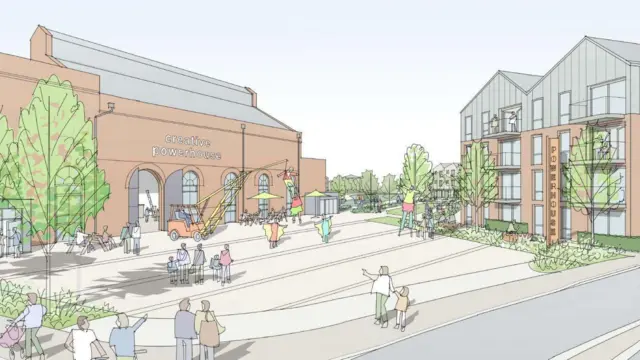
    A sketch drawn image of a public square outside the Powerhouse buildingImage source, Corstophine & Wright

    The Sandy Lane site, where the bomb was found, has been at the centre of major regeneration plans for several years.

    Planning documents submitted in October 2024 proposed up to 250 homes focused around the Daimler Powerhouse - a former factory building now used as a creative hub - with public spaces and walking and cycling routes.

    It was a scaled-back version of an earlier bid for 480 homes lodged in 2021, which was withdrawn.

    According to Coventry City Council, the site would include houses, apartments, employment space and leisure facilities.

  7. The knock on the door that saw resident evacuatedpublished at 15:16 BST 3 June

    Sean O'Brien was working from home when police knocked on his door to tell him an unexploded bomb had been found on the neighbouring building site.

    He told BBC CWR he and his partner Jessica went for a drive and got something to eat, expecting to be back inside within a few hours - but returned to find the cordon had been extended further.

    Speaking on Tuesday morning, O’Brien said: "We stayed in the car nearby but I eventually got a phone call from somebody at the police who was in charge of the bomb disposal. They said: 'Have you got anywhere to stay tonight?'"

    With his partner unable to spend the night on the floor at the rest centre set up by the council due to fibromyalgia and diabetes, the couple ended up booking a hotel.

    He said police had told him the device was thought to be a 50kg bomb.

    O'Brien said his only criticism was that he could have been told earlier to pack a bag for the night, adding: "It is what it is - we're glad they've found it and hopefully they can sort it out today."

  8. 340 tonnes of sand sourced ahead of explosionpublished at 14:59 BST 3 June

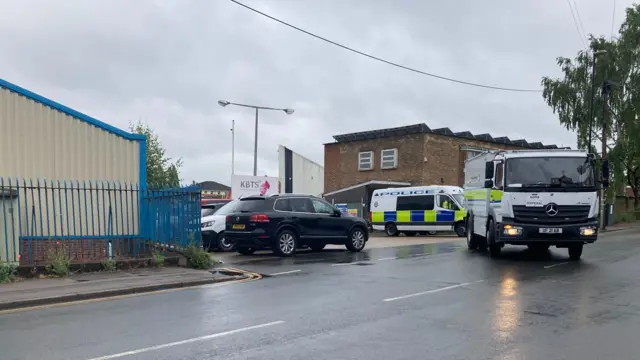
    Police vehicles - including a bomb disposal van - leave the factory site

    The council also helped bomb disposal experts by sourcing 340 tonnes of sand, which was delivered to the site by 06:00 BST.

    The spokesperson said: "This has been a significant, coordinated effort by staff across the organisation, and we know this has been matched by the support of partners across the city.

    "We thank everyone involved for their dedication in ensuring residents were kept safe and supported."

  9. Council supported 37 people and one dog overnightpublished at 14:45 BST 3 June

    Staff worked through the night to support residents who had been evacuated from their homes, Coventry City Council said.

    A rest centre at Central Library supported almost 30 people, a spokesperson said, while 15 households - including 37 people and one dog - were provided with overnight accommodation.

    A statement said: "A rest centre was set up at Central Library and remained open until after midnight, supporting almost 30 people.

    "Our Housing and Homelessness team worked alongside the Emergency Duty Team to ensure that anyone requiring overnight accommodation received it."

    Many others are believed to have stayed either in hotels or with family.

  10. What we know about the bomb disposal effort so farpublished at 14:32 BST 3 June

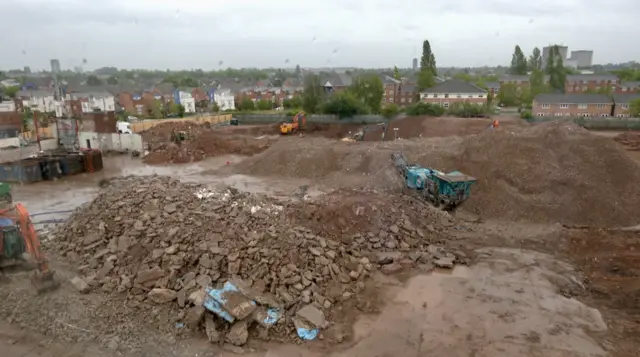
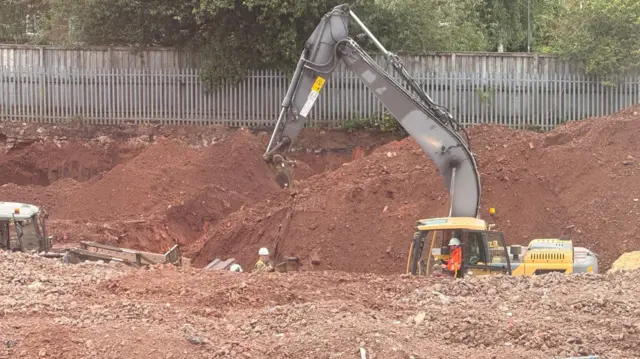
    A building site with piles of rubble and dirt. Plant machinery can be seen on the site with buildings and trees in the background.

    Here's everything we know so far about the unexploded World War Two bomb found in Coventry:

    • The unexploded device was discovered on Tuesday afternoon at a construction site at Sandy Lane Business Park in Coventry
    • Almost 100 homes in the surrounding area were evacuated, with residents offered temporary accommodation at the city's Central Library overnight. Some booked hotels after being told they could not return home
    • A 100-metre cordon remains in place, with roads in the area still closed. Police officers and Army bomb disposal experts have been at the scene throughout Wednesday
    • West Midlands Police has confirmed a controlled detonation will take place later, and people have been warned there will be a loud noise
    • Residents will be allowed to return home once the operation has been completed safely and the area confirmed as secure.
  11. Bomb discovered 'in corner of site'published at 14:20 BST 3 June

    Kevin Reide
    in Coventry

    The bomb was discovered in a corner of the site and has been moved to a central position on a stretcher.

    It has been placed between two large mounds of earth and from what we can see, has been covered with sand bags.

    We have seen disposal experts running long cables too - it feels as if this operation is coming to its conclusion.

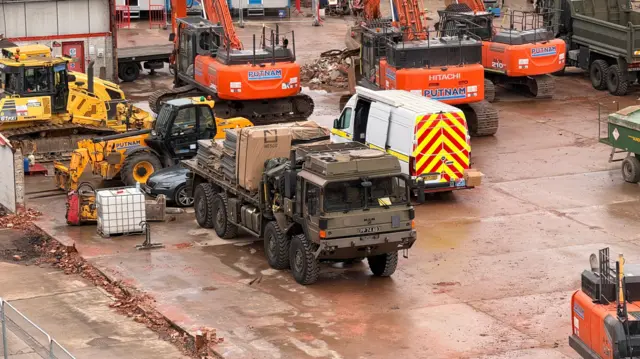
    An army vehicle parked at the site with plant machinery surrounding it
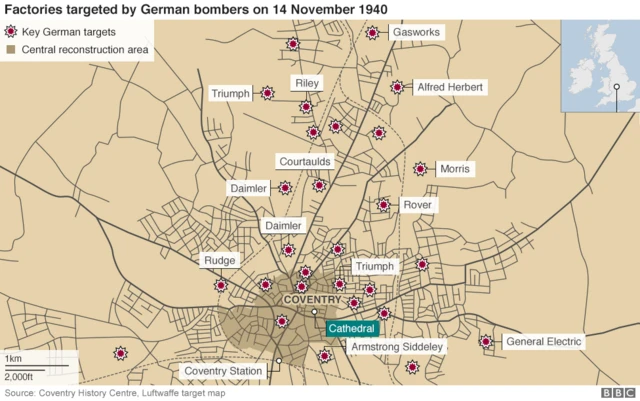
  12. Map shows Daimler among factories targeted in Blitzpublished at 14:03 BST 3 June

    A map that shows the factory sites that were targeted in Coventry during November 1940

    The discovery of the unexploded bomb at Sandy Lane is a reminder of the devastating raid on Coventry on the night of 14 November 1940, in which the Luftwaffe targeted the city's factories and industrial sites.

    The map above, produced using Luftwaffe target records, shows two Daimler sites among the key targets - including one close to Sandy Lane.

    An estimated 568 people were killed in the raid, with two-thirds of buildings in the city centre destroyed.

  13. Bomb likely dropped during November 1940 Blitz, historian sayspublished at 13:49 BST 3 June

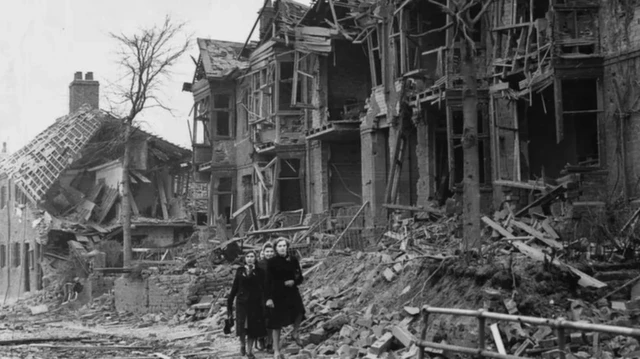
    A picture of building destroyed during World War Two. Three people can be seen walking in front of the rubble.Image source, Getty Images

    Coventry historian Pete Walters says he believes the bomb was most likely dropped during the November 1940 Blitz - the raid the Germans called Operation Moonlight Sonata.

    He told BBC CWR: "The big site at Radford was targeted during that raid and I suspect, but I'm not entirely sure, that this probably happened at the same time.

    "I've no doubt, really, that this is one of the bombs that were dropped on that factory, which did not explode, [and it's] been there all these years."

    Walters said the Sandy Lane site had a long history even before the war, having started life as a cotton mill in the 1860s before being destroyed by fire in the 1890s.

    It was later bought by Harry Lawson and Frederick Simms - the men who introduced the first car factory to Britain - who converted the ruins into what they called the Motor Mills, where the first Daimler cars were made.

    "It's a very historic site," Walters said.

  14. 'Hope for residents to return this afternoon'published at 13:43 BST 3 June

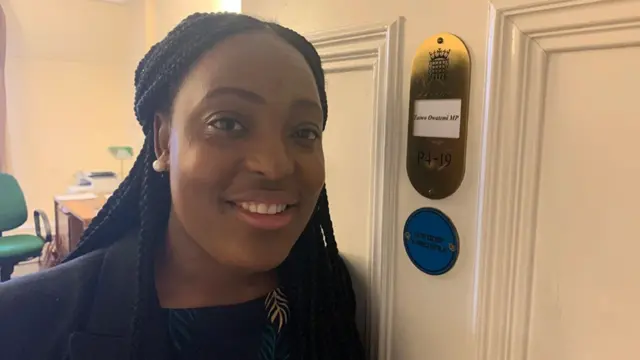
    A woman is prominent in the photo on the left and standing by a door on the right.

    The MP for Coventry North West, Taiwo Owatemi, says the "hope is that residents will be able to return home later this afternoon".

    On Facebook, the Labour MP told residents in and around the Sandy Lane area: "Your safety is the absolute priority.

    "Local police have updated me that they are working closely with military partners, the council, the fire service and emergency services."

    Explosive Ordnance Disposal experts were carefully assessing the device, she said, and added that everyone involved was "doing everything they can to protect residents and bring this to a safe conclusion as quickly as possible".

  15. Controlled detonation to take place later todaypublished at 13:30 BST 3 June
    Breaking

    A large vehicle on what could be a building site

    A controlled detonation will take place at the site later today, West Midlands Police has said.

    This would result "in a loud noise, which is expected and should not cause concern", the force added.

    The controlled detonation follows a "detailed assessment of the device".

    Residents will be allowed to return to their homes once the operation has been safely completed and it is confirmed that the area is secure.

    Emergency services are continuing to work alongside Explosive Ordnance Disposal teams to safely manage the unexploded World War Two bomb at Sandy Lane Business Park in Coventry.

  16. 'Disgruntled' motorists faced issues nearbypublished at 13:15 BST 3 June

    Ushma Mistry
    in Coventry

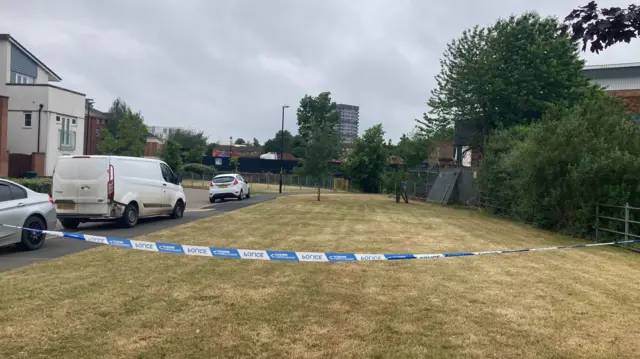
    Police tape over grass at the scene with three vehicles on the left hand side. Buildings can be seen in the distance too.

    I've also been on the other side of the canal near Canal View, where residents were evacuated on Tuesday evening.

    There were a few disgruntled people trying to get to work this morning because their usual route is across the canal bridge, but that remains cordoned off.

    Police officers are stationed on either side of the bridge and people are having to find alternative routes.

    From what I can see, activity on Sandy Lane itself appears fairly normal, with traffic still moving.

    The restrictions seem to be concentrated around the residential area and the construction site, which was already fenced off before the bomb was discovered.

  17. Theatre group project 'suspended until tomorrow'published at 12:54 BST 3 June

    At least five people in Army uniform, with a building in the background.
    Image caption,

    Army bomb disposal experts have been at the scene

    A theatre charity says an initiative at "a very busy hub" has been suspended following the evacuation.

    Highly Sprung Performance co-director Sarah Worth said: "We were starting a project working with the RAF and we had our actors coming down to start that.

    "So all of that has been suspended until tomorrow, so it's all been a bit disappointing."

    Worth added it was an education project called Ground Control, "all about how we're using creativity and physical theatre to bring the STEM [science, technology, engineering and maths] curriculum to life and to think about future careers in space".

  18. People urged to stay away from scenepublished at 12:37 BST 3 June

    Councillor Angela Hopkins, who represents the Radford ward, urged members of the public not to go down to the scene.

    She said: "A number of [people] used our rest centre, which the council set up at Central Library, and of those, the council found accommodation in hotels for a number of families.

    "I'd urge everybody not to go down [to the scene]. The last thing the police need is people coming down there to take photos and videos, and they'll just get in the way.

    "I'm in touch, getting regular updates on the situation, and I've got a meeting shortly with the police, which I hope will update us more on the situation."

  19. Sandbags designed to stop fragmenting metalpublished at 12:16 BST 3 June

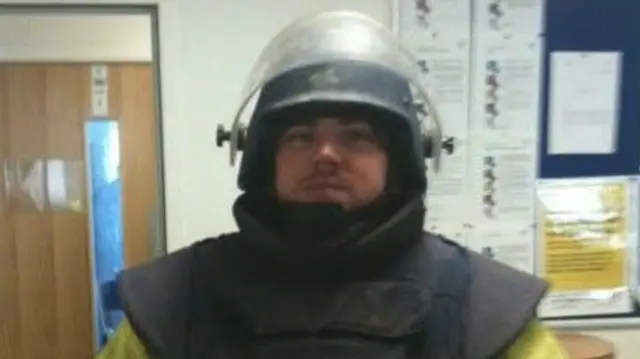
    A man in uniform, including a helmet and black top, standing in front of a door and wall.Image source, Steve Rimmer
    Image caption,

    Steve Rimmer spent eight years in the Army as a bomb disposal engineer

    Bomb disposal expert Steve Rimmer told BBC CWR: "The idea is that sandbags [overwhelm] the top of the bomb with all that weight, so if an explosion does happen, most of the blast goes into the ground and just stops all the fragmentation coming out of the weapon.

    "I spent eight years in the Army as a bomb disposal engineer and the last 15 years in the civilian sector, so we'll go on to construction sites where there's a likelihood of some UXO [unexploded ordnance] being found.

    "There's probably around 100 of us across the country."

  20. 'They'll put in a lot of earthworks, sandbags'published at 11:59 BST 3 June

    Two large vehicles on what could be a building site.

    Bomb disposal expert Steve Rimmer has been explaining that in these cases, a team would arrive following a visit by an officer.

    Explaining the process in similar sorts of situations, he told BBC CWR that the Army had a pager service, "they're on stand-by for this kind of thing".

    "There'll be a BDO, a bomb disposal officer, which will come and assess the exact bomb and what suppression and protection needs to be put in place.

    "Then another team will come out, they'll put in a lot of earthworks, a lot of sandbags in place, should the weapon explode.

    "It's called a High Order, which is what it was designed to do, so if it does do that, then all the suppression's in place so all the infrastructure and people don't get injured by it."