Summary

  • This page contains very strong, uncensored language that some may find offensive

  • US President Donald Trump has issued an expletive-laden threat against Iran's infrastructure if the Strait of Hormuz is not opened

  • Trump says "Tuesday will be Power Plant Day, and Bridge Day, all wrapped up in one" in Iran if the key shipping lane is not reopened

  • He reiterates his earlier threat to unleash "hell" if the country does not meet his 6 April deadline - previous deadlines given by the president have shifted and Trump tells US media there's a "good chance" of a deal being reached

  • The key battleground between the two countries may now be at sea, Orla Guerin writes, as she reports seeing ships at anchor close to the mouth of the strait

  • One Iranian tells the BBC: "It feels like we're sinking deeper into a swamp...what can we do as ordinary people? We can't do anything. We can't stop [Trump]"

  • Meanwhile, the US president says an American crew member rescued after a fighter jet was shot down over Iran is "SAFE and SOUND" - here's what we know

  1. Israel warns it will strike near key Syria-Lebanon border crossingpublished at 21:44 BST 4 April
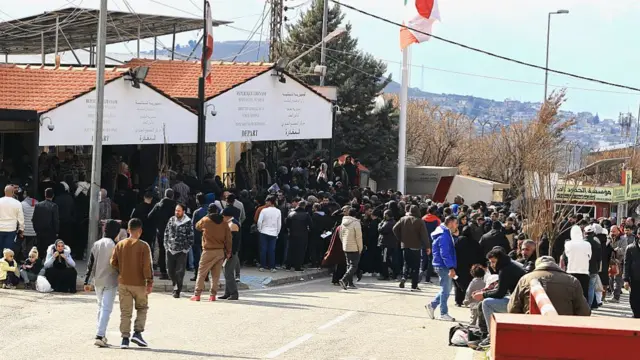
    Thousands of civilians flee their homes due to Israeli airstrikes, gather at the Al-Masnaa crossing to return to their country in Masnaa, Lebanon on March 2, 2026Image source, Getty Images
    Image caption,

    The Masnaa border crossing, pictured here on 2 March, has been one of the key land crossing for the more than 200,000 that have entered Syria from Lebanon during the war

    Israel has issued an evacuation order saying it plans to strike near the Masnaa border crossing between Lebanon and Syria in the "near future".

    Israel Defense Forces (IDF) spokesman Avichay Adraee alleges Iran-backed Hezbollah has been using the crossing for "military purposes".

    The crossing, on Lebanon's eastern border with Syria, is a key route for those travelling between the two nations.

    Earlier this week, the United Nations Refugee Agency said more than 200,000 people had entered Syria from Lebanon since the start of the war, with Masnaa operating "around the clock" as one of the busiest official crossings.

  2. Iran warns region will become ‘hell’ for the US and Israel if escalation continuespublished at 21:16 BST 4 April

    Ghoncheh Habibiazad
    Senior reporter, BBC Persian

    A spokesperson for Iran's highest operational command coordinating the armed forces warns the US and Israel that the entire region will become “hell” for them if escalation continues.

    Ebrahim Zolfaghari, spokesperson for Khatam al-Anbiya Central Headquarters, says: “If hostility escalates, the entire region will turn into hell for you; the illusion of defeating the Islamic Republic of Iran will become a quagmire into which you will sink.”

    Separately, Ali Abdollahi, Khatam al-Anbiya’s commander, threatens that “the gates of hell will be opened” for the US and Israel.

    Their comments follow US President Donald Trump saying Iran has 48 hours to make a deal or open the Strait of Hormuz or “hell will reign down” on the country.

    Abdollahi calls Trump an “aggressive and war-mongering” president, and described Trump’s threat to attack the country’s infrastructure as a “desperate, agitated, unbalanced, and foolish move.”

    He says that if the US attacks Iran’s infrastructure, then Tehran will target infrastructure used by the US Army and Israel “without limitation.”

  3. Iran-backed Houthis say they launched missile attack towards Israelpublished at 21:04 BST 4 April

    The Iran-backed Houthis in Yemen say they launched a missile attack towards Israel.

    Earlier, the Israel Defense Forces (IDF) said its air defences were intercepting a missile launch from Yemen towards its territory - before announcing it was safe to leave shelters a few minutes later.

    It follows several Houthi strikes against Israel over the past week. The group said they launched a barrage of missiles against Israel on 28 March - its first attack since the start of the US-Israel war with Iran.

  4. Missing crew member will want to 'get rid of any kit they can' - former hostage interrogatorpublished at 20:39 BST 4 April

    BBC News speaks to former hostage interrogator

    The BBC has been speaking to a former hostage interrogator, whose identity has been protected for safety reasons.

    He says the missing airman or woman will want to "get rid of any kit they can", potentially burying it. Their senses will be "extremely heightened" by adrenaline but will need to remember to stay completely out of sight, he says.

    Asked what may be hindering the second crew member being found, he says it is unclear if the beacon - a device that can help locate people in rescue missions - is operational.

    He also says it's possible the crew member has been captured without Iran revealing it publicly. They "could turn the whole scenario on its head" by using the beacon to draw US forces in, with the intention of taking them out as well, he says.

    In terms of the tactics the Islamic Revolutionary Guard Corps (IRGC) will be using to locate the person, he says: "Drones, dogs, vehicles of any sort" and "firing up locals in the area" who know the terrain.

    If caught, Iran will probably put the crew member in front of cameras and could even go for "some kind of trial... to further embarrass the Americans", he says.

  5. Five killed in Israeli strike on Iranian petrochemical complex - state mediapublished at 20:12 BST 4 April

    Iranian state media is reporting five people have been killed in a strike on an Iranian petrochemical complex, which Israel says produces a "critical component" for its ballistic missiles.

    The Israel Defense Forces (IDF) says the strike, on the facility in Mahshahr, southwestern Iran, occurred earlier on Saturday.

    It says it is one of two central facilities in Iran producing materials for explosives and other weaponry.

    An Iranian official for the region says five were killed in the strike, with a further 170 being treated for injuries, according the Islamic Revolutionary Guard Corps-affiliated Fars news agency.

  6. 'Money is an incentive but nationalistic sentiments are there' - researcher on rewards offered for pilot capturepublished at 19:41 BST 4 April

    Ghoncheh Habibiazad
    Senior reporter, BBC Persian

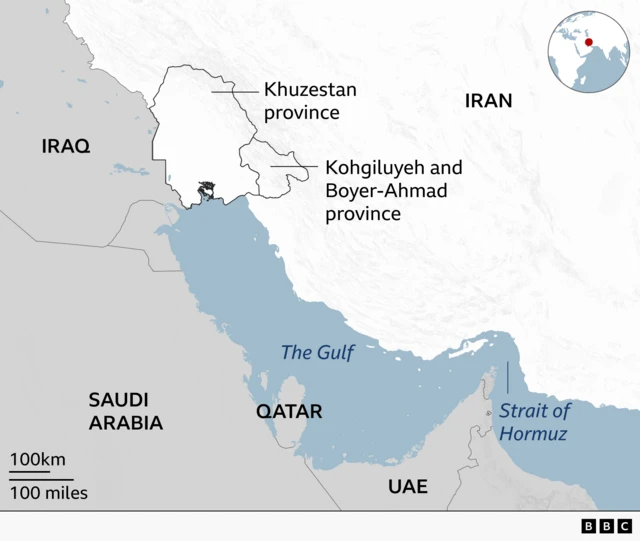
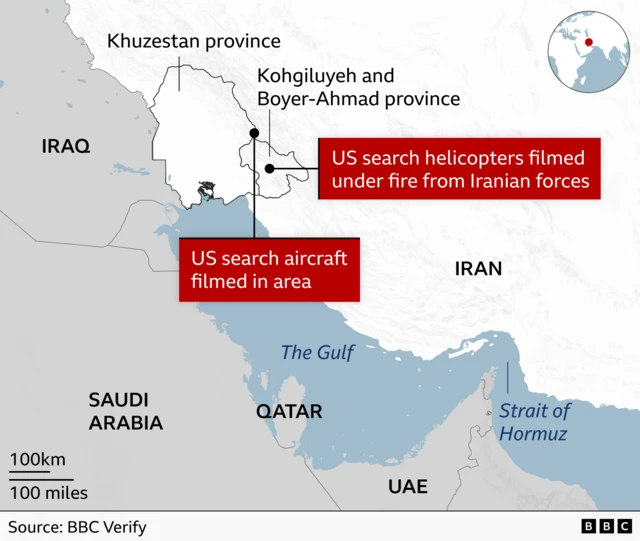
    While we still don’t know exactly where the jet was downed, two provinces have been mentioned frequently in Iran’s state media so far - Kohgiluyeh and Boyerahmad, and Khuzestan.

    The two provinces are diverse, and home to people from a number of different ethnic groups - including nomads.

    Khuzestan is a core centre of Iran’s economy and a powerhouse for oil, while Kohgiluyeh and Boyerahmad is one of Iran’s less industrialised provinces.

    Since the war began, strikes have targeted there - Khuzestan's major steel company has been shut down as a result of strikes, and the province has been targeted today as well.

    State-affiliated Iranian channels have been urging people to try and “capture the pilot alive”. Iranian authorities have also offered rewards, and other groups have put up bounties as well.

    In one widely shared example, Iranian media reported that local traders are offering a reward of about £50,000 ($66,100) - much higher than the country’s estimated monthly salary range of £150 to £230.

    Support for the Islamic Republic among locals in the provinces is not uniform.

    The reward could have been a trigger for some to start looking for the pilot, but Sina Azodi, from the Elliott School of International Affairs at George Washington University, tells the BBC the same search operation would have happened anywhere else in the country anyway.

    He says: “The bounty could motivate some people, but the footage I’m seeing from Iran shows locals using their old rifles to attack and also some cheering.

    "It doesn’t matter where they are, if the jet had been shot down in Isfahan or Tehran, I think many would have been motivated there as well to do it and also to have extra money in their pockets.”

    Azodi says "money is an incentive but nationalistic sentiments are there".

    “When you bomb people who are angry and have just lost their families, they have every reason to attack you or try to capture you, and the money is an additional incentive."

  7. What we know so far about the downed US fighter jetpublished at 19:09 BST 4 April

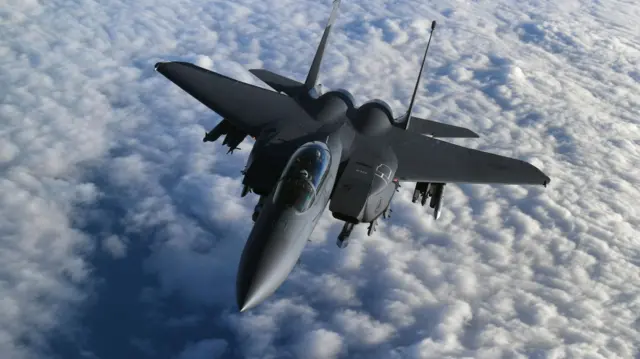
    We know that a US F-15E Strike Eagle fighter jet was shot down over southern Iran on Friday, according to US media reports.

    The pilot - one of two crew members typical for an F-15E - has been rescued by US forces, say reports.

    A helicopter carrying the rescued pilot from the F-15E was hit by small arms fire - which Iran has attributed to its nation's nomadic tribes - injuring crew before it landed safely.

    Separately, a US A-10 Warthog aircraft that was part of the search and rescue mission for the downed jet was also shot and damaged, however its pilot was safely rescued, according to the BBC's US partner CBS News.

    Iran says it has shot down an American A-10 Warthog - it's not known if this is the same plane.

    Iran's top joint military command says new Iranian air defence systems were responsible. Iranian officials are also offering around £50,000 ($66,100) for capturing alive any crew member of the downed US plane still not rescued, according to state media.

    We don't know the status of the US search-and-rescue mission, or what has happened to the weapons officer that would also have been on board the downed F-15E.

    The US has also not provided any official updates on the mission, other than officials speaking anonymously to US media outlets.

    US President Trump has also made no public statement about the incident.

    United States Air Force F-15 Strike Eagle fighter jet over the English Channel during Operation Point Blank, which featured aerial capabilities from the RAF, United States Air Force and French Air ForceImage source, Press Association
  8. Who was Qasem Soleimani?published at 18:35 BST 4 April

    Ghoncheh Habibiazad
    Senior reporter, BBC Persian

    An Iranian holds a picture of late General Qasem ​Soleimani, head of the elite Quds ForceImage source, Reuters

    As we reported earlier, the US State Department says it has arrested the niece and grand-niece of Iranian general Qasem Soleimani after terminating their lawful resident status.

    A loyalist of Iran’s late Supreme Leader Ayatollah Ali Khamenei, Soleimani was seen as one of the most influential figures in recent Middle Eastern politics.

    Soleimani became commander of the Quds Force of the Islamic Revolutionary Guards Corps in 1998.

    He was killed in an air strike near Baghdad airport, ordered by Donald Trump, in January 2020 during Trump’s first term as president.

    Born in south-eastern Iran in 1957, he led Iran’s Sarallah 41st Division against Iraqi forces during the Iran-Iraq War in the 1980s.

    Soleimani was reportedly active in leading military operations in Lebanon, Syria, Iraq and Afghanistan.

    In March 2019, he was awarded the Order of Zolfaqar, Iran’s highest military honour, making him the first military official to receive it since the 1979 Revolution.

    He was sanctioned by the US Treasury for his alleged role in the Syrian civil war.

  9. Kuwait responded to eight missiles and 19 drones in past 24 hours - defence ministrypublished at 18:22 BST 4 April

    Kuwait has responded to eight missiles and 19 drones within its airspace in the past 24 hours, its defence ministry says.

    It says no human casualties or "material damage" has been reported following the attacks.

  10. Israeli soldier killed in southern Lebanon - IDFpublished at 18:04 BST 4 April

    The Israeli military says a soldier has been killed in combat in southern Lebanon.

    "Sergeant First Class Guy Ludar, aged 21, from Yuvalim, a soldier in the Maglan Unit, Commando Brigade, fell during combat in southern Lebanon," the Israel Defense Forces (IDF) says in a statement.

    Israel sent ground troops into southern Lebanon on 2 March, and has been launching broad strikes across the country. That came after Hezbollah fired rockets into northern Israel in retaliation for Israel's assassination of Iran's supreme leader at the start of the war.

  11. US arrests relatives of Iranian general killed in 2020published at 17:50 BST 4 April

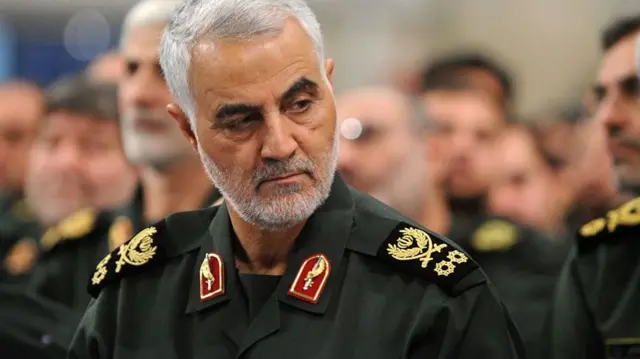
    Iranian Quds Force commander Qassem Soleimani attends Iranian supreme leader Ayatollah Ali Khamenei's (not seen) meeting with the Islamic Revolution Guards Corps (IRGC) in Tehran, Iran on September 18, 2016Image source, Getty Images
    Image caption,

    Qasem Soleimani, then commander of Iran's Quds Force, was killed by a US air strike in Iraq in 2020

    The US has arrested the niece and grand-niece of Iranian general Qasem Soleimani, who was killed by a US air strike in Iraq in 2020, the State Department says.

    It says the relatives, who had been living in the US, had their lawful permanent resident status terminated by Secretary of State Marco Rubio.

    It says Soleimani's niece has continued to be an "outspoken supporter" of the Iranian regime and that she has promoted the regime's "propaganda" in the US.

    "The Trump Administration will not allow our country to become a home for foreign nationals who support anti-American terrorist regimes," the statement says.

  12. Trump continues to push Iran to make dealpublished at 17:29 BST 4 April

    Simi Jolaoso
    North America correspondent

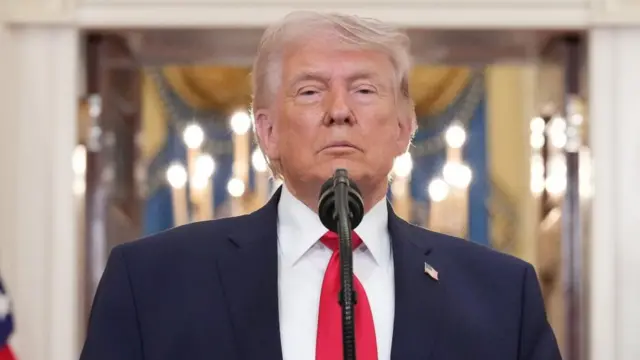
    US President Donald TrumpImage source, EPA

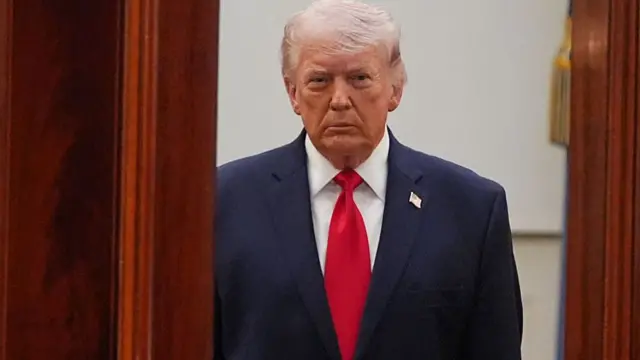
    US President Donald Trump had said that Iran couldn't "do a thing” about American aircraft operating over its territory, and that its air defences had been significantly weakened.

    So the downing of the F-15 has been a blow - and the situation could become worse if the weapons systems officer is captured.

    Iran’s Revolutionary Guard is said to have sealed off a huge area and begun a search for the missing US airman - turning this into a high-stakes race on the ground between the two adversaries.

    President Trump has said the loss of the plane will not affect negotiations with Iran - but he has posted a reminder of his most recent deadline of 6 April for Tehran to agree to a deal, reopen the strait of Hormuz or face the obliteration of its power plants.

  13. Iran says nomadic tribes hit two US Black Hawk helicopterspublished at 17:21 BST 4 April

    Ghoncheh Habibiazad
    Senior reporter, BBC Persian

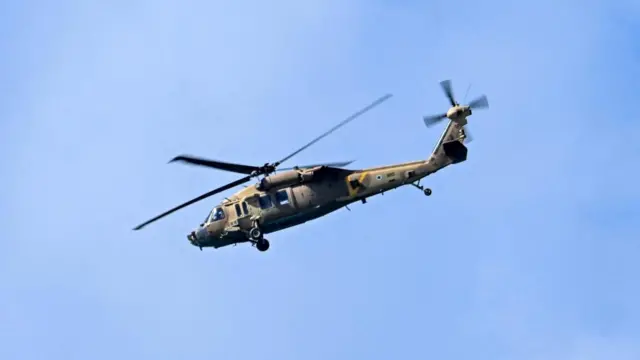
    A Black Hawk helicopterImage source, Reuters
    Image caption,

    A Black Hawk helicopter pictured on 8 March

    Iran says two nomadic tribes living in the Iranian mountains have hit two US Black Hawk helicopters.

    In a statement, the Islamic Revolutionary Guard Corps says the "nomads of Kohgiluyeh Boyerahmad [province] and the Bakhtiaris" have "successfully struck two Black Hawk helicopters in hard-to-reach mountainous regions far from the presence of Iranian armed forces".

    The BBC has reached out to US Centcom for comment.

    The nomads and Bakhtiaris are traditionally known as tribal peoples of Iran, recognised for their rugged seasonal migrations. They're known to carry rifles to protect their herds and camps from wild animals and theft in the remote highlands.

    BBC Verify has confirmed a video from Friday showing what appears to be three armed individuals firing towards at least two Black Hawk helicopters.

    CBS, the BBC’s US partner, reported that one helicopter carrying the rescued pilot from the F-15E jet was hit by small-arms fire, injuring crew members, but landed safely.

    The deputy governor of Kohgiluyeh and Boyer-Ahmad province also said that on Friday local people fired at "enemy helicopters" with rifles, "preventing them from landing anywhere in the province".

    A map showing the locations of Khuzestan province and Kohgiluyeh and Boyer-Ahmad province
  14. Analysis

    What Iran has said about attacks on nuclear-related facilities so farpublished at 17:03 BST 4 April

    Ghoncheh Habibiazad
    Senior reporter, BBC Persian

    The reported attack near the Bushehr nuclear power plant is drawing attention, as Iran’s nuclear programme has long been at the centre of diplomatic talks and sanctions.

    Iran says its programme is peaceful, but the US and Israel have repeatedly disputed this.

    At the start of the war, Iran had about 440kg of uranium enriched to 60%, according to US officials. Enriched uranium is crucial for both civilian reactor fuel and, if taken beyond certain thresholds, for nuclear weapons development.

    On 27 March, the organisation reported that the Khondab heavy water complex and the Ardakan yellowcake production facility, both in central Iran, had been targeted.

    Iran's Ahmadi Roshan uranium enrichment site in Natanz was struck on 21 March - the second attack on the site since the war began.

    The Natanz complex is a core facility for Iran’s nuclear programme, housing large cascades of gas centrifuges that enrich uranium.

    The US also carried out bombings on Natanz and two other key nuclear sites - Fordo and Isfahan - in June last year during the 12-day Iran-Israel war.

  15. Russian staff reportedly evacuated after attack near Iran nuclear plant - a recappublished at 16:30 BST 4 April

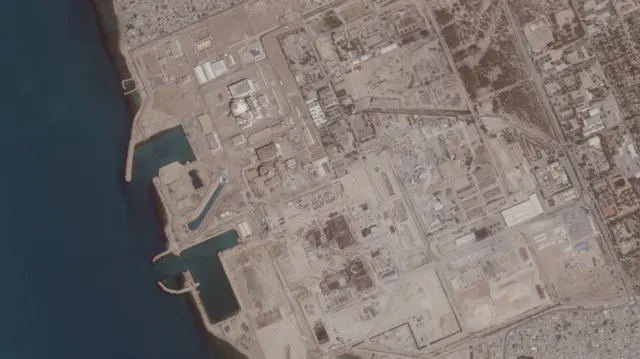
    A satellite image of Bushehr nuclear power plant before the conflictImage source, Reuters
    Image caption,

    Satellite image of Bushehr nuclear power plant before the conflict

    As we've been reporting, Iran said the area around the Bushehr nuclear power plant had been attacked.

    Here's how the event unfolded:

    • On Saturday morning, Iranian state media reported that the Bushehr nuclear power plant area was under attack, with one staff member killed
    • Initial investigations suggest the incident "did not cause damage" to the main parts of the plant, according to Iran’s Atomic Energy Organisation
    • The International Atomic Energy Agency - the global nuclear watchdog - says "no increase in radiation levels was reported"
    • But Russian nuclear power company Rosatom is reportedly evacuating 198 employees from the plant, according to Russian state news agency Tass
    • Iran's Foreign Minister Abbas Araghchi has criticised attacks on the nuclear site, saying radioactive fallout would "end life" in Gulf capitals, "not Tehran"
    • A little earlier, Donald Trump posted on Truth Social saying the US was "getting rid of a Nuclear Iran"
  16. Images show strike damage to Tehran Universitypublished at 16:10 BST 4 April

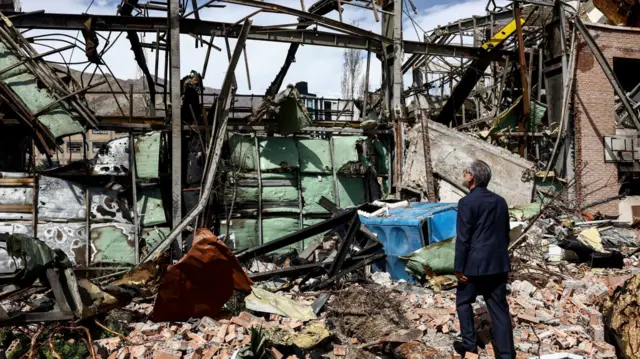
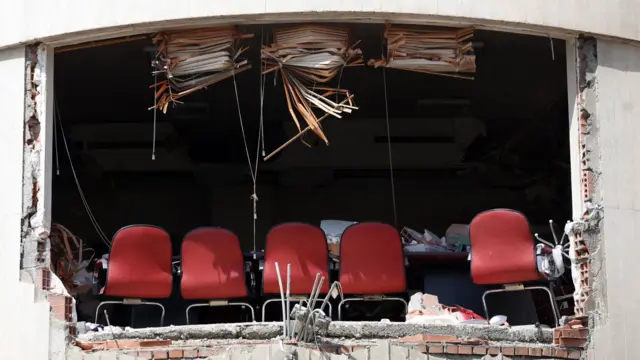
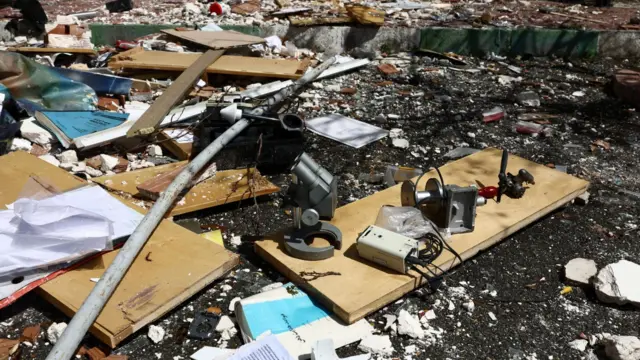
    Images from Iran show the extent of damage reportedly caused by air strikes to Tehran's Shahid Beheshti University on Friday.

    Iran's Science Minister Hossein Simaee Sarraf visited the site earlier today.

    Iran's Minister of Science Hossein Simaee Sarraf inspects the damage at the research building of the Shahid Beheshti University, which was damaged by a strike, amid the U.S.-Israeli conflict with Iran, in Tehran, Iran, April 4, 2026.Image source, Reuters
    A damaged building after US-Israeli airstrikes on the Shahid Beheshti University, in Tehran, Iran, 04 April 2026. A joint Israeli and US military operation, launched on 28 February, continues to target multiple locations across Iran. Tehran university hit by US-Israeli airstrikes amid escalating conflict, Iran Islamic Republic Of - 04 Apr 2026Image source, EPA
    Laboratory equipment at the research building of the Shahid Beheshti University, which was damaged by a strike, amid the U.S.-Israeli conflict with Iran, in Tehran, Iran, April 4, 2026Image source, Reuters
  17. Timeline of Trump's deadline to Iranpublished at 15:49 BST 4 April

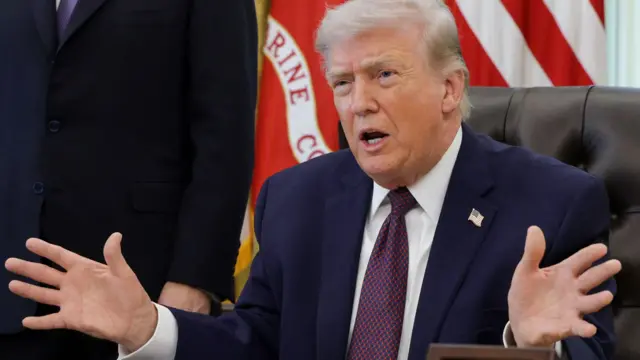
    President Donald Trump speaks before signing an executive order to limit mail-in voting in the Oval Office of the White House on March 31, 2026Image source, Getty Images

    As we've just heard, Trump is threatening to rain down "hell" on Iran if it doesn't "make a deal" or open the Strait of Hormuz within 48 hours.

    He's given many deadlines during the war, with this latest threat matching the 10-day pause in attacks on energy infrastructure he announced on 27 March.

    Here's a timeline:

    • 21 March: Trump said he would "hit and obliterate [Iran's] various power plants, starting with the biggest ones first" if Iran didn't reopen the Strait of Hormuz within 48 hours
    • 23 March: He then said the two countries had had "very good and productive conversations" and said he would postpone any and all military strikes against energy infrastructure for five days
    • 27 March: Trump said he would pause attacking Iranian energy plants for 10 days, in response to what he called a request from the Iranian government, bringing the deadline to 6 April
    • Today: He repeats his 27 March deadline, telling Iran it has 48 hours before "all Hell will reign down on them"
  18. Iran has 48 hours to make a deal before 'hell will reign down', Trump sayspublished at 15:19 BST 4 April

    President Donald Trump arrives to speak in the Cross Hall of the White House on April 1, 2026Image source, Getty Images

    US President Donald Trump says Iran has 48 hours to "make a deal" or open the Strait of Hormuz before "Hell will reign [sic] down on them".

    In a post on Truth Social, he writes: "Remember when I gave Iran ten days to MAKE A DEAL or OPEN UP THE HORMUZ STRAIT. Time is running out.

    "48 hours before all Hell will reign down on them. Glory be to GOD! President DONALD J. TRUMP."

    On 27 March, Trump announced he was pausing any attack on Iranian energy plants for 10 days from then.

    In another post a moment earlier, mostly talking about the benefits tariffs have brought the US economy, he signed off with: "All of this and, simultaneously, getting rid of a Nuclear Iran. MAGA!!!"

  19. Iran credits new air defence systems with downing of US planespublished at 15:07 BST 4 April

    Iran's top joint military command has credited new Iranian air defence systems with the downing of two US warplanes on Friday, according to Iran's state-affiliated IRNA news agency.

    Iran is claiming to have shot down two US warplanes – one F-15E flying over the southwest of the country and a second plane - an A-10 Warthog - involved in a mission to rescue the F-15's crew.

    Spokesperson Ebrahim Zolfaghari says Friday was a "humiliation" for the US and Israel, crediting new "domestically-produced" air defence systems, reports IRNA.

    He adds that Iran will "surely achieve full control of our country's skies" as these new systems are rolled out "one after another".

    US Central Command has not confirmed the details surrounding the downing of any aircraft.

  20. Recap: Stakes raised for US as search for missing airman continuespublished at 14:44 BST 4 April

    Katie Williams
    Live reporter

    The search for a missing US airman after a warplane was shot down in southern Iran has continued into its second day. Here's the latest.

    Search operation continues

    US and Iranian forces are both searching for the missing weapon systems officer, after a US F-15E was downed in southern Iran. Iranian officials are offering rewards of about £50,000 ($66,100), state media report.

    US media say an A-10 Warthog was shot at during the rescue mission, with the pilot reportedly ejecting over the Gulf before being rescued. BBC Verify has mapped what we know based on video footage.

    Stakes raised for US

    This moment is fraught with risk and political peril, our chief international correspondent writes. If the airman is taken hostage and images circulated, it will be a propaganda victory for Iran, she adds.

    Strikes across region

    Meanwhile, strikes have continued. Iran says the area around the Bushehr nuclear power plant has been attacked and one person killed - it is the fourth time the site has been hit during the war. It also says a major petrochemical complex was targeted.

    Videos show overnight Iranian strikes on the Israeli city of Bnei Brak, and Israeli strikes on Beirut.

    The image is a news-style map focused on southwestern Iran and nearby regions. It highlights Khuzestan province and Kohgiluyeh and Boyer-Ahmad province in Iran, near the border with Iraq. Red labels indicate reported incidents: “US search helicopters filmed under fire from Iranian forces” in Kohgiluyeh and Boyer-Ahmad province; “US search aircraft filmed in area” near Khuzestan. The map also shows nearby countries including Saudi Arabia, Qatar, and the United Arab Emirates. Key geographic features include The Persian Gulf and the Strait of Hormuz. Overall, it’s illustrating the location of reported US search operations and alleged Iranian engagement in southwestern Iran, based on BBC Verify reporting.