Summary

  • This live page has now closed - read more on this story here

  • Three people have died after a suspected hantavirus outbreak on a cruise ship travelling from Argentina to Cape Verde

  • It includes a 70 and 69-year-old Dutch husband and wife who became ill on board and were taken off the ship - the body of a third Dutch individual is still on board

  • A 69-year-old Brit is currently in intensive care in Johannesburg, South Africa - the only confirmed case of the virus. Two crew on board are also sick and require urgent care, operator Oceanwide Expeditions says

  • The ship appears to have been stationary off the coast of Cape Verde for at least 24 hours - local media reports that passengers won't disembark on the archipelago; the operator says "no authorization" has been given

  • Hantavirus refers to a strain of viruses carried by rodents - what is it and how can it be treated?

  • Are you on the ship or know someone who is? Get in touch

  1. Confirmed hantavirus case is UK passenger, says South Africa health departmentpublished at 22:43 BST 3 May

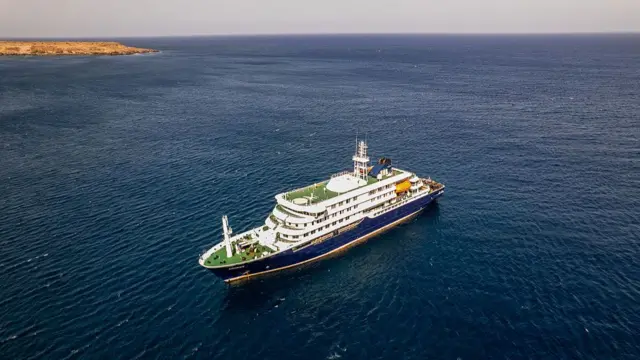
    Cruise ship MV Hondius sailing outside a portImage source, AFP via Getty Images

    Earlier, the World Health Organization (WHO) said that one hantavirus case had been confirmed in a laboratory, with five more suspected cases under investigation.

    A spokesperson from the South African Department of Health now says the confirmed case is a 69-year-old British national.

    He says the patient from the UK "became ill while the ship was travelling from St Helena to Ascension Island and was transferred from a hospital in Ascension to a South African private health facility in Sandton for medical attention".

    "His laboratory test results came back positive for hantavirus," the spokesperson says.
  2. Deceased passenger 'suddenly became ill' after leaving Argentinapublished at 22:31 BST 3 May

    South Africa's Department of Health spokesman Foster Mohale says the 70-year-old man "suddenly became ill" as the cruise ship sailed from the city of Ushuaia in Argentina to the island of St Helena.

    Mohale adds that the man presented with "fever, headache, abdominal pain, diarrhoea", before dying on arrival in St Helena.

  3. Man who died on cruise 'awaiting repatriation' to the Netherlands - South Africa health officialpublished at 22:21 BST 3 May

    A spokesman for the South African Department of Health tells the BBC the 70-year-old cruise passenger who died is "awaiting repatriation to the Netherlands".

    Foster Mohale says the man's wife collapsed while "trying to connect to a flight to her home country of the Netherlands" and "unfortunately passed away" in hospital in the Kempton Park area.

  4. UK Foreign Office monitoring situation and 'ready to support'published at 22:12 BST 3 May

    The UK Foreign Office tells the BBC it is monitoring reports closely, and is "ready to support British nationals" following the suspected hantavirus outbreak.

    "We are in touch with the cruise company and local authorities," a spokesperson adds.

    As we reported in an earlier post, one British national, aged 69, is in intensive care in Johannesburg, South Africa.

    The World Health Organisation (WHO) has told the BBC earlier that three people have died following the suspected outbreak. One case has been confirmed, with five more suspected cases under investigation, it says.

  5. What is hantavirus?published at 21:54 BST 3 May

    Hantavirus infections are typically linked to environmental exposure, the World Health Organization (WHO) says.

    This includes "exposure to infected rodents’ urine or faeces".

    In rare cases, WHO says the virus can also spread between people, and can lead to "severe respiratory illness".

    It requires "careful patient monitoring, support and response", WHO says.

  6. 'Further laboratory testing ongoing,' says WHOpublished at 21:39 BST 3 May

    The World Health Organization (WHO) tells the BBC that "detailed investigations" into the suspected hantavirus cases are "ongoing, including further laboratory testing".

    "Medical care and support are being provided to passengers and crew. Sequencing of the virus is also ongoing," it adds.

    "WHO is facilitating coordination between Member States and the Ship’s operators for medical evacuation of two symptomatic passengers, as well as full public health risk assessment and support to the remaining passengers on board."

  7. 70-year-old passenger first to show symptoms, South African authorities tell BBCpublished at 21:31 BST 3 May

    View of the cruise ship MV Hondius stationary off the port of Praia, the capital of Cape Verde, on 3 May 2026Image source, Getty Images
    Image caption,

    The MV Hondius was sailing from Argentina to Cape Verde

    South African authorities have told the BBC that the first person to show virus symptoms was a 70-year-old passenger who died on board the MV Hondius cruise ship.

    His body is now on the island of Saint Helena, a British territory in the South Atlantic.

    His 69-year-old wife also became ill on board and was evacuated to South Africa, where she died in a Johannesburg hospital.

    The husband and wife were a Dutch couple, AFP news agency reports citing a source close to the case.

    Speaking anonymously, the source tells AFP the third fatality was still on board the ship, and discussions were under way to decide whether two other sick passengers should be placed in isolation in hospital in Cape Verde.

  8. Three dead after suspected hantavirus outbreak on a cruise shippublished at 21:25 BST 3 May

    Three people have died after a suspected hantavirus outbreak on a cruise ship sailing in the Atlantic Ocean, the World Health Organization (WHO) has told the BBC.

    One case has been confirmed, with five more suspected cases under investigation, it says.

    One British national aged 69 is in intensive care in Johannesburg, South Africa.

    The outbreak was reported aboard the MV Hondius cruise ship, which was travelling from Argentina to Cape Verde.

    Hantavirus infections are usually linked to environmental exposure, such as contact with urine or faeces from infected rodents, but in rare cases can spread between people, leading to severe respiratory illness.

    We’ll bring you more on this story.