Summary

  1. Who is making decisions in Iran?published at 16:19 BST 25 April

    Amir Azimi
    BBC Persian editor
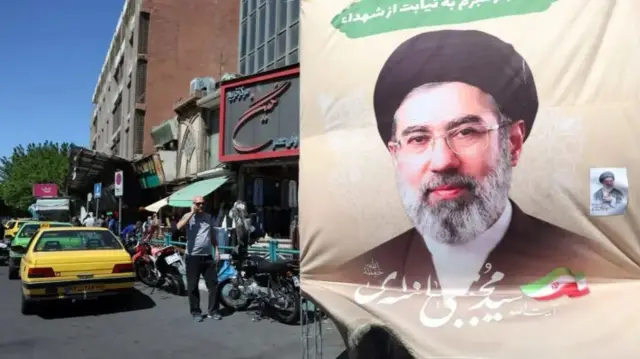
    An image of Mojtaba Khamenei in the middle of a road where yellow and green taxis and motorcycles are parked, with a man wearing sunglasses, black trousers and a grey T-shirt holding a phone to his right ear.Image source, EPA
    Image caption,

    Mojtaba Khamenei has not been seen in public since succeeding his father as supreme leader

    Iran's Foreign Minister Abbas Araghchi was heading up talks with Pakistan earlier, but who is actually making decisions in the country? BBC Persian's Amir Azimi has more.

    Formally, the answer is clear. Mojtaba Khamenei has assumed the role of supreme leader following the killing of his father, Ali Khamenei, on the first day of the war on 28 February.

    But in practice, the picture is far murkier. Mojtaba Khamenei has not been seen in public since taking power. That absence matters. In Iran's political system, authority is not just institutional - it is also performative.

    On paper, diplomacy sits with the government. Foreign Minister Abbas Araghchi continues to represent Tehran in talks with the US, under Iranian President Masoud Pezeshkian.

    Araghchi's role looks operational rather than directive. His brief reversal over whether the Strait of Hormuz was open or closed offered a rare glimpse of how little control the diplomatic track has over military decisions. Pezeshkian, meanwhile, has aligned with the broader direction of the regime without visibly shaping it.

    But neither appears to be setting strategy and their authority is further put into question by the fact that Iran's delegation is headed by Parliament Speaker Mohammad-Bagher Ghalibaf.

    A former Revolutionary Guard commander, Ghalibaf's position is precarious - active but not clearly authorised. He insists his actions align with Mojtaba Khamenei's wishes, yet there is little visible evidence of direct co-ordination.

    In a system that depends on signals from the top, that ambiguity is telling.
  2. Pakistan and Iran had 'cordial exchange of views', Pakistan's PM sayspublished at 15:54 BST 25 April

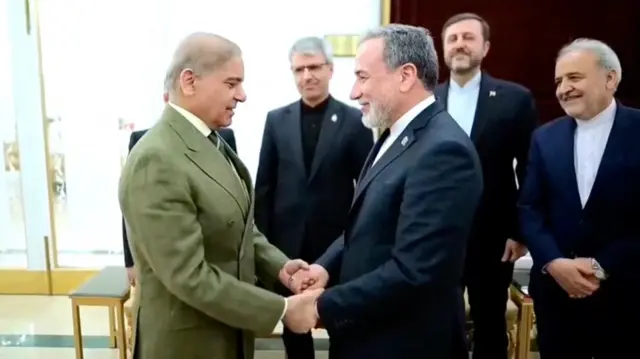
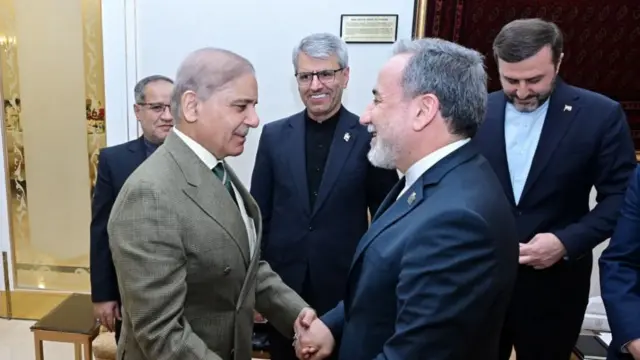
    Pakistani PM Shehbaz Sharif meets Iranian FM Abbas Araghchi in IslamabadImage source, Shehbaz Sharif / X

    Pakistani PM Shehbaz Sharif has just shared an update on X following talks with Iran's Foreign Minister, Abbas Araghchi.

    "Had a most warm, cordial exchange of views on the current regional situation. We also discussed matters of mutual interest, including the further strengthening of Pakistan-Iran bilateral relations," he writes.

    It follows earlier comments from Pakistan's deputy prime minister, Ishaq Dar, who said the meeting between Sharif and Araghchi "lasted around two hours approx".

    "The Prime Minister emphasized on the importance of dialogue and diplomacy for the peace and stability in the region and beyond," he writes.

  3. Iranian foreign minister leaves Islamabad after talks - state mediapublished at 15:49 BST 25 April
    Breaking

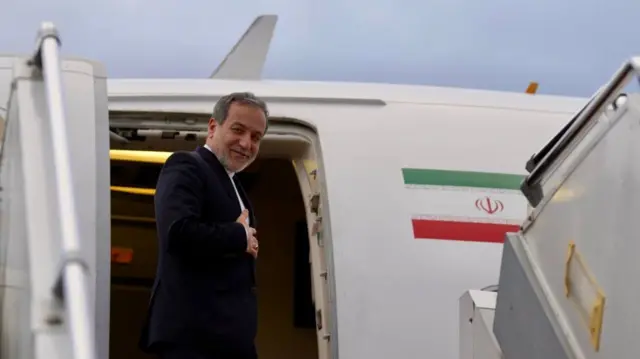
    Abbas Araghchi standing at top of plane steps, holding his right hand to his chest while smilingImage source, IRNA

    Iranian Foreign Minister Abbas Araghchi has now left Islamabad, according to Iran's state-run IRNA.

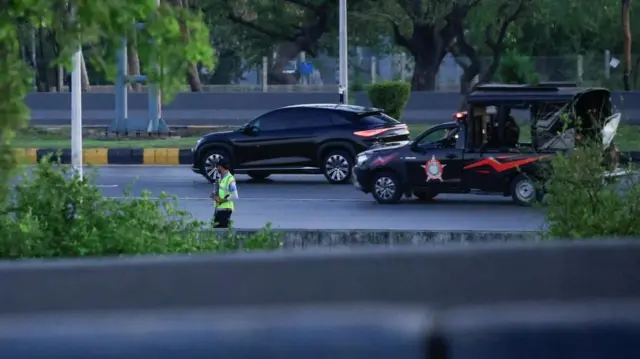
    A short while ago the news agency Reuters news agency shared photographs of a motorcade, which it said was believed to be Araghchi's, leaving the Pakistani capital.

    A black car flanked by another police vehicle drives down a roadImage source, Reuters
  4. Iranian MP warns regional countries of 'destruction of infrastructure' if US attacks againpublished at 15:46 BST 25 April

    Iranian MP Mahmoud Nabavian has threatened regional countries with destructive action if the US attacks again.

    "Regional movements indicate the new folly of the evil American regime," he writes on X.

    "The leaders of the regional countries should know that this time, Iran's crushing response will lead to the complete cessation of regional oil production, the destruction of all infrastructure, and the displacement and refugee status of their people," he adds.

    Nabavian is a hardline MP who was part of Iran's delegation at the first round of talks in Islamabad.

    US President Donald Trump has extended a ceasefire with Iran for an unspecified period. However, US Defence Secretary Pete Hegseth said yesterday that the US was "locked and loaded" on Iranian infrastructure.

    Iran has attacked what Foreign Minister Abbas Araghchi described as the "presence of the US" in Gulf countries since the war began.

  5. Analysis

    US and Iran dig in as trust remains lowpublished at 15:24 BST 25 April

    Carrie Davies
    Pakistan correspondent

    Iranian Foreign Minister Abbas Araghchi meets Pakistani Prime Minister Shehbaz SharifImage source, Reuters
    Image caption,

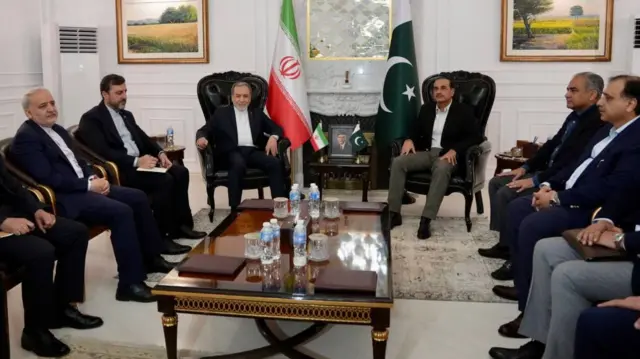
    Iranian Foreign Minister Abbas Araghchi meets Pakistani Prime Minister Shehbaz Sharif in Islamabad

    We now know that Iran's foreign minister has met Pakistan's prime minister and the head of the army.

    Iran has described it as bilateral talks. But the expectation is that this is about the war, with Pakistan acting as a mediator between Iran and the US. Will there be any form of movement? We don't yet know.

    If the US delegation were to leave Washington in the next few hours, they wouldn't arrive in Islamabad until Sunday. Iran is planning to go to Oman and Russia next. Will they wait?

    The US has said Iran wants face-to-face talks but Iran has said there are no plans for a direct meeting. There is very little trust or agreement - at the moment they can't even get on the same page about that.

    Both sides seem to be digging in. There is no public indication that the US is willing to shift its position on the blockade of Iranian ports, or that Iran is willing to change its position on nuclear weapons.

    Meanwhile, Pakistan - acting as a bridge between the two - is in an ever-stretching role to find common ground.

  6. Four killed in Israeli strikes in southern Lebanonpublished at 15:05 BST 25 April

    Lebanon's state-run National News Agency says four people were killed on Saturday in Israeli strikes on southern Lebanon.

    Citing Lebanon's health ministry, it reports that two Israeli strikes - one on a lorry and another on a motorbike - in the Nabatieh district killed four people.

    When approached for comment by the BBC, the Israel Defense Forces (IDF) says "a short while ago" it has killed four people it described as members of Hezbollah.

    The military says it targeted Hezbollah members "who were driving in a vehicle loaded with weapons", as well as a fourth person "riding a motorcycle in southern Lebanon, south of the Forward Defense Line".

    "The terrorists that were eliminated posed a threat to the IDF soldiers operating in southern Lebanon," it says. "The IDF continues to operate in order to remove threats to Israeli civilians and IDF soldiers."

  7. IDF accuses Hezbollah of new strikes on Israeli territorypublished at 14:46 BST 25 April

    The Israel Defense Forces (IDF) says two projectiles were launched from Lebanon towards Israeli territory, with sirens sounding in Upper Galilee.

    "This is a blatant violation of the ceasefire agreement by the terrorist organization Hezbollah," IDF says.

    It adds that one projectile was intercepted and the other fell in an open area. No injuries have been reported.

    Both Israel and Hezbollah have accused each other of violating the ceasefire deal, which was recently extended by three weeks.

    Hezbollah has yet to comment on the attack.

  8. Iran's president calls on Iranians to 'control consumption' as US blockade continuespublished at 14:24 BST 25 April

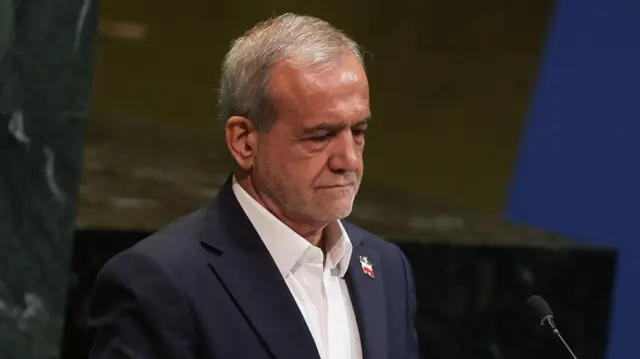
    Iran's President Masoud Pezeshkian pictured in 2025Image source, Reuters

    Iran's President Masoud Pezeshkian has called on people to "control consumption" of electricity as the US blockade of Iranian ports continues.

    "The enemies are destroying our infrastructure and placing us under siege so that people become dissatisfied and the current satisfaction turns into dissatisfaction," he says.

    He adds: "Instead of 10 lights, two lights should be turned on at home; what is wrong with that?"

    The CEO of Iranian power company Tavanir has also urged Iranians to watch their usage and report any unauthorised consumption, according to a video shared on Telegram by Iran's state broadcaster.

  9. Iranian army threatens response if US sea blockade continuespublished at 14:01 BST 25 April

    Iran's armed forces have threatened to respond if the US continues its blockade of the Strait of Hormuz.

    It comes from a statement issued by the army's command centre, and shared by multiple state media outlets, including the Tasnim news agency - which is affiliated with the Islamic Revolutionary Guard Corps (IRGC).

    It says that if the US continues the "siege, banditry, and piracy at sea" in the region, it will "face a response" from the Iranian armed forces.

    As a reminder, the US has intercepted multiple ships after imposing a blockade on maritime traffic entering and leaving Iranian ports on 13 April.

  10. US says 'not anxious' for a deal to end war in Iranpublished at 13:38 BST 25 April

    Pete Hegseth pictured close up, in the foreground is the blurred side profile of Dan CaineImage source, Reuters
    Image caption,

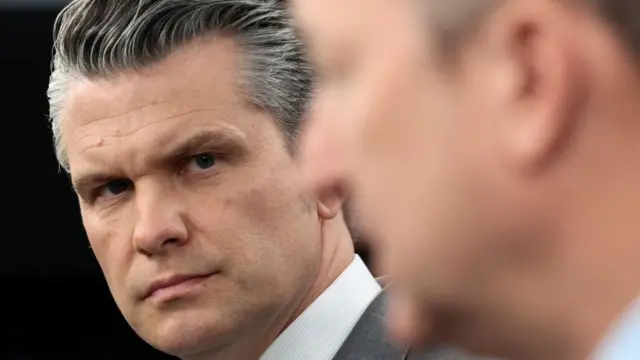
    US Secretary of Defense Pete Hegseth held a press conference with the top US military official Dan Caine on Friday

    Over the past week, the US repeatedly downplayed suggestions that it feels pressure to wrap up the war quickly.

    On Friday, Donald Trump told the Reuters news agency in a phone call that Iran was "making an offer and we'll have to see", but he didn't yet know what the offer was. This followed earlier comments reported by Fox News that Trump felt "no time pressure" to end the war, and would wait for a "good deal".

    His position has been echoed by US Defence Secretary Pete Hegseth, who said Friday that “we have all the time in the world and we’re not anxious for a deal", while US military head Dan Caine said the military was "postured and prepared" to recommence action in Iran if the ceasefire ends.

    Meanwhile Israel Katz, the Israeli Defence Minister, has said the country is "waiting for the green light from the US" to "complete the elimination of the Khamenei dynasty" (Iran's Supreme Leader, Ayatollah Ali Khamenei, was killed by US-Israeli strikes on the first day of the war).

  11. Araghchi 'explained Iran's position' on ceasefire to Pakistan PMpublished at 13:11 BST 25 April

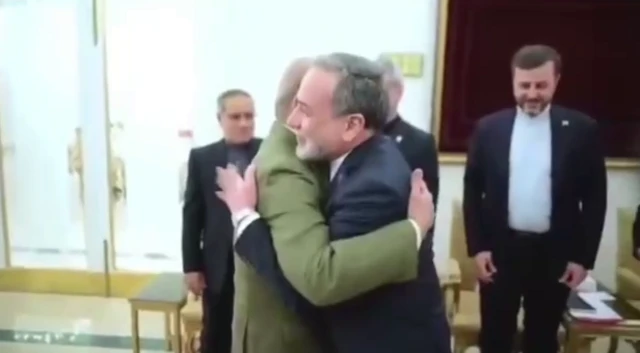
    Iranian Foreign Minister Abbas Araghchi hugs Pakistani Prime Minister Shehbaz Sharif in IslamabadImage source, Iranian Foreign Ministry

    More from Iran's Foreign Minister Abbas Araghchi.

    After his earlier statement about meeting the head of the Pakistani army, Araghchi has released another update, saying he has met Pakistani Prime Minister Shehbaz Sharif.

    The foreign minister says he "explained our country's [Iran's] principled position" on the "latest developments related to the ceasefire" and on the "complete end" of the war.

    The statement also says Sharif has "expressed confidence" that the negotiating process would continue.

  12. Iran shared 'views and considerations' with Pakistan on ending war - foreign ministerpublished at 13:02 BST 25 April
    Breaking

    Several men sit at chairs around a table with the Iranian and Pakistani flags in the backgroundImage source, EPA

    Iran's Foreign Minister Abbas Araghchi has released a statement following his meeting with Pakistan's head of armed forces, Asim Munir.

    The statement says they discussed "the latest developments related to the ceasefire" between Iran and the US.

    It also says Araghchi shared Iran's "views and considerations" on ending the war.

    The statement adds that Asim Munir said Pakistan is ready to continue its mediation efforts.

  13. Analysis

    Islamabad remains hopeful US and Iran will meetpublished at 12:44 BST 25 April

    Jiyar Gol
    BBC Persian, reporting from Islamabad

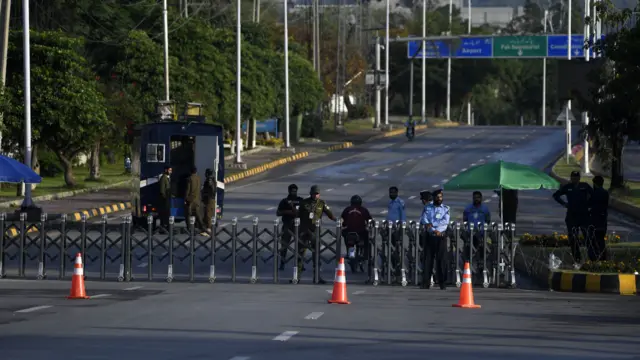
    Pakistani security officials stand guard at a checkpoint amid a high-level security lockdown ahead of anticipated talks in IslamabadImage source, EPA

    Security forces are still present in Islamabad - it seems Pakistan is still hopeful that the US and Iran will meet.

    Iranian Foreign Minister Abbas Araghchi appears to have come with a comprehensive proposal to pass to Pakistan. There are reports that Pakistan's head of armed forces, Asim Munir, will pass this to the US.

    There's no confirmation yet on whether US envoys Steve Witkoff and Jared Kushner have left Washington.

    I'm hearing from Iranian officials - one after another - that meeting the US is not part of Araghchi's mission. But the reality is that Iran is here precisely to put forward a new proposal.

    The details of that remain unclear. What I'm hearing from Tehran is that many hardline clerics say the nuclear issue is not on the table - a sticking point in the last round of talks.

  14. Pakistan 'facilitating Iran-US talks' - foreign ministrypublished at 12:13 BST 25 April

    Dar sits at a table between two peopleImage source, Pakistan Ministry of Foreign Affairs/X

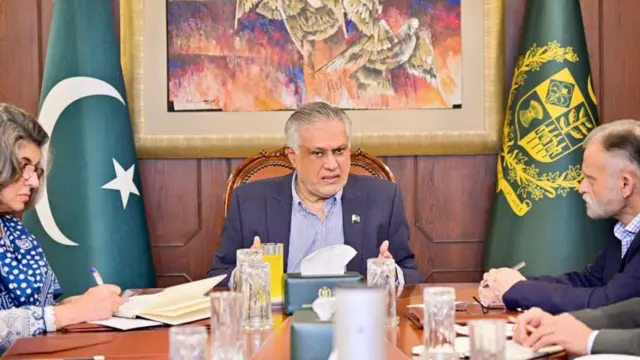
    A social media update from Pakistan's foreign ministry says Deputy Prime Minister Ishaq Dar - who is also foreign minister - held a meeting today "to review the latest developments in the region".

    During the meeting, Dar "reiterated that Pakistan is facilitating Iran-US talks for achieving peace and stability in the region and beyond".

    The foreign ministry also warned against updates on the mediation process being provided by unofficial or unnamed sources, urging media outlets to "focus on official statements only".

  15. Analysis

    Trump administration entering Iran talks with cautionpublished at 12:07 BST 25 April

    Gary O'Donoghue
    Chief North America correspondent

    The Trump administration is clearly approaching this round of talks with caution - not sending Vice-President JD Vance as they did two weeks ago and stressing, as the press secretary put it, to "hear the Iranians out".

    It follows the president's decision earlier this week to extend the ceasefire indefinitely, at the request of Pakistan, so that Tehran could come up with what was described as a unified proposal.

    Since then the stand-off over the Strait of Hormuz has worsened, with both sides regarding the other's actions as a breach.

    But the strait is not the only point of contention - Washington and Tehran are still at loggerheads over Iran's nuclear capabilities and its support for proxies in the region.

    The White House says Vance will be on standby to travel to Islamabad if there is progress - but there is no detail at this stage of what Iran may be prepared to offer.

  16. Who are Jared Kushner and Steve Witkoff, the Trump allies set to go to Pakistan?published at 11:52 BST 25 April

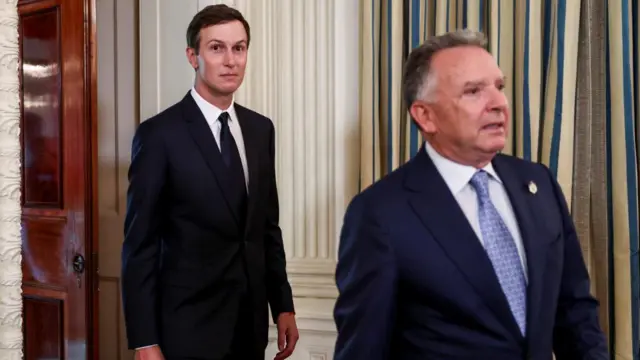
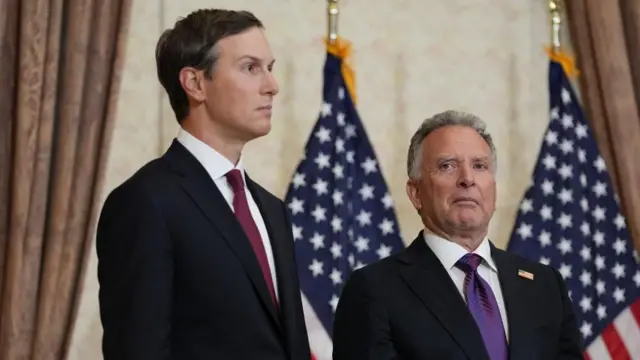
    Jared Kushner and White House Special Envoy Steve Witkoff arrive to attend a joint press conference held by U.S. President Donald Trump and Israeli Prime Minister Benjamin Netanyahu, in the State Dining Room at the White House, in Washington, D.C., U.S., September 29, 2025.Image source, Reuters
    Image caption,

    Jared Kushner (left) and Steve Witkoff (right) at a news conference with US President Donald Trump and Israeli Prime Minister Benjamin Netanyahu in Washington DC on 29 September 2025

    As we've been reporting, the White House says Steve Witkoff and Jared Kushner will be heading to Pakistan today for further discussions on the conflict with Iran.

    So who are they and why are they involved?

    Jared Kushner is US President Donald Trump's son-in-law, married to his daughter Ivanka Trump.

    He was a senior adviser to the president during Trump's first term, and although he no longer has that title, he's been involved in key international issues, including negotiations between Israel and Hamas last year.

    Steve Witkoff is a real estate developer and friend of Trump who was appointed as Special Envoy to the Middle East at the start of Trump's second term.

    He's been the administration's go-to international negotiator, playing a key role in talks concerning both the Israel-Hamas and Russia-Ukraine conflicts.

  17. Smoke rises over Lebanese village near Israel borderpublished at 11:37 BST 25 April

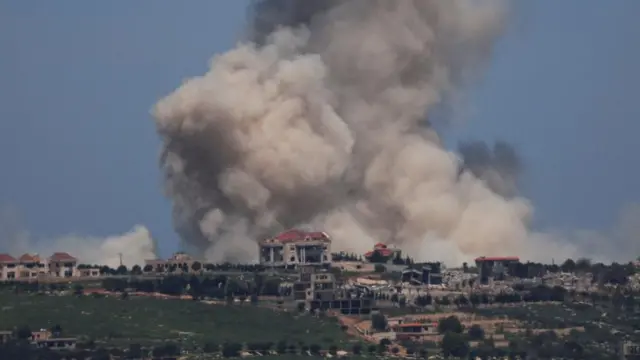
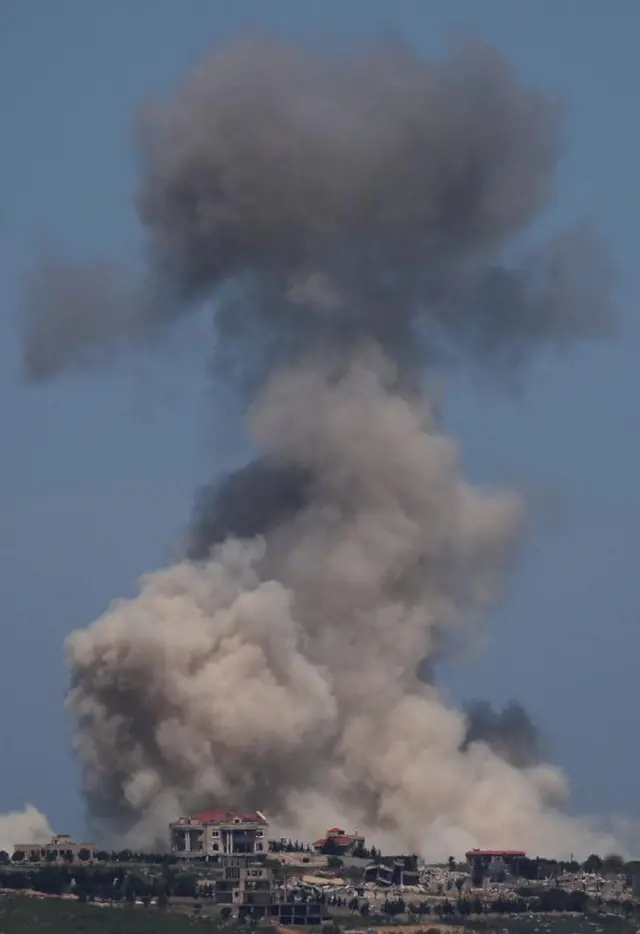
    These are the latest images from Lebanon, where thick smoke has been seen rising in the south of the country - near the border with Israel - after an explosion.

    Earlier, the Israeli military said it struck loaded Hezbollah rocket launchers overnight in three areas of southern Lebanon. Meanwhile, Hezbollah said in a statement this morning that it has targeted the Israeli army.

    Thick grey smoke rises in the sky over a green plain with several houses visibleImage source, Reuters
    Thick grey smoke rises in the sky over a green plain with several houses visibleImage source, Reuters
  18. Still unclear if or how US and Iran will hold talks - here's the latestpublished at 11:25 BST 25 April

    Nabiha Ahmed
    Live reporter

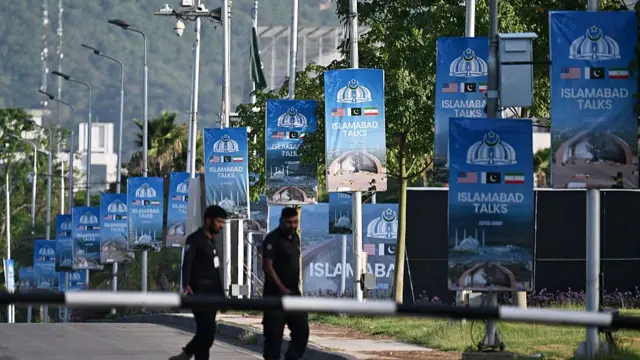
    Two men walk on the road, past posters reading 'Islamabad talks'Image source, AFP

    It's not clear how - if at all - talks will take place between the United States and Iran today.

    The US says its delegation will head to Islamabad on Saturday. Iran's foreign minister is already there, but Tehran says the visit is part of a three-stop regional tour.

    Here's the latest:

    In Pakistan:

    • Tehran says there are no plans for direct negotiations between the US and Iran
    • The US said on Friday that envoys Steve Witkoff and Jared Kushner would head to Islamabad for talks, with Vice-President JD Vance on standby
    • Iranian Foreign Minister Abbas Araghchi has met Pakistan's head of armed forces Asim Munir, and says he'll head to Oman and Russia next to "consult on regional developments"

    In Lebanon and Israel:

    • The Israel Defense Forces (IDF) and Hezbollah have accused each other of ceasefire breaches, with both exchanging strikes despite a three-week ceasefire extension
    • Residents in southern Lebanon have been reminded by the IDF not to "move south of" a marked line of villages

    In Iran:

    • Tehran's Imam Khomeini airport has resumed some international flights, almost two months after passenger flights were suspended
    • Iran says it has executed a man who took part in national protests in January, after accusing him of working for Israeli intelligence
  19. Analysis

    Iran remains deeply sceptical about talks with USpublished at 11:07 BST 25 April

    Jiyar Gol
    BBC Persian, reporting from Islamabad

    (From left to right): Jared Kushner, US President Donald Trump's son-in-law, and US special envoy Steve Witkoff. Photo: 12 April 2026Image source, Reuters
    Image caption,

    Jared Kushner (left) and Steve Witkoff (right) are flying to Pakistan on Saturday

    In June 2025, while US envoys Steve Witkoff and Jared Kushner were in talks with an Iranian delegation led by Iran's Foreign Minister Abbas Araghchi, the US carried out military strikes on Iran.

    During the 12-day war, the US and Israel targeted Iranian nuclear facilities, using B-2 bombers with bunker-buster munitions. Since then, they have said Iran has been trying to rebuild its nuclear programme and develop missiles capable of delivering nuclear weapons.

    In February this year, Witkoff and Kushner met Araghchi in Muscat. During these diplomatic efforts, the US and Israel started the war with Iran, as Trump said he was "not happy" with the way the talks were going.

    Now, the same US envoys are heading to Pakistan for talks.

    Iranian officials remain deeply sceptical and say they do not trust the US, emphasising military readiness.

    Some hardliners say Iran’s nuclear programme is not open for discussion, despite President Trump citing nuclear enrichment as one of the main reasons for attacking Iran.

    Stalled talks appear to be moving now, but the direction is not clear.

  20. Internet blackout in Iran enters 57th daypublished at 10:42 BST 25 April

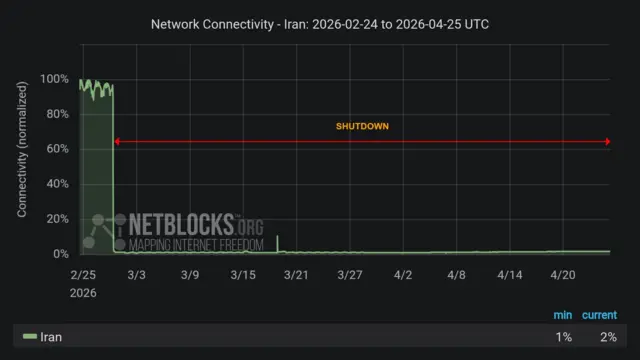
    Chart shows internet connectivity dropping to virtually zero at the start of the Iran conflict and remaining at this level for eight weeksImage source, NetBlocks/X

    Eight weeks have passed since the start of the state-imposed internet blackout in Iran.

    "The disruption, now entering its 57th day after 1,344 hours, stifles the voices of Iranians, leaves friends and family out of touch and damages the economy," says connectivity monitoring site NetBlocks.

    The BBC's Persian service has still managed to contact some people inside Iran, who have been using satellite devices like Starlink to get around the blackout.

    But it can come with a high price - in Iran, using or possessing Starlink can lead to up to two years in prison, and authorities are trying to crack down on it.