Summary

  1. Key developments, so far, from 12th day of conflictpublished at 18:16 GMT 11 March

    Charlotte Hadfield
    Live reporter
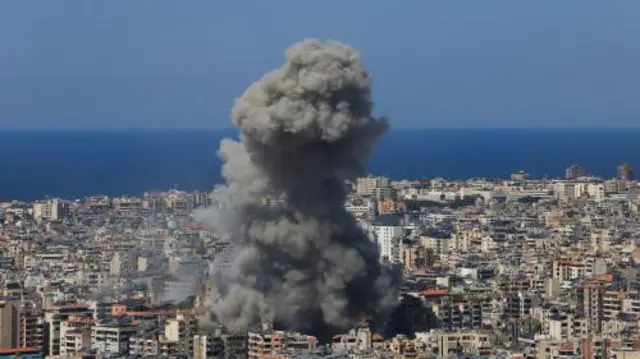
    Smoke rises after an Israeli strike on Beirut's southern suburbs in Lebanon todayImage source, Reuters
    Image caption,

    Smoke rises after an Israeli strike on Beirut's southern suburbs in Lebanon today

    Military warnings

    Israel has launched more attacks against both Iran and Lebanon after confirming that it struck targets in the Dahieh suburb Beirut earlier on Wednesday.

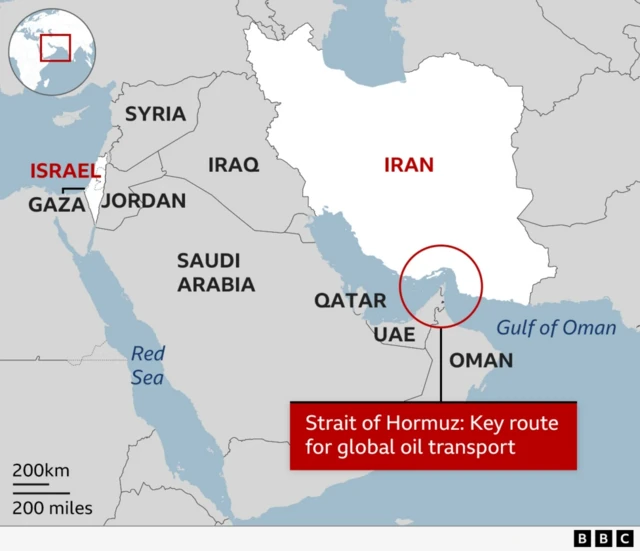
    US Central Command has warned civilians in Iran to "immediately avoid" all ports along the Strait of Hormuz where Iranian naval forces are operating.

    On the ground across the Middle East

    On the Iran-Turkey border, one man tells the BBC he'd stayed to work in Iran but had lost his job when his company was bombed.

    He said his message to US President Donald Trump would be: "Please finish it, keep bombing and kill the regime, but not people".

    Meanwhile in Doha, 12-year-old Yacine spoke of her fear as "there were bombs exploding on top of our building".

    The Strait of Hormuz

    The International Energy Agency (IEA) will approve their largest ever release of oil reserves - 400m barrels - to offset the supply lost through the "effective closure" of the Strait of Hormuz.

    The move comes after three commercial ships were damaged by "unknown projectiles".

    It's a significant intervention, but releasing a third of the stocks its governments hold is not something that the IAE can repeat frequently, writes the BBC's Jonathan Josephs.

  2. UAE air defences responding to incoming missile and drone threats from Iran - MODpublished at 18:11 GMT 11 March
    Breaking

    Air defences in the United Arab Emirates are currently responding to incoming missile and drone threats from Iran, according to the UAE Ministry of Defence.

    In a statement on X, the ministry says that the sounds which can be heard in the emirates are a result of the air defence systems intercepting missiles and drones.

  3. UN security council to vote on Gulf countries' demand to end all attacks by Iranpublished at 18:01 GMT 11 March

    Nada Tawfik
    Reporting from the United Nations in New York

    When the UN Security Council meets this afternoon, it will be voting on two competing draft resolutions.

    The first, put forward by Gulf countries - condemns attacks on them and Jordan by Iran.

    The draft, which now has more than 90 sponsors, demands an immediate cessation of all attacks and threats by Iran, including through proxies.

    It also condemns any actions by Tehran that would close or interfere with international navigation through the crucial Strait of Hormuz.

    In response, Russia introduced its own measure, which it said took a “non-confrontational” approach.

    Moscow’s text urges all parties, without naming Iran, Israel or the US to stop fighting and return to negotiations.

    It also condemns attacks on all civilians. Iran’s U.N. Ambassador Amir Saeid Iravani criticised the gulf countries measure, accusing them of trying to reverse the roles of aggressor and victim through a biased and politically motivated text.

    He warned that if adopted, it would be “a stain” on the Security Council’s credibility and would embolden Israel and the US to carry out further attacks.

  4. Macron says Strait of Hormuz blockage is not justification for lifting Russian oil sanctionspublished at 17:50 GMT 11 March

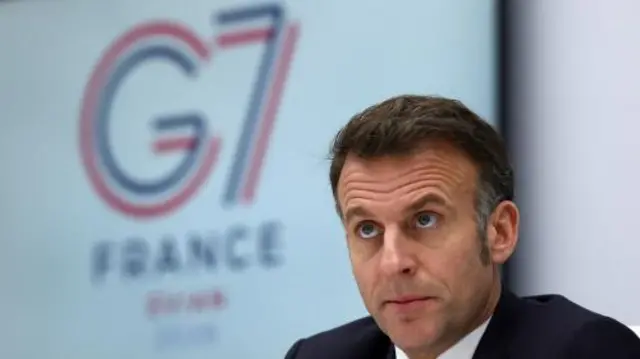
    French President Emmanuel Macron chairs a video conference of G7 leaders to discuss the fallout of the war in Iran on the world economy, amid the U.S.-Israeli conflict with Iran, at the Elysee Palace in ParisImage source, EPA/Shutterstock

    Speaking after a video conference with G7 leaders, French President Emmanuel Macron says that the Strait of Hormuz blockage "does not justify" lifting the sanctions against Russia.

    Macron added that the situation in Iran should not "diminish our focus on Ukraine, our support for Ukraine, or the clarity we have regarding sanctions against Russia".

    The US sanctioned Russian oil following Moscow's invasion of Ukraine, forcing buyers to seek alternatives.

    These sanctions were temporarily eased by the US government to allow India to buy Russian oil currently stranded at sea, amid escalating tensions in the Middle East.

    Treasury Secretary Scott Bessent previously said the 30-day waiver,, external was a "deliberate short-term measure" to allow oil to keep flowing in the global market.

    Macron told leaders during today's G7 conference it's "important we coordinate in order to make sure that freedom of navigation is clearly restored" in the Strait of Hormuz "as soon as possible".

  5. Trump says 'we're not finished yet' in Iranpublished at 17:32 GMT 11 March

    Trump with White House Press Secretary Karoline Leavitt speaking to the mediaImage source, EPA/Shutterstock

    Speaking to reporters outside the White House, US President Donald Trump is asked what it will take for the war in Iran to end.

    "More of the same," he answers. "And we'll see how that all comes out."

    "They've lost their navy. They've lost their air force. They have no anti-aircraft apparatus at all. They have no radar. Their leaders are gone. And we could do a lot worse."

    He says that the US has hit Iran "harder than virtually any country in history has been hit", but, he adds, "we're not finished yet".

  6. Fuel tanks in Oman's port of Salalah hit by dronespublished at 17:18 GMT 11 March

    Several fuel storage tanks in Oman's port of Salalah have been struck by drones, according to state media.

    British ⁠maritime ​security firm ​Ambrey says there is no damage to merchant vessels, Reuters news agency reports.

    In addition to the strikes on the port, Oman News Agency says "multiple unmanned aerial vehicles" were intercepted and brought down. It describes the attacks as "malicious" but says no casualties have been reported.

    It also reports that the Sultan of Oman has spoken by phone to Iran's President Masoud Pezeshkian to reaffirm Oman's "position of neutrality" and expressed "unequivocal condemnation" of the targeting of its territories.

  7. BBC Verify

    Analysing Iranian mine-laying and US anti-mine capabilitiespublished at 16:50 GMT 11 March

    By Thomas Spencer

    Following the US military’s statement that it "eliminated" 16 mine-laying ships, BBC Verify has looked into the thousands of sea mines Iran is reported to have stockpiled which it could deploy to damage commercial ships and effectively close the Strait of Hormuz - and how the US may respond.

    Amongst its inventory the Iranian military has the Sadaf-02 sea mine, designed to sit just below the waterline and detonate about 114kg (250lbs) of explosives after contact with a passing ship.

    Iran also uses the more advanced Maham-2, which sits deeper and detonates up to 350kg (770lb) of explosives when it detects a moving ship above through magnetic or sound sensors.

    The US has Independence-class littoral combat ship (LCS) like the USS Canberra in the Middle East to help combat the threat.

    These mine sweepers use a towed sonar and can deploy Knifefish Unmanned Undersea Vehicles, a drone submersible, to hunt for mines.

    An LCS can also work in tandem with helicopters equipped to hunt for mines like the MH-60S Sea Hawk, which can launch from aircraft carriers or other warships equipped with helicopter pads.

    Map showing countries located around the Strait of Hormuz
  8. Analysis

    If Iran did withdraw from the World Cup, who might replace them?published at 16:36 GMT 11 March

    Dan Roan
    Sports editor

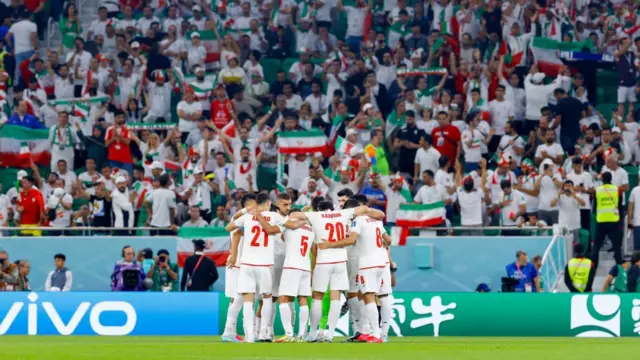
    Iran, seen here in the 2022 World Cup, have played in the past three tournamentsImage source, Getty Images
    Image caption,

    Iran, seen here in the 2022 World Cup, have played in the past three tournaments

    For the World Cup’s main host nation to be bombing the country of one of its qualified teams three months before the tournament starts is an unprecedented situation.

    US President Donald Trump has said Iran would still be welcome to play in the US, according to Fifa. But if Iran does withdraw from what would be its fourth consecutive World Cup, Fifa’s rules are vague.

    The regulations give them discretion to choose a replacement, but it is unclear who that would be.

    The most likely is thought to be a fellow team from the Asian Football Confederation - Iraq, which could secure qualification anyway through a playoff match this month - or the UAE, which missed out on the play-offs.

    What is clear is that this adds to the uncertainty surrounding a tournament that already faces scrutiny over security, funding and ticket prices.

  9. Strike that killed six US troops in Kuwait more severe than previously revealed, CBS reportspublished at 16:22 GMT 11 March

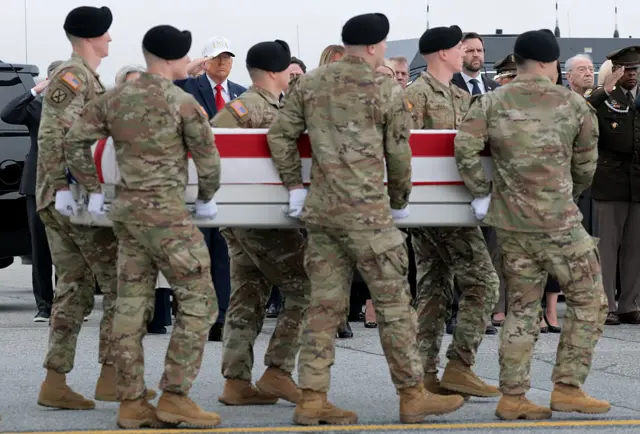
    Donald Trump (wearing a white USA hat), and Vice President JD Vance salute as a U.S. Army carry team moves a flag-draped transfer case during a dignified transfer at Dover Air Force Base on March 07, 2026 in Dover, Delaware.Image source, Getty Images
    Image caption,

    President Trump salutes as flag-drapped coffin of US soldiers killed in Kuwait are brought home

    A drone attack that killed six US service members in Kuwait was more severe than has previously been revealed, multiple sources tell the BBC's US partner, CBS News.

    More than 30 military members were still in hospital on Tuesday night with injuries from the strike on 1 March, sources tell CBS, with dozens suffering brain injuries, shrapnel trauma and burns.

    When asked about the report, the Pentagon told the BBC that about 140 service members have been injured and eight severely injured since the start of the conflict in Iran. The statement did not give specific details on the injuries or what caused them.

    "The vast majority of these injuries have been minor, and 108 service members have already returned to duty. Eight service members remain listed as severely injured and are receiving the highest level of medical care," a spokesperson says.

  10. Trump tells Axios war will end 'soon'published at 16:09 GMT 11 March

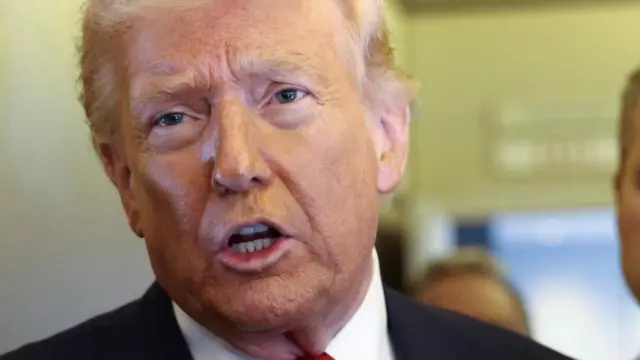
    A close-cropped photo of Donald Trump speaking.Image source, Reuters

    US President Donald Trump has told news outlet Axios the war will end "soon" and there is "practically nothing left to target".

    "Any time I want it to end, it will end," the outlet reported Trump as saying.

    The conflict was launched on 28 February in tandem with Israel, whose Defence Minister Israel Katz said on Wednesday that the war "will continue without any time limit".

    Katz said the conflict would continue for as long as necessary, and until all objectives of the joint Israeli-US campaign were achieved, according to Reuters and The Times of Israel.

  11. Bombs were exploding on top of our building, 12-year-old sayspublished at 15:52 GMT 11 March

    Barbara Plett Usher
    Reporting from Doha

    The Qataris have intercepted three Iranian missile attacks today.

    I was on the street when we got the alert for one of them and looked up to see smoke from the explosions.

    The city is much busier now than it’s been since the war started – more traffic, and more people coming out to the shops.

    The past week has been “surreal” one woman told me, a Canadian whose husband works in the oil industry.

    “You hear the alarm and then you hear the explosion, but at the same time life is normal. So I ask myself: am I dreaming? Is it for real?”

    Twelve-year-old Yacine took out his phone and showed me videos he took of missile interceptions lighting up the night sky at the beginning of the war.

    “There were bombs exploding on top of our building,” he said, “We were really scared. Because (we were afraid) any moment one could hit our building.”

    Bari is a teacher who’s had to move her class online. The early days of attacks were “a disaster, we were so scared,” she says.

    Now her bigger fear is about “the future and the world changing. It's not just missiles,” she says.

    “It's a big issue. You can feel it's something very big coming on the way, something like changing the map of the Middle East.”

  12. US warns civilians to avoid ports where Iranian navy ships are positionedpublished at 15:44 GMT 11 March

    US Central Command (Centcom) is warning civilians in Iran to "immediately avoid" all ports along the Strait of Hormuz where Iranian naval forces are operating.

    Centcom says the Iranian regime is using civilian ports for "military operations that threaten international shipping".

    "This dangerous action risks the lives of innocent people," the warning message says.

    It adds that civilian ports used for military purposes lose protected status and become "legitimate military targets under international law".

    Earlier, Centcom released footage of what it said were 16 Iranian mine-laying ships being destroyed near the Strait of Hormuz.

  13. Trump should 'kill the regime, but not people,' says Iranian whose car was blown up in airstrikepublished at 15:31 GMT 11 March

    Dan Johnson
    Reporting from Iran–Turkey border

    Media caption,

    'Kill the regime but not people': BBC speaks to Iranians crossing into Turkey

    The number of Iranians crossing this border hasn’t significantly increased - it’s been around 1,000 people each day. Many remain fearful of speaking openly about the conflict or the regime.

    Two people described to me official text messages sent to their phones ordering them not to speak to journalists.

    A dual Iranian-Canadian engineer in the oil industry told me he was afraid of being watched and listened to, so even on the Turkish side he was reluctant to be in conversation.

    A young man travelling to reunite with his wife and son in Istanbul said he’d stayed to work but had lost his job when his company was bombed. He saw his car destroyed in an airstrike.

    “Why do I have to leave my country?” he asked. “I cried for the last two days.”

    I asked what his message to US President Donald Trump would be.

    “Please finish it, keep bombing and kill the regime, but not people,” he replied.

  14. Analysis

    Too early to rule Iran out of World Cup - despite sport minister's commentspublished at 15:20 GMT 11 March

    Pooria Jafereh
    BBC Persian

    An Iranian fan at the 2022 World Cup in QatarImage source, Getty Images
    Image caption,

    An Iranian fan at the 2022 World Cup in Qatar

    Despite the Iranian sports minister's comments, it is still too early to rule Iran out of the World Cup.

    The Football Federation Islamic Republic of Iran ultimately has the final say, regardless of what the minister might say.

    At the moment, Fifa remains adamant that Iran will play its scheduled matches against New Zealand, Belgium, and Egypt.

    If Iran were to refuse to travel to the World Cup, it could have serious ramifications. We have been here before: Iran refused to play Kuwait during the qualifiers for the 1982 World Cup. That decision meant they failed to qualify for that tournament and were subsequently banned by Fifa from the 1986 tournament.

    For now, Fifa is likely to wait. The playoff matches at the end of the month will determine the final list of qualified teams, which will make any decision easier to take.

    By then, there may also be a clearer picture of the evolving conflict involving the US, Iran and Israel. At the moment, Donald Trump and Iran’s military leadership are difficult to read.

  15. How fast does the world use 400m barrels of oil?published at 15:05 GMT 11 March

    Jonathan Josephs
    BBC business reporter

    This is a significant intervention from the International Energy Agency, but releasing a third of the stocks its governments hold is not something that it can repeat frequently.

    Those 400m barrels of oil is roughly what the world uses over the course of four days, or what, in normal circumstances flows through the Strait of Hormuz in 20 days.

    It’s a signal of intent from the 32 governments who make up the IEA that they want to limit the shockwaves to the global economy.

    However they remain at the mercy of the markets, and energy traders appeared to shrug off the intervention.

    The IEA described the “oil market challenges” as “unprecedented in scale”, the sort of language that normally means higher prices.

    There was a small fall in oil prices as it was announced, but prices quickly rose again because it remains unclear when the fighting will end and when oil supplies, rather than stocks, will once again flow freely.

  16. Iranian sports minister says Iran won't play in World Cuppublished at 14:56 GMT 11 March
    Breaking

    BBC Persian

    Iran (in white) played the US in the 2022 World CupImage source, Getty Images
    Image caption,

    Iran (in white) played the US in the 2022 World Cup. They are due to play Belgium, New Zealand, and Egypt in the 2026 group stage

    The Iranian Minister of Sports and Youth says the country’s men's national football team is not in a position to participate in the 2026 World Cup.

    In an interview with the IRIB Sports Network on Tuesday, Ahmad Donyamali said: "Given that this corrupt government has assassinated our leader, under no circumstances do we have the appropriate conditions to participate in the World Cup.

    "Our boys are not safe, and conditions for participation do not exist."

    Donyamali added that "over the past eight or nine months, two wars have been imposed on us, and several thousand of our people have been killed and martyred. Therefore, we definitely do not have the possibility for participation."

    The head of Iran’s Football Federation also questioned Iran’s ability to participate in the World Cup yesterday, although with a different line of reasoning.

    Mehdi Taj - speaking after six members of Iran’s women’s national football team received humanitarian visas from Australia after playing there - said: "Given the problems created for the female footballers, if the World Cup outlook is like this, no sound mind would accept sending the team to the US."

  17. Analysis

    How oil producers are trying to avoid the Strait of Hormuz 'choke point'published at 14:38 GMT 11 March

    Sameer Hashmi
    Middle East business correspondent, reporting from Riyadh

    Saudi Arabia is ramping up oil flows through its East-West pipeline network as Gulf producers scramble to keep exports moving.

    The 750 mile (1200km) pipeline carries crude from fields in the Persian Gulf to export terminals on the Red Sea, allowing shipments to bypass the Strait of Hormuz - one of the world’s most important energy choke points.

    Before the current crisis, the East-West Saudi pipeline was transporting about 2.8 million barrels of oil a day. Saudi oil giant Aramco's boss confirmed on Tuesday that they are now pushing flows towards its maximum capacity of about 7 million barrels a day as tankers shift loading operations to the kingdom’s Red Sea ports.

    Saudi Arabia and the UAE are among the few Gulf producers with pipelines designed to partially bypass the Strait of Hormuz. The UAE’s Abu Dhabi Crude Oil Pipeline can transport about 1.8 million barrels a day to the port of Fujairah on the Gulf of Oman.

    But even at full capacity, the pipelines operated by Saudi Arabia and the UAE would move less than half the crude that typically flows through the Strait of Hormuz.

    Other Gulf producers without similar alternatives - including Kuwait and Iraq - have already begun cutting production.

    Amin Nasser described the current disruption as "by far the biggest crisis the region’s oil and gas industry has faced".

    This Flourish post cannot be displayed in your browser. Please enable Javascript or try a different browser.

  18. 'Unprecedented' situation leads to 'largest ever' release of 400m oil barrels - IEApublished at 14:23 GMT 11 March

    Announcing the "largest ever" release of 400m barrels of oil, the International Energy Agency (IEA) said its 32 member countries voted unanimously in favour of the move.

    “The oil market challenges we are facing are unprecedented in scale, therefore I am very glad that IEA Member countries have responded with an emergency collective action of unprecedented size,” says IEA executive director Fatih Birol.

    The IEA says the emergency stocks will be made available to the market over a "timeframe that is appropriate to the national circumstances" of each member country.

    It is the sixth time the IEA has approved a coordinated release of oil stocks, having previously done so in 1991, 2005, 2011, and twice in 2022, it says.

    It adds that its members hold emergency stockpiles of more than 1.2 billion barrels, with a further 600 million barrels of industry stocks held under government obligation.

  19. IEA approves release of 400m barrels of oilpublished at 14:11 GMT 11 March
    Breaking

    The International Energy Agency will approve the release of 400m barrels of oil to offset the supply lost through the "effective closure" of the Strait of Hormuz, its executive director Fatih Birol has announced.

    He says IEA countries voted "unanimously" to launch the "largest ever release of emergency oil stocks in our agency's history".

  20. International Energy Agency to give statement on oil reserves shortlypublished at 14:02 GMT 11 March

    The International Energy Agency is about to deliver a statement on plans surrounding the release of oil reserves in the face of volatility following the Iran conflict.

    We'll be listening and will bring you any key updates. Earlier, our business editor Simon Jack explained what releasing oil reserves can achieve - and why it may not lead to lower oil prices.