Summary

Are you affected?


  1. Avoid drinking tap water, Kumamoto City government tells residentspublished at 21:36 BST

    The Kumamoto City government is asking people to refrain from drinking tap water in the aftermath of the earthquake.

    In an update, Kumamoto waterworks says that turbid - or cloudy - water has been seen in some parts of the city.

    It adds that it is currently inspecting water supply facilities, and advises people not to drink any tap water or use it for cooking until its safety is confirmed.

    The water can still be used in toilets and for cleaning, it adds.

    The authority says in a separate update that it is providing waters bags and other supplies at a number of supply locations around the city.


  2. 'I've experienced earthquakes here before but not to that degree'published at 21:12 BST

    James Kelly
    Journalist, Your Voice

    Matt Gingell poses for a selfie

    Matt Gingell, 26, from Kent, has been living in Kumamoto for nearly two years, teaching English to Japanese children.

    He was in a cafe when the quake struck and instinctively took cover by ducking under a table.

    "I've experienced a few earthquakes here so it's a sensation I have come to be a bit more familiar with, but not to that degree," he tells BBC News.

    Taking a walk through the local shopping centre, he says he's seen cracked buildings and small pieces of debris littering the floor.

    He feels safe in his third floor apartment, but says the "occasional jolts and rumbles of aftershocks" are keeping him "pretty on edge" at the prospect of further tremors.

    BBC Your Voice banner. You Voice is written in white text on a purple backgroundImage source, Your Voice
  3. Japan has a long history of often-devastating earthquakespublished at 20:57 BST

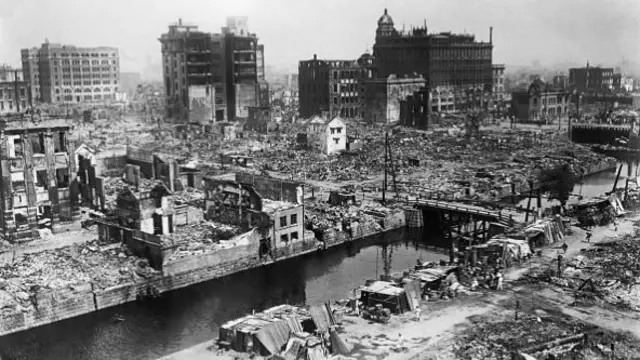
    Flattened buildings and rubble pictured in a black and white photograph of TokyoImage source, Bettman
    Image caption,

    Tokyo's main shopping district pictured after the Kanto earthquake in 1923

    Japan sits at the confluence of four major tectonic plates, making it hugely earthquake prone.

    The country has experienced several major disasters, claiming the lives of thousands of people.

    In 1923, an earthquake in the Tokyo region killed more than 100,000 people.

    Another quake that caused severe devastation was the Kobe earthquake that struck in 1995. It hit the port city of Kobe particularly hard.

    Also known as the Great Hanshin earthquake, the disaster killed more than 6,400 people and left hundreds of thousands homeless.

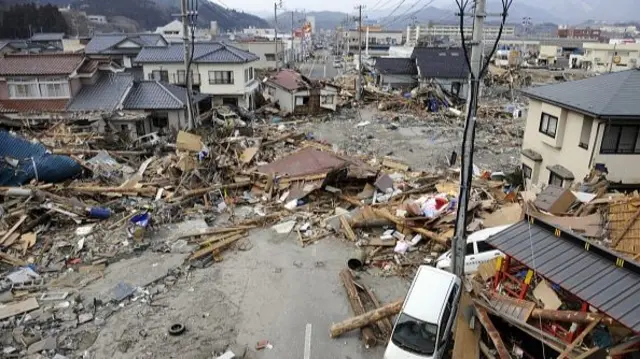
    Debris left by the tsunami litters a street in the town of Ofunato in Iwate prefectureImage source, AFP via Getty Images
    Image caption,

    Debris left by the tsunami in the town of Ofunato in Iwate prefecture, days after the 2011 earthquake

    In 2011, the most powerful earthquake ever recorded in Japan struck off the country's eastern coast.

    The 9.0-magnitude quake triggered a tsunami which swept over Japan's main island of Honshu, killing more than 18,000 people and wiping entire towns off the map.

    A tsunami wave also sparked a major disaster at the Fukushima nuclear power plant, requiring the evacuation of more than 150,000.

    In 2016, multiple earthquakes struck the Kumamoto Prefecture affected today, killing at least 278 people according to Japan's pubic broadcaster NHK.

    We have more on that in our earlier post.

  4. Dozens of medical facilities damaged across Kumamoto, health ministry sayspublished at 20:44 BST

    At least 45 medical facilities in Kumamoto have suffered damage as a result of the earthquake, according to a report by the Japanese health ministry., external

    As of 23:45 local time (14:45 GMT), facilities have suffered power outages, disruption to water supplies, and damage to medical gas supplies.

    A number of towns and cities have been affected across the Kumamoto region, including Uki and Hikawa.

  5. 'It all came crashing down at once': Watch moment Kumamoto Castle walls tumblepublished at 20:13 BST

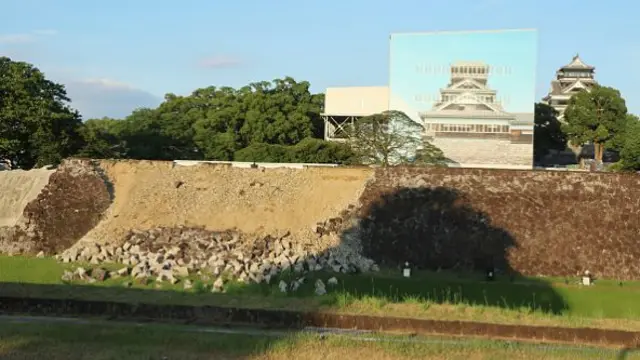
    Bricks tumbled and a huge dust cloud rose from the walls of the 17th century-built Kumamoto Castle in the centre of the city on Tuesday.

    "It didn't fall down piece by piece, it all came crashing down at once", an eyewitness says. "It was really something."

    You can watch the moment the walls collapsed and footage of the aftermath in this short video.

    Parts of the castle were also damaged in the devastating earthquake in the area in 2016.

  6. 'My TV fell on me, my mirror smashed and the roads around me were damaged'published at 19:52 BST

    James Kelly
    Your Voice

    Michal Posen

    Michal Posen, 25, from London, has been living in Kumamoto for two years, working as an English teacher.

    "The earthquake hit when I was at home. My TV fell on me, my mirror smashed and the roads around me were damaged," she tells BBC Your Voice.

    And amid "constant aftershocks", Michal says she's preparing evacuation bags.

    Kumamoto experienced a severe earthquake ten years ago, this has made people anxious she says.

    “There is no water or food left in the stores,” she says.

    BBC Your Voice banner. Your Voice is written in white on a purple backgroundImage source, Your Voice
  7. Earthquake strong enough to be felt in South Koreapublished at 19:24 BST

    Jake Kwon
    Seoul correspondent

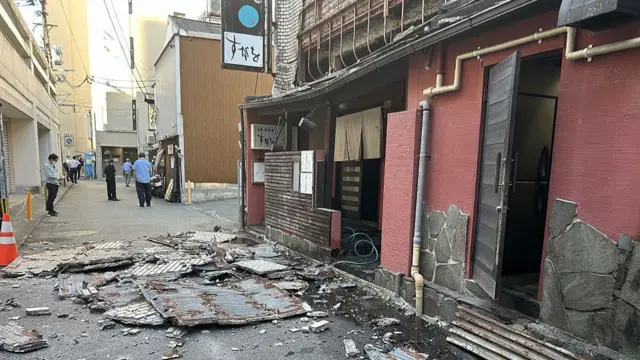
    A shop with a collapsed front damaged in an earthquakeImage source, Getty Images

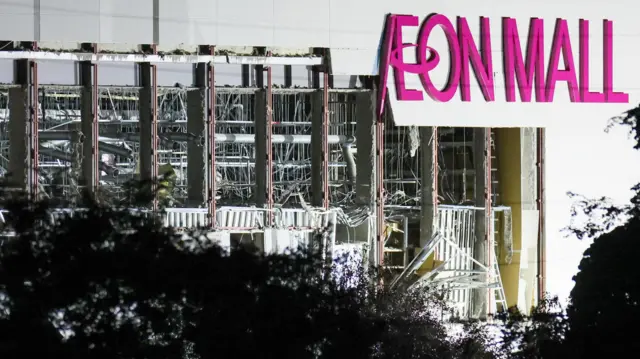
    Witnesses saw an explosion and fire before the Aeon Mall’s second floor collapsed, but it’s not yet clear what caused that explosion.

    Firefighters are clearing the debris, looking for those still trapped. The earthquake struck at 16:27 local time (07:27 GMT) when many were still at work or out shopping.

    The earthquake was strong enough to be felt in Japan's overseas neighbour, South Korea.

    This region is no stranger to earthquakes. In 2016, deadly quakes killed more than 200 people on the island of Kyushu.

  8. Schools, tourist attractions and an athletics stadium closed in Kumamotopublished at 18:57 BST

    The exterior of Kumamoto castle, with loose bricks strewn around on the groundImage source, JIJI Press / AFP via Getty Images
    Image caption,

    Kumamoto Castle - the outer walls of which were damaged in the earthquake - is closed to visitors

    Authorities have closed more than 150 facilities in Kumamoto in the earthquake on Tuesday.

    A list published by Kumamoto City Disaster Prevention shows dozens of sites - including schools, community centres, sports halls and libraries - have been closed.

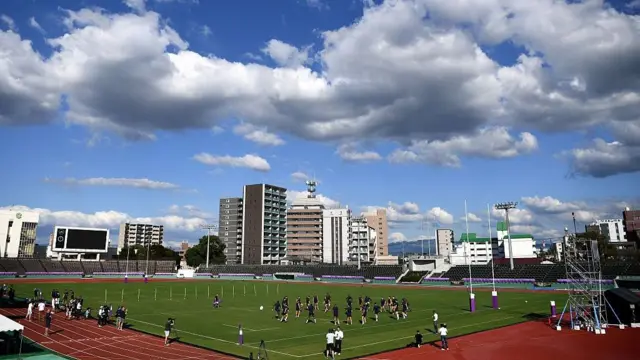
    Also on the list of closed facilities are tourist attractions including the Museum of Contemporary Art and Suizenji Sports Park, a 15,000 capacity multi sports stadium used for - among other things - athletics and football.

    Rugby team in a training sessionImage source, Getty Images
    Image caption,

    France's under-19 rugby team training at Suizenji Sports Park in 2019

  9. 'People are wary of another earthquake after 2016'published at 18:37 BST

    James Kelly
    Your Voice

    Sam Butcher selfie

    "Businesses all throughout the city are closed to assess damages," says Sam Butcher, a Plymouth university graduate who moved to Kumamoto in 2024 on a teaching programme.

    He says his building has no running water and says aftershocks are still occurring hours after the earthquake.

    "People are wary of another earthquake on the way as the 2016 earthquake had an earthquake followed by a second days later," he tells the BBC.

    "Cracks can be seen in many buildings and some employees are able to take disaster leave to fix or tidy things that may have broken in their homes."

    BBC Your Voice banner. Your Voice is written in white on a purple banner
  10. What causes an earthquake?published at 18:14 BST

    Mark Poynting
    Climate and science reporter

    The outer layer of the Earth is divided into different sections called tectonic plates - a bit like the Earth’s puzzle pieces.

    These plates move very slowly - perhaps only a few centimetres a year, which is roughly the same rate as your fingernails grow.

    As they move relative to one another, parts of the plates can get "stuck", and stress builds up over a long period of time.

    Eventually, this stress becomes too much and the plates jolt or slip back into place.

    That releases the huge amounts of energy experienced as an earthquake.

  11. In pictures: Rescue operation at collapsed Aeon Mall continuespublished at 17:57 BST

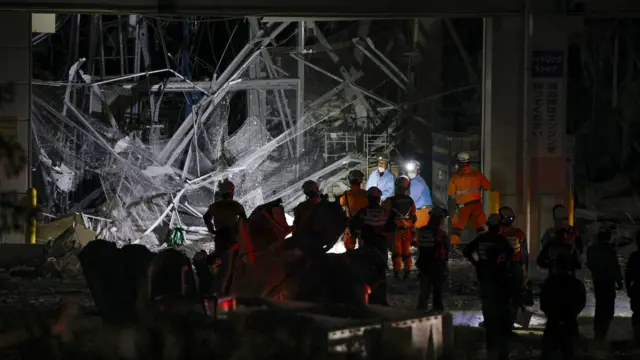
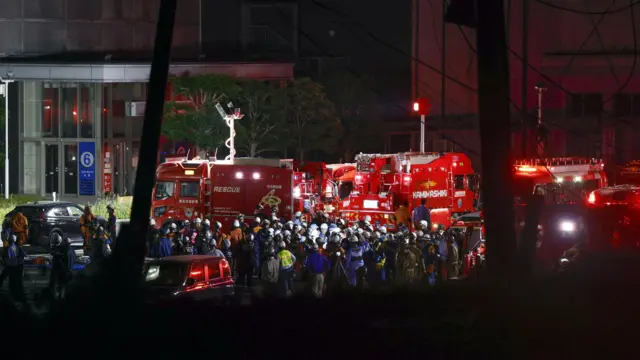
    Searches are continuing long into the night in south-western Japan, where emergency personnel are scouring the collapsed structure of the Aeon Mall.

    Aeon Mall seen from far off - with exposed structuresImage source, EPA/Shutterstock
    Workers are visible in the dark in orange overalls as they search a mangled structureImage source, Reuters
    Fire engines and emergency personnel outside the Aeon MallImage source, Reuters
  12. Nineteen people missing across paper factory and shopping centrepublished at 17:41 BST
    Breaking

    Chie Kobayahsi
    BBC News in Japan

    Two people have been found in a state of cardiac arrest and multiple people remain unaccounted for across two sites hit by the earthquake in the Kumamoto prefecture, an official has confirmed.

    An official at the Disaster Management Division of Kumamoto prefecture tells the BBC that at Nippon Paper's Yatsushiro Plant, two people "were found in cardiac arrest" and nine people are still missing.

    They also say that four people have been rescued from the Aeon Mall, and their lives are "not in danger".

    But 10 people remain unaccounted for at the shopping centre.

    The prefecture is checking reports of a gas leak, the official also says.

  13. BBC Verify

    Video shows high-rise hotel shaken by earthquakepublished at 17:22 BST

    By Thomas Spencer

    We have verified a video showing the moment a hotel in Kumamoto was severely shaken by the earthquake.

    In the clip, the high-rise REF Kumamoto hotel can be seen rocking from side-to-side but appears to withstand the force of the tremors.

    Birds in nearby trees can also be seen taking flight as the building sways.

  14. As search for mall blast survivors continues into the night, what's the latest?published at 16:57 BST

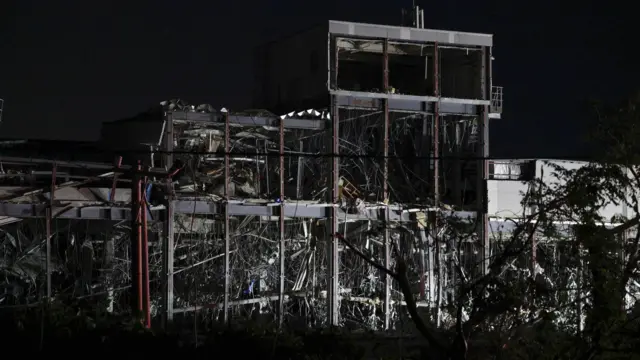
    The shell of Aeon shopping centre pictured in the darkImage source, Reuters

    It's the early hours of Wednesday morning in Kumamoto, where a search operation continues at the Aeon shopping mall. Here's the latest:

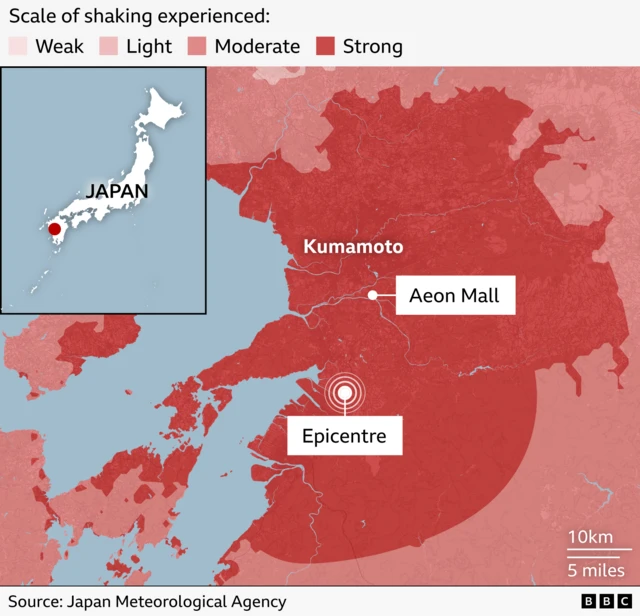
    Map showing the location of earthquake in Kumamoto and the epicentre and Aeon Mall
  15. 'It feels like the building beneath you turns to liquid'published at 16:25 BST

    A boy with a checkered red shirt and short brown hairImage source, Felix Umland

    Felix Umland, a German photography student in Japan was on the 13th floor of a hotel in Kagoshima, about 175km from the epicentre, when the Japan earthquake struck.

    He tells BBC Newshour about the moment the earthquake started: "My phone started blaring an earthquake warning. I was just looking at my phone thinking I don't know what to do now... Five seconds later everything started shaking."

    "I just heard glasses flying in the kitchen and everything in the kitchen started breaking," he says.

    "There's not much you can do, it's a pretty hopeless situation. You're looking around waiting for it to stop."

    Umland adds that although buildings are built to move with the Earth, "it feels like the building beneath you turns into liquid. It's a very surreal feeling".

    "The solid ground just suddenly turned into a mass that was moving."

  16. US Geological Survey estimates earthquake magnitude is 6.8published at 16:10 BST

    As we've been reporting today's earthquake in Kumamoto was initially recorded at a 7.1 magnitude.

    And in its most recent update, the Japan Meteorological Agency lists its provisional magnitude value as 7.1.

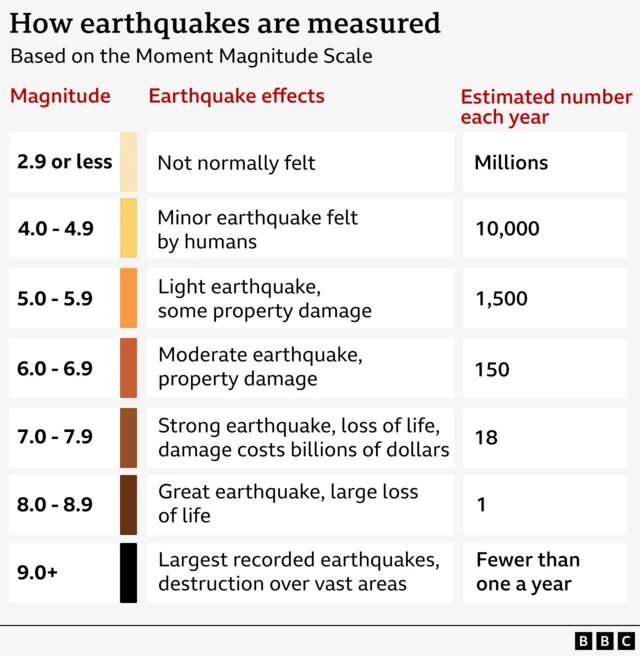
    But, the US Geological Survey, external has estimated the quake's magnitude was 6.8.

    Earthquake magnitude figures are often updated as seismologists obtain and analyse new data.

    As a result, it can often take days for a consensus to be reached on the best overall estimate of a quake's magnitude.

    A chart explaining how earthquakes are measured based on the Moment Magnitude Scale. It has three columns: Magnitude, Earthquake effects, and Estimated number each year. The rows are: Magnitude 2.9 or less – Effects not normally felt – There are millions per year; Magnitude 4 to 4.9 – Minor earthquake felt by humans – 10,000 per year; Magnitude 5 to 5.9 – Light earthquake, some property damage – 1,500 per year; Magnitude 6 to 6.9 – Moderate earthquake, property damage – 150 per year; Magnitude 7 – 7.9 – Strong earthquake, loss of life, damage costs billions – 18 per year; Magnitude 8 – 8.9 – Great earthquake, large loss of life – 1 per year; Magnitude 9+ – Largest recorded earthquakes, destruction over vast areas – Fewer than one per year
  17. BBC Verify

    Video captures loud bang and falling pallets in warehouse storepublished at 15:58 BST

    By Richard Irvine-Brown

    We’ve verified dramatic footage from inside the Kumamoto branch of retail warehouse chain Costco, 3.5km (two miles) to the east of the Aeon Mall.

    One video starts with the sound of a small bang after which children can be seen crying and clinging to their parents as the lights flicker on and off.

    People are also visibly trying to navigate pallets of goods that have fallen from high shelves. Some have been trapped by the falling items while others are seen trying to help them out.

    Media caption,

    Families flee falling merchandise inside Kumamoto supermarket

  18. More than 40,000 without power across Kyushu island, says energy providerpublished at 15:43 BST

    More than 40,000 households are without power in the aftermath of the magnitude 7.1 earthquake that hit inland on the island of Kyushu, according to an update on Kyushu Electric's website.

    This comes as residents in Hikawa town, which sits roughly 25 km (15 miles) south of Kumamoto City, are reporting water and electricity outages, according to Japan's public broadcaster NHK.

    NHK says that the power and water outages are affecting "a wide area" within the town.

    The outlet adds that Hikawa town hall is one of the buildings affected, and is without lighting or air conditioning after one of its two emergency power sources failed.

  19. Kumamoto area was hit by deadly earthquakes in 2016published at 15:19 BST

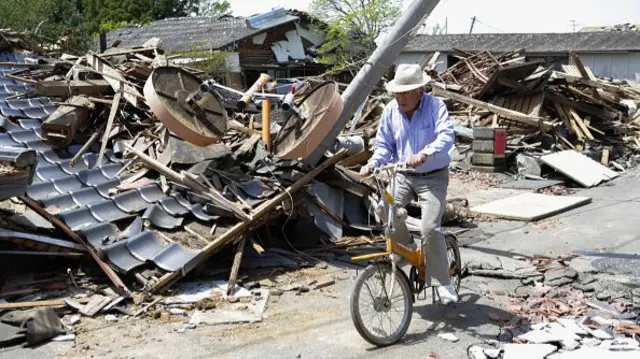
    A man on a bicycle next to the rubble of a collapsed house inImage source, Getty Images
    Image caption,

    The town of Mashiki, pictured on 20 April 2016

    The Kumamoto prefecture is no stranger to earthquakes, and has been hit by powerful ones in the past.

    In 2016, the prefecture was struck by a series of earthquakes. These included a magnitude 6.5 which hit the town of Mashiki on 14 April, and a magnitude 7.3 which struck the same area two days later.

    According to Japan's public broadcaster NHK, 278 people were killed by those earthquakes in Kumamoto and in the neighbouring Oita Prefecture.

    There were also a number of deaths linked to health problems caused by the stress of evacuation, the outlet says.

    Speaking at a press conference earlier, Shinji Kiyomoto of Japan's Meteorological Agency asked the public to "remain vigilant" for additional earthquakes, referencing the events of 2016.

    Emergency responders dig holesImage source, Getty Images
    Image caption,

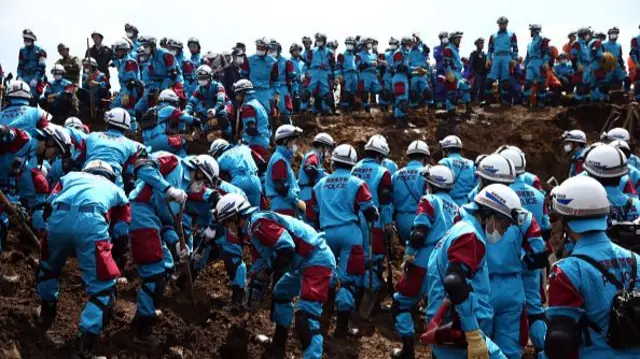
    The 2016 earthquakes required an enormous recovery operation

  20. Kumamoto city is located in Japan's second most-populous islandpublished at 15:00 BST

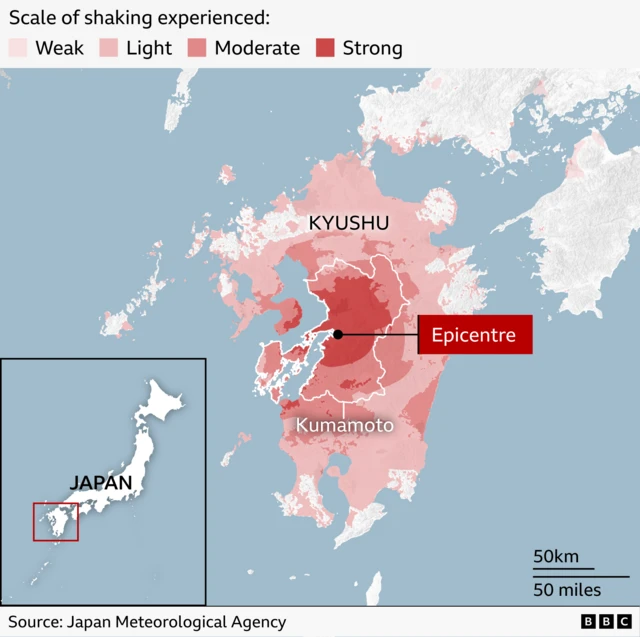
    Kumamoto - where the collapsed Aeon Mall is located - is a city on the Kyushu island of Japan.

    Japan doesn't have a mainland. It is made up of four primary islands, one of which is Kyushu. The other three are Honshu, Hokkaido and Shikoku.

    There are also thousands of smaller islands that sit further out.

    The southern island of Kyushu is the third-largest of the four main islands in Japan, and the second most populous.

    A map showing the epicentre of Tuesday's earthquake