Summary

  1. Do not cancel your travel plans, says French foreign ministerpublished at 13:28 BST 25 July

    Éléonore Caroit looks towards the camera as her portrait is taken. She is wearing a dark blazerImage source, Reuters

    A French foreign minister has told tourists not to cancel their travel plans but to keep an eye on updates as wildfires continue to rage in the country.

    Éléonore Caroit, the minister for international partnerships, tells the BBC's Today programme that the fires are a "tragedy" and nearly 50,000 hectares have been burnt in France so far this summer.

    She says the fires have been "significantly worse" than 2022 - France's worst year for wildfires.

    Caroit says there are still entire areas of France, including Paris, which have not been impacted by the fires and tells tourists: "Please come to France and do not cancel your travel plans."

    She says France's response to the wildfires has been boosted by its European Union membership, with additional resources being sent from across Europe.

    This includes two water bombing carriers from Croatia, two water tractors from Portugal and two Black Hawk helicopters from Czech Republic and Slovakia.

  2. Family wake to 'campsite full of smoke' after evacuationpublished at 13:01 BST 25 July

    Mary Litchfield
    BBC Your Voice

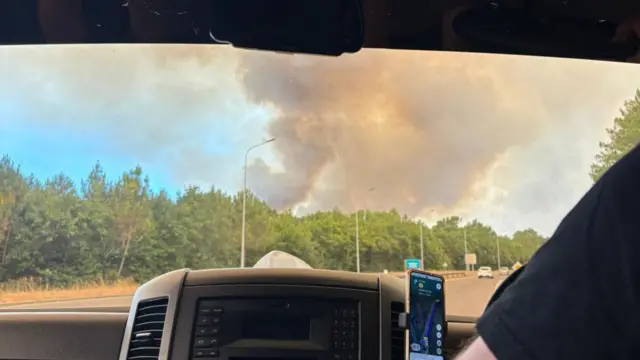
    Smoke rises above a tree line next to a motorway in France. The picture has been taken from the inside of a car and shows a driver's arm and a phone with a maps app displayed on itImage source, Jessica Rowden

    Jessica Rowden was staying in Claouey, Lège-Cap-Ferret with her partner and five-year-old son, when they woke up on Thursday to find "smoke in the sky, local businesses closed and buses not running".

    The family were advised to get ready to evacuate and headed to where Rowden's parents had been staying nearby, but found the roads gridlocked and the air quality deteriorating.

    Rowden, her partner and son moved to a campsite in Rauzan as her parents headed to Bordeaux - but once again on Friday morning they found their campsite "filled with smoke" and were forced to drive north immediately.

    "Our five-year-old son had already developed a cough," she tells the BBC. "The air quality is bad, we’re just worried."

    "It’s days of worry, trying to translate the French newspapers.

    "If we didn’t have Disneyland tickets booked we would be getting on the first ferry we could.

    "My heart breaks for everyone still in the area with no clear end or outcome in sight."

    A purple banner displays the words 'your voice'
  3. Where wildfires are burning in Europepublished at 12:43 BST 25 July

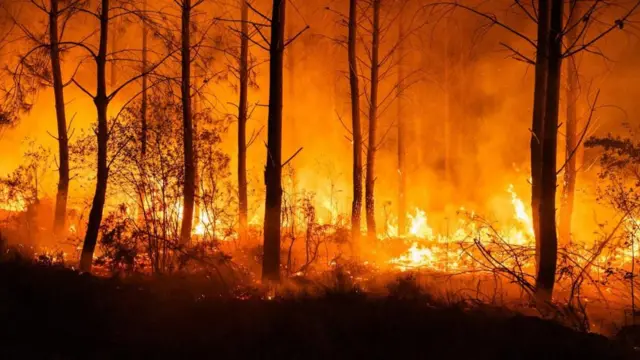
    Flames rip through the grass and lower layers of a forest in France. Several trees stand between patches of fireImage source, EPA/Shutterstock
    Image caption,

    A forest burns in Biscarrosse in southern France on Saturday

    Wildfires have continued to spread across Europe as an exceptionally hot summer and dry conditions have created perfect conditions for fires to spread.

    Earlier we reported that Europe is the fastest-warming continent on Earth, with temperatures rising more than 0.5C each decade since the 1990s.

    Here's a reminder of where major fires have broken out in Europe this summer.

    France: Nearly 200,000 people have been evacuated in the south-west of the country in the Gironde and Landes regions.

    Spain: A national emergency has been declared and at least 60,000 people have been evacuated as fires burn near the capital Madrid.

    Italy: More than 350 fires - including 10 major blazes - broke out on the island of Sicily, the head of the Sicilian Civil Protection said on Wednesday, prompting evacuations.

    Scotland: A major incident has been declared by emergency services as they continue to tackle a wildfire burning in the Cairngorms National Park that has been burning for 10 days.

  4. Hundreds of thousands evacuated as fires rage in France and Spainpublished at 12:29 BST 25 July

    Katie Williams
    Live reporter

    Forest fires burn at the mountains of Robledo de Chavela, near Madrid, SpainImage source, EPA
    Image caption,

    Smoke rises over the mountains near Madrid

    Wildfires continue to rage in France and Spain, with hundreds of thousands of people being evacuated from their homes.

    Almost 200,000 have been displaced in France alone, according to the country's Interior Ministry.

    It comes after almost 60,000 were evacuated from towns in Bordeaux's western suburbs overnight - the latest in a series of evacuations affecting the Gironde and Landes regions.

    Meanwhile, the figure has risen to more than 70,000 in Spain, according to news agency AFP and local media.

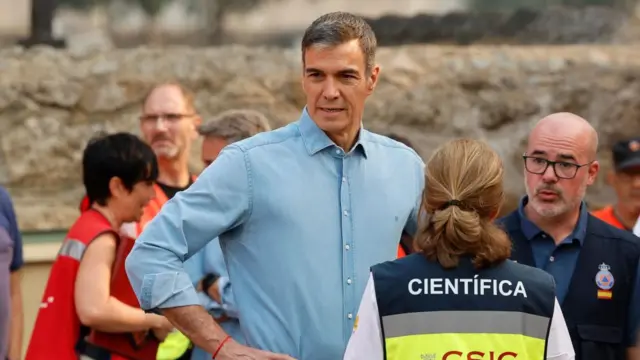
    Addressing reporters this morning, Spanish Prime Minister Pedro Sánchez said the priority was "saving lives" and protecting inhabited areas, but warned that "complex hours" lay ahead.

    The BBC has been hearing from people in affected areas. One tourist who evacuated Bordeaux earlier this week says he can still smell the wildfires from 100 miles away. A BBC journalist holidaying in the region describes a "wall of orange flames" and says she had just 30 minutes to get out.

    Weather conditions will be a factor in shaping the course of the fires going forward.

    In France, the westerly wind is the main issue and is likely to strengthen later today before easing on Sunday, BBC Weather reports. In Spain, there is a chance of some rain this evening but it might not be enough to give any effects, they add.

  5. Spanish officials say priority is 'saving lives' as 70,000 evacuatedpublished at 12:13 BST 25 July

    Sergi Forcada Freixas
    Reporting from Spain

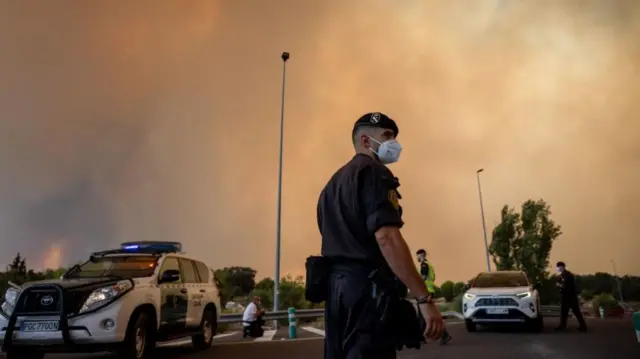
    A Civil Guard officer wears a protective mask as smoke from a wildfire obscures the sky in CenicientosImage source, EPA

    Francisco Martín, the Spanish government's representative in the Madrid region, has just updated the number of people affected by the wildfires in central Spain.

    He said around 70,000 people have now been evacuated because of the fires in Madrid and Ávila, while more than 20,000 others have been told to remain indoors.

    Martín said the priority remains "saving lives and guaranteeing safe evacuations", adding that there have been no casualties so far.

    He warned that further instructions could be issued in the coming hours, urging people to follow any guidance from the authorities "to the letter".

  6. Thick smoke tastes bitter - and the smell is setting into our clothespublished at 12:09 BST 25 July

    Tomos Morgan
    Reporting from La Lande-de-Fronsac

    The BBC's Tomos Morgan is cutting short a holiday to France as the fires continue.

    We’ve spent a week in La Lande-de-Fronsac, an area around 80km (50 miles) from the hotspot of fires near Cap Ferret in the Gironde region of France.

    It’s been clear blue skies every day - the sun shining high - today however, it could not have been more different.

    A thick fog of smoke is layered across the area, the acrid smell of burning is leaving a bitter taste in our mouths… and giving us a headache.

    It penetrated our house overnight, and this morning even our clothes even smelt smoky.

    This area is a classic wine making region - awash with vineyards as far as the eye can see. There is one behind our house, but this morning we couldn’t see the end of the field such was the thickness of the fog.

    So we’ve made the decision to head home to Wales a day early. Although we are not in any immediate danger, health-wise we would rather not risk sitting by the pool or walking around too long in this with two young children.

  7. Wildfires have burnt 98,000 hectares since start of year - French Interior Ministrypublished at 12:01 BST 25 July
    Breaking

    Around 98,000 hectares of land have burned across France since the start of the year, the country's interior ministry tells the BBC.

    It adds that 40,000 hectares have been burnt in the Gironde region alone since January.

  8. Nearly 200,000 people evacuated in France due to wildfirespublished at 11:49 BST 25 July
    Breaking

    Nearly 200,000 people have been evacuated in the south-west of France due to the wildfires, the French Interior Ministry has said.

    Around 57,000 people were evacuated overnight in Gironde, bringing the total number of evacuees in the region to 167,000.

    A further 30,000 people have also been evacuated in the Landes region.

    The total number of people evacuated in France is around 197,000, the ministry adds.

  9. Moderate winds expected in Spain as some rain in forecastpublished at 11:37 BST 25 July

    Elizabeth Rizzini
    Lead weather presenter

    There are gentle to moderate north-westerly winds expected in Spain today, becoming lighter tonight.

    Then back to gentle to moderate winds on Sunday, but more northerly. The situation would be worse if it was a southerly wind and was bringing in drier, warmer air.

    There is a chance of some rain this evening - but it might not be enough to give any effects.

    It is forecast to be pretty dry after that and through the next few days.

  10. Tourist who evacuated Bordeaux says he can still smell wildfires from 100 miles awaypublished at 11:29 BST 25 July

    Mary Litchfield
    BBC Your Voice

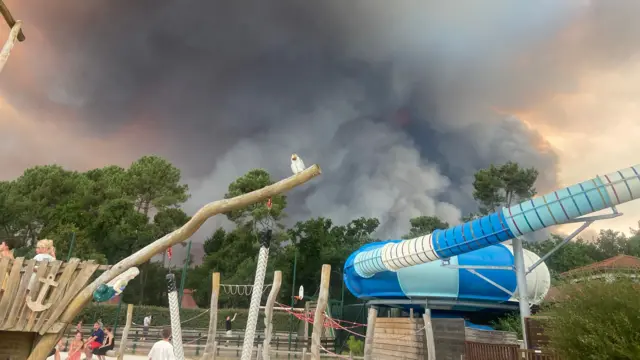
    Photo shows huge cloud of smoke rising above playground in BiscarrosseImage source, Andrea Gretton

    A tourist who was in Biscarrosse with his family has described the scale of the fire near Bordeaux as "frightening".

    "With the strength of the wind and the endless pine forest, it's hard to see an end to the fires," Spencer Randall says.

    He is on holiday with his fiancée Andrea and two children, aged seven and 10. They have now evacuated to an area 100 miles east, he says, but they can "still smell the wildfires from here".

    His family first arrived in Biscarrosse on Wednesday - the day after the fires started.

    "We were getting used to the campsite and out on the lake when we smelt and saw smoke drifting across the reservoir," he says.

    He describes making the decision to leave at 21:00 local time (20:00 BST), hoping to avoid being evacuated in the middle of the night.

    He says the campsite was eventually evacuated at around 01:00.

    "It's terrifying. It's quite strong winds fanning the flames, just terrifying," he says.

    BBC Your Voice banner - white text saying "Your Voice" sits on purple background with darker purple paintbrush strokes
  11. Tourists abandon tents as police evacuate campsite in southern Francepublished at 11:10 BST 25 July

    Joanna Kent
    Reporting from her holiday in France

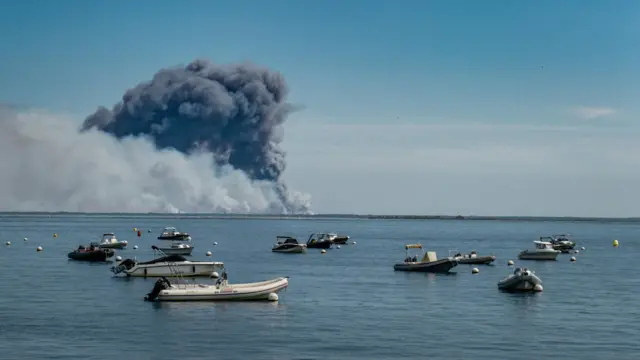
    Smoke from wildfires spreading in the Cap-Ferret peninsula is seen from the Arcachon bay in Arcachon, south-western France, 24 July 2026Image source, EPA/Shutterstock
    Image caption,

    Smoke from wildfires spreading in the Cap Ferret peninsula is seen from the Arcachon bay in Arcachon, on Friday

    BBC South's Joanna Kent was on holiday in the Cap Ferret peninsula with her family when she had to evacuate due to the wildfires on Thursday.

    On the night the fire broke out we saw a wall of orange flames across the bay, a really worrying scene. The following morning we read it had doubled in size. We saw planes flying into the thick black smoke to drop water on the flames.

    We went into the local town which was eerily quiet. When we got back, two van loads of police were at the site going to every tent, caravan and accommodation unit, telling people they had 30 minutes to get out.

    A helicopter was circling in the sky above us, and the police watched as everyone scrambled to pack their belongings into their cars.

    Most people were calm, but a few were clearly panicking, and some had abandoned tents and camping gear.

    We joined a long queue of traffic of tourists evacuating and escaping the peninsula for Bordeaux.

    I feel lucky that we were able to evacuate ahead of the main wave yesterday and really feel for the people in local communities whose homes and businesses are now at risk of being destroyed.

  12. Fire risk remains 'extreme' in parts of Spain today - meteorological agencypublished at 10:58 BST 25 July

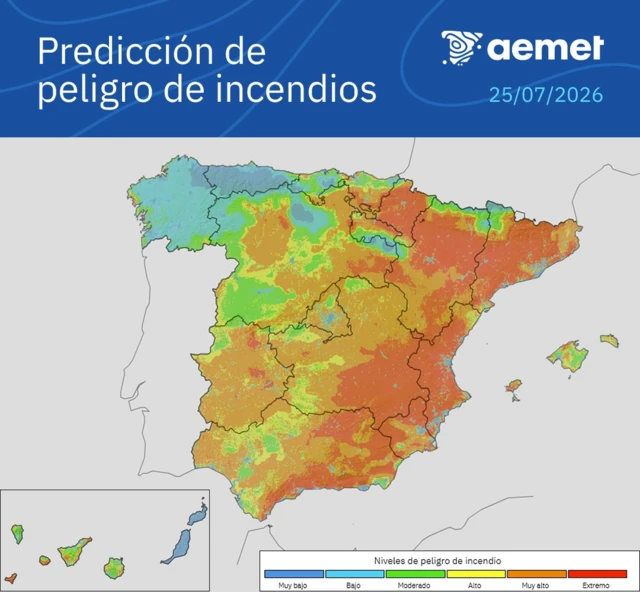
    Spain's meteorological agency Aemet says the fire risk remains "at very high levels" in wide parts of the country, and "extreme" levels in the north-east and east.

    But the risk is "lower than in previous days" in much of the west and centre of the country, it writes on X.

    It has mapped the risk across the country, with the highest-risk areas in red, signifying "extreme" risk.

    Map of Spain shows fire risk with highest risk areas in north-east and east, coloured in red for "extreme" riskImage source, Aemet
  13. 'Complex hours' ahead as authorities respond to fires, says Spanish PMpublished at 10:49 BST 25 July

    Spanish Prime Minister Pedro Sánchez on a visit earlier todayImage source, EPA
    Image caption,

    Sánchez pictured on a visit this morning

    Spanish Prime Minister Pedro Sánchez says the priority is "saving lives" and protecting inhabited areas as wildfires continue to rage in Spain.

    But he warned that "complex hours" lay ahead, adding that although temperatures have dropped, "we do not know exactly how the wind will develop, how strong it will be".

    He made the remarks while visiting affected areas on Saturday.

  14. Where are fires burning in France and Spain?published at 10:36 BST 25 July

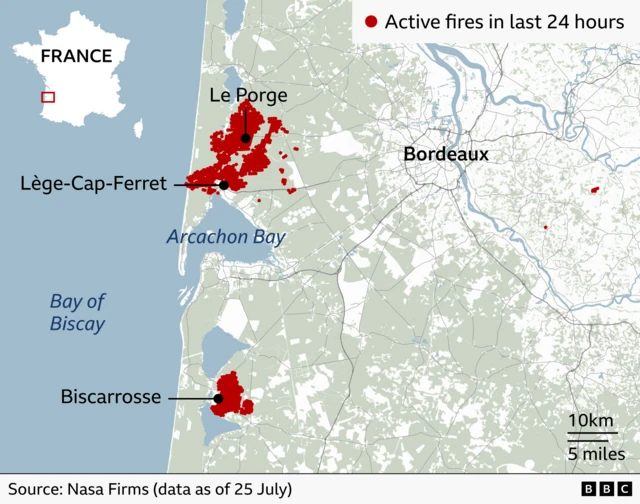
    The entire Cap Ferret peninsula and regions near the French city of Bordeaux have been evacuated after several large wildfires spread in the south-west of France.

    A blaze has spread between Lège-Cap-Ferret and Le Porge in the Gironde region and has been described by local prefect Sophie Broca as an "XXL fire".

    Further down the coast, near the town of Biscarrosse in the Landes region, another major fire began on Thursday afternoon.

    Map of south-west France showing active wildfires recorded in the last 24 hours. Large clusters of red dots mark fire activity around Arcachon Bay, concentrated between Lège-Cap-Ferret and Le Porge on the Atlantic coast. A second sizeable cluster is located near Biscarrosse to the south. Smaller isolated fire detections appear east of Bordeaux. Bordeaux is labelled inland to the east, while Arcachon Bay and the Bay of Biscay are labelled in blue along the coastline. An inset map of France in the top left highlights the location of the affected area. Source: NASA FIRMS data as of 25 July.

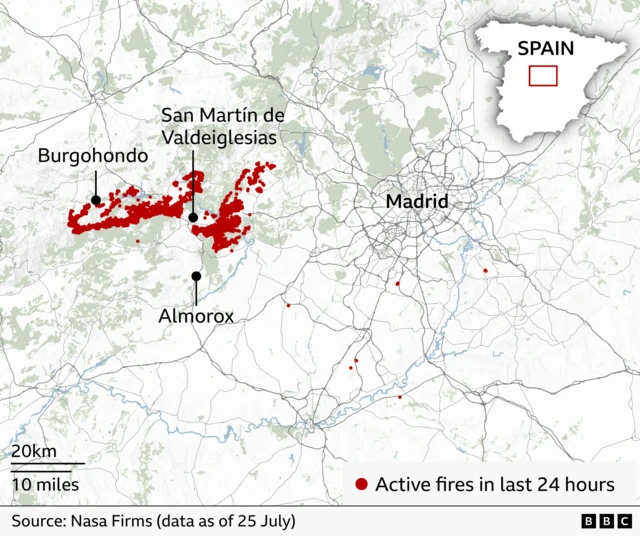
    Meanwhile in Spain, the government has declared a national emergency as fires burn close to the capital Madrid. The city's metropolitan area is home to about 6.8 million people.

    Two wildfires near Madrid merged on Friday and authorities believe they could form an even bigger blaze with a fire in the neighbouring Avila province.

    Map of central Spain showing active wildfires recorded in the last 24 hours. Large clusters of red dots mark fire activity west of Madrid, concentrated around Burgohondo, San Martín de Valdeiglesias and Almorox. The fires form two main zones. A few isolated fire detections are scattered south and east of Madrid. Madrid is labelled near the centre-right of the map. An inset map of Spain in the top right highlights the location of the affected area. Source: NASA FIRMS data as of 25 July.
  15. Spanish PM visits firefighters' control centre in Madridpublished at 10:25 BST 25 July

    Spanish Prime Minister Pedro Sanchez (R) and Spanish Government Delegate in Madrid Francisco Martin (L) visit the firefighters' control center in the village of Cenicientos, Madrid, Spain, 25 July 2026.Image source, EPA

    New pictures show Spanish Prime Minister Pedro Sanchez visiting the firefighters' control centre in the village of Cenicientos in Madrid this morning.

    It comes after Spain's government declared a national emergency as fires continue to rage near the city, with 25,000 people told to evacuate and almost 40,000 told to stay indoors.

    Around 6.8 million people live in Madrid's metro area.

    Madrid's regional government emergency management chief previously told reporters the wildfire was "at its peak" and was "currently beyond the capacity of firefighters to contain".

    Spanish Prime Minister Pedro Sanchez (L) and Spanish Government Delegate in Madrid Francisco Martin (R) visit the firefighters' control center in the village of Cenicientos, Madrid, Spain, 25 July 2026.Image source, EPA
  16. Rain possible in France today, but might not fall everywherepublished at 10:00 BST 25 July

    Elizabeth Rizzini
    Lead weather presenter

    There is the chance of some showers across France today - but the main risk looks more to the east of the fire region.

    The showers will be hit or miss, so may not fall everywhere.

    The westerly wind is the main issue, though, as that is likely to strengthen even more later today and push the fire more to the east and south-east. Winds should ease later Sunday.

    The westerlies are at least bringing more humid air off the Atlantic, rather than from the dry interior.

  17. Number of people evacuated in Spain rises above 60,000published at 09:53 BST 25 July
    Breaking

    The number of people evacuated in Madrid and the Ávila‎ province has now exceeded 60,000, Spain's Interior Ministry tells the BBC.

    Madrid's regional president Isabel Díaz Ayuso previously described wildfires in the region as the "worst" in its history, with the area facing a "perfect storm" of high temperatures, relentless wind and merging fire fronts.

  18. 'We thought someone was having a BBQ - then the smoke got thicker'published at 09:41 BST 25 July

    Srosh Khan
    BBC Newsbeat

    Maisie and Caleb wearing sunglasses with a beach in the backgroundImage source, Supplied

    Maisie and Caleb were on their way to France from London St Pancras station when they got the news alert, telling them about wildfires near their final destination, Bordeaux.

    “We knew there were fires on our way here, but they’ve spread quickly”, Maisie tells BBC Newsbeat from their holiday rental.

    The pair, aged 26 and 27 from west London, have now spent the morning watching the movie Shrek inside, after cancelling most of their plans including a visit to a beach nearby.

    Maisie says they haven’t heard anything official from local authorities, but their Airbnb host did tell them which areas they should avoid because of the fires.

    And it was yesterday when they decided they should spend less time outside.

    “At about seven o’clock you could smell smoke. We thought someone was having a barbecue,” says Maisie. But then “the smoke got thicker and we started to notice ash coming through the air”.

    Caleb says the ash has now covered the pool and has turned his feet black when walking outside.

    And of the smoke, they add: “It really hits your lungs right away.”

  19. An exceptionally hot summer has created perfect conditions for firepublished at 09:30 BST 25 July

    Ben Rich
    Lead Weather Presenter

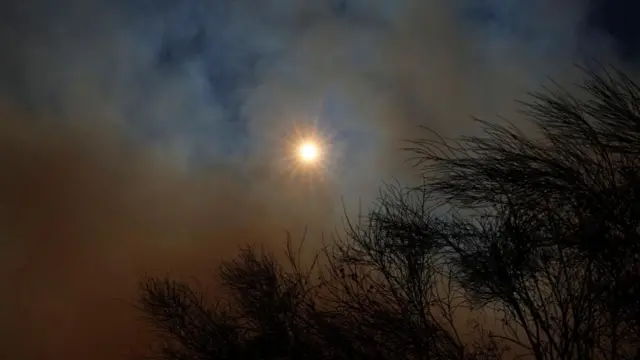
    The sun shines dimly through a cloud of smoke that hangs over some trees.Image source, EPA/Shutterstock

    The weather, on its own, rarely causes wildfires.

    A fire needs a source of ignition. Rarely, this can be a bolt of lightning, but more often it’s caused by human activity – perhaps a discarded cigarette, a spark from a barbecue, fallen power lines or sometimes even arson.

    But the weather can bring the perfect conditions for a fire to take hold and spread, and this is exactly what has happened this time.

    It has been an exceptionally hot summer so far in western Europe with back-to-back heatwaves. Indeed, June was the hottest on record for western Europe, according to data from the EU’s climate change service, Copernicus.

    It was also very dry with below-average precipitation across large swathes of France and Spain.

    This means the vegetation is tinder dry and highly prone to ignition with high temperatures, dry air and gusty winds readily able to fan the flames.

    What’s worse, an unusually wet winter allowed vegetation to grow widely and rapidly which, when dried by the summer heat, has meant abundant fuel for the fires.

    Climate change is increasing the risk of summer heatwaves across Europe – which is the fastest-warming continent on Earth, with temperatures rising more than 0.5C each decade since the 1990s.