Summary

  1. Oil price remains high in Asia tradingpublished at 04:28 GMT 13 March

    Nick Marsh
    Asia Business Reporter, Singapore

    The price of oil has remained high in Asia trading. It's currently at just over $100 for a barrel of Brent crude.

    Yesterday, oil finished the day above $100 a barrel for the first time since 2022, which was in the wake of Russia's full-scale invasion of Ukraine.

    When oil surged above $100 a barrel in 2022, it stayed there for four and a half months. That kind of scenario is still some way off, but US stock markets did finish trading at their lowest point this year.

    The White House says it will grant countries a 30-day license to buy sanctioned Russian oil that's currently stranded at sea in an attempt to ease concerns about supply.

    Data shows that Moscow has already become a significant financial beneficiary from this conflict.

    Unconfirmed reports suggest some countries, such as India and China, are in talks with Iran to allow safe passage of some vessels through the Strait of Hormuz. It's unclear what effect this would have on the price of oil.

  2. Australia releases fuel from emergency stockpilepublished at 03:57 GMT 13 March

    The Australia government will allow six days' worth of petrol and five days' worth of diesel to be made available from its emergency stockpile, amid the ongoing conflict in the Middle East.

    The move follows increased petrol and diesel demand in regional areas, and should "enable fuel companies to more flexibly manage their supply chains", Minister for Climate Change and Energy Chris Bowen said.

    The minimum volume of diesel reserves will be reduced from 2.7bn litres to 2.2bn litres, and for petrol from 1bn litres to 700m litres.

    Bowen said "fuel continues to arrive" in the country.

    The measures come after the Australian government temporarily lowered its fuel standards in response to oil prices rising.

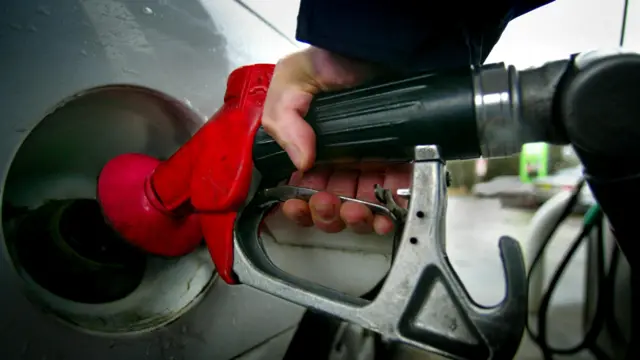
    A close up of a motorist filling a car with a red fuel pump at a petrol station.Image source, Reuters
  3. 'Hidden hand of Putin' and 'oil war' – what the UK newspapers saypublished at 03:30 GMT 13 March

    Harry Sekulich
    Reporting from Sydney

    The Friday morning copies of the UK papers lead with Iran's attacks on British troops at Iraqi airbases.

    "Brit base blitzed by Iran", reads the Sun's front page, describing Tehran's drone strikes on Baghdad and Erbil. "Under fire" is the Daily Mirror's take as the Independent writes "Iran targets our troops", noting no British troops were injured.

    The UK government has also "set sights on vital Strait of Hormuz", the Independent says, writing that Iran's efforts to block the shipping lane "has severely disrupted the supply line of crude oil, raising fears about global energy prices as the cost of heating oil in Britain more than doubled in the past week".

    The papers' Middle East coverage also focuses on new accusations that Moscow is helping Tehran's military tactics. "Russia behind attack on UK troops" is the Daily Telegraph's headline.

    Defence Secretary John Heley's "Hidden hand of Putin" quote features on the front page of the Times and the Guardian. Iranian drone pilots are "using methods learned on Ukraine battlefield", the Guardian writes, adding Russian President Vladimir Putin also "benefits from oil price rises to fund war with Kyiv".

    The Financial Times estimates "oil windfall gives Russia $150m [£112.3m] a day", declaring Moscow "the biggest winner from the conflict in the Middle East".

  4. Russia says global energy market needs its oilpublished at 03:06 GMT 13 March

    Russia's economic envoy Kirill Dmitriev said the global energy market "cannot remain stable" without his country's oil.

    "The United States is effectively acknowledging the obvious: without Russian oil, the global energy market cannot remain stable," Dmitriev posted on Telegram.

    His comments come after the US authorised countries to temporarily buy sanctioned Russian oil and petroleum that's currently loaded on vessels at sea to "promote stability in global energy markets" during the war.

  5. 'There's no hiding place on a ship': The sailors stranded near Iranpublished at 02:39 GMT 13 March

    Media caption,

    Sea traffic around the Strait of Hormuz on 12 March 2025 (left) compared with 12 March 2026 (right)

    The Strait of Hormuz is a key artery for global shipping, but the sudden outbreak of war in Iran has left many ships and their sailors stranded at sea as they watch strikes play out on land around them and overhead.

    "I have seen Iranian drones and cruise missiles flying at low altitude," says Amir, a Pakistani sailor who is on board an oil tanker in the United Arab Emirates which cannot leave the area. "I also hear the sound of fighter jets, but we can't identify which country they belong to."

    In recent days there has been a growing number of reported attacks on ships in the Gulf region, as Iran responded to attacks by the US and Israel by threatening to open fire on any vessels trying to cross the Strait.

    For more voices from the sailors stranded in limbo on those ships, read our piece here.

  6. Oil prices steady in early Asia tradepublished at 02:06 GMT 13 March

    After a week a huge moves on the global energy market, oil prices are broadly steady in Friday morning trading in Asia.

    Brent crude is 0.4% lower at $100.05 (£74.89) a barrel, while Nymex light Sweet is down 0.5% at $95.25.

    Concerns over the impact of the Iran war on energy supplies has rocked markets in recent days as traders monitor attacks on shipping near the vital Strait of Hormuz waterway.

    Earlier, the US said it had temporarily eased sanctions to allow countries to buy Russian oil and petroleum already in transit.

  7. One French soldier killed in Iraq, several injured, says Macronpublished at 01:42 GMT 13 March

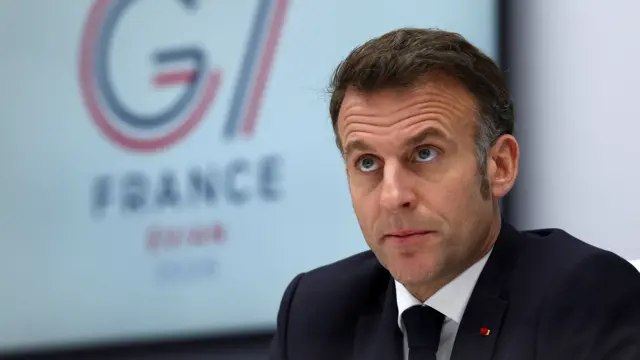
    French president Emmanuel MacronImage source, Reuters

    A French soldier has been killed during a drone attack in Iraq's Erbil region, with several others injured, France's President Emmanuel Macron announced.

    He named Chief Warrant Officer Arnaud Frion as the first French military death since the war in Iran began late last month.

    "To his family, to his brothers in arms, I want to express all the affection and solidarity of the nation," Macron wrote on social media.

    "Several of our soldiers have been wounded. France stands by their side and with their loved ones."

    Macron condemned the attacks on French forces fighting against Islamic State in the region as "unacceptable".

    "Their presence in Iraq is part of the strict framework of the fight against terrorism. The war in Iran cannot justify such attacks."

  8. US reveals 6,000 targets hit in Iranpublished at 01:08 GMT 13 March

    The US has struck 6,000 targets in Iran during Operation Epic Fury, according to new numbers released by US Central Command.

    That included about 60 ships and 30 minelaying vessels the US said it has damaged or destroyed.

    Other targets were command centres, weapons production facilities, ballistic missile sites, submarines and air defence systems in Iran.

    US media have reported that US military investigators believe American forces were likely responsible for hitting a school in Iran unintentionally during airstrikes at the start of the joint US-Israeli operation - but that they have not reached a final conclusion.

  9. US temporarily allows countries to buy Russian oilpublished at 00:45 GMT 13 March

    The US has authorised countries to buy sanctioned Russian oil and petroleum that's currently loaded on vessels at sea.

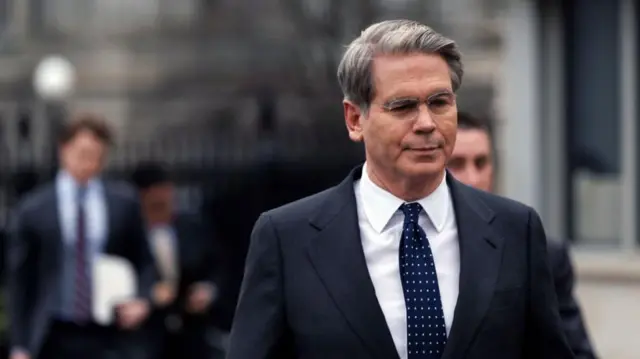
    US Treasury Department Secretary Scott Bessent said it was a temporary measure to "promote stability in global energy markets" during the war. The authorisation will last until 11 April.

    "This narrowly tailored, short-term measure applies only to oil already in transit and will not provide significant financial benefit to the Russian government," Bessent said.

    Oil prices climbed back above $100 a barrel on Thursday and stock markets fell after three more cargo vessels were hit in the Gulf and Iran's new supreme leader vowed to keep blocking the Strait of Hormuz – a key shipping route through which about a fifth of the world's oil usually passes.

    Bessent added: "The temporary increase in oil prices is a short-term and temporary disruption that will result in a massive benefit to our nation and economy in the long-term."

    Earlier, Bessent said the US government would start escorting vessels through the Strait of Hormuz "as soon as it is militarily possible".

    The possible need for a military escort "was always in our planning", he told Sky News.

    Pressed on whether that could start in the coming days, Bessent said "as soon as it is possible to ensure safe passage we will do it".

    A man in a dark suit and spectacles walks outside in dim sunlight.Image source, EPA
  10. Iranians react to Mojtaba Khamenei’s messagepublished at 00:24 GMT 13 March

    Ghoncheh Habibiazad
    Senior reporter, BBC Persian

    It is still very difficult to contact people inside Iran due to the government-imposed internet outage, but some manage to connect briefly.

    I have been asking them, who are all against the current establishment, about their opinion on the message from Mojtaba Khamenei today, which was read aloud by a presenter on state TV.

    "The message was very radical. I think it shows that nothing can be changed from within," a man in his 30s in Tehran said.

    "I don’t even think it was his message. I feel like control of the country is in the hands of the IRGC [Islamic Revolutionary Guard Corps]. The message was harsh," a woman in her 40s in Tehran said.

    Mojtaba Khamenei succeeded his father, Ayatollah Ali Khamenei, as the third Supreme Leader of Iran on 8 March, but he has not been seen live or in a recorded message on state TV since.

    "He’s even more worthless than his father," a man in his 30s in Karaj, a city near Tehran, said.

    BBC Persian is the Persian language service of BBC News, used by 24 million people around the world - the majority in Iran - despite being blocked and routinely jammed by Iranian authorities.

  11. 'We pray for the safety of the crew' - US lawmaker on fuel tanker aircraft crashpublished at 23:59 GMT 12 March

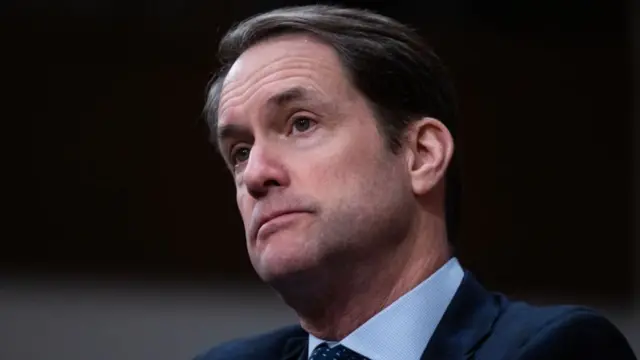
    Democratic representative Jim HimesImage source, Tom Williams via Getty Images

    We're getting some initial reaction from US lawmakers on the crash of a US refuelling aircraft in western Iraq.

    Democratic Congressman Jim Himes tells BBC Newsnight it is still "very early" to determine what caused the incident, adding he hopes the crew that was onboard is safe.

    "This is part of the inevitable cost of a conflict. Even the best military doesn't operate without accidents and that's what appeared to have occurred here," he says.

    "We pray for the safety of the crew, but this is the cost that is to be paid when a nation goes to war."

  12. French soldiers wounded in Iraq drone attackpublished at 23:29 GMT 12 March

    Six french soldiers have been wounded in a drone attack in the Erbil region of Iraq, news agencies including Reuters and AFP are reporting.

    They have been taken to a nearby medical centre, Reuters says, citing the French army.

    The army statement did not provide further details about their injuries or the origins of the drone.

    France has hundreds of troops based in the Erbil region. They have been stationed there as part of an international coalition that has been fighting Islamic State militants.

    Eribil, in the semi-autonomous Kurdistan region, is about 115kms west of the border with Iran.

  13. Israel strikes Hezbollah 'command centres'published at 23:06 GMT 12 March

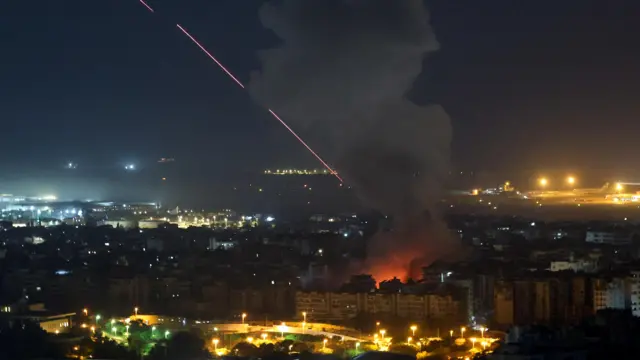
    A plume of smoke rises from BeirutImage source, Reuters
    Image caption,

    A plume of smoke could be seen rising from Beirut this evening

    The Israeli military says it has launched "several waves" of strikes in Beirut and southern Lebanon targeting "Hezbollah infrastructure".

    In a Telegram update, the Israel Defense Forces (IDF) says it struck "several command centres" used to advance attacks against Israel.

  14. US refuelling planes play crucial role in powering bombing raidspublished at 22:43 GMT 12 March

    Chris Partridge
    BBC News weapons analyst

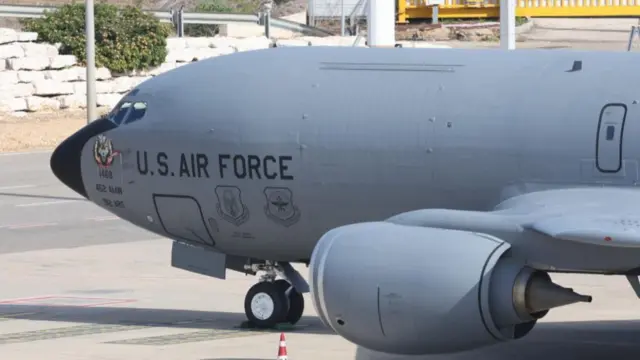
    A close up of the nose of A US Air Force Boeing KC-135 Stratotanker aerial refueling tanker aircraft is seen in Ben Gurion international airport near Tel Aviv, Israel, in FebruaryImage source, EPA
    Image caption,

    A US Air Force Boeing KC-135 Stratotanker aerial refueling tanker aircraft is seen in Ben Gurion international airport near Tel Aviv, Israel, in February

    We do not know what brought down this KC-135 refuelling aircraft but one possibility is a mid-air collision.

    These tankers play a major role in wars, keeping fighter jets and bombers properly fuelled for combat when such aircraft have to fly long distances to get to target.

    It's a huge logistical operation, with many jets in the air at the same time, each requiring fuel.

    Refuelling involves flying very close to the tanker, before a probe from the tanker is extended and lowered.

    The receiving aircraft pilot flies up to the probe and, using a system of lights under the tanker, re-positions themselves so the probe can literally "plug in" to the jet.

    Once contact is made, fuel is transferred in a process that can take several minutes.

    All this time the aircraft is literally feet from the larger tanker - in operations that often happen at night.

    It requires considerable skill for the pilot to maintain contact with the probe, or in some cases a shuttlecock-shaped drogue, in an environment where there may be many other planes close by.

    And during refuelling missions, lights on aircraft may be out completely to avoid detection by the enemy.

    US Central Command said this happened over Iraq but we don't know how far it was from neighbouring Iran.

    The KC-135 typically has a crew of three - a pilot, a co-pilot and a boom operator.

    The Air Mobility Command, according to the USAF, has nearly 400 tankers in its fleet.

  15. US fuel tanker aircraft crashes in Iraq - what we know and don't knowpublished at 22:24 GMT 12 March

    A plane on tarmacImage source, Reuters
    Image caption,

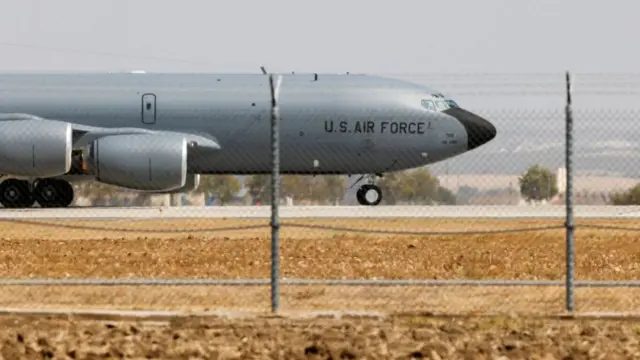
    A file photo of a US Air Force Boeing KC-135 Stratotanker, the type of aircraft involved in this incident

    What we know

    • A US military KC-135 refuelling aircraft has crashed in western Iraq
    • Two aircraft were involved in the incident, the second of which landed safely
    • The incident "was not due to hostile or friendly fire", US Central Command says
    • Rescue efforts are ongoing

    What we don't know

    • How many people were onboard and are there any casualties?
    • What caused the plane to crash?
    • When precisely did the incident happen - and where exactly are rescue operations happening?
  16. US military plane crashes in Iraqpublished at 22:01 GMT 12 March
    Breaking

    An US aircraft has crashed in Iraq, the American military has confirmed.

    A military KC-135 refuelling plane went down after an "incident" involving two aircraft, with "hostile fire or friendly fire" not involved.

    US Central Command says "rescue efforts are ongoing" in western Iraq - what the military describes as "friendly airspace".

    The second aircraft involved in the incident landed safely, a statement adds.

  17. Prayer suspended at Jerusalem holy sites over Iranian missile threatpublished at 21:45 GMT 12 March

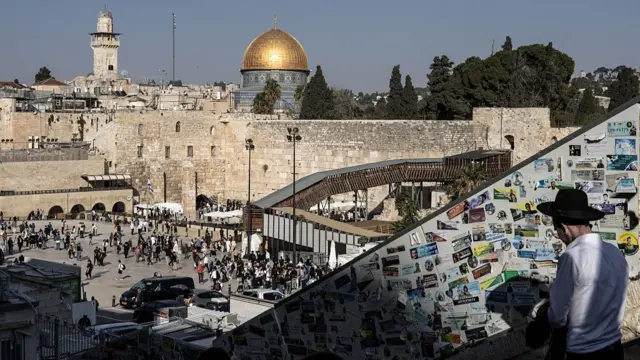
    A man walks down to the Western Wall as the Dome of the Rock at the Al-Aqsa mosque compound appears in the backgroundImage source, AFP via Getty Images

    Prayer at holy sites in Jerusalem has been "temporarily suspended" as a result of Iranian missile threats, Israel's foreign ministry said earlier.

    A statement read: "One of them struck a few hundred meters from the Old City, the Western Wall, Al-Aqsa Mosque and the Church of the Holy Sepulchre."

    As a result, the foreign ministry said prayer at "all holy sites" has been temporarily suspended to protect lives and preserve worshippers' safety.

    Some of the most significant places of worship connected to the Jewish, Muslim and Christian faiths are located in the city.

  18. Iran war moving along very rapidly, says Trumppublished at 21:16 GMT 12 March

    Donald TrumpImage source, Getty Images

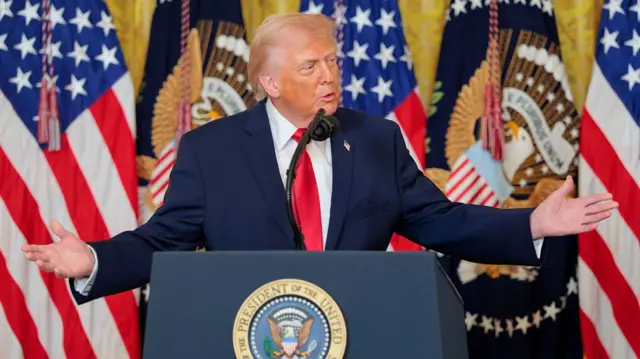
    Donald Trump briefly spoke about Iran during a White House event marking Women's History Month a short while ago.

    The US president said the situation in the Middle East is "moving along very rapidly" and "doing very well".

    He went on to call Iran "a nation of terror and hate", and suggested the country is "paying a big price right now".

    Trump has repeatedly said the joint US-Israel war on Iran is a short-term operation but has not indicated a firm date for when operations could end.

  19. Emirati minister speaks to BBC about war, Dubai and arrestspublished at 21:01 GMT 12 March

    Clive Myrie
    Reporting from Abu Dhabi

    Media caption,

    UAE minister 'not aware of all details' on arrests over filming missiles

    UAE’s Minister of State Lana Nusseibeh has condemned what she calls Iran's egregious, unlawful and unprovoked strikes on countries in the region.

    It was a shock, she says, not only because of the extent of the attacks, but the fact that Iran has drawn the wider region into this conflict.

    Nusseibeh refused to be drawn on whether her country would retaliate militarily against Iran, saying diplomacy has to be the way forward. She said the UAE has the right of self-defence, but that the US would not be allowed to use its airspace or territory to attack Iran.

    The Emirati minister says the economy is resilient and can absorb the shock of attacks on its oil infrastructure and the tourism industry, including strikes on Dubai International Airport and some hotels.

    She also said she was aware of reports that some people have been arrested under strict laws governing the taking of photographs of drone and missile strikes. Nusseibeh denies it’s an attempt to avoid painting a troubling picture of what life is really like at the moment in the UAE.

    You can read more from our conversation here.

  20. No 'significant injuries' after attack on joint Western base in Iraqpublished at 20:41 GMT 12 March

    Earlier we reported that a base in Erbil, northern Iraq, housing UK and US forces came under attack last night, with British forces shooting down two drones.

    Asked about the incident, a US defence official told BBC News there were no significant injuries as a result and all American soldiers stationed there remain on duty.

    The official said US forces at the base in northern Iraq have been defending against strikes since the beginning of the war.

    No British soldiers were injured in the attack either, BBC News understands.