Summary

  1. Defence spending, Greenland, Afghanistan - three times Trump has been critical of Natopublished at 13:06 BST 1 April

    During his first term, President Trump criticised Nato members for failing to spend more on defence, claiming the US was spending more than its European allies. BBC Verify has previously looked at the figures in more detail - read that here.

    Then in January of this year, Trump questioned the transatlantic alliance's loyalty at a time when he was threatening to take control of Greenland.

    Asked at the time by the BBC whether the possible break-up of Nato was a price he was willing to pay to acquire the territory, Trump responded: "Nobody has done more for Nato than I have, in every way."

    It came after he had questioned whether Nato would come to the aid of the US, should it be required: "I know we'll come to [Nato's] rescue, but I just really do question whether or not they'll come to ours."

    That same month, he was also highly critical of Nato and British troops in Afghanistan, claiming the alliance had sent "some troops" but "stayed a little back, a little off the front lines", sparking outrage from veterans and their families.


  2. Analysis

    Trump's threatened to leave Nato before - but this time he's angrier at alliance memberspublished at 12:40 BST 1 April

    Lyse Doucet
    Chief international correspondent

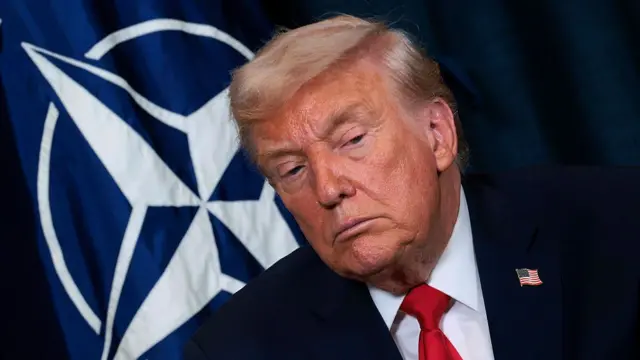
    U.S. President Donald Trump attends a bilateral meeting with NATO Secretary General Mark Rutte on the sidelines of the World Economic Forum (WEF) Annual Meeting on January 21, 2026 in Davos, SwitzerlandImage source, Getty Images

    Of all the warnings in President Trump’s arsenal, leaving the Nato military alliance is among those he’s wielded the most. He almost did it in his first term.

    Nato's former chief Jens Stoltenberg said "we saw clear signs that Trump was preparing to act on his threat", in his recent memoir On My Watch.

    Stoltenberg recounted how he went on Fox News and credited Trump with pressuring Nato allies to increase their military spending.

    Trump didn’t make the speech the White House had reportedly drafted for a US withdrawal.

    This time, in his second term, Trump is even angrier as Nato members hold back from joining a war they weren’t consulted on, and still don’t understand its goals.

    But some, including the UK, know they need to engage on some fronts, including the defence of Arab allies, as well as to help open the vital Strait of Hormuz.

    This new crisis will again strengthen the resolve of European countries and Canada to bolster their own defences.

    But there’s still that cold hard fact that the might of the US military matters - immensely. Nato's current chief Mark Rutte is also called the "Trump whisperer and has to do his utmost to keep the US president on side.

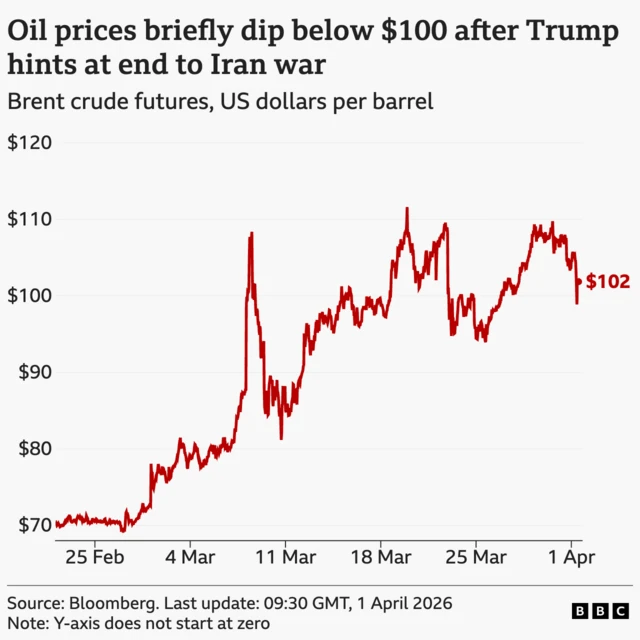
  3. As oil falls back to below $100 a barrel, here's how prices have fluctuated since war beganpublished at 12:29 BST 1 April

    Markets have been volatile throughout the war, with the price of oil in particular sliding up and down due to the effective closure of the Strait of Hormuz - one of the world's busiest oil shipping channels.

    Earlier, comments that seemed to hint at an end to the conflict - from US President Donald Trump and Iranian President Masoud Pezeshkian - resulted in oil prices falling back to below $100 a barrel (£75).

    The below graphic shows Brent crude's fluctuating price from since before the war started until now.

    A line chart showing the Brent crude oil price per barrel in US dollars from 23 February to 1 April 2026. The price opened at around $70 on 23 February, rose to a high of $112 on 19 March, and fluctuated before reaching $102 by 09:30 on 1 April. The source is Bloomberg.
  4. Analysis

    Trump's adept at changing rhetoric, so what does 'very soon' actually mean?published at 12:05 BST 1 April

    Paul Adams
    Diplomatic correspondent

    As always, with Donald Trump, it's important to remember that deadlines are constantly changing and that timelines are not always what they seem.

    As the president himself said last week, "in Trump time, a day is an eternity."

    As this war began, Trump suggested it might last "four to five weeks". White House officials have repeatedly used this formulation, with the Defence Secretary and others regularly saying Operation Epic Fury is ahead of schedule.

    We’re halfway through week five now, so the president's suggestion last night that the war will end "very soon" but might take another two to three weeks already feels like an admission that this is taking longer than anticipated.

    But deliberately or otherwise, the president paints a constantly shifting picture, talking one minute of negotiations proceeding rapidly and the next of threats to obliterate Iran’s energy infrastructure.

    As Pete Hegseth said on Tuesday, "the point is to be unpredictable".

    The president is adept at changing his rhetoric to suit altered circumstances. When he gives his "important update" later tonight, it will be interesting to see if he’s any clearer on the definition of "very soon" and what he expects to have achieved by then.

  5. How long does the US say this war will last?published at 11:56 BST 1 April

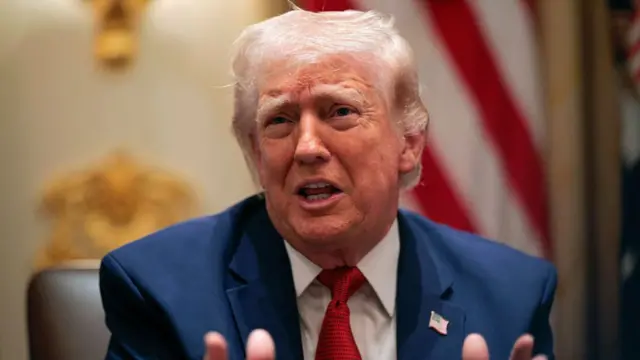
    President Donald Trump speaking during a cabinet meeting. His hands are gestured outward and he is mid speechImage source, Getty Images

    Donald Trump and his top officials appear to want a speedy exit from Iran as the US president signalled on Tuesday the country would exit the conflict soon. Let's take a look back at what he and others have said about when the war will end.

    • On 9 March, Trump told CBS that the war was “very complete, pretty much” - and later said the war would be over “pretty quickly”
    • Last week, Secretary of State Marco Rubio said the US expected to finish its operations in Iran “in the next couple of weeks”. That was echoed by White House Press Secretary Karoline Leavitt, who previously suggested the war could last up to six weeks
    • On Monday, Donald Trump said the US was in “serious discussions” with a new Iranian regime to end the American military operation - but only if a deal is reached and the Strait of Hormuz is immediately “open for business”. Iran denies having any negotiations with the US
    • On the Israeli side, Prime Minister Benjamin Netanyahu said on Monday that the war was “definitely beyond the halfway point”, later clarifying he meant in terms of missions, not time
    • Yesterday, US Defense Secretary Pete Hegseth said there was an “urgency” to finish the job - and that negotiations were “gaining strength”
    • Then, last night, Trump said the US will "leave" Iran in "two to three weeks" when it is certain the regime cannot build a nuclear weapon "for years"
  6. Analysis

    Starmer sending deliberate and meaningful message in updatepublished at 11:48 BST 1 April

    Henry Zeffman
    Chief political correspondent

    Media caption,

    Starmer: 'I do have to level with people on this, this will not be easy'

    The prime minister was adamant that he would not be choosing between the US and the EU.

    But Sir Keir Starmer decided to use today’s press conference, which was called in the context of a spiralling conflict about which the UK and the US profoundly disagree, to advertise his determination to get closer to the EU.

    That was a deliberate and meaningful political decision, even if Starmer has been moving in that direction for a few months now.

    We already knew that there was going to be a second annual UK-EU summit in a month or two’s time, and we already knew that the UK government hoped to use it not only to complete existing negotiations on areas of cooperation but also to seek deeper ties in other areas.

    Still, it was interesting to see how much emphasis Starmer placed on this summit as a moment of economic significance. That said, the PM said that Labour’s 2024 election manifesto still stood, which is to say the commitments that the UK would neither rejoin the EU’s customs union or its single market.

    But it feels increasingly like the government wants to get as close as possible to single market membership as it can from outside the bloc. Of course, Theresa May wanted that once too, but the EU resisted “cherrypicking” — the idea that the UK could have what it saw as the benefits of the single market (economic cooperation through shared regulations) without what it saw as the drawbacks (the free movement of people).

    Those old debates are coming right back to the heart of British politics.

  7. Bank of England: Conflict could lead to higher mortgage payments for 1.3m householdspublished at 11:42 BST 1 April

    Esyllt Carr
    Business reporter, BBC News

    An additional 1.3m households could face higher mortgage payments by the end of 2028 as a result of the conflict in the Middle East, according to the Bank of England’s latest report into the risks facing the global economy.

    The bank's financial policy committee says 5.2 million households could face increases in mortgage costs by the end of 2028, based on current rates, compared to 3.9 million before the conflict began.

    But it says in a new report “typical increases in mortgage payments would remain modest” compared with those in recent years, such as after the mini-budget in 2022.

    Since the US-Israel war in Iran began, oil and gas prices have increased rapidly, and the cost of government borrowing has risen.

  8. Analysis

    With Trump belittling the UK, Starmer repeated his desire for closer EU ties with urgencypublished at 11:26 BST 1 April

    Iain Watson
    Political correspondent

    What we heard from the prime minister this morning spanned the global to the local.

    He always insists he won’t choose between the US and Europe.

    But with Trump questioning Nato and belittling the UK’s military standing it was interesting that Keir Starmer didn’t just repeat his desire for more defence co-operation with the EU - he said it with more urgency.

    He also emphasised the desire for closer economic ties with the EU.

  9. UK PM not the only leader addressing war pressures as Australians told to 'do their bit'published at 11:10 BST 1 April

    Simon Atkinson
    Australia reporter

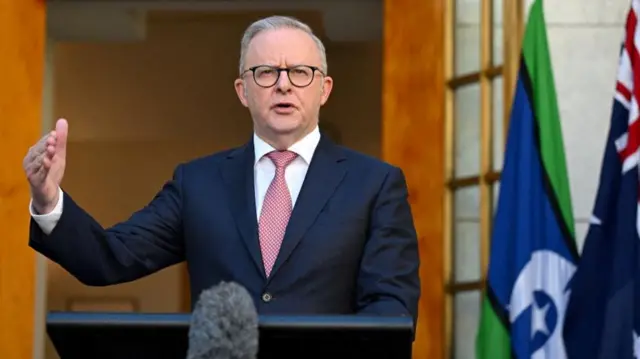
    Anthony Albanese is shown speaking behind a lectern, with a microphone in the foreground. He is wearing a blue suit and white shirt with a pink tie.Image source, Reuters

    Australia’s Prime Minster Anthony Albanese has delivered an address to the nation about how the country is being affected by the war in the Middle East.

    The broadcast speech comes the day fuel duty cuts mean petrol and diesel become a little cheaper for motorists who have been facing surging prices.

    Albanese tells Australians the months ahead may not be easy and calls on people to go about life as normal but asked them “do their bit”.

    This includes not taking more fuel than needed and for those who can, to switch to using public transport.

  10. Starmer says he acts in national interest 'whatever the noise' after Trump threatspublished at 10:54 BST 1 April

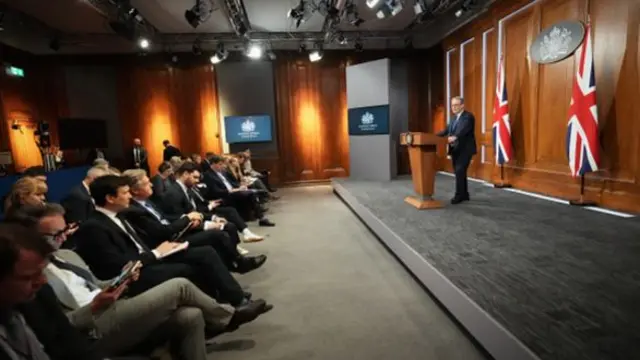
    A wide, side view of the press conference with Keir Starmer on the stage and the press sitting in seats.Image source, Getty Images

    The news conference has now come to an end, but before it did Starmer responded to a question about a recent threat from Trump that the US would no longer come to the aid of the UK.

    Starmer said there's been "a good deal of pressure on me to change my position in relation to joining the [Iran] war, and I'm not going to change my position on the war.

    "Whatever the pressure, whatever the noise, I am the British prime minister and I have to act in our national interests."

    As a reminder, Trump took to Truth Social yesterday to tell allies, including the UK: "You’ll have to start learning how to fight for yourself, the U.S.A. won’t be there to help you anymore".

  11. UK not going to choose between US and Europe - PMpublished at 10:47 BST 1 April

    Shortly before the press conference we reported Donald Trump was considering pulling the US out of Nato after repeated criticism of the bloc's refusal to become involved in the war. Trump has also singled out the UK and Starmer numerous times.

    Asked whether he's forging closer ties to Europe as his relationship with Trump deteriorates, Starmer says he's not choosing between the continent and the US.

    "I think it's in our interest to have a strong relationship with the US and with Europe," he says.

    "But I do think that when it comes to defence and security, energy emissions and the economy, we need a stronger relationship with Europe."

    Starmer also says that stronger co-operation with the continent will help relations with the United States.

  12. Starmer asked if people in UK should change habits due to impacts of warpublished at 10:41 BST 1 April

    Asked whether people in the UK should be looking at changing their behaviours in response to the increasing economic pressures, Starmer replies the government is monitoring the situation closely.

    He says the economic situation will all depend on how long the conflict goes on for, and how quickly the Strait of Hormuz re-opens.

    He is also asked about the rise in fuel duty that's scheduled for September - he says it's being kept under review, a position he has taken before.

  13. 'Increasingly clear UK's long-term interest requires closer ties with Europe'published at 10:35 BST 1 April

    Starmer says it is "increasingly clear" that the UK's "long-term national interest requires closer partnership with our allies in Europe and with the European Union".

    The opportunities to "strengthen our security and cut the cost of living" are "simply too big to ignore", he adds, announcing that a summit with EU partners will occur in the near future.

    In the coming weeks, he says he will announce a new summit with EU partners designed to forge partnerships in a "dangerous world".

    It comes following Donald Trump's repeated criticisms of the UK and European allies in response to the war.

  14. 'This will not be easy,' Starmer says of economic impactspublished at 10:26 BST 1 April

    Keir Starmer wears a dark suit and tie while delivering a press conference at Downing Street.Image source, Getty Images

    Starmer moves on to the economy. "I do have to level with people, this will not be easy," he says.

    Starmer says he is not prepared to ask the British people "once again, to go through a crisis, come out of it, and say 'business as usual, back to the status quo'".

    He refers to measures the government has previously announced to address living costs, including capping energy bills and having fuel duty cuts in place until September.

  15. Foreign secretary to host international summit on Strait of Hormuz, Starmer sayspublished at 10:22 BST 1 April

    Starmer announces Foreign Secretary Yvette Cooper will be hosting a summit of international leaders to discuss plans to restore freedom of navigation in the Strait of Hormuz.

    The Strait has been in effect blocked by Iran in response to Israeli-US strikes, causing global energy prices to rise as a result of the constraints on the key shipping corridor.

    Starmer reiterates previous assertions that the UK will not be drawn into the conflict in the Middle East and that the best way to address rising costs of living is to push for de-escalation and ensure the Strait of Hormuz is re-opened.

    Every diplomatic avenue available is being explored, he says.

  16. Watch live: Keir Starmer gives press conference on Iran warpublished at 10:14 BST 1 April
    Breaking

    Starmer

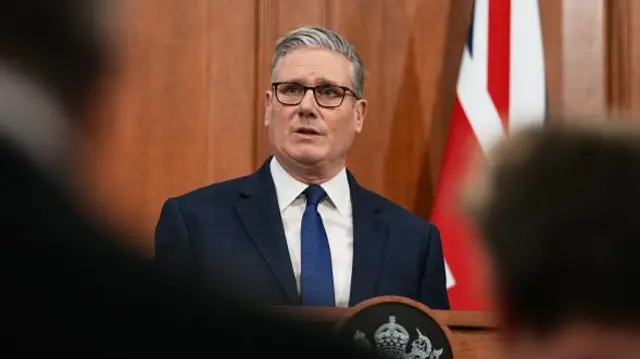
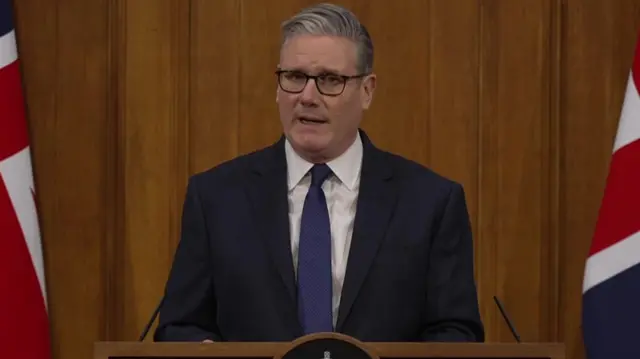
    Keir Starmer is delivering a press conference at Downing Street on the effects of the war in the Middle East.

    We will bring you the key lines and you can watch live by clicking play at the top of this page.

  17. Trump says he is strongly considering pulling out of Nato - Telegraph reportpublished at 10:13 BST 1 April
    Breaking

    Donald Trump is strongly considering pulling the US out of Nato, according to an interview he gave to the Telegraph.

    The newspaper says Trump called the alliance a "paper tiger" and claimed the UK does not have a navy.

    Asked if he would reconsider the US's membership of the alliance after the conflict in the Middle East, Trump said: “Oh yes, I would say [it’s] beyond reconsideration...

    “I was never swayed by Nato. I always knew they were a paper tiger, and Putin knows that too, by the way.”

    “You don’t even have a navy. You’re too old and had aircraft carriers that didn’t work,” he added, referring to the state of Britain’s fleet of warships.

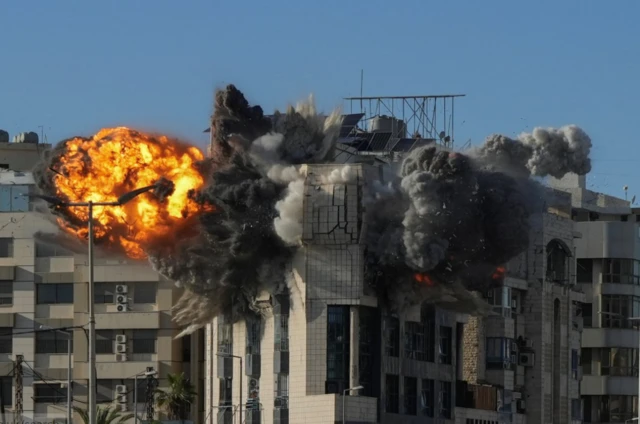
  18. Extensive damage in Lebanon as Israel continues strikingpublished at 10:10 BST 1 April

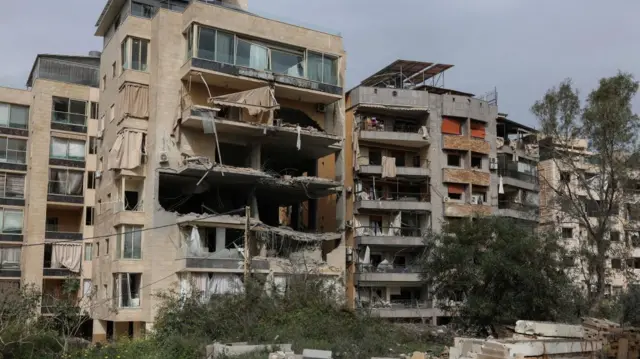
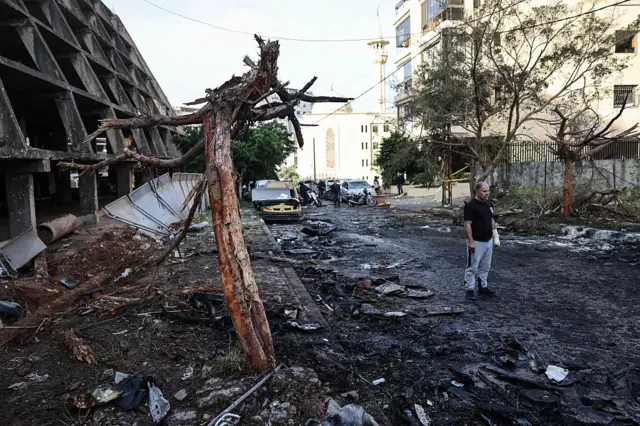
    We're seeing new pictures from Lebanon showing extensive damage to buildings and infrastructure.

    Israel has been carrying out strikes on the country since 2 March and last week expanded its ground operation into the south.

    A damaged block of flats in HadathImage source, Reuters
    Image caption,

    A heavily damaged building stands following an Israeli strike in Hadath

    A man walks among the debris on a street of Beirut in Lebanon, a heavily damaged building to the left of the frameImage source, AFP via Getty Images
    Image caption,

    As of Tuesday, 1,261 people have been killed in Israeli strikes on Lebanon, according to the country's health ministry

    An explosion goes off following a missile strike on a high building in Beirut. Large clouds of grey and black smoke emerge from inside the building as a fireball extends to the left side of the propertyImage source, Reuters
    Image caption,

    A building in Lebanon's capital, Beirut, struck by a missile during an Israeli strike on 31 March

  19. Analysis

    Starmer likely to face questions on deteriorating relations with Trumppublished at 09:53 BST 1 April

    Henry Zeffman
    Chief political correspondent

    Keir Starmer in a black suit, white shirt and patterned green tie sitting down at a table inside No10Image source, EPA

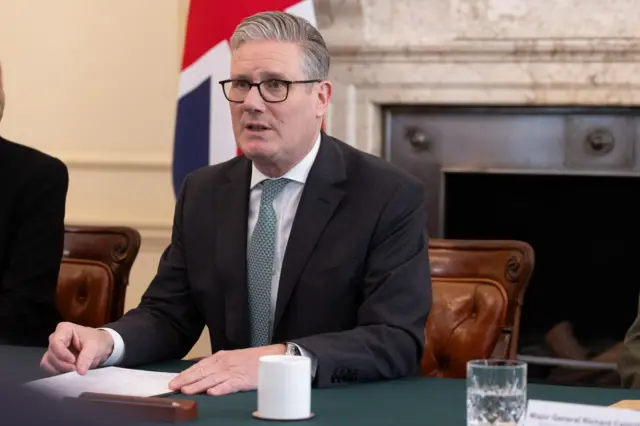
    Sir Keir Starmer will give a press conference from Downing Street soon, focusing on the conflict in the Middle East and what it means for the British economy.

    On the diplomatic side, expect the prime minister to face questions about his deteriorating relationship with President Trump. He may try to avoid responding directly to the president’s assertion that the UK should “go get your own oil” from the Strait of Hormuz.

    Yet it’s been striking in recent weeks how willing Starmer has been to embrace the fact that he resisted pressure from Trump for the UK to play a greater role in the war.

    On the economic side, expect the prime minister to reiterate the position of his chancellor that support is coming for those who need it – but not until the autumn. That is coming under pressure from opposition parties who believe that there are immediate measures the government should take both on fuel prices and household energy bills.

    As today is 1 April, there are various new prices taking effect today. The energy price cap of course – which means that for many prices will fall before the now-inevitable price rise – but also increases in the minimum wage rates, the state pension and working age benefits.

    It is likely that Starmer will argue that these amount to support with the cost of living, even though they were planned before this conflict.

  20. Houthis claim third strike on Israelpublished at 09:46 BST 1 April

    A spokesperson for the Iran-backed Houthis says the group has carried out a third strike on Israel.

    The Yemen-based group fired missile at "sensitive targets of the Israeli enemy" in the south of the country, Yahya Sarea says in a video statement translated by Reuters.

    He adds that the operation was conducted in co-operation with Iran and Hezbollah. The group entered the conflict on the weekend by firing projectiles at Israel.