Summary

  1. Inflation remains steady as food price rises easepublished at 10:17 BST

    Jacob Phillips
    Live reporter

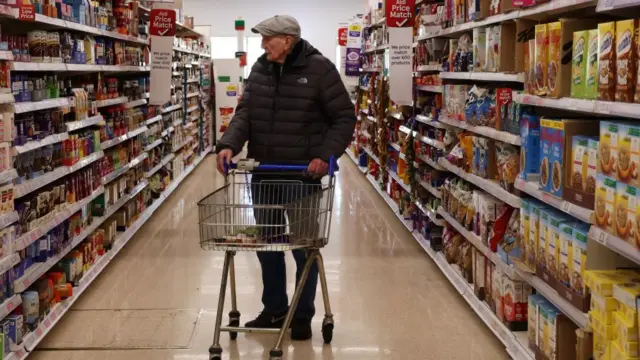
    An older man walks down a supermarket aisle with a shopping trolley. He is wearing a flat capImage source, EPA/Shutterstock

    The UK's inflation rate remained at 2.8% in the year to May, slightly lower than the 3% rise that was predicted by economists.

    It means prices are rising slower than feared - a genuine relief despite hints of bumps in the road, writes our deputy economics editor.

    The Office for National Statistics says the inflation rate held steady as rises in the cost of transport were offset by food prices easing. How will your shopping basket be impacted? We've taken a closer look.

    This month's figure of 2.8% is still above the Bank of England's 2% inflation rate target - set by the government.

    Chancellor Rachel Reeves insists Labour is "protecting families and businesses against rising costs" but Shadow Chancellor Mel Stride insists again that prices are rising too fast.

    Tomorrow the Bank of England will decide whether to change interest rates but economists say the new figures "strengthen the case" for rates to remain the same.

    We're now bringing our live coverage to an end, but you can read more in our news story and test your knowledge with five quickfire questions.

  2. How inflation will hit your shopping basketpublished at 09:44 BST

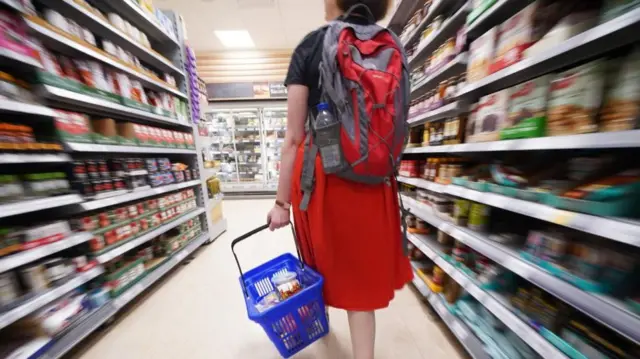
    A woman in a red skirt and wearing a red backpack holds a blue shopping basket as she walks down a shopping aisleImage source, PA Media

    The latest official inflation figures show that the pace of food price rises has eased, particularly for some meats, dairy products and vegetables.

    What does that mean for your shopping basket?

    In short, it means that overall grocery bills are still increasing, but the pace of price rises may have slowed. Although there are a few bright spots where prices have actually fallen.

    We've taken a look at the impact on some staples of the weekly shop:

    • Milk, cheese and eggs prices ticked up by 0.4% in May, compared to the year earlier
    • Bread costs rose by 1% in the year to May, compared to a 2% increase in the year to April
    • Pasta and couscous prices rose by 4.1%, compared to a 6.1% increase in the figures from the month before
    • The price of meat rose by 2.3% compared to 3.6% in the year to April - the ONS says that the price of beef and veal (it lumps them both together) rose by 9.3% in May - down from 27% in previous month's figures
    • Vegetables, including potatoes, rose by 2%, easing from a 3.3% increase in the year to April
    • Coffee prices rose by 2.5% in May compared to 6.3% in April
    • Low fat milk was cheaper in May, down 0.4% whereas whole milk prices grew by 7.2% - although that was a slowdown from a 10.7% increase in April's figures
    • The price of fish rose by 2.1% in the year to May compared to 5.7% in April
  3. Five quick-fire questions on everyday productspublished at 09:33 BST

    This Riddle post cannot be displayed in your browser. Please enable Javascript or try a different browser.

  4. Inflation rates in other parts of the world - a quick lookpublished at 09:18 BST

    We've had inflation rate figures coming in from other countries as well.

    In Sweden, the inflation rate stands at 1.5% in May, up from 0.8% in April, below the 2% target, with the Swedish Cenbank saying inflation is low and economic activity is somewhat weaker than normal.

    In Slovakia, the year-on-year EU-harmonised inflation rate eased to 4.0% from 4.3%, according to data released by the country's statistics office today.

    • For context: The EU-harmonised inflation rate - measured by the Harmonised Index of Consumer Prices - is the standardised metric used across European Union member states.

    The US inflation rate rose to 4.2% in May - the highest it has been since hitting 4% three years ago. This was largely driven by rising energy costs in the wake of the US-Israel war in Iran.

    The EU inflation rate was 3.2% in the year to April, up from 2.8% in the year to March. This figure is calculated using the EU-harmonised approach.

    Romania had the highest inflation rate in the EU in the year to April, having risen to 9.5%. Sweden had the lowest at 0.5%.

    The inflation rate in France was provisionally estimated as 2.8% in May, up from 2.5% in April.

    Meanwhile, Germany's inflation rate decreased to 2.7% in May, according to estimates. It was previously recorded at 2.9% in the year to April.

  5. Analysis

    A lull – but for how long?published at 08:51 BST

    Dharshini David
    Deputy economics editor

    Today’s inflation figures showed prices rising more slowly than feared in May.

    But another official measure of prices – which looks at raw material costs and wholesale prices - hints at some further bumps. The rate of increase in the former was at its highest in May for over three years, fuelled by higher oil and other energy costs.

    Those kind of cost hikes can take up to a year or more to work their way through supply chains to shop shelves.

    So analysts expect inflation to bump up further, to perhaps 4%. But it will remain a fraction of the kind of rates we saw shortly after Russia’s invasion of Ukraine. Not only have costs of energy and fertiliser risen by far less – but the landscape is different.

    A weak jobs market and more cautious consumers means retailers are more wary about hiking prices.

    There may already be hint of that in the moderation of price rises in food and furniture last month.

    Which bodes well for inflation falling back to target next year – if the deal between the US and Iran holds.

  6. Beef prices fall as households watch grocery billspublished at 08:47 BST

    Dearbail Jordan
    Senior business reporter

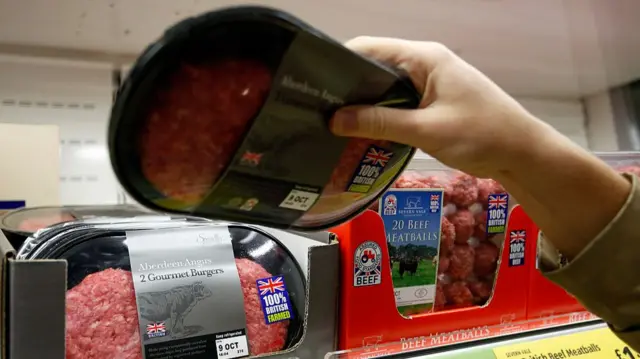
    A customer selects a packet of 100% British Farmed Aberdeen gourmet beef burgers at a supermarket.Image source, Getty Images

    According to the Office for National Statistics, one of the reasons the pace of food inflation slowed in May was because of the price of beef.

    As a reminder, food inflation fell from 3% in the year to April to 2.2% in the year to May.

    Why? Well, according to the Agriculture and Horticulture Development Board, British households just can't afford beef at the moment.

    At the same time, while the number of cows being slaughtered has fallen, carcasses weigh more so there's been oversupply.

    The ONS says that the price of beef and veal (it lumps them both together) rose by 9.3% in May which, admittedly is still high.

    But compared to previous months when prices jumped by as much as 27%, the slowdown is evident.

  7. Inflation remains steady at 2.8% - what does this mean for you?published at 08:41 BST

    Manish Pandey
    Live reporter

    The inflation rate in the UK remained at 2.8%, according to new figures from the Office for National Statistics.

    Here's a closer look at what this would mean for everyday costs:

    Fuel prices

    • The price of petrol and diesel has soared by 24.6%, with transport costs rising by 6.8%
    • As our economics editor writes, it's thought there is still some upward pressure on inflation working its way through the system, yet to be passed on to consumers in fuel and other prices

    The food shop

    Interest rates

    • The case for a hold on interest rates has strengthened, says Yael Selfin, chief economist at KPMG UK
    • Economists widely expect the Bank to maintain the core interest rate tomorrow at its current level of 3.75% - generally considered good news for people on a variable-rate or tracker mortgage
  8. Food prices 'will likely pick up' over coming months, says British Retail Consortiumpublished at 08:21 BST

    Emer Moreau
    Business reporter

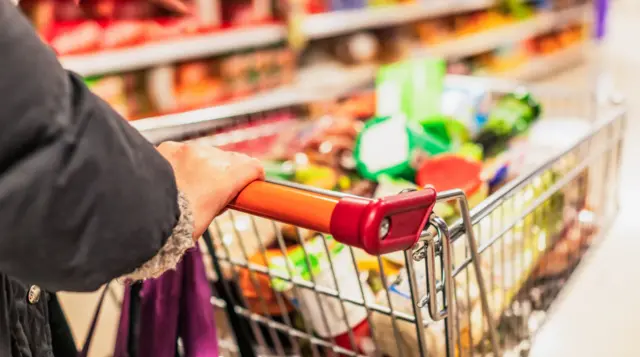
    Person rolls a shopping trolley full of products down a supermarket aisle.Image source, Getty Images

    Food inflation fell from 3% in the year to April to 2.2% in the year to May, the slowest rate of food inflation since December 2024.

    • As a reminder, the chief economist at the ONS says a rise in the inflation rate was "offset by lower food prices, with decreases in inflation seen across a range of meat, dairy and vegetable items compared to last month"

    The British Retail Consortium (BRC) says easing food inflation showed how competitive the British supermarket sector is.

    But Harvir Dhillon, a BRC economist, says that "it will likely pick up over the coming months as input costs rise, following the conflict in Iran".

  9. Consumer prices still don't reflect Strait of Hormuz closure, Food and Drink Federation chief sayspublished at 08:17 BST

    Dearbail Jordan
    Senior business reporter

    Vessels at the Strait of Hormuz.Image source, Reuters
    Image caption,

    The key oil shipping channel has been effectively closed by Iran since the war began in February

    The inflation rate remaining at 2.8% in May was a surprise, according to many economist forecasts.

    While food prices eased, that might not last according to the Food and Drink Federation.

    The lobby group's chief executive, Karen Betts, says: "Consumer prices still don’t reflect the inflation caused by the closure of the Strait of Hormuz.

    "It generally takes several months for the increased costs paid by farmers, processors and manufacturers to filter into raised prices at the tills, not least because of the widespread use of long-term contracts for energy and ingredients."

    She says manufacturers are having to pay more on transport, packaging and energy, therefore: "We expect food inflation to pick up this year and into next."

  10. Inflation figures could 'strengthen the case' for interest rate decision tomorrowpublished at 08:08 BST

    Emer Moreau
    Business reporter

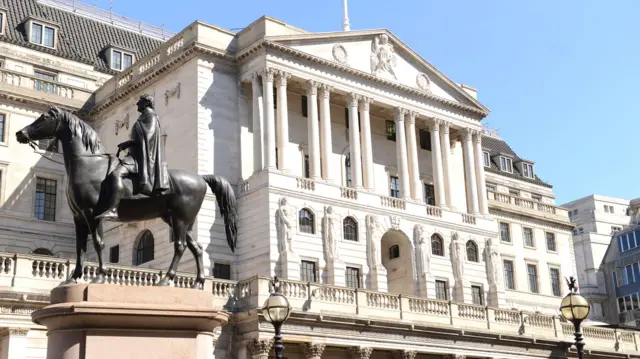
    Photo of Bank of England.Image source, Getty Images

    Today's inflation rate news comes ahead of the Bank of England's next interest rate decision on Thursday.

    Economists widely expect the Bank to hold the core interest rate at its current level of 3.75%.

    Yael Selfin, chief economist at KPMG UK, said the new figures "strengthen the case" for a hold on interest rates.

    "Underlying inflationary pressures have yet to show clear signs of strengthening, which is likely to underpin a majority decision within the Monetary Policy Committee to hold interest rates at Thursday's meeting," she says.

    On fuel prices, Selfin say: "Motorists have been squeezed by higher petrol prices since March, however this now looks set to reverse as energy prices ease amid progress towards reopening the Strait of Hormuz.

    "Nonetheless, the adverse impacts of the disruption to energy supplies are already in the pipeline, with household energy bills set to rise by 13% from next month."

  11. Analysis

    Upward pressure on inflation yet to manifest in fuel prices for consumerspublished at 07:53 BST

    Faisal Islam
    Economics editor

    The best measure of inflation in the pipeline, what are known as Input Producer Prices, were up 8.7% in May on the year, after a 71.8% increase in crude oil prices in the year to May. It’s the highest rate since February 2023.

    This suggests there is still some upward pressure on inflation working its way through the system, yet to be passed on to consumers in fuel and other prices.

    The slightly better news here is that in the month of May that crude oil factor had already fallen back 5.9%. This month it had fallen yet further, to within range of pre-Iran war levels.

    Food price pressures are also calming for now, but there are many concerns about the price of fertiliser, which is globally reliant on chemicals manufactured from the Gulf petrochemical industry.

    All of this will be greatly helped if the Strait of Hormuz reopens properly.

  12. 'Prices are still rising too fast,' says shadow chancellorpublished at 07:34 BST

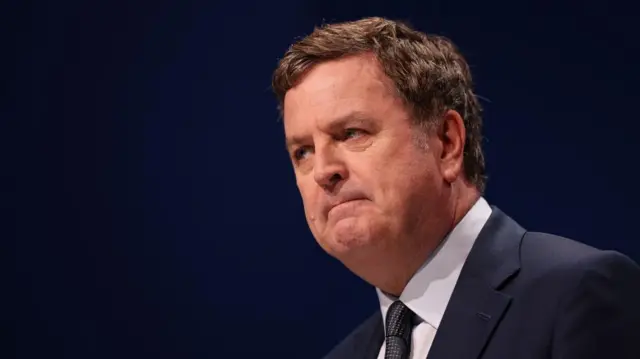
    Mel Stride looks stern as he delivers a speech in October 2025. He is wearing a dark suit and is against a dark blue backgroundImage source, EPA/Shutterstock

    Mel Stride insists that "prices are still rising too fast" following the release of the latest inflation figures.

    "Thanks to Labour’s choices the UK went into the latest energy crisis with the highest inflation in the G7," the shadow chancellor says in a post on X.

    He adds: "Rachel Reeves has increased the deficit by 75% and those lining up to replace Keir Starmer want to borrow even more."

    Stride says that only the Conservatives "have a leader with the backbone and strong team needed to build a stronger economy and get Britain working again".

  13. UK government has got the right economic plan, Chancellor sayspublished at 07:31 BST
    Breaking

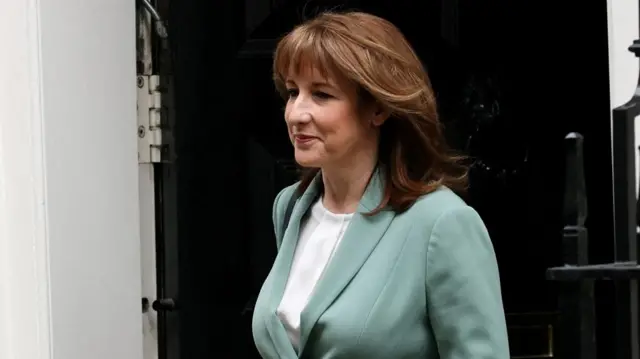
    Rachel Reeves steps out of 11 Downing Street wearing a teal suit and a white shirtImage source, Reuters

    Chancellor Rachel Reeves says that while conflict in the Middle East pushes prices up globally, the UK government has "got the right economic plan and inflation has held steady".

    As a reminder, prices in the UK rose by 2.8% in the year to May, the same rate as the previous month, according to new figures.

    She adds: "We’re protecting families and businesses from rising costs, with cuts in energy bills and freezes in fuel duty and rail fares.

    "This is the right economic plan to build a stronger more secure Britain."

    Quote Message

    We’re protecting families and businesses from rising costs"

    Chancellor Rachel Reeves

  14. Motor fuel and air fare prices risepublished at 07:26 BST

    Dearbail Jordan
    Senior business reporter

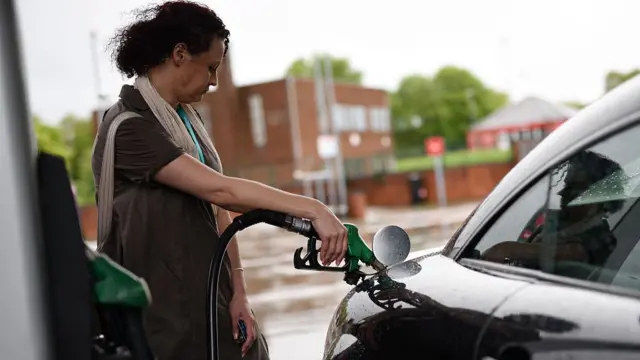
    A woman puts fuel in her car at a filling station.Image source, Getty Images

    The biggest contribution to inflation was transport prices, in particular air fares and motor fuel.

    The price of petrol and diesel soared by 24.6% in the 12 months to May 2026 - the highest since September 2022.

    No surprise there - this was fuelled by the US-Israel war with Iran and the closure of key Strait of Hormuz oil route.

    Plane tickets were also more expensive than a year ago.

    Overall, prices in transport rose by 6.8%, ahead of a 4.5% increase in the year to April.

  15. Analysis

    Today's figure raises hope the cost of living squeeze won't be as bad as fearedpublished at 07:15 BST

    Dharshini David
    Deputy economics editor

    Genuine relief.

    The failure of inflation to rebound as expected last month raises hope the cost of living squeeze won’t be as bad as feared this year.

    But at one point, there were hopes that inflation would have returned to its 2% target this spring; these figures are a reminder of the price pressures a war thousands of miles away have exerted at home.

    With higher energy costs, however, taking several months to feed through to other areas such as food it is likely that inflation will rise a bit further this year.

    But most economists expect it to remain below 4% as the deal to bring about an end to the Iran war allows vessels through the Strait of Hormuz and energy production to rebound fully in the Middle East.

  16. Inflation remains steady as transport price rises offset by ease in food pricespublished at 07:10 BST

    We're now hearing from ONS Chief Economist Grant Fitzner, who says the inflation rate held steady as rises in the prices of air fares, vehicle taxes and petrol was offset by an ease in food prices.

    Fitzner adds decreases in inflation were "seen across a range of meat, dairy and vegetable items compared to last month, as well as the cost of domestic heating oil, which fell back after climbing in recent months".

    He says the annual cost of raw materials continued to increase, led by rises in the cost of chemicals.

    The increase in the cost of goods leaving factories also slowed, partially due to a drop in the cost of domestically produced cars, he adds.

  17. May inflation rate comes as a surprisepublished at 07:05 BST

    Dearbail Jordan
    Senior business reporter

    The inflation rate remaining at 2.8% in the year to May is a surprise.

    Economists had been expected the pace of price rises to increase to 3%.

    We'll bring you details of the data shortly.

  18. UK inflation rate remains at 2.8%, ONS figures showpublished at 07:01 BST
    Breaking

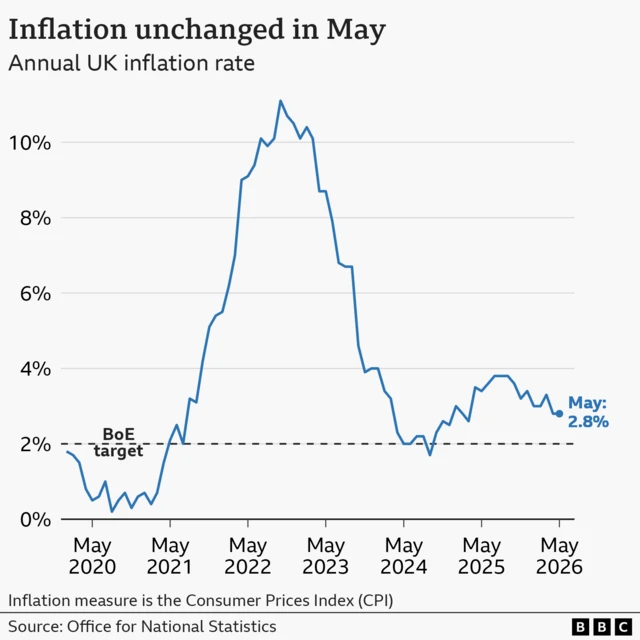
    The UK's inflation rate remains at 2.8% in the year to May, the latest figures from the Office for National Statistics (ONS) show.

    Line chart of the UK's Consumer Price Index annual inflation rate,  from January 2020 onwards In the year to January 2020, inflation was 1.8%.  It then fell close to 0% in late-2020 before rising sharply,  hitting a high of 11.1% in October 2022. It then fell to a low of 1.7%  in September 2024 before rising again. In the year to May 2026,  prices rose by 2.8%, unchanged compared with the 12 months to April 2026.
  19. How does the inflation rate affect you?published at 06:55 BST

    The inflation rate measures the pace of price increases of goods or services over a period of time.

    So, if the pace of inflation rises it means everyday essentials such as food, energy and transport are more expensive.

    The rising cost of goods and services has an impact on the money you save or earn - as you are having to pay more.

    It erodes your spending power unless your pay is rising faster than inflation. This causes many households to feel squeezed.

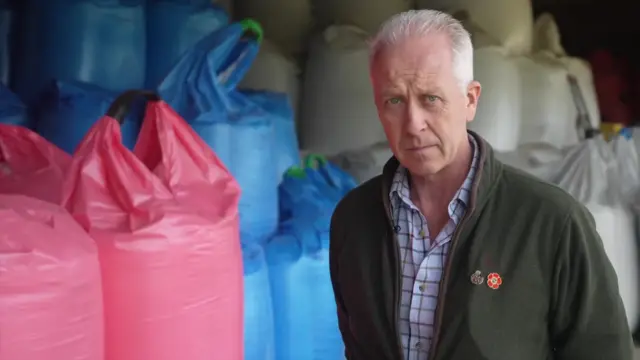
  20. 'We are on a knife edge': Farmers weigh up whether to plantpublished at 06:45 BST

    Priya Patel
    Economics producer

    Al Booth a farmer

    Some farmers say increases in food prices later this year now look unavoidable because of disruption in the Strait of Hormuz since the start of the Iran war in February.

    Hampshire farmer Al Brooks tells BBC News fertiliser costs have risen by "45% or more", warning prices are unlikely to return to previous levels even if global tensions ease.

    He says recent volatility has been "so sharp" that any savings "don’t carry through", as many farmers have already paid high prices to secure supplies for next season.

    "We have committed...we’ve had to budget, look at our cash flow, and decide whether it is worth planting. I’ve already bought my fertiliser ready for next year," he says. "We are on a knife edge with what we’re doing."

    Booth adds that some farmers are now questioning whether to plant at all. "There are a lot of farm businesses...asking whether it’s even worth it," he says.

    "This is affecting people’s mental health quite, quite badly."