Summary

  1. Khamenei burial marks the end of six days of public mourningpublished at 14:58 BST

    Lyse Doucet
    Chief international correspondent
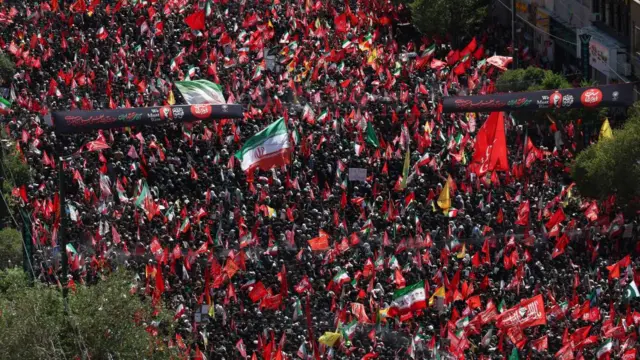
    Hundreds of people carrying red flags or Iranian flags line the streets during the last day of mourning for the former Iranian supreme leader Ali KhameneiImage source, Reuters

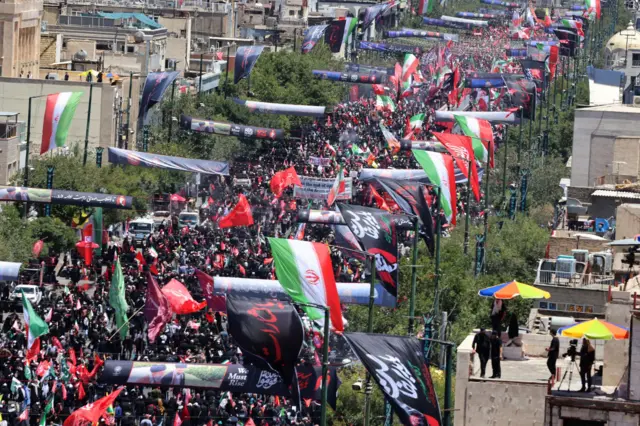
    This marks the end of six days of public mourning in five cities, in Iran and neighbouring Iraq – funeral ceremonies replete with religious and political symbolism.

    On this final day, huge crowds again filled the main streets, this time leading to the golden domed Shrine of Iman Reza in Mashhad, Iran’s holiest city and the birthplace of Ayatollah Ali Khamenei.

    The most loyal, the most religious waved Iranian flags and photographs, and placards calling for revenge.

    Other Iranians, who always opposed his authoritarian rule, stayed away.

    And still not seen is the Ayatollah’s son and successor, Mojtaba Khamenei, who was severely injured in the US-Israeli attacks which killed his father.

  2. No US bases in Middle East safe from heavy fire, IRGC warnspublished at 14:46 BST

    Iran's Islamic Revolutionary Guard Corps (IRGC) has warned the US against carrying out further attacks in the Middle East following reports of a strike on a US-linked air base in Jordan.

    The IRGC is quoted in Iranian media as saying that if the US "repeats its aggression, no other US bases in the region will be safe from our heavy fire".

    The statement adds: "If anyone attacks you, then attack him in the same way that he attacks you."

  3. US-linked air base in Jordan hit by 10 missiles in Iranian attack - reportspublished at 14:43 BST

    An air base in Jordan has been hit by 10 missiles in an attack by Iran's Islamic Revolutionary Guard Corps (IRGC), according to state media.

    State-run outlet IRIB, and other Iranian media, cite IRGC as saying the Muwaffaq Salti Air Base in Azraq - which is linked to the United States - has been "destroyed".

    Jordan has not confirmed the attack.

    Earlier, a spokesperson for Jordan's government said sirens sounded after Iranian missiles were launched at the country this afternoon.

    The spokesperson said the missiles had been intercepted and the armed forces are on high alert.

    We'll bring you more from the IRGC statement shortly.

  4. BBC Verify

    How have ships been getting through the Strait of Hormuz?published at 14:17 BST

    By Thomas Copeland and Libby Rogers

    Iran has been trying to assert control over the Strait of Hormuz and has demanded that ships take a government-approved route close to its Gulf coast.

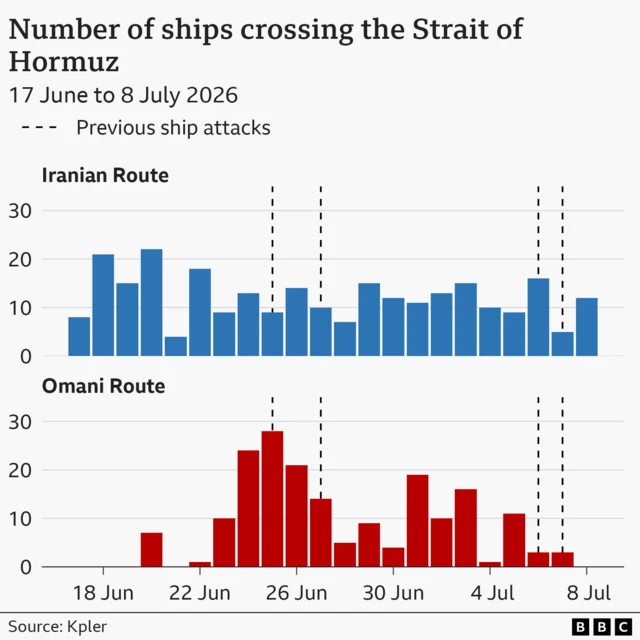
    Since a deal to end the war with the US was signed on 17 June, Iran has been blamed for five strikes on ships using a different route through the strait, recommended by the American military, using Omani waters.

    New data from the maritime intelligence firm Kpler shows that no ships used the Omani route yesterday - falling from just three ships the day before.

    Of the 23 ships that moved through the strait yesterday, Kpler’s data shows at least 12 used Iran’s northern route instead.

    Bar chart titled “Number of ships crossing the Strait of Hormuz, 17 June to 8 July 2026”. Two panels compare daily crossings on the Iranian route (blue) and Omani route (red). Dashed vertical lines mark previous ship attacks around 25 and 27 June. The Iranian route remains relatively steady throughout the period, generally between about 8 and 22 ships per day. The Omani route shows a sharp increase around the attack dates, peaking at nearly 30 ships on 25 June, before declining but remaining variable into early July. Source: Kpler.
    Return to the latest post
  5. BBC Verify

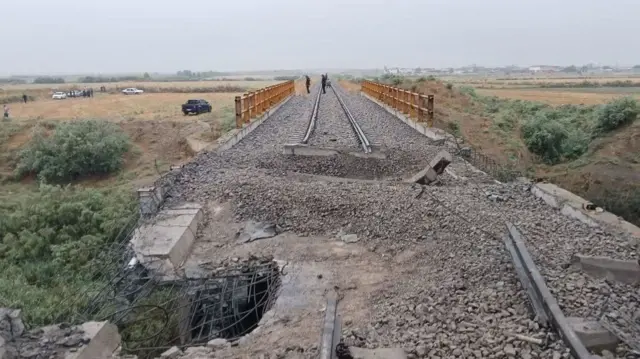
    Verified footage shows damage to railway bridge in northern Iranpublished at 14:01 BST

    A damaged railway bridge, the tracks have been split by a large crater, a large section of railings are destroyed and there is a hole in the side of itImage source, Tasnim

    By Shayan Sardarizadeh

    Videos and images published by Iranian media showing damage to a railway bridge in the northern city of Aqqala have been verified.

    Two videos filmed overnight show damage to Agh Tekkeh Khan railway bridge in Iran’s Golestan province, nearly 40km (25 miles) east of the Caspian Sea.

    Photos published by Iranian media this morning show a hole and a crater on the bridge, with visible damage to the railway track and debris scattered around.

    The Islamic Revolutionary Guard Corps (IRGC) says the bridge was targeted by a US cruise missile, but there had been no casualties.

  6. Thousands walk alongside Khamenei's coffin before burialpublished at 13:35 BST

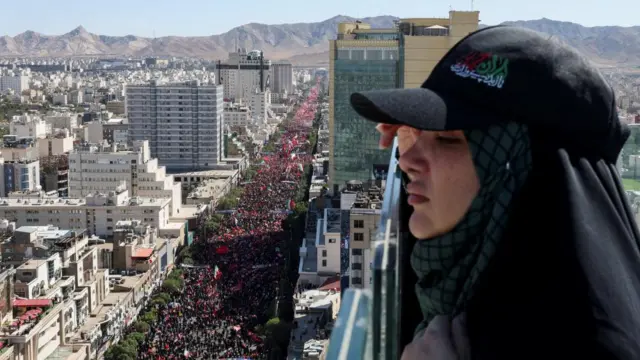
    A woman stands on the roof of a building and looks across at crowds. A thick stream of people can be seen down a main street. Mountains can be seen surrounding the building in the backgroundImage source, Reuters

    As strikes are reported in Iran and Jordan, the final funeral procession of the former Iranian Supreme Leader, Ali Khamenei, has been making its way through the streets of Mashhad in north-eastern Iran.

    There have already been six days of funeral events ahead of the burial, including a procession on a 10km (6-mile) route that passed through the capital Tehran's landmark Enghelab Square on Monday.

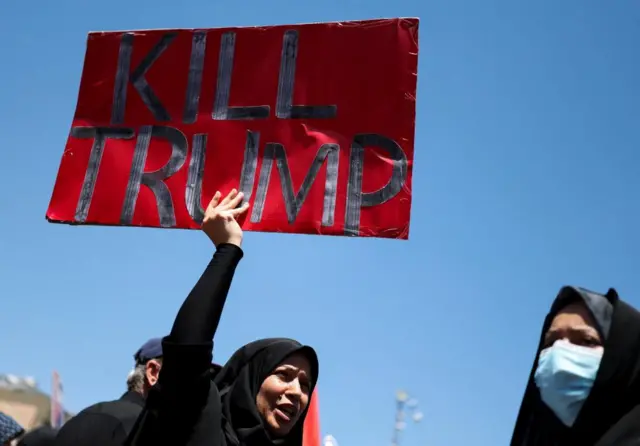
    Thousands of flags and signs - some showing pictures Khamenei and others calling for US President Donald Trump to be killed - have also been on display.

    An open lorry moves slowly through the street surrounded by hundreds of people. Many have red flagsImage source, Reuters
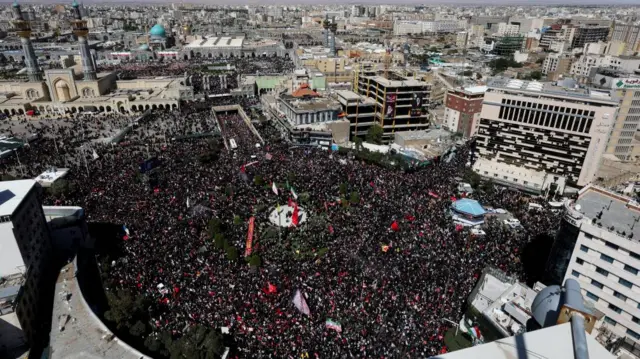
    Large crowds gather near a major roundabout in Mashad in Iran. Several large flags can be seenImage source, Reuters
    Image caption,

    Mourners gather in Mashhad on the day of the burial of Iran's late Supreme Leader Ayatollah Ali Khamenei

  7. BBC Verify

    Major damage to Iranian port control tower after overnight US strikespublished at 13:25 BST

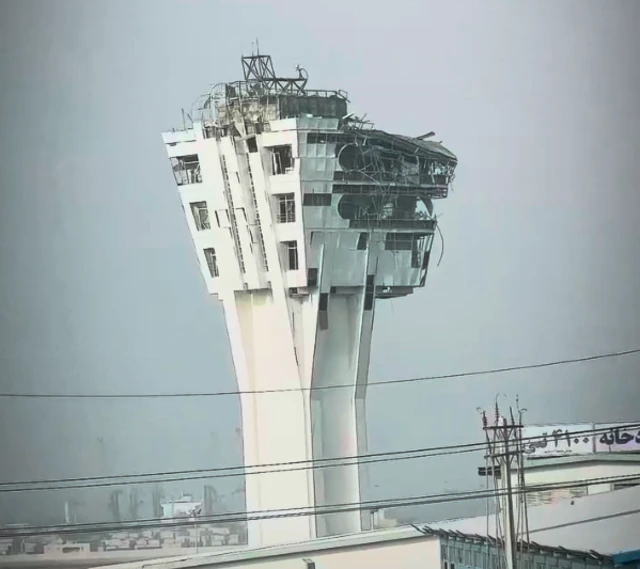
    A screengrab of a video showing a tower with several floors collapsed, you can see destroyed windows, rubble and exposed metal in the damaged areaImage source, Instagram

    By Ghoncheh Habibiazad and Sherie Ryder

    Two verified videos show damage to the control tower at a major port in the south-eastern Iranian city of Chabahar following overnight US strikes.

    Both clips - one filmed during the night and the other this morning - show severe structural damage, including a partially collapsed roof, on the Beheshti Port tower.

    A caption attached to the daytime video reads: "For us, it wasn't just a tower... it was part of Chabahar."

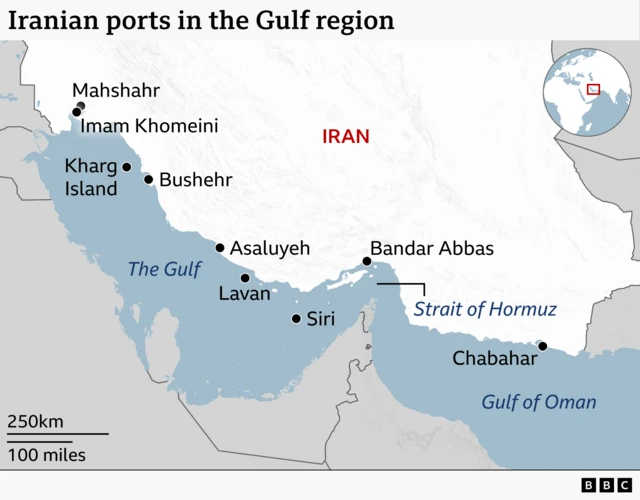
    Suggested alt text: Map titled “Iranian ports in the Gulf region” showing the southern coastline of Iran along the Persian Gulf and the Gulf of Oman. Labeled Iranian ports include Mahshahr, Imam Khomeini, Kharg Island, Bushehr, Asaluyeh, Lavan, Siri, Bandar Abbas, and Chabahar. The Strait of Hormuz is marked between the Gulf and the Gulf of Oman. Iran is highlighted in light grey, surrounding waters in blue, with a distance scale in kilometers and miles.
  8. IRGC says it has control over Strait of Hormuz and threatens 'crushing response' to interferencepublished at 13:23 BST

    Iran's Islamic Revolutionary Guard Corps (IRGC) says Iranian forces have established control over the Strait of Hormuz.

    It says that it is has "maintained [the strait's] security" and begun its "gradual reopening" over the past two weeks, according to a statement published on the IRGC-affiliated Tasnim news agency.

    It says traffic through the waterway has reached "around 50%" of its pre-war levels, and "continues to increase" for vessels which obtain "authorisation" from Iran.

    "Once again we declare that foreign powers have no claim to this land or to the Strait of Hormuz," the statement says.

    Any interference will result in a "crushing response", it says.

    BBC Verify has been looking at data of traffic in the strait, which shows that 23 cargo ships and tankers crossed it on 8 July.

    An average of 138 ships passed through the strait each day before the conflict started on 28 February, according to the Joint Maritime Information Centre.

  9. New attacks on US sites a response to overnight strikes, says Iranian state-linked mediapublished at 13:20 BST

    Iran's Mehr news agency says that Iran began a new wave of attacks against US targets in response to America's overnight attacks on areas in the south of Iran.

    The news outlet, which is linked to the Iranian regime, says that sites in Kuwait have been targeted in missile attacks launched by the Islamic Revolutionary Guard Corps (IRGC).

    It also reports missile attacks on US bases in Jordan - which, as we reported in our previous post, has shot down eight missiles in its airspace, according to state media.

    Explosions have also been reported at the Victory Base in Baghdad, Iraq, it adds.

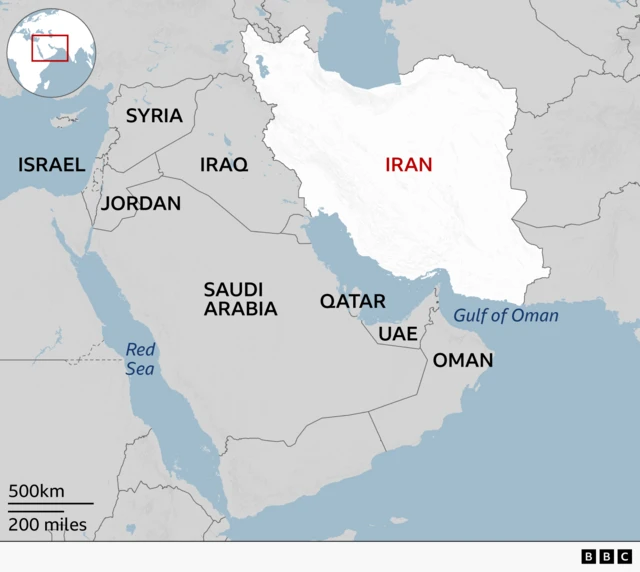
    A regional map highlighting Iran in white with its name in black. Countries that have come under fire from Iran and its allies are labelled - Israel, Cyprus, Lebanon, Iraq, Kuwait, Jordan, Bahrain, Qatar, UAE, Oman, Saudi Arabia, Azerbaijan, Syria. Surrounding countries are grey.
  10. Jordan intercepts eight missiles - state mediapublished at 12:41 BST

    Jordan's armed forces tells the country's state-run Petra News Agency that air defence systems "intercepted and shot down" eight missiles launched from Iran this afternoon.

    Some shrapnel fell but no casualties or material damage have been reported, the outlet reports.

    It comes after sirens sounded earlier, with a government spokesperson confirming the attempted strikes.

    The US, which operates a military base in Jordan, is yet to comment.

    Iranian media has accused the US of striking close to a nuclear power plant earlier today.

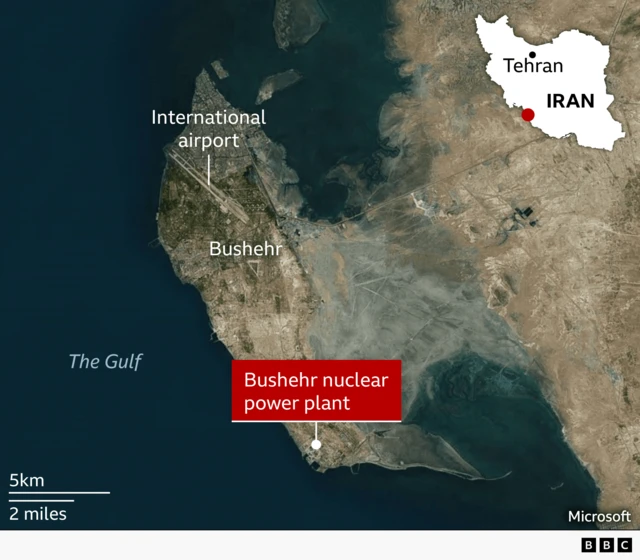
  11. Nuclear power plant targeted in new US attack - Iranian mediapublished at 12:29 BST
    Breaking

    Iranian state-linked media is reporting that the Bushehr nuclear power plant has been targeted this afternoon.

    A comment, attributed to a deputy governor of the province and shared by state-linked Iranian media outlets, says that the perimeter of the plant was hit by projectiles fired by the US.

    The US has not commented on the latest strikes.

    As we've been reporting, a number of Iranian missiles were shot down over Jordan in the last couple of hours.

    A satellite map of southwestern Iran showing the city of Bushehr on the coast of the Gulf. The Bushehr nuclear power plant is marked with a red label near the southern tip of the peninsula. The international airport is labelled just northwest of the city.
  12. Missiles launched from Iran 'entered Jordanian airspace'published at 12:23 BST

    A Jordanian government spokesperson has told the state-run Petra News Agency that sirens were sounded after missiles launched from Iran this afternoon entered Jordan's airspace.

    The spokesperson told the news agency they had been intercepted and Jordan's armed forces are on high alert to deal with any further threats.

    Earlier a correspondent from the AFP news agency reported hearing sirens blaring in Jordan.

    Jordan hosts US troops and military installations.

  13. US embassy in Jordan tells people to seek cover over missile threatpublished at 12:09 BST
    Breaking

    The US Embassy in Jordan has told American citizens to seek cover as "reports indicate missiles, drones, or rockets are in Jordanian airspace".

    It says that it will continue to review the situation and provide further information as needed.

  14. Air alert sirens sound in Jordanpublished at 12:07 BST
    Breaking

    Sirens have been heard in Jordan, according to its state broadcaster and the AFP news agency.

    We'll have more details on this shortly.

  15. One injured after Kuwait intercepts missile and drone attackpublished at 11:45 BST

    One person was injured by falling debris after missiles and drones were launched at Kuwait, its defence ministry says.

    In a statement posted on X, the defence ministry says three ballistic missiles, one cruise missile and 10 drones were intercepted overnight.

  16. BBC Verify

    Strait of Hormuz ship traffic down to 23 ships yesterdaypublished at 11:23 BST

    By Thomas Copeland and Libby Rogers

    Just 23 cargo ships and tankers crossed the Strait of Hormuz on 8 July, according to data from the maritime intelligence firm Kpler.

    This is down from 36 ships on 7 July. Of the ships that crossed on 8 July, at least 12 crossed via Iran’s northern route through the strait, the data shows.

  17. Crowds grow ahead of former supreme leader's funeralpublished at 11:14 BST

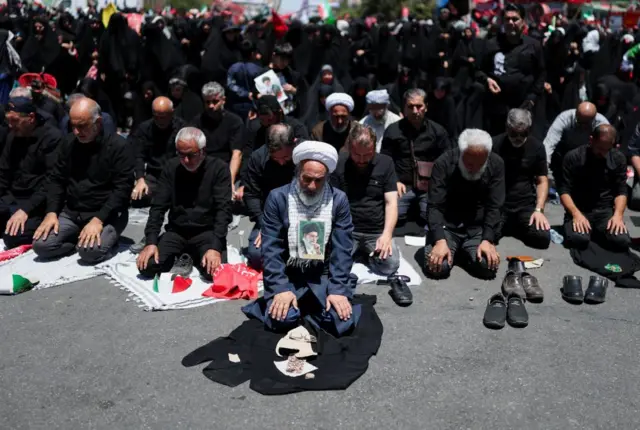
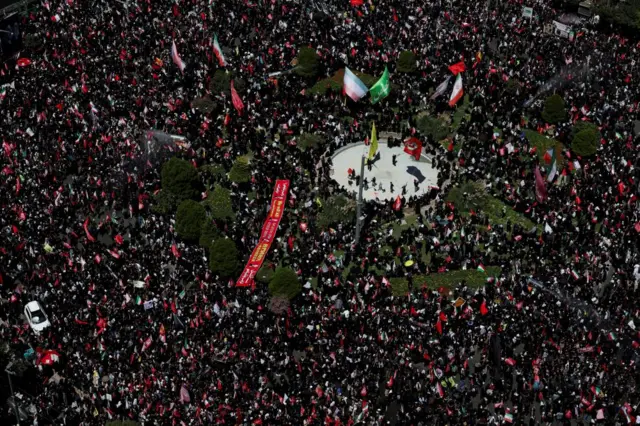
    Thousands of people are on the streets of Mashhad in northeastern Iran ahead of the late Supreme Leader Ali Khamenei's burial.

    Many are waving Iranian flags, while some have been pictured holding signs calling for US President Donald Trump to be killed.

    Khamenei was killed in February during the first hours of the US-Israel war against Iran, and today's funeral is the culmination of a carefully orchestrated six-day event.

    Crowds take over the streets of Mashhad for the final day of Supreme Leader Khamenei's funeralImage source, Getty Images
    A woman holds a "kill Trump" signImage source, Reuters
    People praying on their knees in MashhadImage source, Reuters
    An aerial of mourners gathering in MashhadImage source, Reuters
  18. Explosions heard in Iranian port city - state mediapublished at 11:08 BST

    People in Bushehr, a port city in southern Iran, have reported the sound of two explosions, state media organisations Fars and Mehr say.

    It is not clear what caused the explosions - we'll bring you more detail when we have it.

  19. The fraught situation in the Strait of Hormuzpublished at 10:48 BST

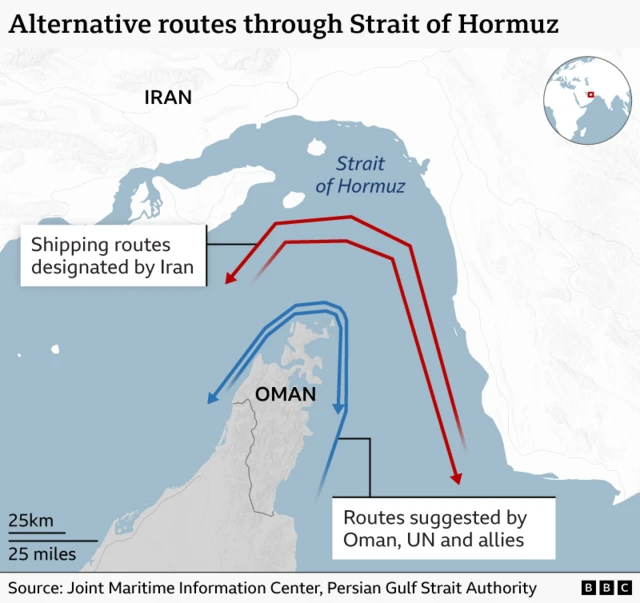
    Ships hoping to sail through the Strait of Hormuz face a confusing picture, with both sides seeking to push traffic through different routes.

    Vessels have been advised to avoid going through the middle of the Strait of Hormuz due to the ongoing conflict.

    The Joint Maritime Information Center (JMIC) - which the US is a member of - has recommended vessels take a route close to the coast of Oman at the south of the strait, in order to avoid the risk of Iranian mines.

    But Iran says no vessel is permitted to pass through the strait unless it travels along a designated route further north, closer to its coastline.

    Its Persian Gulf Strait Authority will only issue permits if that route is taken, with others "strictly prohibited".

    These competing attempts to manage how the strait operates have added to the fraught situation facing shipping companies in the vitally important shipping lane.

    Map of the Strait of Hormuz showing two sets of alternative shipping routes. Red arrows mark shipping lanes designated by Iran, running through the northern part of the strait near the Iranian coast. Blue arrows mark routes suggested by Oman, the UN and allies, running farther south around the coast of Oman. Iran is labelled to the north and Oman to the south. An inset map shows the strait’s location between the Gulf and the Gulf of Oman.
  20. Iran accuses US of 'flagrant breach' of truce agreementpublished at 10:32 BST

    The Iranian foreign ministry has accused the US of a "flagrant breach" of parts of the memorandum of understanding (MoU) signed on 17 June, which brought about a temporary truce.

    That called for an "immediate and permanent termination of military operations", and said Iran would "make arrangements using its best efforts for the safe passage of commercial vessels" through the Strait of Hormuz.

    How both sides interpret that part of the MoU has become a key point of tensions in this conflict.

    The foreign ministry says the US carried out attacks under the "false pretext" of responding to "alleged incidents involving several non-compliant vessels" in the strait.

    The US previously accused Iran of a "clear violation of the ceasefire" for targeting three commercial ships in the strait. Iran has not claimed responsibility for those attacks.

    The foreign ministry also condemns "crude rhetoric" from Donald Trump, who on Wednesday called Iran's leadership "scum" and "cuckoo".

    It accuses the US of a "grave war crime" for the targeting of several locations, including two railway bridges.