Summary

  1. BBC Verify

    Video shows fire at southern Iranian fishing dock after US strikespublished at 15:31 BST 8 July

    By Shayan Sardarizadeh

    BBC Verify has authenticated footage showing the aftermath of overnight US strikes on the southern Iranian town of Kuhestak, in Hormozgan province near the Strait of Hormuz.

    The first part of the video, filmed at night, shows multiple fires and smoke at what appears to be a fishing dock.

    The second verified clip, filmed from the Kuhestak beach in the morning, shows a column of black smoke billowing from the dock.

    Checks by BBC Verify indicate that the footage is recent and has not been manipulated with AI tools.

    Media caption,

    Video shows fire at southern Iranian fishing dock after US strikes
  2. What's been going on at Nato?published at 15:18 BST 8 July

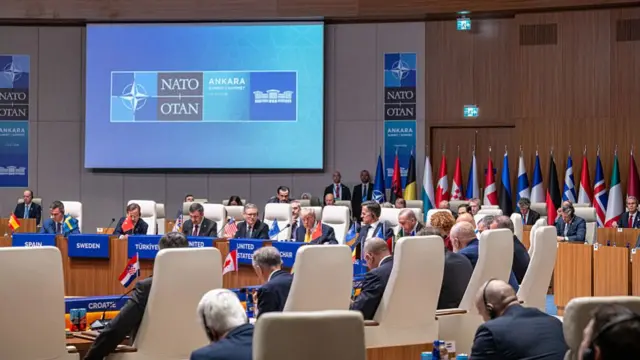
    A wide shot of the Nato summit in Ankara. A meeting is underway with world leadersImage source, Getty Images

    Talks have been taking place between world leaders at the Nato summit in Turkey, where we're expecting to hear more from US President Donald Trump a little later on.

    In the meantime, here's a recap of some of the news lines we've heard so far from Ankara:

    On Ukraine:

    • The war in Ukraine dominated the first day of talks yesterday, as Ukrainian President Volodymyr Zelensky urged allies to prioritise air defence systems
    • Earlier this afternoon, Trump met with his Ukrainian counterpart, and later suggested he could give Ukraine the right to make Patriot air-defence missiles
    • Addressing reporters in Ankara, the US president also said both Kyiv and Moscow wanted to see a "settlement" to end the conflict

    On the alliance:

    • Twelve countries, including the UK, have agreed to spend more than £37bn ($50bn) over the next ten years on a new long-range missile to protect Europe - known as the Deep Precision Strike project
    • Not for the first time, Trump took the opportunity to express his upset with Nato, calling Spain a "terrible partner" and accusing the organisation's members of refusing to help in the war with Iran
    • He also said that the dispute over Greenland "hurt my relationship with Nato"
    • But, at a later meeting, the US president reportedly told leaders that he wants to keep his country in an alliance with Nato, according to the Reuters and AFP news agencies
  3. 'Hit them hard again tonight': What Trump just said on Iranpublished at 15:09 BST 8 July

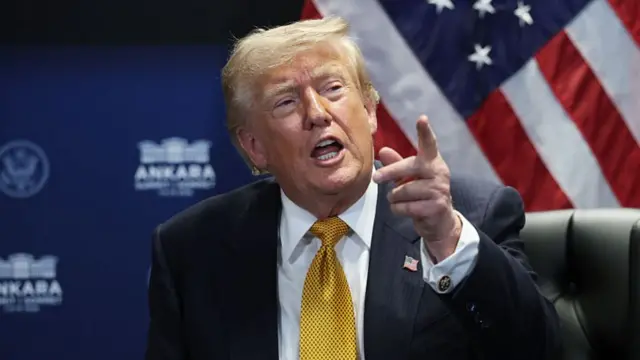
    Donald Trump points his finger as he speaks to the press at the Nato summit in AnkaraImage source, Getty Images

    Trump has now finished speaking so if you're just joining us, here's a recap of what we just heard from the US president on Iran:

    • The president reiterated that the goal of US operations in Iran was to end the country's nuclear programme, not bring about regime change
    • Pushed on his earlier comments that a ceasefire between Iran and the US was over, Trump refused to be drawn on whether a deal might be reached: "We may just do it without a deal because you know what, it's easier"
    • The president also threatened to reimpose a naval blockade on Iran, which was lifted as part of the initial agreement to end the war
    • Trump's visible anger shows he may have lost patience with Iran, our White House reporter Bernd Debusmann Jr writes
  4. Trump threatens to reinstate naval blockade of Iranpublished at 14:56 BST 8 July

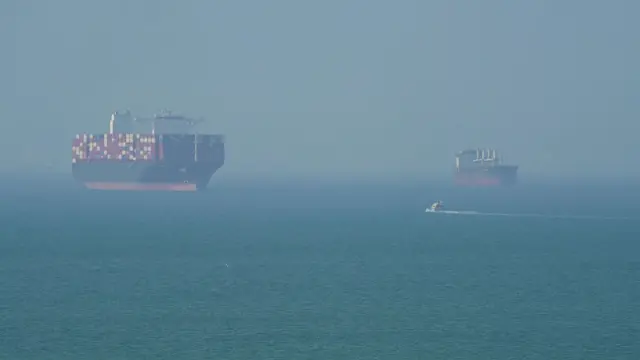
    A Cargo boat navigates the sea on April 28, 2026 on Qeshm Island, Iran in the Strait of HormuzImage source, Getty Images
    Image caption,

    The US imposed a naval blockade of Iranian ports in April following the failure of talks to end the war

    Trump next says the US is considering reinstating its naval blockade of Iranian ports, which was lifted as part of the initial agreement to end the war on 17 June.

    "We may put it back, the blockade," Trump says. "And it will only be a blockade for Iran, anybody else can have whatever they want."

    Iran will "drop some mines if they can", Trump says, but adds that the US has minesweepers that could clear them.

    He also says that Nato countries have offered during the summit today to send minesweepers to the region.

  5. US may launch attack deeper into Iran - US defence secretarypublished at 14:48 BST 8 July

    Trump goes on to say that the US is not currently hitting Iran "at the highest level" and warns future attacks could include strikes on the country's critical infrastructure, including bridges and desalination plants.

    The president also says the US could take over Kharg Island - a major oil terminal off the coast of Iran - saying "there's not a thing" Tehran could do about it.

    He repeats that "there may be a big attack" tonight, before US Defence Secretary Pete Hegseth warns any such attack would take place "deeper" into the country.

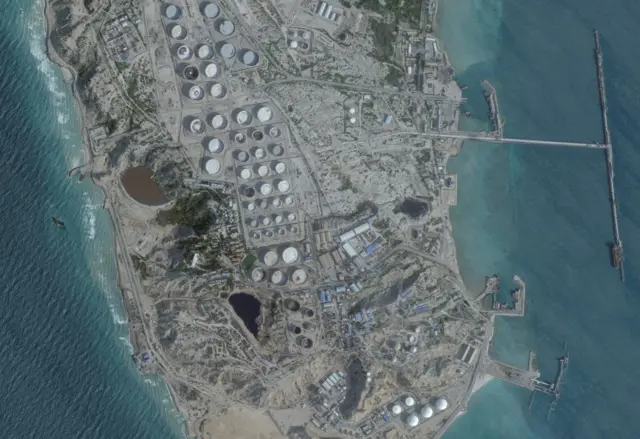
    Satellite image of Kharg IslandImage source, Reuters
    Image caption,

    Trump has made repeated threats against Kharg Island, a key terminal for Iranian oil exports

  6. Analysis

    A visibly angry Trump appears to have lost patience with Iranpublished at 14:31 BST 8 July

    Bernd Debusmann Jr
    White House reporter

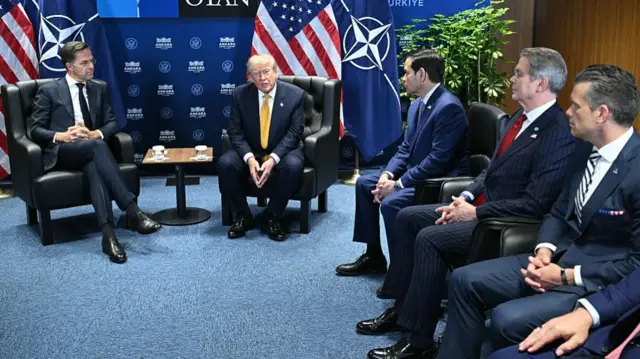
    Donald Trump during a meeting with Nato Secretary General Mark RutteImage source, Reuters

    Something seems to have shifted in US President Donald Trump.

    After weeks of optimism that - despite occasional outbreaks of fighting - talks were progressing and would ultimately be successful, he now seems to have concluded that the conflict may have reached a turning point.

    That optimism is now much more muted, and Trump has left open the possibility of prolonged, renewed strikes - starting tonight.

    "We'll see how it all works out," he told reporters during a meeting with Ukraine's Volodomyr Zelensky. "I'm not happy with them".

    The potential collapse of negotiations and an end to the ceasefire puts Trump in a tricky situation domestically, with some within his own Republican Party uncomfortable with the war from the beginning.

    Some openly questioned what - if anything - the US gained from the 14-point agreement that extended the ceasefire, and whether Tehran could be trusted to re-open the Strait of Hormuz.

    A return to fighting would, in the minds of some on Capitol Hill, confirm that those fears were warranted.

  7. Trump doubts whether US and Iran can make a dealpublished at 14:20 BST 8 July

    Trump is now asked if his comments about the ceasefire being "over" will mean a return to full-scale war between the US and Iran.

    The US president does not directly say whether the war has restarted, but accuses Iran of violating the agreement "every day", adding that they "lie" and "cheat".

    "They will never build a nuclear weapon under our deal, but I don't know if we're going to have a deal. We may just do it without a deal because you know what, it's easier," he adds.

  8. Iran's leaders are 'cuckoo', says Trumppublished at 14:08 BST 8 July

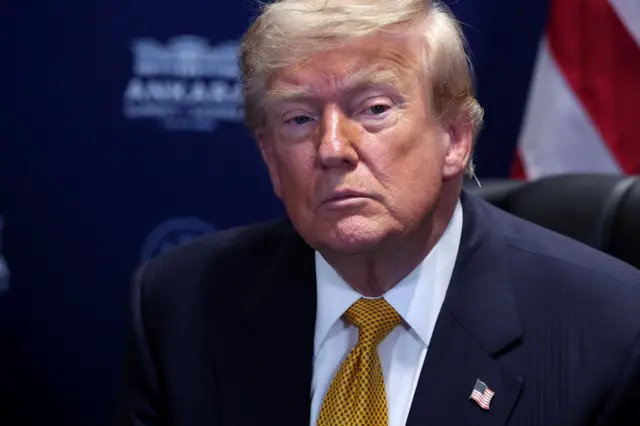
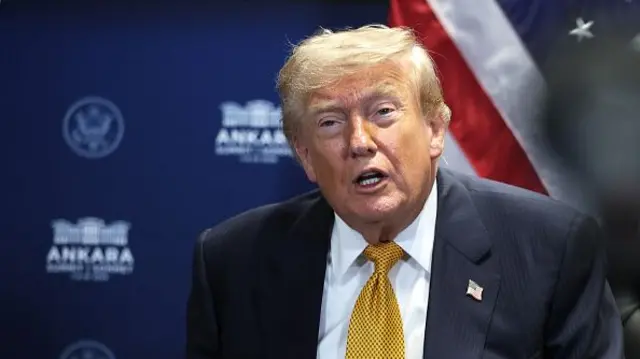
    Donald Trump wears a blue suit and yellow tie and sits in front of a wall with the Ankara summit logo onImage source, Getty Images

    Trump says he's "not happy" with Iran, and repeats the US position that Tehran can't be allowed to acquire a nuclear weapon.

    "My whole thing is not about regime change," he adds, saying that the US has "made a lot of progress" towards ending the country's nuclear programme.

    Trump says Iran is "not the bully" of the Middle East anymore, and repeats his remark from earlier today, describing Iran's leadership as "cuckoo".

  9. Trump says US will strike Iran 'hard again tonight'published at 14:05 BST 8 July
    Breaking

    US President Donald Trump is now speaking to reporters alongside Ukraine's President Volodymyr Zelensky at the Nato summit.

    Asked about Iran, Trump says: "We hit them very hard last night, very, very hard."

    He goes on to say the US will "probably hit them hard again tonight".

    Trump adds: "I gave them a little warning, we're gonna hit them hard again tonight."

  10. BBC Verify

    'Don’t put your life in danger': Iran's warning to tanker in straitpublished at 13:49 BST 8 July

    By Kayleen Devlin

    Maritime security experts say Iran's attacks on commercial vessels in the Strait of Hormuz appear intended to dissuade ships from using a transit route near the coast of Oman.

    BBC Verify has obtained a recording of a marine radio transmission in which the Iranian Navy repeatedly instructs the captain of the Al Maryah tanker to alter course, and tells him its route is "not safe", warning: "Don't put your life in danger."

    Ship-tracking data from MarineTraffic suggests the vessel was transiting the strait through Oman's waters on the southern side before its location data was switched off yesterday.

    Martin Kelly, senior intelligence analyst at security firm EOS Risk Group, says the strongest factor linking the vessels attacked in recent days is they were using, or intended to use, this route recommended by US-led naval forces. "The available evidence is more consistent with an attempt to influence routing behaviour," he adds.

    Richard Meade, editor-in-chief of shipping news organisation Lloyd's List, says Iran continues to enforce its own approved northern transit corridor “while maintaining restrictions" on the Omani route, which has "seen increasingly limited commercial traffic" since Iran began attacking ships again in late June.

  11. From 'smart' to 'scum' - Trump on Iran's leaderspublished at 13:27 BST 8 July

    Three weeks ago, with the two countries close to signing a ceasefire agreement, Donald Trump referred to Iran's leadership as "very smart".

    Today, he has labelled them "scum" and "sick people", declaring the ceasefire to be "over".

    Take a look at the two clips below.

    Media caption,

    'Smart' to 'scum' - Trump on Iran leadership three weeks apart

  12. Bahrain accuses Iran of targeting its civilianspublished at 13:11 BST 8 July

    Bahrain's military says it thwarted a number of Iranian attacks overnight.

    The General Command of the Bahrain Defence Force accuses Iran of "targeting civilians" with missiles and drones.

    Bahrain's air defences "intercepted and destroyed a number" of aerial attacks, it says.

    Earlier, Kuwait said it had also been targeted.

  13. Hegseth cancels Israel visit after latest strikespublished at 12:56 BST 8 July

    Carrie Davies
    BBC correspondent in Jerusalem

    Mark Rutte, Donald Trump, Marco Rubio, Scott Bessent and Pete Hegseth at the Nato summitImage source, Getty Images
    Image caption,

    Pete Hegseth was pictured at the Nato summit earlier alongside Mark Rutte, Donald Trump, Marco Rubio and Scott Bessent

    As tensions rise in the Middle East, the BBC understands that US defence chief Pete Hegseth has cancelled a trip to Israel today.

    Hegseth has been in Turkey attending the Nato summit with US President Donald Trump.

    Plans for the Israel visit were never officially confirmed by the US or Israel.

    Several news outlets have said the visit would have included a discussion about Israeli concerns over the potential sale of F35 fighter jets to Turkey. Israeli Prime Minister Benjamin Netanyahu has said that that sale would be a mistake.

    Neither Israel nor the US have commented publicly on the cancellation.

  14. Iran demands recognition of 'new Iranian order' in Strait of Hormuzpublished at 12:44 BST 8 July

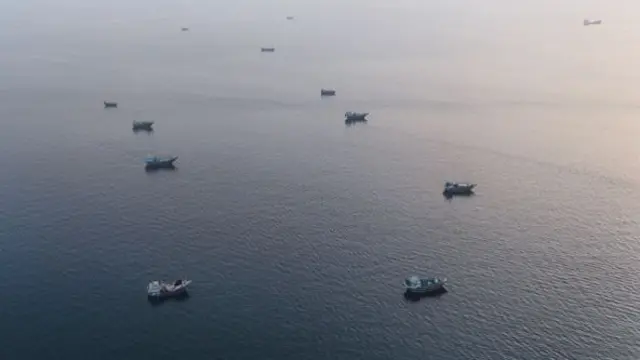
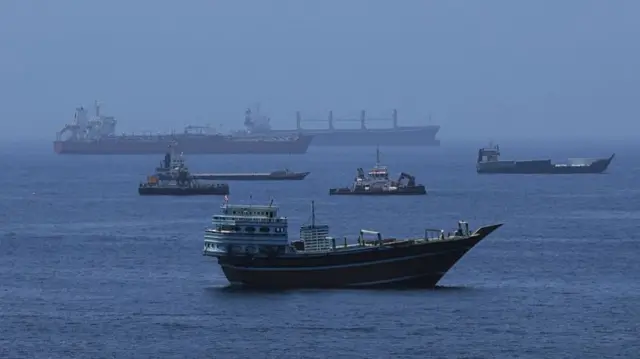
    An aerial photograph of boats sitting on flat waterImage source, AFP via Getty Images

    Overnight, Iran's parliamentary speaker Mohammad Bagher Ghalibaf accused the US of contravening the truce in several ways, one of which was by "violating Iranian adjustments in the Strait".

    Shortly after, another senior Iranian lawmaker, Ebrahim Azizi, said there was "no alternative" but to recognise "the new Iranian order in the Strait of Hormuz".

    Security in the vital Gulf shipping route has been one of the most intractable issues to resolve in US-Iran ceasefire talks, with both sides having differing interpretations of who should have access to it and how.

    Under the US-Iran memorandum of understanding of 17 June, Iran agreed to use its "best efforts for the safe passage of commercial vessels with no charge for 60 days".

    But it has since demanded ships coordinate with Iran when passing through, and warned that attempts to cross the strait along a route designated by the UN's International Maritime Organization (IMO) were "unacceptable and completely dangerous".

  15. Trump airs Iran, Greenland and Nato grievances at summitpublished at 12:28 BST 8 July

    Frank Gardner
    Security correspondent in Ankara

    Trump’s presence has loomed large over this summit.

    His disdain, even dislike, for Nato threatens to undermine the message of unity promoted by officials, ministers and leaders here.

    Mark Rutte, the organisation’s secretary-general, points to the substantial step up in defence spending by European nations since the summit last year.

    Yet this has failed to mollify the US president.

    He’s lashed out at Nato for declining to join his war of choice against Iran.

    Trump has also called Spain "a terrible partner" - and most worryingly of all, he has renewed his interest in a US takeover of Greenland.

    Denmark’s prime minister responded by repeating her country’s earlier position that "Greenland is not for sale".

  16. Thousands of sailors stranded on ships in Strait of Hormuzpublished at 12:09 BST 8 July

    Tankers in the Strait of HormuzImage source, Reuters

    More from UN maritime head Arsenio Dominguez, who says around 6,000 people remain stranded on hundreds of ships in the Strait of Hormuz.

    The International Maritime Organisation secretary general says attacks on vessels in recent days "further intensify the fear, uncertainty and psychological strain already being endured by the nearly 6,000 seafarers who remain stranded on board vessels unable to depart the Persian Gulf safely".

    In March, before the US and Iran signed an agreement meant to open the Strait, Dominguez said roughly 20,000 sailors remained stranded in the Gulf.

    Now he calls on all sides to "de-escalate the situation without further delay" in order to allow trapped ships to safely depart.

  17. UN maritime agency urges ship operators to stop sailing through Straitpublished at 12:03 BST 8 July

    Oliver Smith
    Senior business producer

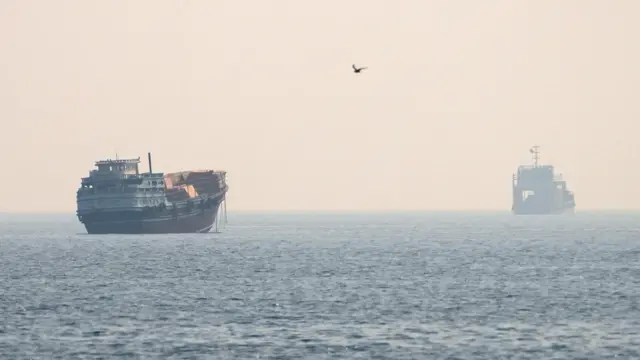
    Several large commercial vessels moored on Strait of HormuzImage source, Anadolu/Getty Images

    The head of the International Maritime Organisation (IMO) – the UN agency which oversees international shipping – has condemned the attacks on ships in the Strait of Hormuz over the last two days and urged shipping operators not to send vessels through the waterway.

    “These reckless attacks have again placed innocent seafarers in grave danger,” says IMO secretary-general Arsenio Dominguez.

    “As long as the safety and security of crews cannot be assured, I urge flag states, shipowners, ship operators and all relevant authorities to avoid exposing seafarers to unnecessary danger by transiting the Strait,” he adds.

    Shipping transits, including oil tankers, have steadily increased since the ceasefire deal between the US and Iran.

    Shipping analysts Lloyd’s List tracked 211 movements in and out of the Strait in the week up to 5 July – still well below pre-war levels of around 138 ships passing through every day.

  18. Iranian president says US 'bending rules' as World Cup hostpublished at 11:52 BST 8 July

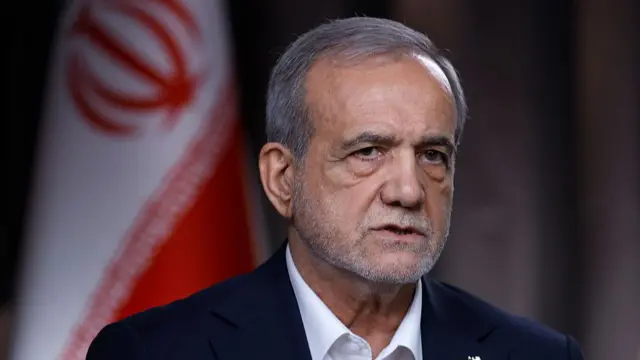
    Masoud Pezeshkian, a man wearing a white shirt and dark blazer.Image source, Getty Images

    Iran's President Masoud Pezeshkian has criticised the US government's "conduct as World Cup host", accusing it of "bending rules, bullying rivals, creating obstacles, and cheating".

    It comes after Donald Trump said he asked Fifa to review a one-match suspension for American footballer Folarin Balogun - with Fifa later clearing him to play in their next match.

    Iran's World Cup participation was stymied by visa and travel issues.

  19. Analysis

    This is an escalation - but how far will it go?published at 11:37 BST 8 July

    Carrie Davies
    BBC correspondent in Jerusalem

    The memorandum of understanding (MoU), an agreement between Iran and the US to work towards ending the conflict, is less than a month old.

    The ceasefire has technically been in place since early April, although both sides have accused the other of violating it during previous tit for tat strikes.

    By saying the ceasefire is "over", but that the talks are not, Donald Trump’s comments seem to both close the door and keep it open a crack.

    They are not dissimilar to his previous posts in the period after a ceasefire was agreed but before the MoU was signed - a carrot and stick approach, promising Iran much if it signed a deal, and threatening destruction if it didn’t.

    They also show his frustration. The question is, will that mean a return to hostilities?

  20. Shipping company confirms Hormuz attackpublished at 11:19 BST 8 July

    Tanker company Bahri has confirmed one of its vessels, Wedyan, was "involved in an incident" while transiting the Strait of Hormuz on Tuesday.

    "We are pleased to confirm that all crew members and personnel on board are safe and accounted for with no reported injuries," a statement reads.

    Bahri says the vessel's cargo is secure and that the ship remains "in a seaworthy condition".

    Earlier, BBC Verify earlier confirmed that Wedyan was among the three ships targeted.