Summary

  1. Trump says US will strike Iran 'hard again tonight'published at 14:05 BST 8 July
    Breaking

    US President Donald Trump is now speaking to reporters alongside Ukraine's President Volodymyr Zelensky at the Nato summit.

    Asked about Iran, Trump says: "We hit them very hard last night, very, very hard."

    He goes on to say the US will "probably hit them hard again tonight".

    Trump adds: "I gave them a little warning, we're gonna hit them hard again tonight."

  2. BBC Verify

    'Don’t put your life in danger': Iran's warning to tanker in straitpublished at 13:49 BST 8 July

    By Kayleen Devlin

    Maritime security experts say Iran's attacks on commercial vessels in the Strait of Hormuz appear intended to dissuade ships from using a transit route near the coast of Oman.

    BBC Verify has obtained a recording of a marine radio transmission in which the Iranian Navy repeatedly instructs the captain of the Al Maryah tanker to alter course, and tells him its route is "not safe", warning: "Don't put your life in danger."

    Ship-tracking data from MarineTraffic suggests the vessel was transiting the strait through Oman's waters on the southern side before its location data was switched off yesterday.

    Martin Kelly, senior intelligence analyst at security firm EOS Risk Group, says the strongest factor linking the vessels attacked in recent days is they were using, or intended to use, this route recommended by US-led naval forces. "The available evidence is more consistent with an attempt to influence routing behaviour," he adds.

    Richard Meade, editor-in-chief of shipping news organisation Lloyd's List, says Iran continues to enforce its own approved northern transit corridor “while maintaining restrictions" on the Omani route, which has "seen increasingly limited commercial traffic" since Iran began attacking ships again in late June.

    Return to the latest post
  3. From 'smart' to 'scum' - Trump on Iran's leaderspublished at 13:27 BST 8 July

    Three weeks ago, with the two countries close to signing a ceasefire agreement, Donald Trump referred to Iran's leadership as "very smart".

    Today, he has labelled them "scum" and "sick people", declaring the ceasefire to be "over".

    Take a look at the two clips below.

    Media caption,

    'Smart' to 'scum' - Trump on Iran leadership three weeks apart

  4. Bahrain accuses Iran of targeting its civilianspublished at 13:11 BST 8 July

    Bahrain's military says it thwarted a number of Iranian attacks overnight.

    The General Command of the Bahrain Defence Force accuses Iran of "targeting civilians" with missiles and drones.

    Bahrain's air defences "intercepted and destroyed a number" of aerial attacks, it says.

    Earlier, Kuwait said it had also been targeted.

  5. Hegseth cancels Israel visit after latest strikespublished at 12:56 BST 8 July

    Carrie Davies
    BBC correspondent in Jerusalem

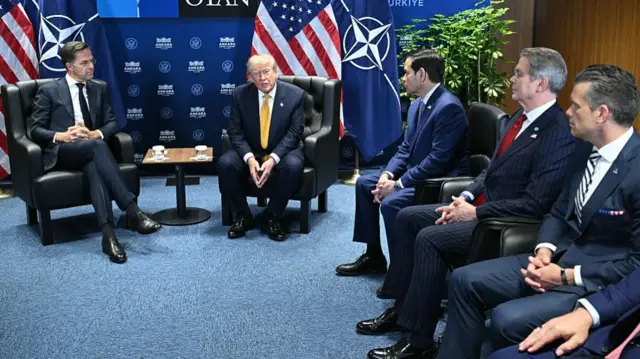
    Mark Rutte, Donald Trump, Marco Rubio, Scott Bessent and Pete Hegseth at the Nato summitImage source, Getty Images
    Image caption,

    Pete Hegseth was pictured at the Nato summit earlier alongside Mark Rutte, Donald Trump, Marco Rubio and Scott Bessent

    As tensions rise in the Middle East, the BBC understands that US defence chief Pete Hegseth has cancelled a trip to Israel today.

    Hegseth has been in Turkey attending the Nato summit with US President Donald Trump.

    Plans for the Israel visit were never officially confirmed by the US or Israel.

    Several news outlets have said the visit would have included a discussion about Israeli concerns over the potential sale of F35 fighter jets to Turkey. Israeli Prime Minister Benjamin Netanyahu has said that that sale would be a mistake.

    Neither Israel nor the US have commented publicly on the cancellation.

  6. Iran demands recognition of 'new Iranian order' in Strait of Hormuzpublished at 12:44 BST 8 July

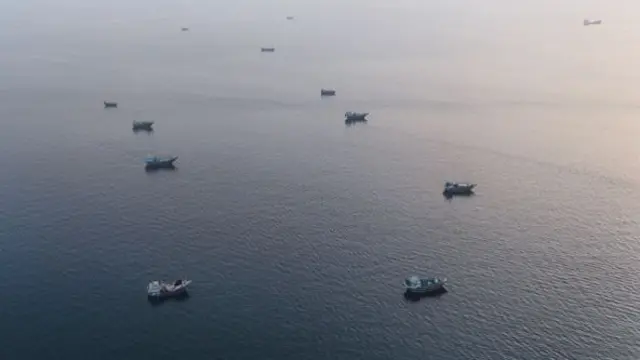
    An aerial photograph of boats sitting on flat waterImage source, AFP via Getty Images

    Overnight, Iran's parliamentary speaker Mohammad Bagher Ghalibaf accused the US of contravening the truce in several ways, one of which was by "violating Iranian adjustments in the Strait".

    Shortly after, another senior Iranian lawmaker, Ebrahim Azizi, said there was "no alternative" but to recognise "the new Iranian order in the Strait of Hormuz".

    Security in the vital Gulf shipping route has been one of the most intractable issues to resolve in US-Iran ceasefire talks, with both sides having differing interpretations of who should have access to it and how.

    Under the US-Iran memorandum of understanding of 17 June, Iran agreed to use its "best efforts for the safe passage of commercial vessels with no charge for 60 days".

    But it has since demanded ships coordinate with Iran when passing through, and warned that attempts to cross the strait along a route designated by the UN's International Maritime Organization (IMO) were "unacceptable and completely dangerous".

  7. Trump airs Iran, Greenland and Nato grievances at summitpublished at 12:28 BST 8 July

    Frank Gardner
    Security correspondent in Ankara

    Trump’s presence has loomed large over this summit.

    His disdain, even dislike, for Nato threatens to undermine the message of unity promoted by officials, ministers and leaders here.

    Mark Rutte, the organisation’s secretary-general, points to the substantial step up in defence spending by European nations since the summit last year.

    Yet this has failed to mollify the US president.

    He’s lashed out at Nato for declining to join his war of choice against Iran.

    Trump has also called Spain "a terrible partner" - and most worryingly of all, he has renewed his interest in a US takeover of Greenland.

    Denmark’s prime minister responded by repeating her country’s earlier position that "Greenland is not for sale".

  8. Thousands of sailors stranded on ships in Strait of Hormuzpublished at 12:09 BST 8 July

    Tankers in the Strait of HormuzImage source, Reuters

    More from UN maritime head Arsenio Dominguez, who says around 6,000 people remain stranded on hundreds of ships in the Strait of Hormuz.

    The International Maritime Organisation secretary general says attacks on vessels in recent days "further intensify the fear, uncertainty and psychological strain already being endured by the nearly 6,000 seafarers who remain stranded on board vessels unable to depart the Persian Gulf safely".

    In March, before the US and Iran signed an agreement meant to open the Strait, Dominguez said roughly 20,000 sailors remained stranded in the Gulf.

    Now he calls on all sides to "de-escalate the situation without further delay" in order to allow trapped ships to safely depart.

  9. UN maritime agency urges ship operators to stop sailing through Straitpublished at 12:03 BST 8 July

    Oliver Smith
    Senior business producer

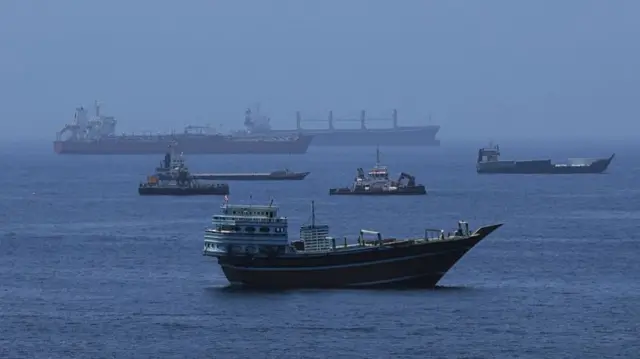
    Several large commercial vessels moored on Strait of HormuzImage source, Anadolu/Getty Images

    The head of the International Maritime Organisation (IMO) – the UN agency which oversees international shipping – has condemned the attacks on ships in the Strait of Hormuz over the last two days and urged shipping operators not to send vessels through the waterway.

    “These reckless attacks have again placed innocent seafarers in grave danger,” says IMO secretary-general Arsenio Dominguez.

    “As long as the safety and security of crews cannot be assured, I urge flag states, shipowners, ship operators and all relevant authorities to avoid exposing seafarers to unnecessary danger by transiting the Strait,” he adds.

    Shipping transits, including oil tankers, have steadily increased since the ceasefire deal between the US and Iran.

    Shipping analysts Lloyd’s List tracked 211 movements in and out of the Strait in the week up to 5 July – still well below pre-war levels of around 138 ships passing through every day.

  10. Iranian president says US 'bending rules' as World Cup hostpublished at 11:52 BST 8 July

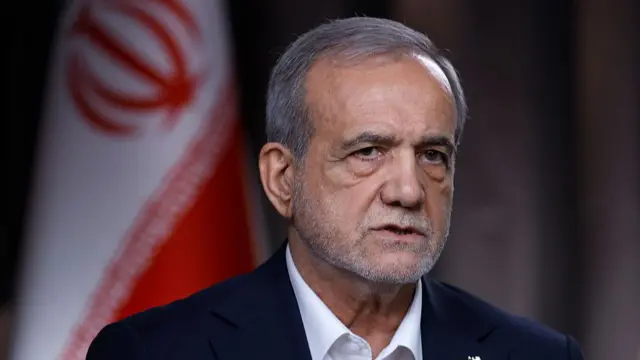
    Masoud Pezeshkian, a man wearing a white shirt and dark blazer.Image source, Getty Images

    Iran's President Masoud Pezeshkian has criticised the US government's "conduct as World Cup host", accusing it of "bending rules, bullying rivals, creating obstacles, and cheating".

    It comes after Donald Trump said he asked Fifa to review a one-match suspension for American footballer Folarin Balogun - with Fifa later clearing him to play in their next match.

    Iran's World Cup participation was stymied by visa and travel issues.

  11. Analysis

    This is an escalation - but how far will it go?published at 11:37 BST 8 July

    Carrie Davies
    BBC correspondent in Jerusalem

    The memorandum of understanding (MoU), an agreement between Iran and the US to work towards ending the conflict, is less than a month old.

    The ceasefire has technically been in place since early April, although both sides have accused the other of violating it during previous tit for tat strikes.

    By saying the ceasefire is "over", but that the talks are not, Donald Trump’s comments seem to both close the door and keep it open a crack.

    They are not dissimilar to his previous posts in the period after a ceasefire was agreed but before the MoU was signed - a carrot and stick approach, promising Iran much if it signed a deal, and threatening destruction if it didn’t.

    They also show his frustration. The question is, will that mean a return to hostilities?

  12. Shipping company confirms Hormuz attackpublished at 11:19 BST 8 July

    Tanker company Bahri has confirmed one of its vessels, Wedyan, was "involved in an incident" while transiting the Strait of Hormuz on Tuesday.

    "We are pleased to confirm that all crew members and personnel on board are safe and accounted for with no reported injuries," a statement reads.

    Bahri says the vessel's cargo is secure and that the ship remains "in a seaworthy condition".

    Earlier, BBC Verify earlier confirmed that Wedyan was among the three ships targeted.

  13. Where did the US strike overnight in Iran?published at 11:03 BST 8 July

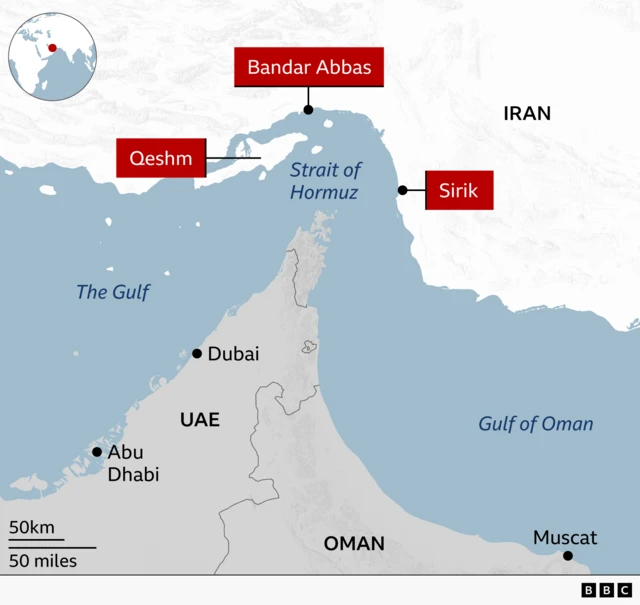
    The US says it hit "over 80 targets" in its latest wave of strikes, which were in response to attacks on commercial ships in the Strait of Hormuz. There has been confirmation of strikes in the following places:

    • The Iranian military says coastal bases and civilian facilities were struck in the provinces of Hormozgan and Mahshar
    • More strikes hit Bandar Mashahr, south-west Iran - an Iranian soldier was killed by shrapnel, according to the Islamic Revolutionary Guards (IRGC)
    • Iranian media reported strikes in the Bushehr region of south-west Iran

    The places targeted are clustered around the coastline along the Strait of Hormuz.

    Map of southern Iran and the Strait of Hormuz highlighting three locations targeted in the latest US strikes on Iran: Bandar Abbas on the northern shore of the strait, Sirik on Iran's southeastern coast, and Qeshm island. The map also shows the UAE and Oman - Iran's neighbours to the south - and labels the cities of Dubai, Abu Dhabi and Muscat.
  14. Kuwait says it intercepted ballistic missiles and dronespublished at 10:53 BST 8 July

    Kuwait intercepted two ballistic missiles and 13 drones overnight, according to its defence ministry.

    In a statement posted on X, official spokesman Major General Saud Abdulaziz Al-Otaibi says Kuwait's airspace was breached but the projectiles were shot down, with no injuries reported.

    However, Kuwaiti authorities have since reported some power cuts.

  15. Qatar accuses Iran of 'blatant breach' of international lawpublished at 10:41 BST 8 July

    Qatar has condemned "unjustified" Iranian attacks on Bahrain and Kuwait, which its foreign ministry says were a "blatant breach" of international law and the two countries' sovereignty.

    Doha also emphasises the need to "pursue the path of dialogue and diplomacy, to de-escalate tensions, and to build upon the progress achieved under the memorandum of understanding".

    As a reminder, Iran says it is targeting US military sites in Bahrain and Kuwait after American strikes against it overnight.

  16. What Trump has said about the Iran talks in the pastpublished at 10:28 BST 8 July

    A short while ago, Donald Trump declared the ceasefire with Iran "over", though did leave some leeway for his negotiating team to continue talks with Tehran.

    It's not the first time the US president has issued definitive statements about the agreement - here is what he has said previously.

    • 8 April - US and Iran sign agree to a tentative two-week ceasefire
    • 21 April - Trump says he doesn't want to extend the two-week ceasefire and says he "expects to be bombing" again soon. Later that day, he says US attacks have been called off after a request from Pakistan
    • 8 May - Trump says the world will know the ceasefire is over when there is "one big glow coming out of Iran"
    • 11 May - Days later, Trump says the ceasefire is on "massive life support"
    • 11 June - Trump indicates the ceasefire is over, threatening to hit Iran "very hard", before calling off the strikes later that evening
    • 17 June - As Trump signs an initial agreement to end the war, he says: "If they don't behave, we'll go right back to dropping bombs right smack in the middle of their head"
    • 8 July - Trump says the ceasefire is "over" but says negotiators on both sides can continue to talk
  17. Attacks on tankers spark renewal of fighting in Gulf - a recappublished at 10:14 BST 8 July

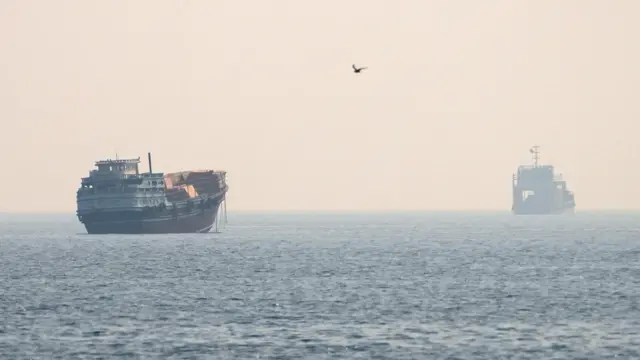
    A ship seen on the waterImage source, Reuters
    Image caption,

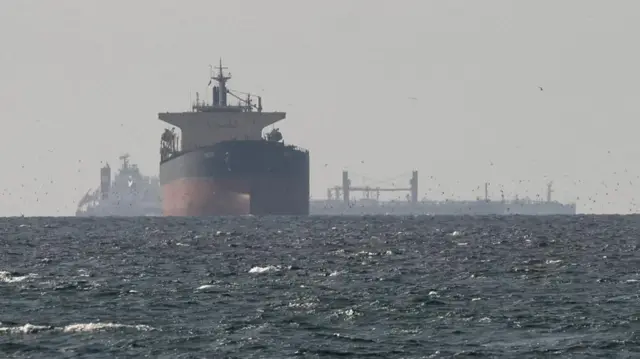
    Cargo ships seen in the Gulf near the Strait of Hormuz

    Tensions have spilled over again in the Gulf, following a string of attacks on shipping in the Strait of Hormuz. It's the worst exchange of fire between the US and Iran since they signed a memorandum of understanding (MoU) to end the conflict on 17 June. Here's what's happened this week.

    Monday

    • The UKMTO says a tanker travelling through the Strait of Hormuz reported a fire after being hit by an unknown projectile

    Tuesday

    • In two separate incidents, tankers report being hit in the Strait of Hormuz. Iran has not directly claimed responsibility for either of these attacks, or the one on Monday
    • The US military says it has "begun launching a series of powerful strikes against Iran", hitting more than 80 targets. This is in response to attacks on commercial shipping in the Strait of Hormuz in a "clear violation of the ceasefire", it says

    Wednesday 8 July

    Earlier

    • Iran's Islamic Revolutionary Guard Corps announces it targeted US military sites in Bahrain and Kuwait
    • Nato chief Mark Rutte calls the American strikes "absolutely necessary"
    • But Iran's speaker Mohammad Bagher Ghalibaf accuses the US of breaching the agreement between the two countries

    Moments ago

    • US President Donald Trump says that the ceasefire with Iran is "over", telling reporters at the Nato summit in Ankara: "I don't want to deal with them anymore, they're scum"
  18. Footage shows US strikes hitting Iranian port citypublished at 10:07 BST 8 July

    Multiple strikes on the city of Bandar Abbas overnight were captured on video, with several explosions visible and flames seen rising over a facility.

    It is not clear from the footage what was being targeted by the US.

    Media caption,

    Video captures strikes hitting Iran

  19. BBC Verify

    What we know about the three tankers struck in Strait of Hormuzpublished at 10:00 BST 8 July

    By Kayleen Devlin

    The US military says it resumed strikes on Iran in response to attacks on three commercial vessels transiting the Strait of Hormuz.

    The first ship cited by the US, Al Rekayyat, is a Qatar-owned liquefied natural gas (LNG) tanker. BBC Verify understands it was struck by a projectile off the coast of Oman on 6 July while transiting the strait.

    The impact caused a fire on board, although no casualties have been reported. The vessel crossed with its automatic identification system (AIS) location signal switched off and was last identified in satellite imagery on 22 June near Qatar's main LNG export hub.

    The second vessel, Wedyan, is a Saudi-owned crude oil tanker carrying Saudi crude. Its AIS signal has been switched off since 3 July.

    The third mentioned by the US, Cyprus Prosperity, is a Liberia-flagged crude tanker which went through the strait with its location data switched on and was carrying oil to Fujairah port in the UAE.

    UKMTO has confirmed three incidents but has not identified the vessels. The British maritime authority also says no casualties or environmental damage have been reported.

  20. Oil prices rise again after Trump declares ceasefire 'over'published at 09:56 BST 8 July

    Emer Moreau
    Business reporter

    Oil traders have reacted quickly to Trump’s announcement that the ceasefire is “over”.

    Just before he made those remarks, a barrel of oil was just under $76 (£57). At 0945 BST, it was over $78 (£58) and appears to be rising further.

    As we reported earlier, oil prices had already been ticking upwards after Iran and the US traded strikes overnight.