| 13 November 2014 |

|
|
| BBC Homepage | | |
| |||
| Contact Us | | |
Battle of EveshamYou are in: Hereford and Worcester > History > Battle of Evesham > Battle of Evesham - people  Battle of Evesham - peopleProfiles of the key figures in the Battle of Evesham - a Baron, a King and a Prince. SIMON DE MONTFORTThe soldier and democrat who almost overthrew a KingThe 6th Earl of Leicester led a colourful life - crusading, marrying into the Royal family, falling out with the King over a massive debt, briefly being the most powerful man in the country, before meeting a bloody end on a hill in Worcestershire. 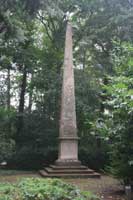 Obelisk in memorial of Simon de Montfort Simon de Montfort, as his name suggests, was the son of a French nobleman and crusader, and came from a military family. Other members of his family also met violent deaths – his father was killed at the siege of Toulouse in 1218, and his brother at the siege of Castelnaudary in 1220. He married into royalty - his wife was Eleanor of England, daughter of King John and Isabella of Angouleme, and sister of King Henry III. The marriage may have had the approval of the King, but was very controversial – the barons objected, the Archbishop of Canterbury, Edmund Rich, condemned it (because Eleanor had taken a vow of chastity after the death of her first husband) and Eleanor's brother Richard, 1st Earl of Cornwall, rose up in revolt when he learned of the marriage. At first Simon got on well with King Henry III, who even made him Earl of Leicester, but later relations between the two men soured. As is so often the case, this was a row over money - Simon owed a great deal of money to Thomas II of Savoy, and named the King as his security. Henry was furious, and threatened to throw Simon in the tower - so he promptly fled to France, and from there went to the Holy Land on a crusade. Trouble with the KingRelations between the King and Simon never really recovered, and after various run-ins, including the wonderfully named 'Mad Parliament' of 1258, Simon ended up leading the Baron's rebellion. 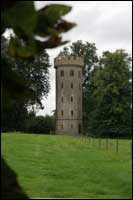 Leicester Tower built by de Montfort's relatives At first things went well - he won the Battle of Lewes (May 14, 1264) and eventually captured the King and his son Edward. He then set up what some historians call the first true Parliament – he invited each county to send two representatives, insisting that they were elected. Unfortunately for de Montfort, this move towards democracy didn't go down too well with the barons, who held real power in the country. Prince Edward escaped, and de Montfort's chief ally Thomas de Clare changed sides, taking his troops with him. PRINCE EDWARDLater Edward I, aka Longshanks – the hammer of the ScotsThis was a man who was better to have as a friend than an enemy, as the Scots were to find out. 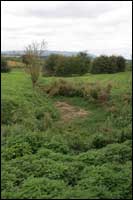 Battle Well - the centre of Prince Edward's line His nickname, 'Longshanks', comes from the fact that he was 6'2" tall (1.88m), with long legs and arms. He was impatient, a contemporary account describes "his eyes in his anger sparkling like fire", ambitious, and quite a soldier – though he was almost killed by an assassin, whilst on a crusade. He also gave the Tower of London the look we know today, including building the famous Traitor's Gate. After he'd beaten Simon de Montfort at the Battle of Evesham, he went on to subjugate Wales (defeating the brothers Llywelyn and Dafydd ap Gruffydd), before turning his attention to the Scots. He defeated them at Berwick (massacring the population afterwards) and at Dunbar. He also took the Stone of Destiny, used for the coronation of Scottish Kings, to Westminster Abbey – it was returned in 1996. HENRY IIIReigned for a long time - but not very wellHenry came to the throne at the age of nine, and reigned for 56 years, making him the longest reigning monarch of England. Sadly, longevity is just about Henry's only achievement, and his capture and imprisonment by Simon de Montfort nicely sums up his reign. There was even some argument about the infant King's right to the throne - there was a rival claim by Prince Louis of France. Louis had the backing of the Archbishop of Canterbury, so poor Henry had to make do with the Bishop of Gloucester at his coronation. The crown was also AWOL at the time – the nine-year-old got a simple gold band to wear. His time on the throne was one long battle with England's powerful Barons, and he will go down in history as the first King to call a Parliament. He was greedy by nature – demanding presents from rich Londoners when his son was born, and sending back the ones he didn't like. The second Baron's War went very badly for Henry, who was captured by Simon de Montfort after losing the Battle of Lewes. 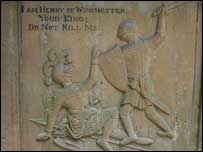 The King appeals for mercy He was lucky to escape with his life after the later Battle of Evesham, as he was dressed in the colours of de Montfort's army, who were massacred almost to a man by victorious Royalist troops. On the plus side, he did establish Westminster as the seat of Government, and refurbish the Abbey in glorious style. He's buried in the Abbey, though because his sarcophagus wasn't finished in time, he had to share the tomb of Edward the Confessor for time – an unsatisfactory end to an unspectacular reign. last updated: 01/09/2008 at 16:02 SEE ALSOYou are in: Hereford and Worcester > History > Battle of Evesham > Battle of Evesham - people 
|
| | About the BBC | Help | Terms of Use | Privacy & Cookies Policy |