What are the key learning points about energy changes in chemistry?
Exothermic reactions give heat out to the surroundings. Endothermic reactions take heat in from the surroundings.
Combustion and most neutralisation reactions are exothermic, while reactions like sodium carbonate with ethanoic acid are endothermic.
Everyday examples of exothermic processes are burning and they body's metabolism.
Examples of endothermic processes include melting ice and evaporation.
A temperature increase shows an exothermic reaction; a decrease shows an endothermic one.
What energy changes happen during reactions?
Energy is conserved in chemical reactions.
The total amount of energy in the universe never changes.
When a chemical reaction occurs, energy is transferred to or from the reaction’s immediate surroundings.
in endothermic reactions, energy enters.
in exothermic reactions, energy exits.
What are exothermic reactions?
An exothermic reaction transfers energy to its surroundings.
The temperature of its surroundings increases.
Exothermic reactions include:
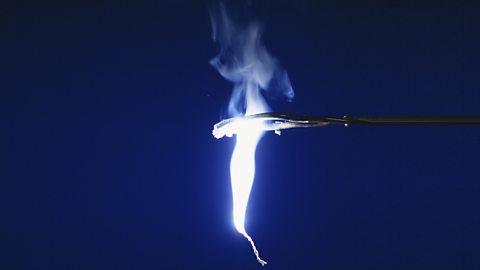
This is the scientific word for burning. It is where a substance reacts with oxygen from the air and transfers energy to the surroundings by heating and light. reactions.
most A reaction between an acid and a base producing a salt and water. reactions.
Key fact
You see exothermic reactions in burning candles, your metabolism, setting cement, even rusting.
Example
The reaction between sodium hydroxide and hydrochloric acid is exothermic.
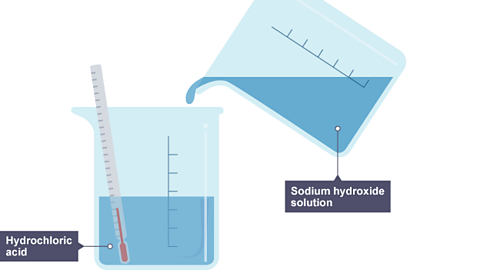
Image caption, 1. Sodium hydroxide solution is poured into a beaker of hydrochloric acid. Inside is a thermometer showing room temperature.
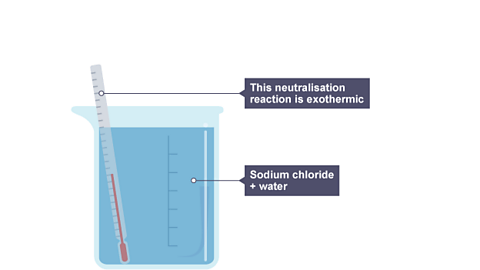
1 of 2
What are endothermic reactions?
An endothermic reaction takes in energy from its surroundings.
The temperature of its surroundings decreases.
Key fact
You see endothermic reactions at work in photosynthesis, cooking, water evaporation and ice melting.
Example
The reaction between sodium carbonate and ethanoic acid is endothermic.
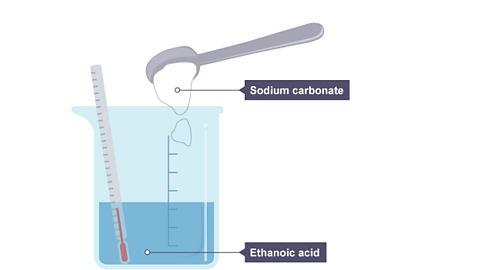
Image caption, 1. Sodium carbonate powder is tipped into a beaker of ethanoic acid, which contains a thermometer showing room temperature.
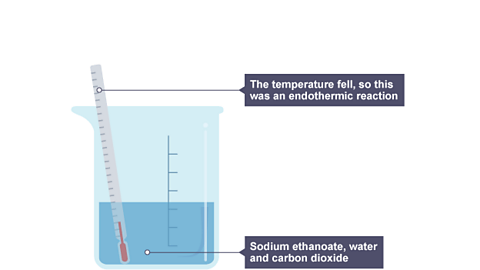
1 of 2
Question
The table below gives the starting and finishing temperatures of 2 reactions.
Which reaction is exothermic and which reaction is endothermic?
Answer
Reaction A is endothermic as the temperature decreases and Reaction B is exothermic because the temperature increases.
VIDEO: What are energy changes in chemistry?
A study of the energy changes involved in chemical reactions, whether exothermic or endothermic.
Energy Changes
Life – it's all about change.
You're born! You grow up! You sit your exams…
Chemical reactions are all about changes too – so let's have a look at the energy changes involved in them.
Bonds between atoms or ions are broken and formed in chemical reactions.
Whenever that happens, there's energy transfer.
Energy is given out by the reaction and transferred out to the surroundings…
Or taken in – transferred from the surroundings…
Either way, the amount of energy present changes.
Endothermic reactions take energy from their surroundings.
So, whatever those surroundings are – the air, the water in a solution, or the test tube the reaction's happening in – they're going to get colder as the reaction takes place.
Now, photosynthesis is an endothermic reaction.
Chloroplasts in plants absorb light to break apart carbon dioxide and water to form glucose and oxygen.
Exothermic reactions transfer energy to their surroundings, usually by heating, causing the temperature to increase.
Combustion reactions are exothermic – they're what power engines and warm our houses.
When burning wood, coal, gas or oil, oxygen combines with carbon and hydrogen, and energy is transferred to the surroundings.
There's a good way to remember the difference between exothermic and endothermic reactions:
“EX” for EXit – exothermic reactions give energy out.“EN” for ENter – endothermic reactions take energy in.
Another important thing to understand about energy changes is the activation energy.
That's the minimum amount of energy that particles must have to react.
A reaction profile shows three things:
- the relative energies of the reactants and products
- the activation energy needed to go from one to the other
- the overall energy change
The reaction pathway is a line from the reactants at the start to the products at the end.
For an exothermic reaction, energy is given out, so the final products have less energy than the reactants had to begin with.
That's a negative overall energy change, which you can see because the graph ends at a lower point than where it started.
For an endothermic reaction, energy is taken in, so the final products have more energy than the reactants started with.
That's a positive overall energy change – and the graph ends higher than it started.
So… chemical reactions – they might gain energy, they might lose energy, but they certainly never stay the same.
How much do you know about energy changes in chemistry?
More on Metals and the reactivity series
Find out more by working through a topic
- count3 of 3
- count1 of 3