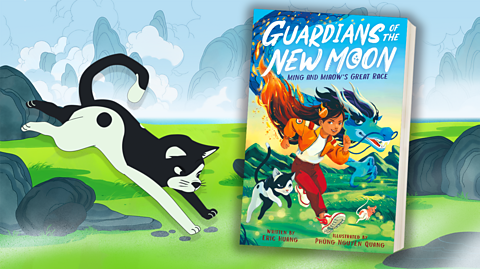
Bobby Bains Plays a Blinder
Bobby Bains Plays a Blinder, written by Bali Rai and illustrated by Daniel Duncan, is the sixth title in the 2026 Blue Peter Book Club.
Watch the animation below to discover more about the book.
Bobby Barnes is football mad. He also loves helping people. As a Sikh, it's an important part of his faith. When Bobby meets lonely old Trevor at the food bank, he has a genius idea that Trevor needs a friend and Bobby's granddad, Nana Jean needs one too. They both love football. They both love reggae, and they've both got seriously dodgy knees. So Bobby hatches a plan to get them out of the house and back on the pitch. Because in football and in life, if you don't shoot, you don't score.
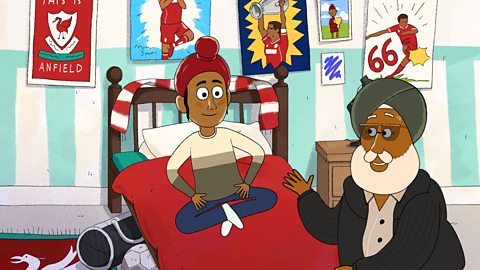
Bobby Bains loves football! He thinks about it from when he wakes up to when he goes to sleep; he even dreams about football.
Bobby’s grandad, Nana-ji, also loves football, but can’t run around the pitch like he used to.
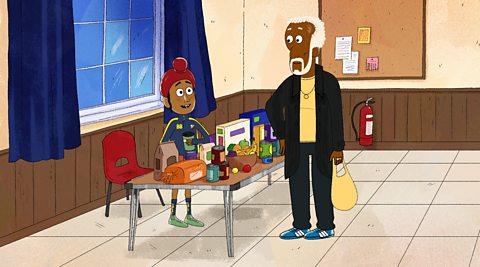
Bobby is a Sikh and helping others is an important part of his faith. He helps his mum at the local food bank. This is where he meets Trevor, but Trevor has a secret…
Can Bobby and Nana-ji uncover Trevor’s secret and persuade him to join a new walking football league?
You can get a sneak peek of the book over on Blue Peter.
Themes and metaphors
Throughout the story, Bobby is guided by kindness, his grandfather's advice, and the teachings of Guru Nanak, the founder of Sikhism.
In the story, Bobby finds a famous quote by Guru Nanak:
“Whatever kind of seed is sown in a field…, a plant of that same kind… springs up in it.” (page 26)
Bobby is confused by the quote’s meaning, so Nana-ji explains that it is a metaphor.
A metaphor is a word or phrase used to describe something as if it were something else.
Bobby doesn’t plant real seeds; instead, he plants 'kind actions' that will grow and spread throughout his community.
We see the result of his ‘seeds of kindness’ when Mr Ambrose participates in walking football and later joins Bobby’s family for Christmas.
The power of 𝙞𝙩𝙖𝙡𝙞𝙘𝙨
Did you notice how some of the words in Bobby Bains Plays a Blinder lean over to the right?
Writing words in this slanted style is called italics. The author, Bali Rai, uses italics as a helpful tool throughout the story - but why?
Firstly, to emphasise and add power to words. This shows you how they should sound when you read them aloud:
“I love football and I mean love!” (page 3)
Secondly, to highlight words from another language. Bobby’s family speaks both English and Punjabi, so words such as patka (a head covering), langar (a free community meal) and Nana (grandfather) are written in italics to show they are special cultural terms.
Remember, italics aren’t there to make the text look fancy; they’re a clever tool used by authors to make certain words stand out and change how you read a story aloud.
The message of the story
One of the greatest parts of the story is its message: sport belongs to everyone!
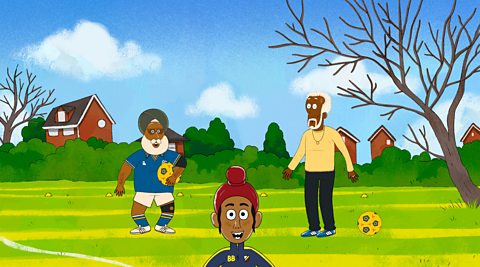
Throughout the story, we see people from different backgrounds, cultures and ages playing football. This includes Bobby and Thiágo in their team, Maisie and Bella at the Christmas fair, and finally Nana-ji and Mr Ambrose in the walking football match.
The theme of inclusivity runs throughout the story and works alongside the other two themes: sowing seeds of kindness and Bobby’s love for football!
Nani-ji and Mr Ambrose both loved playing football in the past, but had lost their confidence due to their age (and sore knees!). Bobby’s passion for spreading kindness and getting people involved in football inspires the older members of his community to join in.
Bobby’s passion for inclusivity is clear; he shows that kindness and football can bring everyone together!
Example 1
Take a look at this extract from the story.
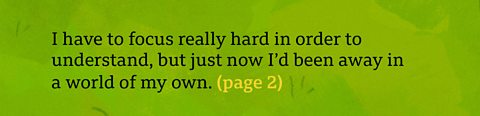
Can you find the metaphor in this sentence?
I have to focus really hard in order to understand, but just now I’d been away in a world of my own.
✓ In this sentence the metaphor is:
"…I’d been away in a world of my own."
A metaphor describes something as if it were something else.
Here, Bobby compares daydreaming to being on a different planet. He didn’t actually go to space, but he felt like his mind was on a different planet (and not in class!)
Example 2
Now, have a look at this line from the book.
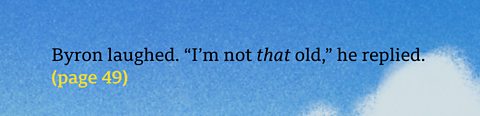
Why has the author use italics for the word ‘that’?
Byron laughed. “I’m not that old,” he replied.
✓ Italics have been used to make it clear that you should emphasise the word ‘that’ when you read the story.
Byron is trying to make it clear that he is getting old, but not as ancient as Bobby is making him out to be!
Example 3
This quote is taken from the final pages of the story:
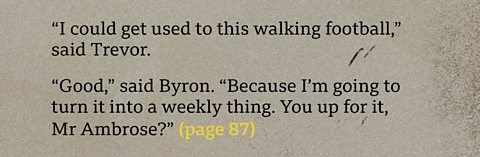
How does this quote support the theme of inclusivity that runs through the book?
“I could get used to this walking football,” said Trevor.
“Good,” said Byron. “Because I’m going to turn it into a weekly thing. You up for it, Mr Ambrose?”
✓ This quote shows that older people can enjoy football too, and it brings together the story’s key themes: ‘sport belongs to everyone’, ‘football is fantastic’ and ‘kindness can spread through a community’.
Blue Peter Book Club
Watch as Shini and the Book Clubbers talk about their favourite parts of Bobby Bains Plays a Blinder.
If you love football, you'll love this book. It's about a boy who loves football and wants to help his community.
Ever wondered how football, friendship and kindness can help bring people together? Well, that's what this month's Book Club book is all about.
It's Bobby Bains Plays a Blinder.
Bobby Bains is football mad. He also loves helping people. As a Sikh, it's an important part of his faith. When Bobby meets lonely old Trevor at the food bank, he has a genius idea that Trevor needs a friend, and Bobby's granddad, Nana G, needs one too. They both love football, they both love reggae, and they've both got seriously dodgy knees.
So, Bobby hatches a plan to get them out of the house, and back on the pitch. Because in football and in life, if you don't shoot, you don't score.
Kicking off the reviews are book clubbers Preetam, Jaiyan, Harman and Arjun.
Our squad play for a team near Walsall and, like Bobby, are footy mad. So, to get the lowdown on the book, I'm joining their training session.
So, what did you guys think of the book?
I really enjoyed it because it shows that we can all come together as a community.
I thought it was really interesting that anyone can play football, even no matter what age they are.
Do you have to be a football fan to enjoy the book?
You don't have to be a football fan because it's all about being kind to each other.
Were you guys a fan of the size and you know, the layout?
I liked it because, like, it's easier for people to read.
I think it was good how they've done the yellow pages for people who struggle reading from white ones.
Absolutey, so a book about inclusivity is also inclusive to others.
Like Bobby, our book clubbers get involved in sewa. So, what exactly is sewa?
Sewa is an act of community service. Like, doing an action and you don't get anything in return.
So, Preetam, how tricky would you say is it to perform sewa? And how do you think it made Bobby feel when he did it?
It's not that hard, but I reckon it probably made Bobby feel a sense of pride, because he's helping his loved one and the community.
So Jaiyan, what kind of sewa do you guys do?
When we're at football, before we play matches or even setting up drills, we help our coaches.
I want to help too. So, to decide what I'll be doing for sewa, I'm in goal for a penalty shootout. If I save more goals than they score, I can pick my helpful task. If they score more than I save, they decide what I'll be doing.
Help me out here, what do I have to do?
Dive! Dive? Bend your legs and dive! Be big!
Ok, I can't stall this any longer. Go on, Jaiyan!
There was no chance I was saving that. They are not going easy on me! I thought we'd developed a bond! Come on, Shini. This can't be a clean sweep.
Listen, I feel like you beat me fair and square there. So go on, what am I doing for sewa?
We've decided you'll be cleaning the stadium café.
I knew I should have focused on my dive.
It's all about being selfless they said, doing tasks without expecting credit for them.
Whilst I get stuck into my sewa, what did the team make of the book overall?
I like this book because it's not only about football but helping out the community.
It shows teamwork and kindness.
It shows the community can come together as one.
Read this book if you want to learn more about Sikhism.
Have you read Bobby Bains or any of our other BP Book Club reads? Well, if you have, be sure to send us in a review and you could earn one of these: A BP Book Club badge!
So, what are you waiting for? Go get reading. They'll all be available in your local libraries.
If you’ve read the book, can you write about what you enjoyed most? Think about the story, the challenges and the outcomes
Imagine you are Bobby. What could you do to help someone at school who you think is lonely?
Both of these will help you earn your Blue Peter Book Club badge, which you can read about here.
Quiz
Now put what you've learnt to the test with this quiz.
More on Blue Peter Book Club
Find out more by working through a topic
- count3 of 19

- count4 of 19
- count5 of 19