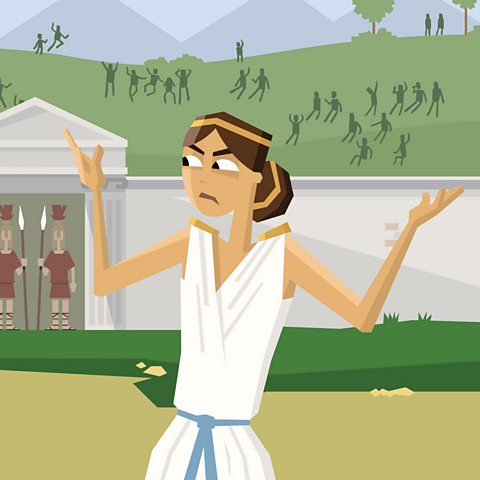
What was it like to be a soldier in Ancient Greece?
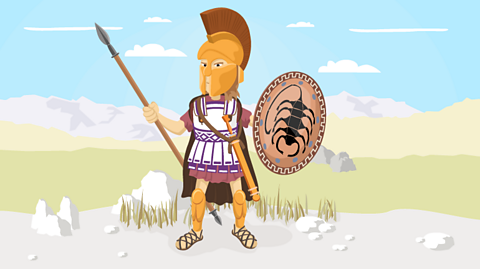
Ancient Greek armies had fierce warriors who fought both each other and foreign enemies.
Their battles on land and at sea helped shape the way wars were fought for hundreds of years.
They trained and practised so they could be prepared to fight. They used many different weapons and had powerful armies and navies, which were groups of warships used for fighting at sea.
Important words
Important words on the Ancient Greeks at war.
| Keyword | Definition |
|---|---|
| Armour | Protective clothing made from metal or leather, worn by soldiers to keep them safe in battle. |
| Aspis | A large, heavy round shield made from wood and bronze, used by hoplites for protection. |
| Bronze | A strong metal made by mixing copper and tin. The Greeks used it for armours, helmets and weapons. |
| Doru | The long wooden spear carried by Greek hoplites. |
| Greaves | Metal armour worn on the lower legs top protect them during battle. |
| Hoplite | A Greek foot soldier who fought on land using a long spear and a round shield. |
| Naval | To do with ships and the sea, especially battles fought at sea. |
| Trireme | A fast Greek warship with three rows of oars on each side. |
Who did the ancient Greeks fight and why?
In ancient times, Greece wasn’t one country like it is today. It was made up of many smaller city states that often argued and sometimes even went to war with each other.
Two city states Sparta and Athens fought against each other in a long war, called the Peloponnesian War, from 431BC to 404BC.
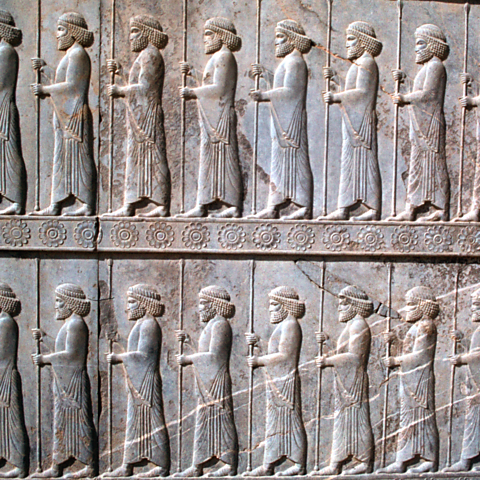
However, the Greeks would work together when a foreign enemy threatened them. Their biggest enemy was the Persians, who were from the area around modern-day Iran. Persian kings tried to conquer Greece several times, but the Greeks fought them off.
In the end, the Greeks led by Alexander the Great defeated the Persian Empire in around 330BC.
How did the hoplites fight as a team?
The core of the Greek army was made up of foot soldiers who fought with a long spear and used a large round shield for protection. They were known as hoplites.
A hoplite had to buy his own armour, unless his father had died in battle. Then he used his father’s equipment.
In battle, they fought as a team by lining up in ranks and locking their shields together. Only their spears pointed over the top of their shields. This helped them protect each other while moving forward and fighting the enemy.
This arrangement, or formation, was known as a ‘phalanx’.
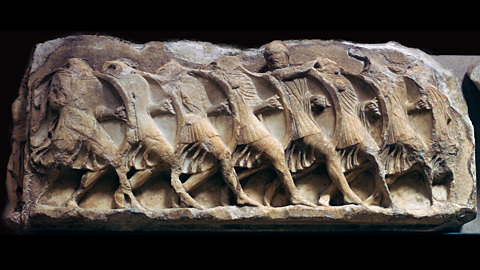
When facing another army, enemy soldiers saw only a wall of spears and shields moving towards them. It was tough to break through once soldiers in a phalanx started marching forward together.
The Greeks had archers (men with bows and arrows) and cavalry (men on horses) too, but it was the use of the phalanx that won many famous battles.
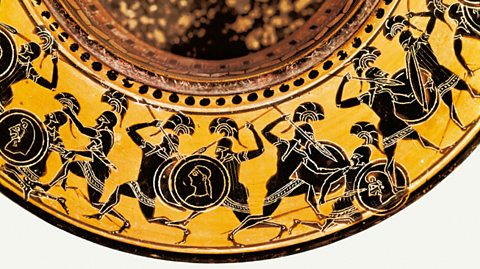
What weapons did Ancient Greek soldiers use?
Click through the slideshow to learn more about what weapons the Ancient Greeks used in battle.
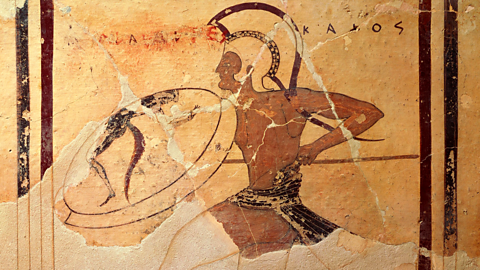
Image caption, Hoplites used a long spear known as a 'doru' and a short sword called a 'xiphos' for fighting up close.
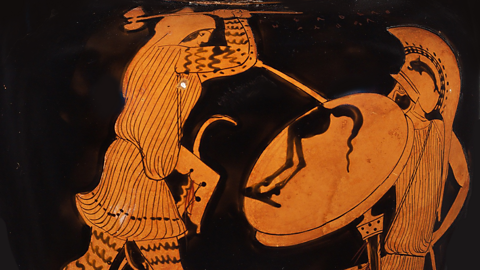
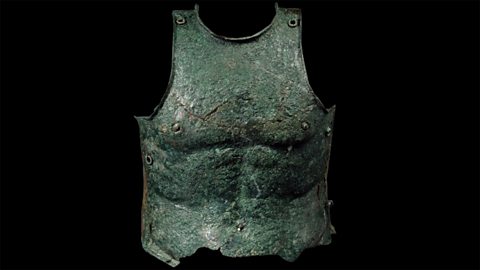
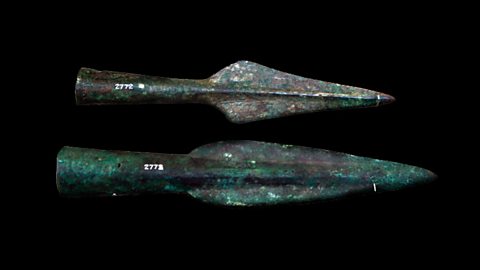
1 of 4
The Spartan soldier state
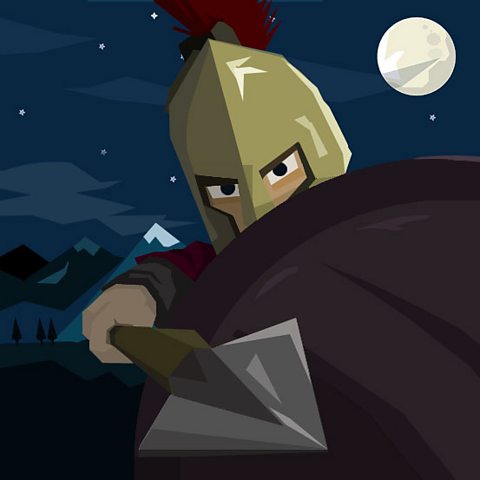
The Spartans were known for training strong, skilled soldiers. They believed that strict discipline and a tough upbringing were the secret to making the best soldiers.
Boys left their families at seven to begin their 23-year-long training to become a soldier. Only those who went through this gruelling training system were considered true Spartan citizens. It was a hard life, boys were only allowed one tunic and had to walk everywhere barefoot, even in cold weather.
Girls in Sparta weren't allowed to be soldiers, but they did compete against the boys at sport. Spartan women also had more freedom than other Greek women. For example, they could run the family farm.
Spartan mothers were thought to have told their sons before they left for battle to “Come back with your shield, or on it,” because dead Spartans were carried home on their shields. They believed only a coward would drop his shield and run away.
How did the Ancient Greeks fight at sea?
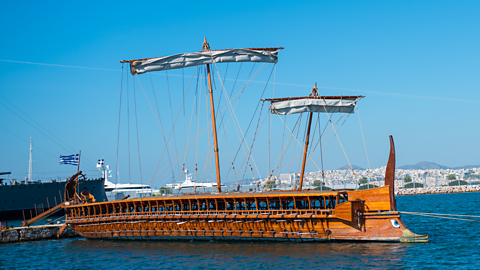
The Greeks were soldiers who used powerful warships called 'triremes', which were fast and easy to steer.
Each trireme had three decks, one above another, with rows of oars on each side powered by many rowers working together
The ships had a bronze covered ram at the front. This strong metal ram was used to smash into enemy ships.
Naval battles were important. These were battles fought at sea using ships. They were very important to Athens, which had one of the largest fleets - groups of ships used for war - in Ancient Greece.
Battles at sea helped the Greeks protect their trade routes and defend against invaders like the Persians.
Think like a historian

Have a look at the thinking points below and think about your answer to the questions. You could even write it down on a piece of paper or discuss it with somebody else if you want to.
Why do you think the Ancient Greeks built such fast and powerful ships like triremes?
How did working together as a team help hoplites in battle?
What can their armour and weapons tell us about what the Ancient Greeks thought made a good soldier?
Perhaps you thought about how the Greeks built fast and powerful ships like triremes so they could move quickly in battles at sea and crash into enemy ships before they were attacked. Their speed helped them protect their trade routes and defend Greece from invaders like the Persians.
Did you remember that teamwork was very important for Greek soldiers? When hoplites fought side by side in tight lines, their shields locked together to make a strong wall. This formation meant each soldier protected the person next to them, making the army much stronger.
Maybe you thought about their heavy shields, and their need for armour and sharp weapons. Their armour and weapons show that the Greeks valued strength, bravery and teamwork. Hoplites had to be strong to carry heavy shields, brave to fight close to the enemy, and disciplined to stay in formation when in battle.
Activities
Activity 1: Meet a hoplite
Click on the hoplite to find out about his weapons and armour.
Activity 2: Famous battles
Click on each of the scenes to find out about some famous ancient Greek battles.
Activity 3: Quiz – War in ancient Greece
Let's find out what you know about how the Ancient Greeks fought.
Game: The Argo Odyssey
Argo the dog is missing! He was last spotted on a Greek battlefield.
Play the game to train with the Spartans and learn how to fight in the phalanx formation.
Grown-ups corner
Are you a parent, carer or teacher?
Take a look at some of the links below on KS2 History which are packed full of knowledge, videos, quizzes and activities.
KS2 Ancient Greece
BBC Bitesize for Teachers
KS2 Ancient Greece: 1. Everyday life in the city-states
BBC Bitesize for Teachers
Resources - Teacher notes: Once upon a time in Ancient Greece. document
BBC Bitesize for Teachers
Horrible Histories: Raid and Trade game! game
Play Horrible Histories: Raid and Trade KS2 History
More on Ancient Greece
Find out more by working through a topic
- count5 of 6

- count6 of 6
- count1 of 6

- count2 of 6