What are the key learning points about the types of wave?
To understand the difference between A wave that moves in a direction at right angles to the way in which the particles are vibrating. and A wave that moves in the same direction (parallel) as the direction in which the particles are vibrating. waves.
To describe in terms of A particle is a single piece of matter from an element or a compound, which is too small to be seen. Particles can be atoms, molecules or ions. movement, how waves transfer energy from one place to another.
To identify the different parts of a wave.
What are waves?
Waves transfer energy from one place to another through vibrations
(The repeated and regular fluctuations, above and below the same position, eg the pressure of a sound wave or the voltage of an alternating current..)
The direction of these oscillations is the difference between A wave that moves in the same direction (parallel) as the direction in which the particles are vibrating. and A wave that moves in a direction at right angles to the way in which the particles are vibrating. waves.
What are longitudinal waves?
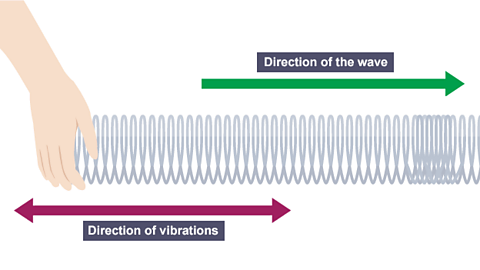
A longitudinal wave is one in which the vibrations of the particles are parallel to the direction in which the wave is travelling.
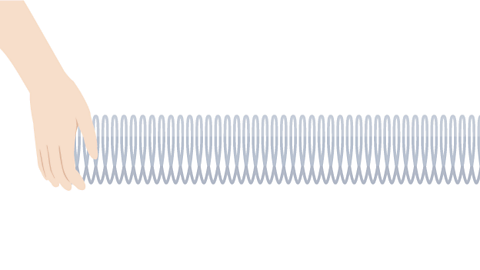
Image caption, 1. An outstretched slinky spring
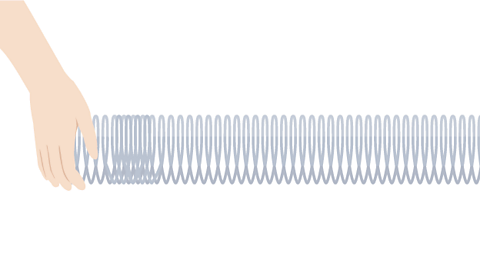
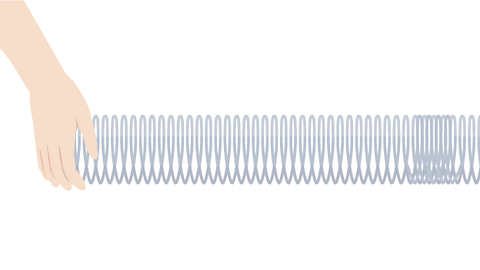
1 of 4
In the diagram, the compression moved from left to right and energy is transferred from left to right.
The movement of the coils of the slinky and the energy are parallel.
However, none of the particles are transported along a A wave that moves in the same direction (parallel) as the direction in which the particles are vibrating. .
Instead, they move backwards and forwards as the wave is transmitted through the A material through which a wave can be transmitted (propagate)..
Examples of longitudinal waves include:
Sound waves.
Sound with a frequency greater than 20,000 Hz (20 kHz). waves.
One way of remembering examples of longitudinal waves is to emphasise the O in lOngitudinal and sOund and ultrasOund.
What are transverse waves?
A transverse wave is one in which the vibrations of the particles are perpendicular (at right angles) to the direction in which the wave is travelling.
How to demonstrate transverse waves
Transverse waves are often demonstrated by moving a rope rapidly up and down.
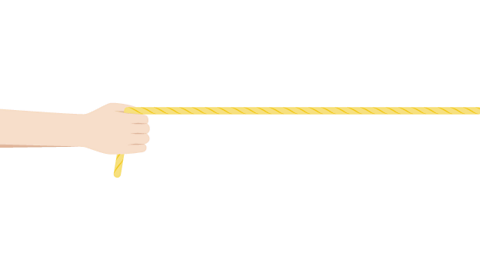
Image caption, 1. A hand holds a length of rope taut.
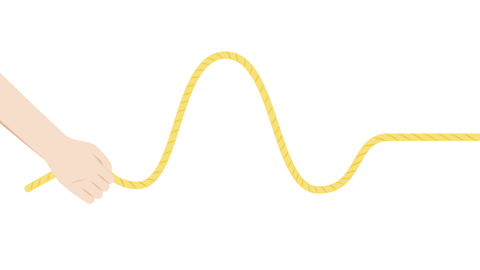
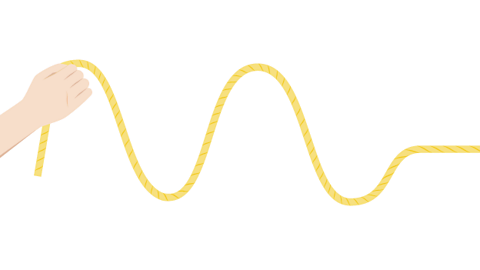
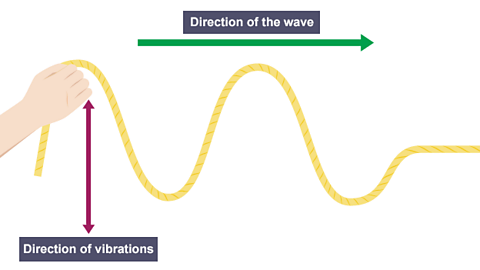
1 of 4
In the slideshow, the rope moves up and down, producing peaks and troughs.
Energy is transferred from left to right at right angles to the hand movement.
However, none of the particles are transported along a transverse wave.
Examples of transverse waves include:
Vibrations in a guitar string.
Electromagnetic waves – eg light waves, microwaves, radio waves, x-rays.
Water waves.
Key fact
All waves transfer energy from one place to another, but they do not transfer matter.
What are the different parts of a wave?
Some important terms:
Rest position (equilibrium position) - the undisturbed position of particles or fields when they are not vibrating.
Displacement - the distance that a certain point in the medium has moved from its rest position.
Peak - the highest point above the rest position.
Trough - the lowest point below the rest position.
Amplitude - the maximum displacement of a point of a wave from its rest position.
Wavelength λ – distance from one point on a wave to the next identical point. Wavelength is measured in m.
Time period T - the time taken for a full vibration of the wave, usually measured from peak to peak, or trough to trough. Period is a time and so is measured in s. A period of 2 s means that the time for one complete vibration is 2 s or that the time taken for one complete wave to pass a point is 2 s.
Frequency f - the number of waves passing a point each second, or the number of vibrations each second. Frequency is measured in hertz, Hz. A frequency of 50 Hz means there are 50 vibrations every second, or that 50 waves pass a point in one second.
How much do you know about types of wave?
More on Waves
Find out more by working through a topic
- count2 of 4

- count3 of 4

- count4 of 4