Is football coming home?
2026 marks the 23rd edition of the FIFA Men’s World Cup… and while it comes every few years, this year's international football tournament will look slightly different to fans across the globe.
The competition has a long history, and several countries have brought home the title more than once. But when is the FIFA Men’s World Cup and who's going to be playing in it?
BBC Bitesize has the answers to all your biggest questions below! You can also check out BBC Archive’s fascinating video from the year England last won the FIFA Men’s World Cup.
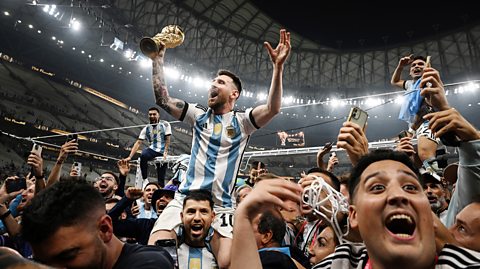
What is the FIFA Men's World Cup?
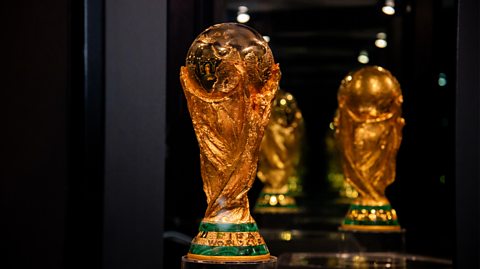
The World Cup is an international football tournament organised by the FIFA (Fédération Internationale de Football Association). It sees senior men’s national teams from across the globe go head-to-head to win the World Cup title.
The first ever tournament took place in 1930 and was held in Uruguay. The tournament has taken place every four years since, except for the years it should have been held during and shortly after World War II – in 1942 and in 1946.
The World Cup happens every four years to give enough time for the qualification tournaments and playoffs to take place. Each competition, there is also a new host, so it gives countries time to plan logistics and prepare for the arrival of thousands millions of fans.
Expanding from 32 teams, in 2026 the FIFA Men’s World Cup will feature 48 national teams competing in a 39-day tournament. The competition begins with the group stage, where the 48 teams are divided into 12 groups (categorised A-L).
Each group contains four teams and every team will play three matches. The top two teams in each group automatically qualify (24 teams), with the eight best third-place teams also advancing to the knockout stage.
When did England win the FIFA Men's World Cup?
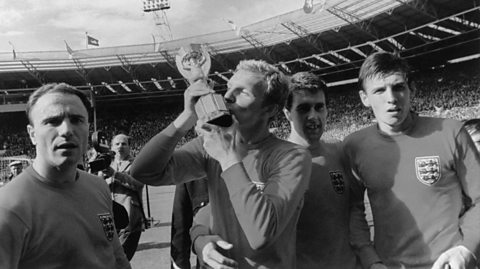
It’s now been 60 years since England last won the FIFA Men’s World Cup in 1966. This is the first and only time England has brought back the title, after Bobby Moore’s team defeated West Germany 4-2 on 30 July 1966.
The final was held in the original Wembley Stadium in London. England’s Martin Peters scored one goal and player Geoff Hurst scored a hat-trick in the game.
In 2026, England has qualified to compete in the World Cup. The 26-man team will be led by manager Thomas Tuchel.
1966: Make your own World Cup Willie
Blue Peter's Valerie Singleton speaking to camera
She said: "Well, there's another lion that I think you're going to see quite a lot about in the news this year. He's been chosen as the mascot for the World Cup football finals, which are being held in England this summer."
Camera cuts to World Cup Willie mascot
Pointing at the figure, Singleton continues: "And this is the one that I made for our Blue Peter shelves, and he's very simple to make. His head is made out of a woolly ball. He's got an egg carton for his face, felt clothes, and pipe cleaner body, legs and arms wrapped around with wool. Very simple to make.*
Cuts back Valerie Singleton demonstrating how to make your own World Cup Willie
"And if you want to make one, this is what you do. First of all, you make the shape of the man out of pipe cleaners like this, make them nice and firm. And we've done this quite a lot of times before, if you remember we used pipe cleaner bases for the horses that we made after the Black Beauty story.
"And when you've done that you then begin to wrap wool all the way around until it looks like this. And because you obviously want the body very much fatter than the rest of the figure, I started off by using a nylon stocking just on this part, saves using so much wool and of course the wool is a lovely fawn colour which is just right for a lion.
"Well then the next thing to do is to do the socks and I just cut up a bit of an old sock that I had and I folded it in half like that, sewed it up one side and along the bottom, turned it the right side out and there they are. And in fact, to make them look really realistic, just around the top I've put some red wool and then, leaving a gap for the white, I put some blue wool. So it gets that lovely ribbed look of the footballer's socks and, of course, the red, white and blue.
"And the next thing are his shorts - and, again, we've done this lots of times before. Here I've used felt, as I said, because you don'tneed to do any hemming and again, we make quite sure that it goes all the way round, just slightly overlapping for the seam, and reaches from his waist down to his knees.
"And then, if you remember, we cut a very tiny slit like that and sew up the two sides of the shorts and up the front for thetrousers, until they're like that. There they are.
"And those now slip on over the bottom like that. And if you're wondering why I'm doing the clothes first and I haven't got onto the head yet, it's because it's very much easier to dress him first and it's quite a good idea to just pin this in place like that back and front. Of course you'd sew it, i'm just putting a pin in it for now.
"That holds it nice and firmly there, so there he's got his shorts and his socks. Now for the top again I've used felt - this time it's lovely bright blue And again, I've cut a piece that goes from about one elbow across to the other elbow and reaches just over the top of the shorts.
"And you can see if I hold it up that I have, in fact, cut out the sort of arm shape here by cutting it in about a quarter of an inch and then bringing it out like that, so you get the curve of the arm. And I did two exactly the same. There they are.
"Leaving one as it is with the other one, we're going to make up a Union Jack on the front. And it's a very good idea when you're doing this to have a flag just by you so you make quite sure you do it properly. And using ordinary tape, first of all the white, we're going to do the smaller of the crosses, one of the saltire crosses.
"And, I'm just pinning this for the moment, that goes across there, that one goes that way. So you've got there the white running across and the red tape that I've used in fact is exactly the same width. But if you fold it in half and then put it across the middle, you can see there that it looks exactly right. Like that.
"And here, in fact, I have got one that I finished. There it is. And you see that the important thing to do, in fact, is to do the smaller, thinner cross that way first. Completely finish it with the white and the red. Then when you've done that, you can start building up the big cross on the front, which, of course, is the St. George's cross.
"Slightly wider white tape, and the red tape is exactly the same one as I use here, only this time, as it is not folded in half. Then at the sides you can see I folded it up or rather sewn it up here, leaving the gap for the sleeves and also on the other side and this slips again over his legs. I think it's the easiest way.
"Arms fitting in through there and again sew it along the shoulder seams like that. Don't forget to leave a gap for the head in there and there you've got him almost finished. In fact, the next thing, of course, he needs are his football boots.
"And for this, I used the ordinary ski boots that you can get for these teenage dolls. And if you cut them down, they are, in fact, rubber. If you cut them down, they look exactly like football boots. And these slip on his feet. One on that side and one on the other side.And there you are - he's completely dressed.
"Now, of course, the next thing we need is his head. And for this, I've made a woolly ball and this is rather interesting, actually, because it's completely different from the way that we've made them before. This time, instead of using two circles of cardboard, I've used just an ordinary square and wrapped it round and round and round like that. And you then slip this off like that.
"I'm just going to use the end bit there to tie it. That goes round the middle. Make sure that it does fit in the middle and pull it tight likethat and then simply cut through the loops. And when you've done that, make quite sure you cut through all of them, you can then begin to open it out. Ouch, snipping me there - careful you don't do that.
"And fluff it up and trim it until when you've done it, you've trimmed it nice and closely, you'll find it makes it look much softer until you've got that shape. And for the face, I've used an egg carton. And here I've used the bit where the egg fits in.
"You can just see the line that I've drawn round that, which in fact is the bit that we're going to use. And onto that, you paint a World Cup Willie face. There it is. It looks exactly like a lion. I've painted this, by the way, a sort of sandy colour rather than leave it the white. And this, we're going to stick onto, like that, onto the front.
"Should, if you push it on really firmly, stick on. There you are, like that. You can see it. Oh, well, it should do. I think it needs to be held for a few moments longer, in fact. And when you've done that, you then give him ears, again out of the egg carton, just painted the same colour.
"And by the way, the head is very slightly darker. And a cocktail stick, put that through there like that, and in turn, put that into the top.If you put a bit of glue on that, it should hold it nice and firmly.
"Finally, his tail, which again is just a pipe cleaner, curled round like that and just cut the ends so that you get the nice bushy tail. And, of course, that curls up like that.
"Put it up the back of the jacket and you can stick that. I find that it stays as it is, actually. Ease his head up a bit - there it is. You've got World Cup Willie.
"And, of course, all he needs now is his cup - his football. There it is. It's a ping-pong ball painted brown, and it says on it, 'World Cup.' Of course all he does need now is the cup as well.
"Well anyway i think he'd make a rather splendid mascot. I think he's fun to make - anyway let's hope you have a go."
End of Blue Peter segment
Originally broadcast on 9 May 1966, this BBC Archive video takes a look back at the World Cup celebrations six decades ago.
In the footage, Blue Peter's Valerie Singleton shows viewers how to make their own 1966 World Cup mascot. The famous mascot is a lion called Willie.
World Cup Willie was the first-ever official mascot for a FIFA World Cup. The lion, who wears a Union Jack jersey, was introduced during the 1966 tournament that was hosted in England.
BBC Archive offers a unique collection of thousands of archive films, capturing life and events across the UK since the 1940s.
When did Scotland last qualify for the FIFA Men's World Cup?
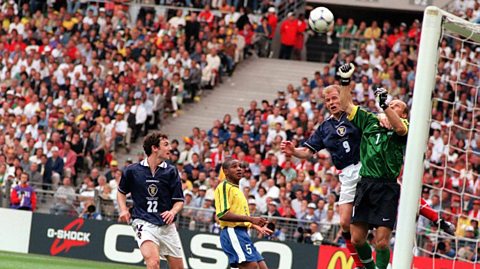
In case you missed it – Scotland have qualified for the FIFA Men’s World Cup for the first time in 28 years! They last participated in 1998 and 2026 will mark their ninth appearance in the tournament.
Scotland have previously qualified for 10 World Cups but declined to appear back in the 1950 tournament. In 2026, the 26-man squad will be led by head coach Steve Clarke.
In their history, Scotland have never made it past the group stages. But could 2026 be their lucky year?
Have Wales and Northern Ireland qualified for the World Cup?
While England and Scotland have qualified for the 2026 FIFA Men’s World Cup – what about Wales and Northern Ireland? In March 2026, Wales and Northern Ireland had the chance to qualify for the World Cup via play-offs but were both unsuccessful.
Wales have only qualified for two World Cups in the past, in 1958 and 2022. Northern Ireland has made it into three previous World Cups – 1958, 1982 and 1986 – but have never made it past the group stages.
When was the last time all four home nations qualified for the same men's World Cup?
Decades ago, the process of qualifying was quite different. But the last and only time all home nations – England, Scotland, Wales and Northern Ireland – played at the same Men's World Cup was in Sweden in 1958.
How do you qualify for the FIFA Men's World Cup?
Qualification for the FIFA World Cup 2026 started back in September 2023. To qualify, national teams compete in a multi-stage tournament held by their continental confederations.
For example, the continental confederation for the England national football team is UEFA (Union of European Football Associations). Out of all the eligible nations, only 48 qualify for the 2026 final tournament.
Of the 48 participating nations, the host nations receive automatic qualification, while the rest battle through group stages and play-offs to secure their place to win the FIFA Men’s World Cup.
Who has the most FIFA Men's World Cup titles?
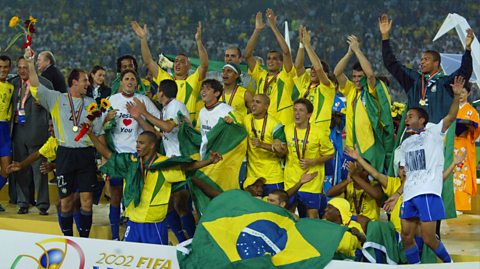
Since its inception, there have been 22 World Cup tournaments so far. Taking place every four years, the 2026 FIFA Men’s World Cup will be the 23rd edition.
But who has won the most World Cup titles? Well, that title is held by Brazil who have won five times in total.
They have participated in the tournament 22 times so far and won the FIFA Men’s World Cup in 1958, 1962, 1970, 1994 and 2002. In joint second for the most titles is Germany and Italy, who have both won four times, followed by Argentina who have three titles.
When does the 2026 FIFA Men's World Cup start?
The 23rd edition of the FIFA Men’s World Cup will take place from 11 June to 19 July 2026. The opening match of the tournament is between Mexico and South Africa and takes place on Thursday, 11 June in Mexico City’s Estadio Azteca.
A record 48 nations are participating, which is 16 more than the 32 that featured in Qatar in 2022. The World Cup 2026 will consist of 104 record-breaking matches.
Don't understand all the football jargon? We've got all the answers you need!
Where is the 2026 FIFA Men's World Cup?
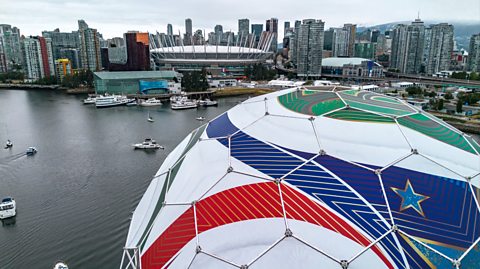
For the first time in history, the FIFA Men’s World Cup will be co-hosted by three countries – Canada, Mexico and the United States. The games will be played across 16 North American host cities:
- Canada: Toronto, Vancouver
- Mexico: Guadalajara, Mexico City, Monterrey
- The United States: Atlanta, Boston, Dallas, Houston, Kansas City, Los Angeles, Miami, New York New Jersey, Philadelphia, San Francisco Bay Area, Seattle
The new World Cup champion will be crowned at New Jersey's MetLife Stadium on 19 July 2026.
Who has qualified for the 2026 FIFA Men's World Cup?
In the 2026 FIFA Men’s World Cup, there are a record 48 teams taking part. Below is a list of all participating and the final draw for the group stages.
The teams will be split evenly across 12 groups, which are made up as follows:
- Group A: Mexico, South Africa, South Korea, Czech Republic
- Group B: Canada, Bosnia-Herzegovina, Qatar, Switzerland
- Group C: Brazil, Morocco, Haiti, Scotland
- Group D: United States, Paraguay, Australia, Turkey
- Group E: Germany, Curaçao, Ivory Coast, Ecuador
- Group F: Netherlands, Japan, Tunisia, Sweden
- Group G: Belgium, Egypt, Iran, New Zealand
- Group H: Spain, Cape Verde, Saudi Arabia, Uruguay
- Group I: France, Senegal, Iraq, Norway
- Group J: Argentina, Algeria, Austria, Jordan
- Group K: Portugal, DR Congo, Uzbekistan, Colombia
- Group L: England, Croatia, Ghana, Panama
When is the FIFA Women's World Cup?
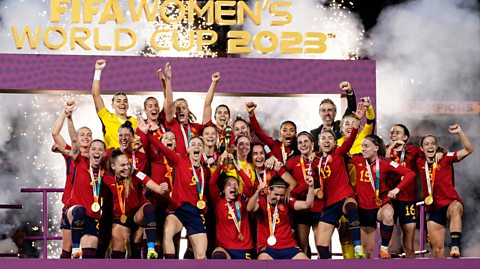
The FIFA Women’s World Cup has been held every four years since the first ever tournament in China in 1991. The first ever winner of the FIFA Women’s World Cup was the USA.
The next FIFA Women’s World Cup takes place between 24 June and 25 July 2027 and will be held in Brazil. This is the first time a South American nation will host the tournament, which will see 32 nations compete.
This article was written in June 2026