The history of the UK's motorways (and when they are best avoided!)
When you're travelling around the UK, either for a holiday with family and friends or to visit relatives for birthdays or Christmas, it's likely you've hopped in a car and taken part of your journey on a motorway.
But what actually is a motorway, and how are the rules for them different from other roads? And how do you avoid the dreaded traffic jams and delays when journeying on UK roads?
Here at Bitesize we've gathered all the facts in one place, so next time you're on a road trip, you can pass the time by entertaining friends or family with these interesting nuggets of road-related wisdom!
What is a motorway?
First things first, what even is a motorway?
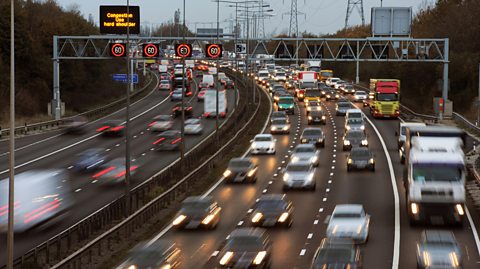
A motorway is a high-speed road with multiple lanes (usually three or more) designed for long-distance traffic. Motorways have controlled access and no stopping, except at designated exits. The speed limit on a motorway is usually 70mph.
Smart motorways, which are a more recent phenomenon in the UK having been introduced in 2010, are motorways on which the speed limit is varied and lanes (including the hard shoulder) are opened or closed for driving in response to the level of traffic.
There are 2,300 miles (3,701km) of motorway in the UK.
Test your knowledge on motorways with our Great British motorways quiz.
What was the first motorway in the UK?
The first motorway in the UK was the Preston Bypass in Lancashire, which is now part of the M6. It was opened on 5 December 1958 by the then Prime Minister Harold Macmillan and was just over eight miles long. It cost nearly £3m to build and didn’t come without its problems. Just three weeks later it was temporarily closed after freezing water damaged its surface.
What is the longest motorway in the UK?
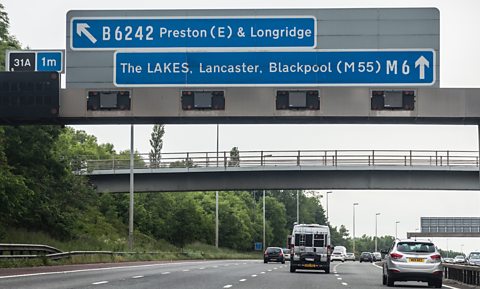
The M6 also takes the title of being the longest motorway in the UK. It runs entirely in England and is a whopping 230 miles (370km in length).
It begins near Rugby, south east of Birmingham, before travelling north west passing Coventry, Birmingham, Wolverhampton, Stoke-on-Trent, Preston, Lancaster and Carlisle. It ends at junction 45, near Gretna, just short of the Scottish border. After this, it becomes the A74(M) and continues towards Glasgow as the M74. Its busiest sections are around the West Midlands and Cheshire.
What is the busiest motorway in the UK?
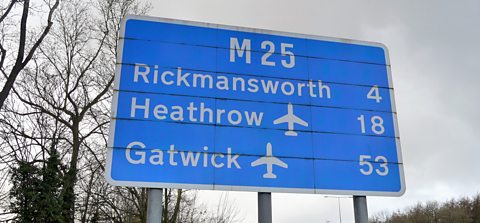
The busiest motorway in the UK is the M25, which runs in a large 117-mile (188km) circle around Greater London.
Construction began on this motorway in 1975, with the final section opened in 1986 by then-Prime Minister Margaret Thatcher.
It is estimated that around 250,000 vehicles use it every single day. It can mean that the flow of traffic is extremely slow moving, particularly near Heathrow airport.
This area has very slow traffic for 7.5 hours a day and queues that are six miles long on average.
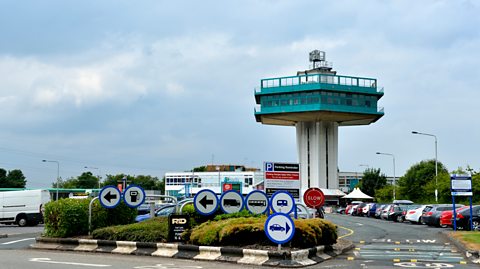
What is a motorway service station?
As of 2025, there are 97 motorway service areas in the UK. A service station is a designated place where drivers can come off the motorway to take a break, get food and drink, fuel up their vehicles, use the toilet or even sleep in overnight hotel facilities.
Gloucester Services on the M5 has been consistently named as the best service station in the UK, closely followed by Tebay on the M6 in Cumbria.
What are the rules of the motorway?
The usual rules of the road apply on motorways, including wearing seatbelts and adhering to the speed limit, but there are a few extra rules that motorists must also follow.
Stopping on a motorway is extremely dangerous, and therefore a vehicle should not stop unless there is an actual emergency. Stopping for a rest break or to answer the phone, for example, is illegal and could land you with a fine or penalty points on your driving licence.
It might sound obvious, but being a pedestrian on a motorway is not permitted. They must not be on the motorway or slip road unless it is an emergency. It is also an offence for any driver to pick up or drop someone off on a motorway.
What are the worst times to travel on the motorway?
If you want to avoid delays, slow-moving traffic and lots of queuing, you're best avoiding the motorway during rush hour. This is when most people are travelling to work or school in cars. If you can, it is best to avoid travel on weekdays between 6am and 10am and 4pm to 8pm.
Friday afternoon is usually the busiest day of the week on the motorways.
Other times to avoid the motorway include bank holiday weekends, especially the Friday night and Saturday morning as everyone has the same idea, and jumps in the car for a long weekend break. The same can be said of the bank holiday Monday evening, when everyone is returning home, ready to start their work and school week again.
Generally the last Friday before Christmas, sometimes dubbed 'frantic Friday', is one of the worst times to travel on the motorway as lots of people have finished school and work for the festive season and families are known to travel across the country to stay with relatives for the celebrations.