With great power comes great responsibility...
Superheroes are seriously popular. The Marvel Cinematic Universe is the most popular film franchise of all time, having generated more than $30 billion across over 30 films. Avengers: Endgame, released in 2019, grossed over $2.7 billion globally.
But in the real world, would they be able to defeat their enemies? In other word, how scientifically possible are their powers?
BBC Bitesize has journeyed through the Marvel, DC and Disney universes to see who's a (scientific) hero and who's a zero.
Iron Man
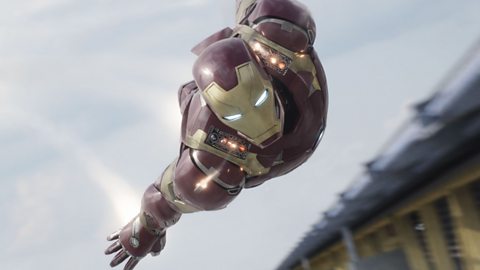
Edward 'Tony' Stark - also known as Iron Man - has a metal flying suit. But how realistic is it?
Well, exoskeletons are already being used to help people with disabilities which affect their mobility, so a suit like Iron Man's may actually be quite plausible in the future.
You might think the weight of a suit like Tony's would cause problems, but it can be made to feel up to 80% lighter by transferring some of the burden to the ground rather than your body.
This has been done using prototype backpacks made by Australian military engineers. The bags are attached to exoskeletons that reach the ground and essentially push upwards, reducing the pressure on the person wearing it.
While flying exoskeletons have been tried - such as Solotrek, which could fly up to 200 kilometres in the air - the project was shut down in 2002 due to a crash. So, it seems we've got a while to wait yet.
Frozone
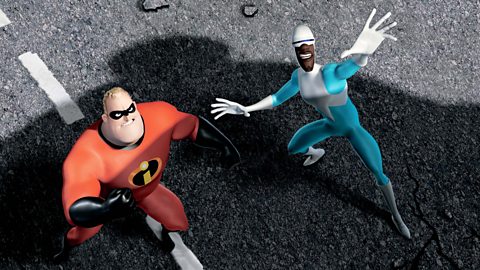
The extremely cool Frozone is a character in The Incredibles who can freeze people and objects by drawing moisture from his body and the air around him. Without water vapour in the air, his powers are extremely limited.
If you've ever wanted to study superheroes at university, you might actually be able to. One student at the University of Leicester wanted to see if Frozone could feasibly cover a person in a layer of ice by using the water available to him.
The student started by imagining the person was a man of average height and weight - about 174 centimetres tall and 83.6 kilograms. To freeze him fully, they calculated that Frozone would need a body of water weighing about 2.53x10⁻⁷ kilograms. That's roughly the amount of water in a raindrop.
To figure this out, they calculated the man's surface area, then the surface area of a water molecule. They divided the former by the latter to find the number of molecules needed. Finally, they multiplied that by the mass of one water molecule - and voilà.
It turns out Frozone's powers are feasible. So, next time there's a cold snap in Chicago, you know who to blame.
Black Panther
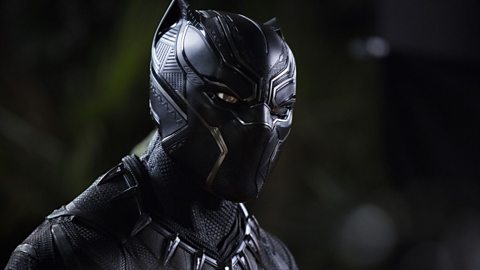
Black Panther hails from a mineral-rich country called Wakanda. The material mined there is called Vibranium - a substance that crash-landed in the region in a meteorite.
In the comics and films, it’s the strongest substance in the world. Black Panther’s suit is made out of it, and not only can it withstand the force of pretty much anything, it also stores that energy to be released later. Hilarity ensues when Shuri demonstrates this to T’Challa by making him fly across the room.
But will it ever be possible to create a man-made substitute for Vibranium? The technology to turn pressure and force into voltage already exists - it's used in the light-up trainers you used to think were cool as a child.
At the moment, though, there's no natural substance that resembles Vibranium, although graphene comes close in terms of strength. This is essentially a sheet of carbon atoms in a hexagonal pattern, and is one atom thick. It's the strongest substance in the world, but no one has fashioned it into a suit that can fight back just yet.
Elastigirl
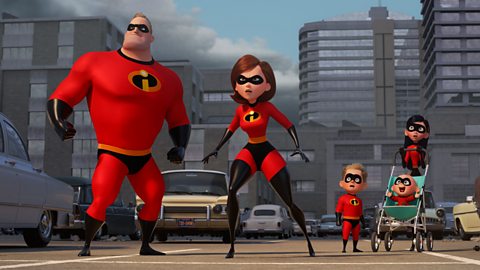
Returning to The Incredibles, another University of Leicester student took a look at super-mum Helen Parr, or Elastigirl as she’s better known.
They wanted to find out how much force it would take to stretch Elastigirl’s arm. To do this, they calculated the tensile stress - the amount of force needed to stretch an object.
It was about 10.1 MPa (megapascals), and the force required would be around 318.4 N (newtons), though only if Elastigirl's arm is stretched to 30 metres and a thickness of 1 millimetre.
To put this into perspective, 300 newtons is the force needed to pull about 10 Xboxes, which weigh 30 kilograms. So, if you can imagine that, you can imagine what it's like to be Elastigirl.
Superman

In the 1940s, Superman’s powers were revealed to be obtained through absorbing energy from the Sun. This means he's solar-powered, like the solar panels you find on top of houses. These are made of solar cells - which means Superman is also a solar cell.
Students at the University of Leicester wanted to find out his solar cell efficiency - how much energy is being used by the solar power he absorbs. It was 656,000%, which is astronomically higher than any solar cell on Earth. The highest recorded is 44.7%.
Superman would need far more energy than he could possibly obtain as a solar cell. But, to be fair to him, he's an alien from Krypton - so we should probably assume there's some Kryptonian physics at play that we humans can't possibly understand.
This article was published in April 2019 and updated in July 2026.