All about the extra-terrestrial
The mysteries of space have fascinated us for thousands of years.
Ancient and medieval writers interpreted strange sights in the sky as signs from God, or a glimpse into Heaven. In 749 AD, one chronicle recorded that ships with crews were seen sailing through the sky above the Clonmacnoise Monastery in Ireland.
Today, many people ascribe sights like this to extra-terrestrial beings. According to a 2025 YouGov poll, three-quarters of Brits believe intelligent alien life exists somewhere in the universe, with 32% believing it's visited Earth already.
Here, BBC Bitesize takes a look at UFOs - those unexplained airborne objects that have interested us for so long. What are they, where have they reportedly been seen and how have they been depicted in film and television?
What is a UFO and what does it stand for?
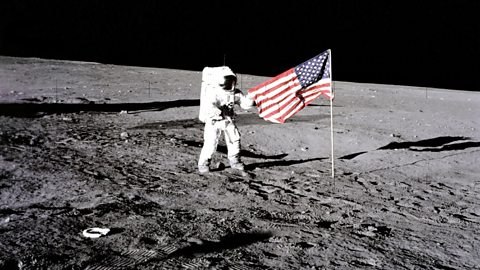
A UFO is an ‘Unidentified Flying Object’ – put simply, it’s any airborne object or light that the observer can’t explain in the moment.
You might think of aliens when you hear the term. That’s because it’s become associated with extra-terrestrial spacecraft, like flying saucers, and intelligent alien life visiting Earth. But its literal meaning isn’t linked to this at all.
UFOs became a subject of interest after the Second World War, when rocketry – the science and technology of building rockets – took off. A period known as the Space Race began in the mid-1950s, when Cold War rivals, the United States and Soviet Union, competed to achieve firsts in space flight.
Aviation had advanced massively by this time, with the development of jet aircraft, radar and missiles meaning there were more unfamiliar sights in the sky than ever before. Rising Cold War tensions and fears of a nuclear war meant people were more anxious about enemy planes and potential attacks.
Why has UFO been changed to UAP?
A term you might not have heard before is UAP – ‘Unidentified Aerial Phenomenon’, or ‘Unidentified Anomalous Phenomenon’.
Official bodies such as NASA now use this term instead of UFO. The shift officially happened in 2020, though the term had been used as early as 1987.
This was done to help combat the science-fiction connotations and ridicule attached to the original term, so that researchers can analyse sightings objectively. UAPs also aren’t just limited to the sky anymore. The term ‘anomalous’ encompasses objects in water and air as well as space.
Other related terms are ufology, the investigative study of UFO reports, and flying saucer, a colloquial term describing disc-shaped unidentified objects.
Are UFOs real?
It's the all-important question…
In most cases, when UFOs are investigated, they’re revealed to be conventional objects. Often they’re human-made aircraft – like drones, military planes or satellites – or optical phenomena such as cloud formations, meteors and bright planets.
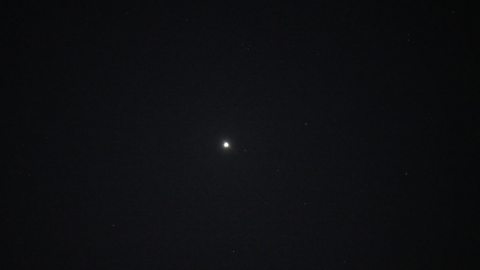
The human eye can play tricks on us. For example, Venus can appear unusually bright in the night sky and may seem to move relative to the background stars during periods of ‘retrograde motion’ – an optical illusion you may have heard about on social media. Camera lenses can also distort light into saucer-shaped objects.
Some sightings are hoaxes, meaning a deliberate lie intended to trick people into believing something is true. In the age of artificial intelligence, when images and videos can easily be faked, this is something we may have to be on the lookout for.
What are the most famous UFO sightings?
Kenneth Arnold, 1947
This was the first well-known UFO sighting, when businessman Kenneth Arnold claimed he’d seen nine high-speed objects near Mount Rainier in Washington, USA, while flying his own small plane.
Arnold described them as crescent-shaped and believed they were travelling at several thousand miles per hour, moving ‘like saucers on water’. This speed, at a height of about 10,000 feet, would have been impossible at the time.
A newspaper article mistakenly reported they were saucer-shaped, which is where we get the term ‘flying saucer’ from.
Roswell, 1947
Arnold’s sighting was the first to gain widespread media attention, and more reports of similar incidents followed.
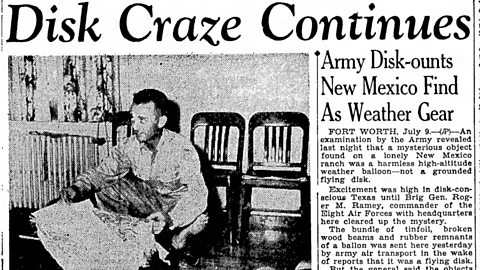
On 7 July the same year, Mac Brazel told the sheriff in Roswell, New Mexico, he’d found debris scattered across his ranch. He thought there might be a connection to the recent flying saucer stories, and wondered if something had crashed during a storm.
A nearby military airbase worked with a journalist to release a statement declaring that ‘the many rumours about the flying disc became a reality yesterday’.
However, less than 24 hours later, the US military said it had made a mistake, and the ‘saucer’ was actually a crashed weather balloon. It released images of military personnel holding the debris.
It was only in the 1970s that people started to question this explanation, when one of those military personnel claimed the weather balloon story was a cover-up. This sparked books, documentaries and a film, before US government reports in 1994 and 1997 concluded the object had indeed been a weather balloon carrying equipment to scan for evidence of Soviet nuclear testing.
Rendlesham Forest, 1980
You might think it’s an unlikely setting – but a forest in Suffolk, in the East of England, is now synonymous with one of the most famous reported UFO sightings in history.
On Boxing Day 1980, US military personnel stationed at an RAF base reported seeing a glowing triangular object with strange markings over nearby Rendlesham Forest. Two days later, investigators took a recording of glowing objects and odd beams of light, and reported measuring radiation readings that they believed were unusual and higher than usual.
Three years later, a memo sent by the deputy commander of the base to the Ministry of Defence was released by the US government. It described an encounter with what seemed to be a UFO in the forest – and since then, the incident that’s become known as ‘Britain’s Roswell’ has been fiercely debated.
Phoenix Lights, 1997
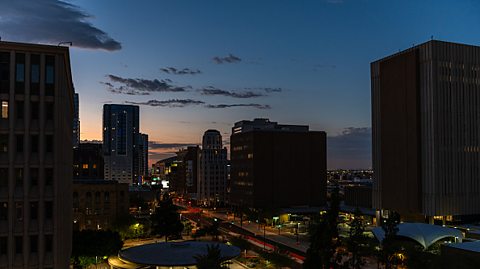
Something strange happened on 13 March 1997: thousands of people all reported seeing the same set of glowing objects moving across a 300-mile stretch of Mexico and the US states of Nevada and Arizona.
Between 7:30 and 8:45 that evening, a V-shaped object with five glowing lights was seen slowly gliding from Nevada to Phoenix, Arizona and then, from around 10:00, a series of stationary orange lights appeared.
The US Air Force claimed this ‘second wave’ was made up of flares dropped by aircraft during training, but officials couldn’t provide an explanation for the ‘first wave’. Some argued it was simply aircraft flying in formation, but this didn’t satisfy many eyewitnesses and researchers.
USS Nimitz, 2004
When US Navy pilots came across a white, wingless object shaped like a Tic Tac off the coast of southern California, they didn’t know what to make of it. Roughly 40 feet long, it had no visible engine or exhaust and appeared to be performing unusual manoeuvres.
It was tracked using radar, but disappeared when one pilot tried to intercept it, before reappearing at their designated meeting point 60 miles away in a matter of minutes.
It’s the video of the incident that has captured people’s imaginations. A different jet took Forward-looking Infrared (FLIR) footage of the object, which was released by the US government in 2020. Three years later, pilots testified about the incident before Congress.
Scientists and sceptics believe the object was likely an infrared glare from a distant aircraft, with its manoeuvres being optical illusions created by the camera’s system.
How have UFOs been portrayed in film and television?
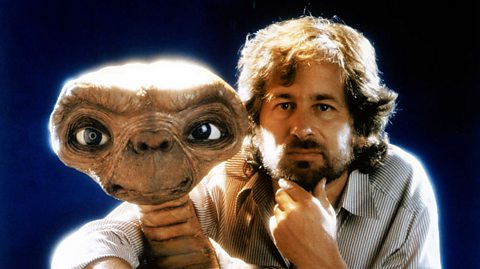
But rational explanations haven’t stopped us being fascinated by UFOs for decades. Nowhere is this more apparent than in film and television.
While science fiction is generally believed to have started with Mary Shelley’s Frankenstein in 1818, the genre exploded in popularity from the mid-20th century. The abbreviation 'sci-fi' was first used in 1954.
By this time, atomic technology and space exploration meant the genre seemed culturally significant. E.T.: The Extra-Terrestrial might be the first film that comes to mind when you think of UFOs and aliens - but several others had come before its 1982 release.
During the first frenzy of UFO reports in the 1950s, multiple films explored the topic. For example, The Day the Earth Stood Still tells the story of a peaceful alien who lands in Washington, D.C. to warn humans against nuclear warfare. Steven Spielberg, who also directed E.T., released Close Encounters of the Third Kind in 1977, which followed ordinary people drawn to a mountain in search of UFOs.
You might also have heard of The X-Files, a TV series that ran from 1993-2002. Starring Gillian Anderson and David Duchovny, it follows FBI agents attempting to prove that aliens are real and the government is hiding the truth about UFOs. Independence Day, starring Will Smith, imagines a hostile alien takeover and was released in 1996. A sequel followed in 2016.
You might have heard of the Men in Black. Smith also appears in this action franchise, about a secret government agency that monitors extra-terrestrials living on Earth. But do you know the story behind the title? It comes from a claim by a ufologist in 1953 that three men in black suits had visited him, threatening him against continuing his research into flying saucers. This inspired a Marvel comic series and, later, the films.