

18mh linn / Iain Ruadh Stiùbhart
Beachdan
Taghadh à lèirmheasan a chaidh a sgrìobhadh mun bhàrdachd aig Iain Ruadh Stiùbhart, cuide ri beachdan air an clàradh air bhidio agus ann an earrainnean fuaim.
MacGregor, N. (2002-2004)
'John Roy Stuart – Jacobite Bard of Strathspey', ann an Transactions of the Gaelic Society of Inverness, 63, dd. 64-65
John Roy's principal memorial of Culloden lies in song. He composed three fine songs on the battle and its aftermath. Two are quite well-known and are still sung; the third, it seems, has only survived in manuscripts from 1823…These songs matter. The Gaels had no newspapers and no war memorials. These song, learned, sung and passed on through generations and across the seas, served as both, and more.
In 'Oran Eile air Latha Chuilodair' John Roy Stuart expressed his devastation at the events of that day. Sorrow at the plight of the Jacobite forces is matched with harsh words for those seen as the enemy. He laments the absence of the 'cóig brataichean sròil', the five Jacobite clans who were elsewhere, in Badenoch or in Sutherland, that day, and, one by one, honours the fallen nobility of the Gaels.
Then there is the roll of dishonour. John Roy was not alone in believing Lord George Murray to be a traitor, although modern historins seem to agree that this was not in fact the case. He casts him as Achan, who, in the book of Joshua, betrayed the Israelites for a 'good Babylonish garment', gold and silver. If he had harsh words for Lord George Murray, his condemnation of the Duke of Sutherland is even more scathing. Over several verse, he curse him comprehensively. If you want a picture for its opening, think of a clump of trees, and one of them close to death from Elm disease. He ends with a scene that looks forward to the work of Alfred Hitchcock.
Mackenzie, J. ed. (1841)
Sàr-Obair nam Bàrd Gaelach, dd. 287-288
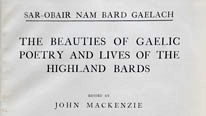
The sombre feelings whose dark current chafed his soul in consequence of the extinguishment of the Jacobites' hopes on that day, are beautifully embodied in two fine and pathetic songs. In one of these he directly charges George Lord Murray with treachery, and pours forth torrents of invective and revenge. His martial strains thunder along with the impetuosity of the mountain torrent – racy, sinewy, and full of nerve. He was so firm in his opinions of his Lordship's sinister motives that he rushed from rank to rank that he might "hew the traitor to pieces". His elegiac muse was also of a very high order; his "Lament for lady McIntosh," whose attachment to the Jacobite party is well known, is at once lofty in sentiment, poetical in its language, and pathetic in its conceptions. We do not mean to ascribe to poetic or military genius all the recklessness which a sober-plodding world compliments it with; and we, therefore, suppress a gossiping story in which our warrior-poet figures with the lady of the Lord Provost of Glasgow. After lurking in the caves, woods, and fastnesses of his native country, he escaped to France with the other faithful adherents of Charles, where he paid the debt of nature, leaving behind him an imperishable fame for the genuine characteristics of a warrior and a poet.
The Adobe Flash player and Javascript are required in order to view a video which appears on this page. You may wish to download the Adobe Flash player.
Teacsa
Ag innse mu dhàimh ri bàrdachd Iain Ruadh
Tha a' bhàrdachd aig Iain Ruadh a' còrdadh rium gu mòr air sàillibh 's gur ann às an sgìre seo fhèin a bha e, dìreach mu coig mìle sìos a rathad bhon taigh seo, 's gum biodh e tric an Àrd Mhurchais far a bheil sin an-diugh, Agus tha mi ga shamhlachadh, nuair a bhios mi as na monaidhean, tha mi ga shamhlachadh ann an diofar àiteachan.. air falach, no ro Chùl Lodair, shuas a' sin a' sealg, agus tha mi faireachdainn dàimh ris air sàillibh 's gur ann às an sgìre seo fhèin a bha e, agus tha seòrsa de dàimh agam ris fad, fad, fad às.
Bha dà mhac bràthair Iain Ruaidh an làthair aig Chùl Lodair cuideachd, Dòmhnall Breac agus Seumas a' Chnuic. Agus Seumas a' Chnuic, fhuair esan cead fuireach an seo às dèidh Chùl Lodair, tha mi chreids gun robh e glè òg, agus gun do leig iad dheth e, no gun do bhruidhinn cuideigin às a lèth. Agus dh'fhuirich e as an t-seann dachaigh mar fhear-tac an sin, agus tha mi creidsinn gun deach, feumaidh gun deach e dhan eaglais stèidhichte, 's ann don eaglais Caitligeach a bhuineadh an teaghlach sin, ach tha fhios againn gu robh Seumas a' Chnuic, mac bràthair Iain Ruaidh, gu robh esan as an eaglais stèidhichte. Agus air clàr na h-ealgaise, nuair a chaidh mo shean, shean, shean, shean seanair a bhaisteadh, 's e Seumas Grannd a bh' air-san cuideachd, cò bha an làthair agus na fhianais aig a' bhaisteadh ach Seumas Stiùbhart, Seumas a' Chnuic, mac bràthair Iain Ruaidh. Mar sin, tha mi faireachdainn dàimh shònraichte ri Iain Ruadh as an dòigh sin.
Air adhart gu
CeanglaicheanBBC iD
BBC iDStiùireadh a’ BhBC
Ceangalaichean BBC

BBC © 2014 Chan eil uallach air a' BhBC airson na th' air làraich-lìn eile.
Gheibhear sealladh nas fheàrr den duilleig seo le sealladair lìn nas ùire agus na duilleagan stoidhle (CSS) air. Ged a chithear susbaint na làraich leis an t-sealladair lìn a th' agaibh, tha sinn a' moladh an dreach as ùire den bhathar-bhog ur sealladair a thoirt a-nuas, no ur duilleagan-stoidhle a chur air ma ghabhas sin dèanamh.