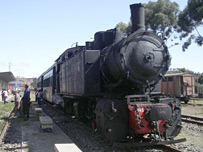
Africa's network of railways was started in 1852 in Alexandria, Egypt and continued until the 1960s. Most of the main lines were completed by the 1920s. They were hugely expensive to build, both in terms of lives lost and financial cost. Most of them were government owned and run.
Why the railway network was built
The reasons for embarking on these great railway projects were varied:
Trade
Abbas I, the Egyptian ruler, masterminded the first railway on the continent in the mid 1850s. He was driven by a desire to bring Egypt in line with Europe (the first train ran in Britain in 1825). He also wanted to use the trains to stimulate trade.
Emperor Menelik of Ethiopia had similar motivation. While in Egypt the railways carried goods which were already being manufactured and exported. In other parts of Africa the railways created new demands and so stimulated trade where there had been done. This was particularly the case with the Ugandan Railway running from Mombasa (on the coast of modern Kenya) to Lake Victoria (modern Uganda). The train could cut transport costs by 90-95%. Many people who earned their livelihoods as carriers were put out of work because of it.
War
Railways were built so that Europeans could better fight opponents to colonialism. In Sudan the railway from Wadi Halfa to Khartoum was part of Kitchener's subjugation of the region. Later a line was extended from Atbera eastwards to Port Sudan, initially for the purpose of transporting troops and supplied during the First World War.
Control
The railway network provided Europeans in Sub-Saharan Africa with a means of controlling the areas where they had colonies, linking one part of a region to another. This made it possible to impose the same sets of laws and regulations over vast areas.
The construction of the line from Lagos to Kano made the idea of a Nigerian state, embracing two very different regions, a possibility.
Mining
A large number of lines were built simply to transport minerals from mines to ports, with little benefit to communities on the way. In the Belgian Congo, copper from Katanga was taken to the port of Lobito in Angola on the Benguela railway. In Liberia a railway was built from the iron producing region of Nimba country to the port in Buchanan.
Resistance and revolt
Although some African rulers like Emperor Menelik and Abbas I were in favour of trains, others were suspicious and disapproving. They could see that a railway not only changed the geographical landscape but also the landscape of power and trade. The Damal of Cayor, Lat Dior Diop, in Senegal was adamant in his opposition.
"As long as I live, be assured, I shall oppose, with all my might the construction of this railway." - Damal of Cayor, Lat Dior Diop, to French Governor Servatius.
The ruled, as well as their African rulers, were hostile. The Ugandan Railway, running from Mombasa (coast of modern Kenya) to Lake Victoria (modern Uganda) was built with labour from India, since Africans refused to do the back breaking work of preparing the ground and maneuvering sleepers and track into position. Once the railways were built the people who worked on them were in a strategic position, and could have huge impact on the economy if they withheld their labour.
Strike week
"This has been a very exciting week. What a pity we haven't daily papers in Freetown. By this time it's rather stale to talk of the splendid fight which Railway and Public Works Men have put up for their war bonuses (given to Indian and European mechanics)...
If R. Barker, the blundering Acting General Manager and locomotive Superintendent of the Railways did think once that Sierra Leoneans could only bark without biting, then he is shockingly disillusioned. It is grand the way the fellows have stuck together." - Sierra Leone Weekly News, 19 July 1919, 'Rambling Talks' by the Rambler.
In Southern and East Africa segregation of the staff and their facilities caused friction.