Where Europeans owned and farmed land the determination to resist majority rule was strong. In Zambia and Malawi, the white minority gave in and those countries became independent in 1964. Angola and Mozambique remained tightly bound up with the ruling colonial power of Portugal until the latter itself underwent a revolution in 1974.
UDI
Rhodesia was a different case altogether. In 1922 it was declared a self-ruling colony, with the governing being done by Europeans. There were considerable tensions between white Rhodesians and the British Colonial Office, which felt an obligation to monitor, however feebly, the interests of the African population.
In 1961, the Zimbabwean African People's Union (ZAPU) was formed. Two years later, in 1963, the Zimbabwean African National Union (ZANU) was formed after splitting off from ZAPU. Both were banned during that year. In 1965, 35 colonies in Africa were already independent under majority rule. Ian Smith, the Prime Minister of Rhodesia, made a Unilateral Declaration of Independence, or UDI, as it became known.
Leisure for some
"I have seen wives of men with modest salaries, who in Europe would have no servants at all, habitually spending the whole day at bridge and tennis, while leaving the care of their children and even the keys of the storeroom in hands of native servants. Yet they were constantly complaining about the native dishonesty and inefficiency." - Letter published in the Sunday Express, Johannesburg, 31 Dec 1936.
Negotiation
This was against all the wishes of the British government, who hoped to help Rhodesia towards majority rule in line with the rest of the continent. Rhodesia left the Commonwealth and Britain imposed economic sanctions.
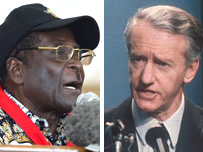
It took another fifteen years of negotiation and fighting before Rhodesia, renamed Zimbabwe, became independent under majority rule with Robert Mugabe leading the government in 1980.
"In the course of human affairs, history has shown that it may become necessary for a people to resolve the political affiliations which have connected them with another people, and to assume amongst other nations a separate and equal status to which they are entitled." - Ian Smith explaining his Unilateral Declaration of Independence on Rhodesian radio, 11 Nov 1965.