Ex-Wimbledon champion Vondrousova given four-year ban
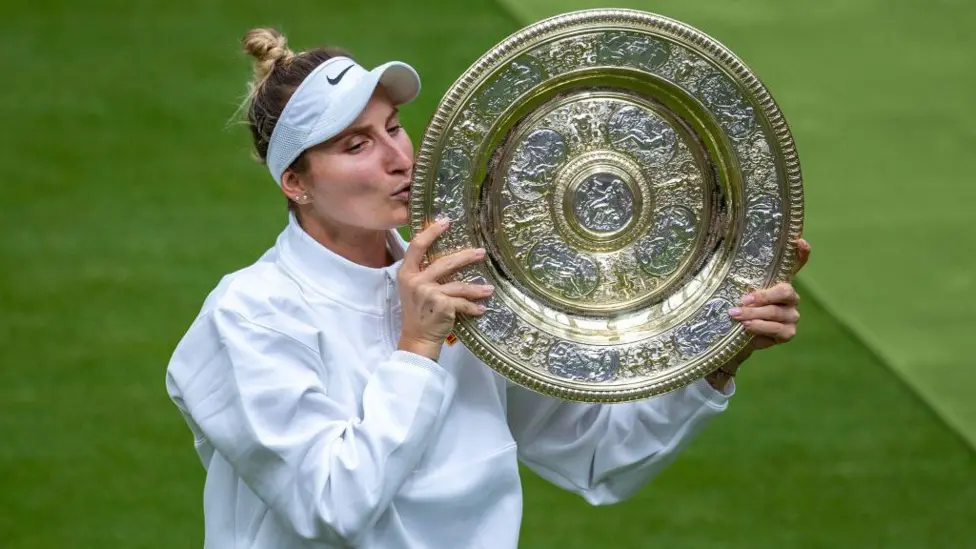
Marketa Vondrousova beat Ons Jabeur in the Wimbledon women's singles final three years ago
- Published
Former Wimbledon champion Marketa Vondrousova has been banned for four years for refusing an anti-doping test.
Vondrousova, 26, was charged by the International Tennis Integrity Agency (ITIA) after denying a doping control officer entry to her home to conduct the test in December 2025.
The Czech player said in April she feared for her safety when the officer called and said they failed to follow "protocol".
But a tribunal determined Vondrousova, who became the first unseeded player to win the Wimbledon women's singles title in 2023, provided "no compelling justification" for refusing a test.
Vondrousova's suspension will end on 21 June 2030, but she has a right to appeal against the decision to the Court of Arbitration for Sport (Cas).
"I have never doped, I have never had a positive test. Throughout my entire career I have undergone countless anti-doping controls and have always stepped on to the court with a clear conscience," Vondrousova wrote in a statement.
Also a French Open finalist in 2019, former world number six Vondrousova has not played competitively since January and dropped to 122nd in the rankings.
"I cannot say what comes next," she added. "For the first time in my life I do not have a plan."
During the hearing, Vondrousova explained stress and poor mental health had affected her decision-making, in addition to her safety concerns.
ITIA chief executive officer Karen Moorhouse said while the agency understands the testing process is "uncomfortable" and also acknowledges the additional burden it can carry for players competing, "it is essential to protect fair competition".
Vondrousova said she felt scared when the officer approached her door late at night without properly identifying themselves or following protocol, adding: "In that moment it was about feeling safe, not about avoiding anything."
The ITIA said Vondrousova told the doping control officer she would not take the test and signed a refusal form when she went outside to walk her dog shortly afterwards.
Speaking to a small group of journalists after the decision was announced on Monday, Moorhouse said it was "extremely rare" for a player to refuse a doping test.
In 2024, Russian player Vladislav Ivanov also received a four-year ban for refusing to take a test during competition.
Analysis: Why Vondrousova has received such a lengthy ban
Seeing a recent Wimbledon champion receive such a lengthy ban has sent shockwaves through tennis.
Some might think it seems harsh given Vondrousova did not test positive for a banned substance, while other players who have actually failed tests - including Jannik Sinner and Iga Swiatek in recent high-profile cases - served much shorter bans.
Vondrousova, a silver medallist at the Tokyo 2020 Olympics, said she has "always respected" the rules and controls, adding she felt "if you are honest, cooperative and do everything you can, it will be enough".
The ITIA says it had little option other than to ask the independent tribunal to hand out a four-year suspension - the starting point for any player who refuses or evades a test.
"You can't have an anti-doping system where a player is in a better place by refusing to take a test than they would be by taking a test and testing positive," Moorhouse said.
Vondrousova cited the horrific knife attack on her fellow Czech player Petra Kvitova - who was stabbed by an intruder at her home in 2016 - as a reason why she did not open the door to the doping control official.
Vondrousova claimed the female officer, who visited at 8pm, did not provide identification.
ITIA senior director Nicole Sapstead insisted all of its officers carry identification and a letter of authority, adding the player can also ask the officer to cite a unique ID code as an extra safety mechanism.
Vondrousova's mitigation included she was suffering from stress and other mental health issues, but the ITIA said the evidence she provided was not considered "compelling justification" for refusing a test.
Sapstead said each case is treated individually on the specific circumstances, adding that broad examples of "compelling justification" might include an urgent hospital visit or attending a funeral.
With any appeal likely to take many months, Vondrousova will certainly miss another opportunity to celebrate the greatest moment of her career with a return to Wimbledon later this month.
Refusing to take a doping test - whatever the reason - looks likely to cost her a further chunk of what should be the peak years of an impressive career.

