The small Basque club that produced Arteta, Alonso and Iraola
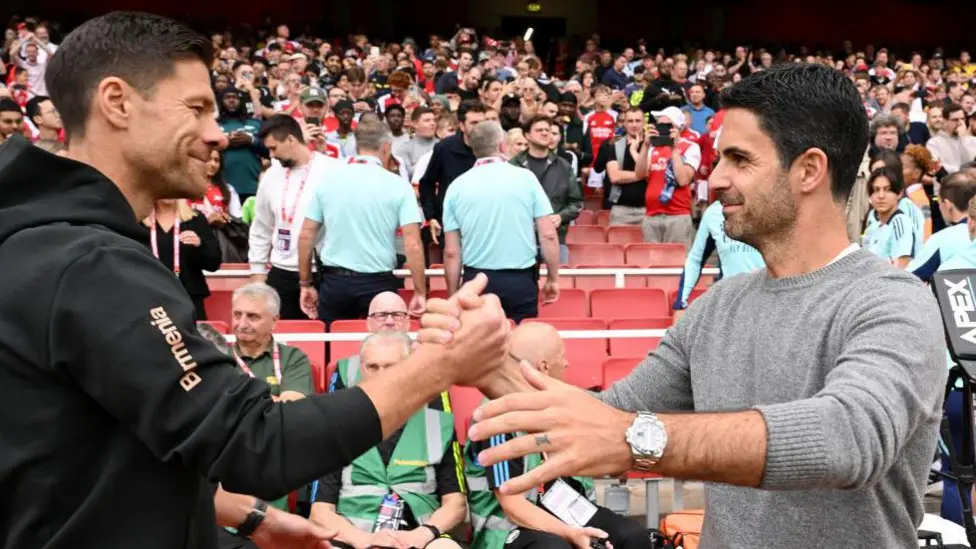
Xabi Alonso and Mikel Arteta will be meeting in the Premier League this season
- Published
Mikel Arteta, Andoni Iraola and Xabi Alonso have the distinction of managing three of the Premier League's biggest clubs, but their connection runs back to when they were eight years old sharing a gravel pitch for a tiny club in the Basque Country.
With just seven months between the oldest, Alonso, and the youngest, Iraola, they lined up together for grassroots club Antiguoko Kirol Elkartea in San Sebastian.
This was no elite academy, but a typical low-budget football club with concrete pitches and the talent to punch above its weight.
It is a far cry from the riches of the Premier League, where Arteta is entering his seventh season after winning the title.
Alonso, meanwhile, is officially starting work as Chelsea manager at the same time his childhood team-mate Iraola, who was interviewed for the Blues job, does likewise at Liverpool.
The Basque region is well represented in the Premier League.
Aston Villa manager Unai Emery - who co-owns fourth-tier club Real Union, just a half-hour drive from Antiguoko - and Villa sporting director Roberto Olabe are both from the region.
Pep Guardiola's former Manchester City assistant Juanma Lillo and the club's former sporting director Txiki Begiristain also hail from the area, as do Arsenal midfielder Martin Zubimendi and former Premier League managers Julen Lopetegui and Javi Gracia.
And now Antiguoko, a modest grassroots club turned semi-professional outfit in San Sebastian, are having a big influence at the top of the English game.
How Arteta, Iraola and Alonso shone

Iraola is bottom right and Arteta is in the middle with the coach Roberto Montiel's hand on his shoulder
Asked in 2024 why so many Basque managers end up in the Premier League, Arteta replied: "Go to San Sebastian, come back and then ask me the question."
"It's probably the passion, the food and the education we all had. It is probably about opportunities, and someone has to believe in you," he added.
Iraola also explained that they played against each other for their schools and on the beach in San Sebastian but then crafted their passion at a pitch in Berio, home to Antiguoko, where he, Arteta and Alonso eventually lined up together.
"We're just a neighbourhood club; we've been lucky enough to coincide with a generation of players that is historic," Roberto Montiel, vice-president and sporting director, told BBC Sport.
"When Arteta, Iraola and Alonso were children, we played on a gravel pitch. For a club like ours, it is a source of pride to see how these players, whom we have seen grow up as footballers, have triumphed as players and now as coaches.
"At that time, players born after August 1981 could play with those born in 1982, so Xabi Alonso, Andoni Iraola and Mikel Arteta all played together in several tournaments.
"Andoni Iraola was a very shy child with exceptional talent. Mikel Arteta was a leader then, just as he is today. Xabi Alonso was very quiet, but on the field he was an excellent playmaker."
Arteta is described as someone who always stood out – a match-winning attacker at the time. Alonso, the son of Spain international Periko Alonso, was always expected to make it in football.
In a BBC Sport interview in 2019 while managing Sociedad's B team, he said: "It's my roots. I was born 15 minutes from here - I live close by so all my childhood has been around Real Sociedad.
"My father was a player, later he was manager so I always have had a very strong link to the club. I used to go to the stadium but later I was lucky enough to play for the first team and that was a dream come true at that moment."
However, Iraola was not an obvious star and spoke of his surprise at making it in the first team to BBC Sport earlier last season.
"I was worried when moving to Bilbao," he admitted. "It's one hour from my home, that I wouldn't have the level to play with these guys and I was changing schools but I quickly saw I could play at that level but it came quite late."
His former coaches say he executed the fundamentals excellently and simply adapted whenever asked to play at a higher level, eventually becoming regarded as one of Athletic Club's greatest-ever players.
Antiguoko were founded in 1982, just before the World Cup in Spain. Basque giants Real Sociedad and Athletic Club in Bilbao were dominating Spanish football, both winning back-to-back titles between 1981 and 1984.
That success partly inspired the launch of Antiguoko, in the densely populated San Sebastian, sandwiched between hills on one side and La Concha beach on the other.
The basic conditions were no barrier to success, with the club producing more than 40 alumni who have gone on to play in the top flight, including Athletic Club's legendary striker Aritz Aduriz - also part of that team with the trio of future Premier League managers.
"We compensate for that significant gap with enormous passion for the work we do, and we continue to compete head-to-head with top teams at all youth levels," general manager and goalkeeping coach Gorka Azpeitia added.
Antiguoko's highlights include scoring five goals against local professional side Real Sociedad at youth level and beating a Real Madrid team featuring goalkeeper Iker Casillas 4-2 with Alonso and Iraola in the team in 1999.
They have also eliminated La Liga clubs Valencia and Celta Vigo in youth cup competitions.
Last season, Antiguoko's Under-19s finished above Real Sociedad, Osasuna and Alaves in their league, following their rise to semi-professional status and the transformation of their concrete pitch into a high-quality artificial surface.
Although Antiguoko receive some payments for development costs when players achieve success in the professional game, it is getting harder to compete with the bigger clubs.
Azpeitia added: "It was a very special generation, yes. At that time, professional clubs didn't recruit players as early as they do now.
"That allowed them to stay together at the club for so many years. Today we continue to recruit and develop very good players, but it's more difficult for them to stay at the club for as long as they did.
"I hope I'm wrong, because it's certainly not for a lack of effort, but it will be difficult to replicate a generation like that one."

Mikel Arteta is next to his coach Montiel (quoted), Iraola is in the middle with his arms folded
'A society with a very strong sporting culture'
All three coaches remain friends, having moved on in the late nineties.
As a teenager, Arteta left first to join Barcelona, also signing a deal with Adidas as his boot sponsor, and he asked them to provide Antiguoko with some new kit.
The Arsenal manager remains in contact with club staff, visiting them and hosting them in north London.
Alonso chose Real Sociedad as a player and Iraola went to Athletic Club with Aduriz. Alonso and Iraola both began their coaching careers at Antiguoko when completing their Uefa Pro Licenses.
In that time, Azpeitia met the now-Liverpool manager and said Iraola displayed "simplicity, humility and intelligence" when working with young players.
Iraola was given a sporting merit award this summer, joining remotely for the club's end-of-season gala. He recently told BBC Sport, "it is amazing that we see each other on these high-level football pitches 30 years later."
In terms of Alonso's connection to home, his brother Mikel, who enjoyed a high-level playing career with Real Sociedad, Bolton Wanderers and Charlton Athletic, among others, remains in more regular contact with the club.
The Antiguoko story is only a snap shot of the success coming from the region of Gipuzkoa, which houses San Sebastian.
It has the highest concentration of Michelin-starred restaurants, as well as the more modest yet spectacular pintxos bars found in the city centre.
With its own language, known as Euskara, that has no genealogical relationship to any other European dialect, and outstanding natural beauty, notably its golden sandy beaches, there is a high quality of life for the 726,000 residents.
"We are a society with a very strong sporting culture, and people from Gipuzkoa are very competitive," Montiel explained. "It's that character that makes us different."