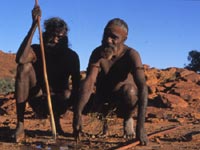
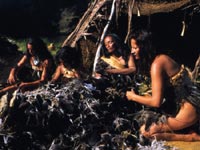
AustraliaLong periods of human/megafauna coexistenceSupporters of climate or environmental change as the primary cause of the extinctions point out that in Australia humans lived near the megafauna for at least 5,000 years and possibly as many as 46,000 years before the latter became extinct. A burial site at Lake Mungo in New South Wales provides evidence for the early human presence there. A skeleton known as Mungo III was discovered in 1974. He was deliberately buried and red ochre was added to the body, possibly as part of the funeral rites. Scientists from the Australian National University at Canberra have applied a whole series of new dating techniques to the bones and surrounding sediments, including electron spin resonance and gamma spectrometry. Their results put Mungo III between 50,000-81,000 years old. Many scientists favour a date around 65,000-68,000 years ago for the arrival of Australia's first people. Mungo III was not one of the first arrivals - it probably took people between one and three thousand years to reach New South Wales from their landfalls in the north. There are megafauna skeletons dated at about 25,000-30,000 years old, so no matter what his age, Mungo III demonstrates that people and megafauna shared Australia for a long, long time. Little evidence of huntingA megafauna bone showing definite signs that humans butchered the animal for meat. In prehistoric Australian sites, small animal bones predominate, and the only megafauna we know were hunted by ancestors of the Aborigines are red and grey kangaroos. Sites like Cuddie Springs, where both stone tools and megafauna bones have been found, are still controversial, as complicated sediments make it difficult to date the stone tools. New ZealandSmall deathsAs well as megafaunal creatures such as the moa, smaller animals also perished when the Maoris turned up. In total, over 30 kinds of bird perished. This was in part due to the actions of introduced species such as dogs and rats, however some of the small birds became extinct because people hunted them. This has implications for the argument that only large animals vanish when people turn up. Is New Zealand different because it lacked terrestrial mammals? Would the small birds have survived if people had medium and large mammals as alternative prey? Or does the fact that New Zealand lost a lot more small species than large undermine the 'large animals dying means human culprits' theory?
|