| Dr Richard N Holdaway- Extinction Biologist, Palaecol Research, Christchurch
- Dr Richard N Holdaway gives his view on the New Zealand megafaunal extinctions.
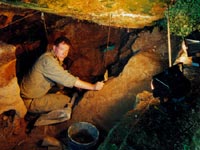
Richard Holdaway's research focuses on the timing and causes of the extinction of fully half the bird species in New Zealand over the past 2,000 years. This involves research on the relationships, palaeoecology, and palaeobiology of New Zealand birds over the past 30,000 years and the time of arrival and potential effects of introduced predatory mammals. It also involves modelling the effects of human exploitation and human-induced habitat change on populations of large herbivorous birds. New Zealand"My research supports the view that human influences - both direct predation and habitat removal - were directly and solely responsible for the extinction of the large birds of the New Zealand megafauna, including the moas, flightless geese, adzebills, eagle and giant harrier. All survived the substantial climatic changes at the end of the most recent glaciation, and went extinct in a very short period starting less than 2,000 years ago, during which no major climate change occurred. "Very large deposits of moa remains are associated with the earliest camp sites of Polynesian settlers. Disease can be discounted because the extinctions were selective on a size and ecology basis, and many smaller species were lost while others in the same groups survived. "The pattern of extinction on other island groups around the world, in synchrony with the arrival of humans, suggests that the New Zealand experience was typical of human impacts on island ecosystems. Continental-scale extinctions in North and South America and Australia exhibit the same synchrony with arrival of humans and can be attributed to the onset of new levels of predation on large species with low rates of reproduction."
| |