|
Today
many of the buildings associated with them, such as the miners'
homes and pit head engine houses, have gained a new life as sought-after
cottages.
But
the clues always remain.
For
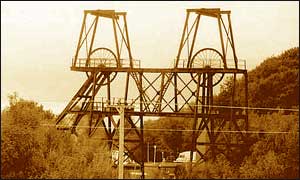
example, the village of St Martins, in the far north west of the
county near Oswestry, grew up around Ifton Colliery, once the largest
coal mine in Shropshire.
Originally
sunk in the 19th Century, the pit employed more than 1,300 men at
its peak, but closed in 1968 due to underground fire problems and
the loss of its markets.
The
site of the pit was cleared and is now an industrial estate, but
just a brief look around the village reveals its history. There's
an imposing miners' social club building, built in 1932, on the
main road running through the village, and the site of the mine
is easy to find - it's on Colliery Road!
Some
of the mine buildings remain at the pit head, although they are
on private land. These include the pithead baths and the office
block, and a small coal tub mounted on rails acts as a memorial
to the mine.
Just
about everywhere you go in Shropshire, there is some connection
with mines and mining.
Coal
deposits dot the county, with coalfields around Oswestry, Shrewsbury,
Coalbrookdale, the Wyre Forest and the Clee Hills.
Metal
deposits were mined at Llanymynerch and in a large swathe of south
west Shropshire, with copper mines at Clive and nearby Weston, as
well as Eardiston and Harmer Hill.
 |
|
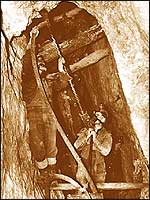
Overhead
mining for barite - then known as barytes - in Sallies Mine
in 1946
|
Limestone
was mined at Lilleshall and elsewhere in the county.
In
all, from the mining heyday in the Victorian era to the 1960s, when
most of the collieries closed, there were more than 80 mines in
Shropshire.
And
each had its own band of men who worked underground in terrible
conditions - pit ponies and children were the norm - its own community,
and its own tales of tragedy.
 |
|
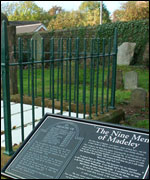
The
'nine men of Madeley' tomb in St Michael's churchyard
|
Accidents
were so common as to be a part of life - at the Brick Kiln Leasow
Pit in Madeley, for example, in 1864, nine men and boys died when
a hoist failed. Their grave can still be seen at St Michael's Church,
Madeley.
Although
the Coalbrookdale coalfield did not have the big mining disasters
that other areas did, thousands of lives were still lost in individual
accidents and working in any mine was inherently dangerous. It's
hardly surprising that - faced with grim conditions and frequent
accidents - the mining communities were very religious.
Death
could come from a roof fall, a fire, invisible yet deadly accumulations
of gas, or people falling down shafts or winding accidents. Lodgebank
Colliery was renamed 'Slaughter Pit' after 1875 when 11 men were
killed by gas.
And
deaths by accidents were not restricted to the miners themselves,
or to when the mines were open. There have been several cases of
children falling down old shafts or unwary explorers entering disused
mine entrances only to be overcome by gas.
It
should also be mentioned that care should still be taken when looking
around old mining sites today, as many sites are still dangerous
for the unwary.
|