The Valley of Life or Death
BBC2 9:00pm Thursday 16th November 2000
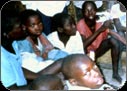 NARRATOR (ADEN GILLETT): In this African
valley there’s an extraordinary and deadly mystery. On one side
of the valley people are dying of AIDS in their hundreds while their
neighbours, with the same apparent behaviour and risk, are far less
affected by the disease. NARRATOR (ADEN GILLETT): In this African
valley there’s an extraordinary and deadly mystery. On one side
of the valley people are dying of AIDS in their hundreds while their
neighbours, with the same apparent behaviour and risk, are far less
affected by the disease.
(ACTUALITY CHAT)
NARRATOR: In this school if the epidemic continues to spread 60%
of these children will die from AIDS. But the extraordinary thing
is that if they were children just a mile away on the other side
of this valley their chance of dying would be three times less.
After 15 years of work a small group of scientists believe they
have the answer to this mystery. The implications for the world
are enormous.
INTERVIEWER: We’re talking about millions of lives here.
PROF. BERTRAN AUVERT (National Institute of Health, France): Million
of life and million of death.
NARRATOR: In this part of rural Zambia a group of people are about
to defy hundreds of years of tribal custom because of fear and what
seems like superstition. Kahilo Sibeso is 8 years old and he is
about to enter the Mukondaa, the sacred circumcision ground of the
Luvale tribe, yet Kahilo is not Luvale, he is Lozi and the Lozi
have never been circumcised.
DANIEL SIBESO: AIDS is a real problem for us and if a child is circumcised
there is less chance of him getting the disease.
NARRATOR: In other parts of Africa people believe that burning the
hide of an ox, or sleeping with a virgin can cure them of AIDS.
With no medical solution in sight these people are desperate. They
believe that circumcision will save their children. The question
is: are they right? Can something like circumcision really save
people from a disease that is destroying societies all over the
world?
DR MICHEL CARAEL (United Nations, AIDS): This epidemic has no precedent
in history. I mean no other disease has the potential to ruin a
society in terms of social, economic impact, in terms of mortality,
infant mortality. We, we are back 50 years ago, so this epidemic
cannot be compared to anything else. I mean for societies in southern
and east Africa this is an incredible tragedy.
DR FRANK PLUMMER (University of Nairobi): On a global scale close
to 60 million people have either, either have HIV or have died of
HIV and that is similar to the number of people that, both military
and civilian, that died during World War 2 which was the greatest
catastrophe in human history.
NARRATOR: Today in Africa there is a very real need to find something,
anything, to slow down the spread of a disease that is devastating
whole communities. Joseph Odhuko is the latest in his family to
get the disease.
JOSEPH ODHUKO: Here I buried my wife. She died in 1996, OK, and
this is my second son, he died when having 27 years. He died on
3rd and I buried him on 7th, so he passed away. My wife died because
of AIDS and my son died because of AIDS and even my brother, my
elder brother died because of AIDS, so they totally I’ve buried
six of them because of that.
NARRATOR: Most scientists agree that a vaccine against HIV is, at
best, years away. If everyone used a condom this could stop the
disease in its tracks, but even if condoms were generally available
only a minority seems prepared to use them. It means that in Africa
AIDS is spiralling out of control.
JOSEPH ODHUKO: My friends started dying, one after the other. You
could be sitting here now, alive and well but within a year you’re
history.
NARRATOR: And yet at the heart of this epidemic there is a bizarre
anomaly. For no obvious reason, some people are at far more risk
from AIDS than others, an enigma that could prove crucial to science.
So here in this valley, although the two groups should have the
same risk, the people on one side have a 20% HIV infection rate
and the people on the other 7%. It is a pattern repeated throughout
Africa, dramatic disparities in rates of HIV infection. If scientists
could understand what caused some people to be more at risk than
others then it might help them slow down the spread of this deadly
disease, but for years the cause of the disparity remained a mystery.
In 1985 anthropologist Priscilla Reining was working with the Haya
tribe in Tanzania near Lake Victoria. It was the beginning of the
AIDS epidemic and Reining wondered why the Haya were being hit so
hard.
PRISCILLA REINING: Why should the Haya have relatively high AIDS
rates and other people, other groups of people in Africa, in sub-Saharan
Africa, not reporting any at all and so why is this, why are the
Haya clobbered by AIDS and that was a question that I really had
in my mind and had it for years, I mean for, for quite some long
period of time.
NARRATOR: Before there was a final answer to this question it would
take 15 years of hard work by a small group of determined scientists
fighting against a sceptical majority. It was a question that had
an unexpected answer, one that could have profound implications
for millions of people. While Reining was working with the Haya,
in Nairobi the group of researchers was also trying to understand
AIDS. It was 1985. The epidemic was in the early stages and they
had little idea how the virus was being spread.
FRANK PLUMMER: Well we were trying to understand if ordinary bacterial
sexually transmitted diseases promoted HIV transmission and to identify
other risk factors for acquisition of HIV by man like frequent sex
with prostitutes or tattooing or injections or blood transfusions,
those kinds of things. We were working with a group of prostitutes
in Nairobi of whom about 80% were HIV infected, so if somebody had
sex with them that was unprotected they would have a very high chance
of being exposed to HIV, so you could assume that any man that’s
had sex there would have had a sexual exposure to HIV.
NARRATOR: Plummer wanted to know which of the men who had been exposed
to HIV through prostitutes would actually get the virus and what
was the key factor that made these men more at risk than others.
FRANK PLUMMER: And well how do you find those men? Well a high proportion
of those men get other sexually transmitted disease like gonorrhoea,
or chancroid, or herpes, or, or whatever and they show up at a clinic
for treatment.
NARRATOR: Plummer found 300 of these men in this Nairobi clinic.
They had been exposed to HIV through prostitutes but hadn’t yet
been infected. Over the course of a year they were tested repeatedly
for HIV to see whether they would get infected with the virus and
why. This is an Eliza HIV test. If the blood plasma turns blue then
it contains the virus. In the following year 24 of the 300 men were
infected with HIV, but why were these 24 more at risk than the others?
Plummer felt that he had found the answer.
FRANK PLUMMER: We found three associations, three things that are
more frequent in HIV positive men than in HIV negative men. That
was past history of sexually transmitted diseases, particularly
diseases that cause ulcers, frequent sex with prostitutes and being
uncircumcised. Men who were uncircumcised had about a four- to five-fold
increase in likelihood of being HIV positive.
NARRATOR: At the time it seemed extraordinary. Why should it be
that just because a man was uncircumcised he should be more at risk
from HIV and AIDS? Everyone had expected men with sexually transmitted
diseases to be more easily infected, as HIV can pass more readily
into the body through open sores like ulcers, but no one had even
considered circumcision, except the prostitutes themselves. This
is the same Majengo slum where Plummer did his study and this is
Salome, one of Majengo’s 2,000 prostitutes.
SALOME: It’s true that circumcised men can get HIV but an uncircumcised
man has more chance.
INTERVIEWER: Why do you say so?
SALOME: Because his foreskin could be hiding other diseases, and
give him more risk of HIV. When I think about it, I realise I am
more at risk from HIV with an uncircumcised man.
NARRATOR: It seemed like simple biology. Foreskins can trap the
bacteria that cause sexually transmitted diseases and STDs like
ulcers make it easier for HIV to get into the body, but it turned
out that wasn’t the whole story at all. In the data there was another,
more dramatic finding, something that Plummer couldn’t explain.
Even without ulcers, uncircumcised men were still 8 times more likely
to get HIV. Having a foreskin alone seemed to radically increase
their chance of getting the virus.
FRANK PLUMMER: I remember picking up a sheaf of, of computer paper
from the statistician and flicking through pages and pages of these
results and coming across this and, and being very excited about
it, getting on the phone and calling my colleague and saying, "Hey,
I’m going to, look what we’ve found."
NARRATOR: Despite Plummer’s enthusiasm, when his paper was published
it was met with enormous scepticism. After all it was only one study,
and a small one at that. Scientists were focused on condom use and
vaccines as ways to stop AIDS. Few wanted to listen to a controversial
new theory, but to one person Plummer’s work made perfect sense.
The anthropologist, Priscilla Reining, had long wondered why the
Haya were suffering so much from AIDS while tribes nearby were much
less affected. Then she heard about Plummer’s study on circumcision.
PRISCILLA REINING: Wow, you know it, it, for me it was, it really
an explanation and I, I understood, which I hadn’t at all. I mean
it never would have occurred to that this was a factor, but when
I heard it I knew that that quote unquote had to be important.
NARRATOR: No one had made this connection before, but as an anthropologist
Reining recognised its importance. She knew that in Africa tribes
were divided into the circumcised and uncircumcised and that this
was a powerful and sacred part of their identity.
ARCHIVE FILM NARRATOR: They witnessed the most important ceremony
in a Masai’s life. This is the day of circumcision, the day a boy
becomes a warrior.
NARRATOR: Reining wanted to see if there was a widespread correlation
between circumcision and HIV. If there was, it might shed light
on the mystery of different infection rates. She started with circumcision
data from tribes across Africa and an ethnographic map.
PRISCILLA REINING: Here’s a working pattern of the one that in fact
we used. The Haya live here immediately west of Lake Victoria. They’re
easy to find on any scale map because the lake is such a prominent
feature. The Kikuyu live in Kenya, so I could look up Haya in the
ethnographic atlas and go to the right column and go down and see
they did not circumcise. This sort of verified it for me. Then I
can look at Kikuyu and, and see yes, that they, they were circumcised,
they did practise circumcision.
NARRATOR: Reining compiled the circumcision data of hundreds of
circumcised and uncircumcised tribes. Then this data was placed
on a map of Africa.
PRISCILLA REINING: This was the map which we published and the black
are depicting ethnic groups which do not practise circumcision as
a norm and the grey are groups which do practise circumcision, so
this is a corridor which runs from the southern Sudan down into
South Africa. Here is an overlay of HIV and you can see that there’s
a high degree of conformity between the red which is relatively
high HIV rates. There is red down the same band and interestingly,
over here as well. The statistical relation, the statistical relationship
was .90 which is very good and so, you know, wow, it really is there.
NARRATOR: On the face of it what Plummer and Reining had discovered
was astonishing. Although this was just preliminary work, it seemed
to imply that circumcision might really be a factor in the AIDS
epidemic. The people living on one side of this valley are more
likely to die from AIDS because the men are uncircumcised. But few
scientists could see a biological reason why the foreskin could
be responsible for so many deaths. They were looking for other reasons,
so without solid evidence in 1989 most people thought that circumcision
couldn’t be the cause after all and in any case Reining’s study
was too simplistic to draw a firm conclusion.
PROF. RICHARD HAYES (London School of Hygiene and Tropical Medicine):
The major problem with an ecological study is that there may be
many other differences between those populations that could account
for the differences in the rate of disease, so to take a very simple
example if you constructed a map showing the number of televisions
per head of population against the rate of HIV you might conclude
that television was a protective, had a protective effect against
HIV because televisions are very common in the West and HIV is very
common in Africa where televisions are rare. Now that is demonstrably
absurd and the, the situation with circumcision is, was rather similar.
NARRATOR: Hayes thought that just because a map of uncircumcised
tribes matched high HIV rates it didn’t prove that one caused the
other. There could always be another explanation. There was another
blow to the circumcision theory when in 1989 Hayes and a team of
researchers tested and questioned circumcised and uncircumcised
men in Tanzania. The results of their survey seemed to directly
contradict Plummer and Reining’s work.
RICHARD HAYES: The work that we’d done ourselves in Tanzania in
some population based studies there didn’t seem to show any protective
effect. In fact if anything the circumcised men in the populations
we were studying seemed to have a higher rate of HIV, so we felt
at that stage that the evidence concerning this was, was, was very
inconsistent.
NARRATOR: By the early 1990s it seemed that the circumcision theory
had hit a brick wall in the scientific community, yet within a few
years in Africa some people noticed the disparity in HIV rates and
began to act on it, despite the risks. Now some of the Losi tribe
in north-west Zambia see from their own experience that because
they are uncircumcised they suffer more from AIDS and some Losi
fathers are defying tradition to bring their sons to circumcisers
in another tribe.
MAN: Two years ago they were coming at least, but numbers were a
bit low. Now this year they are coming in large number.
INTERVIEWER: Why do you think that is? Why are they coming here?
MAN: Because they are worried about AIDS. AIDS, AIDS is all over.
That’s one most important factor can give you AIDS.
NARRATOR: The parents of these children are convinced that circumcision
can protect their sons from AIDS, but there could never be a public
policy of encouraging circumcision unless this belief could be substantiated.
Now scientists are beginning to piece together the biological reasons
why a foreskin might make you vulnerable to the HIV virus. When
AIDS first took hold in the West in the mid-1980s scientists had
no idea how the disease passed from person to person. Then they
discovered that homosexual men could be infected as the HIV virus
passed through the delicate skin of the anus and they also found
that the virus could penetrate the equally think mucosal surface
of the vagina and they worked out how this was possible. The virus
gets in where the skin isn’t protected by keratin. This is a cross-section
of human skin, the dermis and the epidermal layer of cells above
and on the surface layer a protein called keratin forms a thick,
protective coating. If this keratin layer is intact it is almost
impossible for viruses to get into the body and there are very few
places on the body that are not covered in keratin.
PROF. TOM LEHNER (Guy’s, King’s and St. Thomas’ School of Medicine):
Well keratin is a thick layer which is impervious to micro-organisms
and this is one of the reasons why, despite what people think, skin
does not get very commonly infected, unlike mucosa such as the nasal
tract, the lungs, genito-urinary tract which gets much more common
infection, infected. In fact most infections are upper respiratory
or genitals.
NARRATOR: Even though scientists knew how the virus could be transmitted
between homosexual men and from men to women, astonishingly no one
had looked at how the virus could pass from women to men through
the penis and no-one knew which part of the penis lacked keratin
and was vulnerable to HIV. Could the virus enter through the shaft
of the penis or through the head or glans or could HIV get through
the foreskin? To find out scientists had to identify where there
was the least amount of keratin. Last year in Australia a team of
scientists decided to check a textbook theory to see where the keratin
was missing on the penis.
PROF. ROGER SHORT (University of Melbourne): Well it’s difficult
to believe this, but a couple of years ago if you looked in the
textbooks to see what was known about the difference in appearance
of a circumcised versus an uncircumcised penis there was almost
no information and the first thing we decided to do was to look
at the glans penis, this part of the penis, to take serial sections
through the inner part of the penis and compare circumcised and
uncircumcised men and I was convinced that following circumcision,
since you got more sort of trauma and abrasion to the tip of the
penis, that the glans gets thicker and more keratinised and that’s
why the virus doesn’t get in.
NARRATOR: The theory was that because the head of an uncircumcised
penis is protected by the foreskin it doesn’t develop a thick layer
of keratin letting HIV in more easily than a circumcised penis.
This is a cross-section from the glans of a circumcised penis. The
lighter layer is keratin on the surface of the skin. Short’s team
counted the cells that make up the keratin layer and then the layer
of keratin on the glans of an uncircumcised penis. According to
the textbooks the keratin here should have been much thinner, but
they were exactly the same thickness.
ROGER SHORT: There’s no difference in the appearance of the glans
or the amount of keratin on it as between circumcised and uncircumcised
men, so we scratched our heads and though gosh, that wasn’t what
we expected. What could be the possible alternative and incredibly
slowly we came to the obvious conclusion that we should really be
looking at the foreskin itself, not at the glans.
NARRATOR: This is a cross-section of the skin on the inner mucosal
surface of the foreskin. It has far less keratin. Short realised
this part of the penis was completely different from any other.
ROGER SHORT: The inside of the foreskin has got much less keratin
on it and so it’s likely to be the site of viral entry into the
body and in addition it’s got all these amazing cells called Langerhan
cells which sort of gobble up and internalise the virus.
NARRATOR: The green marks are Langerhan cells. Their job is to defend
the body against infection. They have arms that reach out to the
surface of the skin and trap viruses and deliver them to the immune
system so they can be destroyed, but the danger from HIV is different
to other viruses. HIV hijacks the Langerhan cells and when it gets
into the body the virus wreaks havoc and starts to destroy the immune
system.
TOM LEHNER: Oh it’s a Trojan horse basically. The Langerhan cells
is in fact a line, allowing a virus to enter the body and carry
it to the very system, namely the lymph glands, where those viruses
can start proliferating.
NARRATOR: This is a cross-section showing Langerhan cells reaching
up to the inner mucosal surface of the foreskin. With little keratin
covering the cells here it is much easier for them to reach out
to the HIV virus and there are more of them.
TOM LEHNER: We’ve found a larger number of Langerhan cells in the
foreskin, therefore the chance of the foreskin being infected is
so much greater, therefore it fits the bill.
NARRATOR: Even though these biologists had shown, in theory, that
the foreskin might be the most likely entry point for HIV, no one
had done the definitive experiment – to infect a living foreskin
with HIV to see if it really was more susceptible to the virus.
Meanwhile, the evidence was building up in Africa too. A five year
survey of Mombassa truck drivers showed yet again that men were
four times more likely to get HIV if they were uncircumcised. Other
studies from across Africa confirmed this. In Uganda, for example,
there was the astonishing statistic that none of 50 circumcised
men living with HIV positive women got the virus. But one of the
most important pieces of evidence was still missing. In an operating
theatre in Chicago an adult male is being circumcised. The foreskin
will be used for a unique experiment. For the first time the human
foreskin is going to be exposed to HIV under laboratory conditions.
By putting the foreskin in culture viral pathologist Bruce Patterson
can keep it alive and so try to mimic how it would react if it was
still attached to a human body. To keep it alive the tissue has
to be treated in a lab across town within 45 minutes.
DR BRUCE PATTERSON (Children’s Memorial Hospital, Chicago): What
we’re going to do is take a biopsy from the mucosal surface and
a biopsy from the external surface. The external surface having
more keratin, but we really feel that the mucosal surface is most
susceptible because of its relative lack of keratin. This tissue
mind you is fresh and it’s still living and we hope to get it in
culture in time to continue living.
NARRATOR: Patterson’s theory is that cells in the inner surface
of the foreskin will be infected by the virus and cells on the outer
surface will not because they are covered with a thicker layer of
keratin. For the first time HIV is being dripped onto a living foreskin.
Within minutes it can infect individual cells. To see where the
virus has got in the foreskin is sliced half a millimetre thin to
reveal the individual cells. Among the millions of cells in this
cross-section Patterson has to find which ones have been attacked
by HIV. To find out if the cells are infected, Patterson dyes the
Langerhan cells with a green marker and then a different market
for the HIV.
BRUCE PATTERSON: Next we will add the flourescent HIV tag that we
developed that’ll bind directly to the HIV virus.
NARRATOR: If HIV infects the Langerhan cells their colour will change
from green to yellow. The results were remarkable.
BRUCE PATTERSON: The most dramatic finding is the ease with which
foreskin is infectable and the extent to which it’s infected. We,
we see many, many infected Langerhan cells.
NARRATOR: This is a picture of the inner surface of the foreskin.
With less keratin to protect it the HIV virus has penetrated not
just Langerhan cells but two other types of immune cell. And this
is the outer keratinised surface with no sign of infected cells.
Patterson has yet to analyse the data in detail, but feels there
could be important implications.
BRUCE PATTERSON: The potential is that if this is a primary tissue
involved in the transmission of HIV and we are capable of removing
it then we should remove it in an effort to prevent the spread of
HIV.
NARRATOR: Yet despite this evidence circumcised men are still at
risk. The virus can still get into a circumcised penis through any
small cut or in ways that scientists have yet to understand, so
removing a foreskin will not fully protect a man from HIV. Only
a condom can do that. Yet Patterson’s work seems to support the
earlier studies. Men appear to be far more likely to get HIV if
they are uncircumcised. But in Africa it is hard to persuade people
to adopt a policy of circumcision when for some tribes being uncircumcised
is a centuries-old and closely guarded symbol of cultural identity.
DR GILBERT OGUTU (Luo Council of Elders): When you talk about circumcision
you are changing people’s culture, people’s customs. The customs
give us identity and we don’t, just as Council of Elders we are
the custodians of Luo norms and values, we are the custodians of
Luo customs which have evolved over the years. For us to think in
terms of possibilities of changing anything the Luo Elders must
come together and we must have a good reason why this needs to be
changed.
NARRATOR: The doubts of tribal elders in Africa are echoed by a
powerful international anti-circumcision lobby based in the United
States. For organisations like Nocirc even if the science was absolutely
convincing circumcision is seen as mutilation and a violation of
human rights.
NOCIRC MEMBER: I’m concerned now that governments are going to get
involved to encourage a practice which significantly alters male
genitalia for the life of the individual on the basis of correlational
data which should never be used for any action. It should only be
used to suggest further research, at the very best.
NOCIRC MEMBER: It could, it could be disastrous consequences.
NOCIRC MEMBER: Subjecting African males to this is a crime against
humanity, will become a crime against humanity.
NOCIRC MEMBER: We’re talking about another Holocaust, a scientifically
sanctioned Holocaust against African males.
FRANK PLUMMER: Circumcision is a very emotive issue. The debate
becomes, is not dispassionate, is not rational, it’s not based on
scientific evidence, it’s based on other things which I think makes
doing the right thing a lot more difficult. It also makes people
hesitant to, to do studies and to make decisions because they know
that there’s going to be problems and people don’t like to get into
controversy.
NOCIRC MEMBER: We would like to see real solutions to, to the AIDS
ep, epidemic. We would like to see the scientists who are spending
time with the science turn their attention to real solutions. We
feel that this is a distraction from seeking real solutions, real
cures to AIDS.
NARRATOR: While scepticism continued, in Africa another population
study was underway focussing on the town of Kisumu. The Luo people
of Kisumu have been hit hard by AIDS. Today a quarter of the town’s
population have the virus. Two years ago a team of researchers set
out to answer the same question yet again, to see why so many people
in Kisumu should have HIV when many fewer were infected in certain
other cities in Africa, but this time they didn’t anticipate that
circumcision could be the answer. The authors instead decided to
turn the focus of the study on other factors. Above all they thought
that more Luo could be infected because their culture encouraged
riskier sexual behaviour.
MICHEL CARAEL: We looked at various factor that may explain the
very high prevalence in Kisumu. We look at age at first sex, at
condom use, at other STDs, at religion, socio-economic factors.
NARRATOR: After questioning 1,000 men in each city they found that
sexual behaviour was remarkably similar and couldn’t explain why
infection rates varied so much. In fact by far the most important
factor yet again was circumcision. There seemed to be little difference
between the cities except that in Kisumu Luo men were uncircumcised.
BERTRAN AUVERT: We found in Kisumu uncircumcised men have HIV prevalence
of about 21/22% and circumcised men, males have about 7% of HIV
prevalence so you have, you have a three, three times increase in
HIV prevalence due, due to lack of cir, due of lack of circumcision.
MICHEL CARAEL: So there is a huge difference between circumcised
and non-circumcised, but for sure we have looked also at the many
other factors that may play a role in this difference in this discrepancy
looking at religion, age at circumcision and when you take into
account all these factors probably the difference is less great,
but still there is a huge difference between the two populations.
NARRATOR: The same Luo people that live in Kisumu also live on one
side of this valley. On the other side are the Luhya. Finally scientists
believe they may be able to explain why these people living just
yards apart are suffering from AIDS in such a dramatically different
way. The Luhya are circumcised and the Luo are not. In the end it
was not this study alone, but the weight of evidence from all over
Africa that supported the circumcision theory. If a study falls
on the left of the line it shows that circumcision reduces the chances
of getting HIV, but the final enigma were the studies on the right.
These shows that circumcision could actually increase HIV rates
and they included Richard Hayes' own early study in Tanzania.
RICHARD HAYES: We had found in our studies in rural Tanzania that
in fact if anything circumcised men seemed to have a higher rate
of HIV and this was one of the reasons I was very sceptical about
this alleged protective effect.
NARRATOR: Given the strength of evidence Hayes went back to the
data, this time using adjusted figures that could filter out distorting
factors like religion. By dividing all the men from one religion
into circumcised and uncircumcised then if more uncircumcised men
had HIV he could be sure that circumcision was having an independent
effect on HIV rates.
RICHARD HAYES: And what we found when we did that very careful analysis
was that from finding a higher rate of HIV in circumcised men we
now found that on a fully adjusted analysis the circumcised men
were actually at a lower risk of HIV.
NARRATOR: This year Hayes pulled together all the statistical studies
from 15 years in a meta-analysis and he found that by using adjusted
figures these studies now supported the circumcision theory. Finally,
the sceptic was convinced.
RICHARD HAYES: And of the 28 you can see here the 15 studies where
a, an adjusted analysis had been done and indeed all 15 of these
studies found a protective effect and combining their results together
we estimate that overall the data suggests that circumcision reduces
the risk of HIV by something like 60%.
NARRATOR: This year in Durban 11,000 experts from around the world
came together to talk about AIDS. With the prospect of a successful
vaccine still years away and with limited condom use failing to
control the spread of the disease, for the first time people were
taking circumcision seriously.
SPEAKER: We explored sexual behaviour, prevalence of other sexually
transmitted infections and male circumcision as factors that could
explain the differences in HIV spread between the four cities.
NARRATOR: There is a growing acceptance among scientists that there
is a correlation between lack of circumcision and AIDS. Even the
World Health Organisation and the United Nations are considering
the implications and now for the first time in Africa the idea is
being translated into a trial. In western Kenya, Tom Onyango has
the job of promoting circumcision and that means offering safe circumcision
and also spreading the word to the children of Siaya district.
TOM ONYANGO: What are some of the benefits of removing the foreskin?
Here.
CHILD: It keeps it clean.
TOM: It keeps it clean. What else?
CHILD: It makes condom use easier.
TOM: I just makes…
NARRATOR: Onyango believes that if circumcision could be made culturally
acceptable and safe it could cut the rate of infection for men and
therefore women as well.
TOM ONYANGO: …another one. The decision is yours.
NARRATOR: And he sees it as a useful back-up to the government’s
policy of encouraging condom use which could be effective but is
not proving popular.
TOM ONYANGO: Acts.
CHILDREN: Now.
TOM: To.
(CHILDREN RESPOND IN UNISON)
TOM: Thank you very much. Well I think because of the rumours about
condoms people believe some condoms are laced with the HIV virus,
some have got holes, they, they easily burst and they’ve been talking
to them against these rumours, but people change slowly, but we
believe male circumcision is one of the strategies we can sell to
our people.
NARRATOR: Tom Onyango’s problem is that for circumcision to be accepted
there must be a big change in African culture, for among Luo Elders
there is a belief that any policy of circumcision could be a serious
threat to tribal identity.
GILBERT OGUTU: We are not going to tell the Luo that now it must
be, you are custom to circumcise. Supposing we got into circumcision
now and by God’s providence somebody came up with a vaccine or with
a treatment, are we going to revise?
NARRATOR: But whether the circumcision trial in Kenya works depends
on whether the young men of uncircumcised tribes are persuaded by
their elders or not. Shadrack Abayo is facing that choice.
SHADRACK ABAYO: Generally the Luo never circumcise but when it’s
a matter of life and death it’s for the individual to decide.
ROBERT BAILEY: You are the experts about the male circumcision.
We are representing the other youths who are not here with us today…
NARRATOR: Shadrack Abayo is not alone. Professor Robert Bailey has
interviewed more than 800 young Luo men and among the majority there
is a familiar refrain.
ROBERT BAILEY: We feel that there’s a very high level of acceptability
of circumcision. In fact in all our discussions with people they,
they lament the lack of services available to them and they see
it really as a, as a human rights issue. They say well you know
why didn’t we, why aren't we able to make informed choices.
PRISCILLA REINING: There would certainly need to be decisions that
are made among the group and not somebody outside saying you’ve
got to do it, or don’t do it. I mean either way either way. That,
that’s not an external decision.
NARRATOR: Ultimately it is Shadrack’s father and uncles who have
the final say and now they too are persuaded.
SAMUEL ABAYO: According to what I hear, according to what I’ve been
told I come to realise I must save my people for this problem which
is come. And I have to accept it. I’ve accepted my boy to be circumcised
because the world want it. I not want it but the world want it.
He believe the Luo tradition that one, that one end there, but I
have to save my people.
NARRATOR: At Tom Onyango’s new clinic Shadrack Abayo is being offered
a safe operation and counselling. There is a real worry that if
circumcision is offered to millions men will think themselves invulnerable
and abandon any notion of safe sex and condom use.
ROBERT BAILLEY: It is a real danger to promote circumcision as a
cure-all for preventing HIV infection. It should never be installed
as a stand alone intervention. We should not be telling young men
that if they’ve become circumcised that they are then free of ever
becoming infected by HIV AIDS. We know that men who are circumcised
get infected with HIV.
MICHEL CARMAEL: Certainly in addition to condom promotion, STD treatment,
potentially circumcision they have a huge impact on the number of
new infection. There is not doubt.
BERTRAN AUVERT: In South Africa they are making in some places among
women aged 24 which 67 person today I really think that if all males
were circumcised in Africa the epidemic couldn’t go much higher
than 10-15%.
INTERVIEWER: So we’re talking about millions of lives here.
BERTRAN: Million of life and million of death.
(ACTUALITY CHAT)
NARRATOR: Whatever the experts decide in the future in the meantime
some young boys like Kahilo Sibeso are being circumcised without
clinical care because their parents feel there is no alternative.
Back to 'The Valley of Life or Death' programme page
Further information
|

