The Mystery of the Miami Circle
BBC2 9.00pm Thursday 25th January 2001
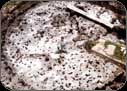 NARRATOR (MICHAEL LUMSDEN): In the heart of downtown Miami between the skyscrapers
and hotels lies a mystery. Something extraordinary was recently
discovered here: strange holes in the ground. These holes are worth
$27million. They don't contain oil or gold, but something much more
intriguing.
NARRATOR (MICHAEL LUMSDEN): In the heart of downtown Miami between the skyscrapers
and hotels lies a mystery. Something extraordinary was recently
discovered here: strange holes in the ground. These holes are worth
$27million. They don't contain oil or gold, but something much more
intriguing.
BOB CARR (County Archaeologist): Nothing like this had actually
ever been observed anywhere in North America.
JOHN RICISAK (Archaeologist): Afraid it's a puzzle that'll take
a long time to figure out.
NARRATOR: These holes could be the most exciting find in America
for decades, or they could be a costly mistake. The discovery has
sparked a furore. In July 1998 a Florida developer started work
on a luxury development on prime waterfront property where the Miami
River meets Biscayne Bay, but a routine archaeological survey of
the site was to unleash an extraordinary chain of events.
MICHAEL BAUMANN: When we purchased the site in March of 1998 there
were five apartment buildings approximately three storeys in height
that were built back in the mid part of the '40s. We subsequently
then tore down those buildings to make the site ready for the eventual
construction of the 600 rental apartments.
BOB CARR: Michael Baumann, the developer, had bought the property
several years ago, had paid $8½ million for a very valuable piece
of downtown real estate so thus was moving very quickly forward
to get these new buildings built.
NARRATOR: By law Baumann, the developer, had to allow an archaeological
survey, so Bob Carr, the county's leading archaeologist, did a routine
inspection. Baumann wasn't anticipating any great discoveries.
MICHAEL BAUMANN: America's a young country and we have a couple
of hundred years of history, we certainly don't have centuries of
history and therefore whatever they find, albeit very important
to our civilisation and our society, it certainly cannot compare
to that that you find at Stonehenge or you find at Pompeii or you
find anywhere else throughout Europe.
NARRATOR: At first the archaeologists removed the top layer of ground
and found nothing special, but as they dug lower they were taken
by surprise.
BOB CARR: We were actually out there during the demolition and began
to observe that beneath the buildings and beneath the fill there
was some very significant archaeological materials.
NARRATOR: Below the fill was a layer of ancient refuse, or midden.
It was evidence of prehistoric life.
BOB CARR: To our surprise beneath the fill we find that at least
50% of this prehistoric site was still intact.
NARRATOR: But this was just the start. What they were about to find
would exceed their wildest expectations. As they carried on digging
a bizarre feature came to light.
BOB CARR: As we began to excavate within the footer trench we were
able to observe in the bedrock cavities and openings. Some of them
appeared natural, but some of them, at least to me, appeared to
be humanly made.
NARRATOR: They had found strange round holes pockmarking the surface
of the limestone bedrock. The rock is porous and easily eroded,
so these could be normal erosion holes - or could they be man-made?
JOHN RICISAK: Bob Carr and I definitely had differing opinions as
to what the, the nature and origin of these holes were. I thought
they were natural solution cavities, Bob Carr thought that they
were of culture origin, that they were made by human beings who
once lived on this site.
NARRATOR: They also found larger rectangular basins containing smaller
holes. The archaeologists puzzled over this. Was it possible that
the basins had a design?
BOB CARR: And some of them appeared to form a pattern or an arc.
Well our surveyor, Ted Riggs, being very astute about such things
really was quite sure that it was an arc and in fact that the arc
was part of a circle.
TED RIGGS (Surveyor): I noticed the formation of these four pits.
Assuming that four holes forming an arc were part of a circle I
calculated what the radius of a circle with that arc would be.
NARRATOR: Riggs could imagine that the curve of the four uncovered
pits was just a section of a full circle so he worked out where
the centre would be and the circle's dimensions.
TED RIGGS: I spray-painted a circle on top of the fill 38ft diameter.
NARRATOR: The archaeologists brought in a digger.
JOHN RICISAK: We dug down through the overlying fill into the midden
soil to about 10cm above the bedrock and I went behind the backfill
with a metal probe trying to detect the presence of these cavities
in the rock.
TED RIGGS: And as they followed the machine these other basins appeared
all in sequence forming this perfect circle, exactly where we had
predicted it would be.
NARRATOR: Riggs was right. Underneath his line was a complete circle
of basins cut into the rock. The archaeologists believed they may
have found something truly remarkable: the remains of a mysterious
ancient monument. Perhaps it was the legacy of a long lost people.
BOB CARR: It was very exciting because as we began to do our research
and talk to our colleagues across North America we found that nothing
like this had actually ever been observed anywhere in North America.
NARRATOR: For the archaeologists it was a tantalising discovery.
Within days it became known as the Miami Circle. Riggs was the first
person to talk to the press. His theories about the discoveries
sparked a media frenzy.
BOB CARR: And then things began to get very crazy.
TED RIGGS: The first thought that went through my mind it looks
like Stonehenge in negative.
NARRATOR: Riggs had other ideas too.
TED RIGGS: To me it is a ceremonial centre.
MAN: It's sacred, it's, it's a sacred thing.
TED RIGGS: The almanac calendar. It is an astronomic observatory.
BOB CARR: People from all over the United States, all over the world
began to email from Finland, from Asia. The idea that there could
have been an UFO landing place here was one of the crazy ideas we
heard.
NARRATOR: Riggs also speculated about the people who built it.
TED RIGGS: The authors of this monument were the Olmec.
NARRATOR: Riggs believed the circle wasn't North American. Instead
he thought it was the relic of an ancient culture in Central America
thousands of miles to the south. The Olmec were the earliest of
a series of great civilisations which arose from about 1,000BC.
They produced magnificent artwork carved in stone. They were followed
by other cultures such as the Maya who all built extraordinary cities
with vast pyramids and temples. No monuments of these cultures have
ever been found in North America, but the idea that the Miami Circle
might be Olmec or Mayan raised expectations to a fever pitch. By
February '99 public fascination with the circle was at a peak, but
the site was on prime Miami real estate. Construction of the apartments
was long overdue and the developer was losing money.
MICHAEL BAUMANN: It took approximately 5½ years to get to
the point we were at at that juncture and invested tens of millions
of dollars to get there.
NARRATOR: The archaeologists still had so much to find out, but
they were running out of time. The builders were ready to move in.
MICHAEL BAUMANN: What we told them was that they weren't going to
just use our property to start an archaeological dig without paying
for it.
NARRATOR: Baumann was poised to send in the bulldozers, while protestors
campaigned loudly to save the site.
BOB CARR: The demonstrators were outside. We learned later that
several of them were armed and were planning to take over the circle.
NARRATOR: Local officials were under intense pressure to act. They
started legal proceedings and forced the developer to sell his land
to the State of Florida. In a blaze of publicity the Miami Circle
was bought, with public funds, for $27million. A prime slice of
Miami real estate was preserved for archaeological research, but
was the circle worth its price tag? All the big questions about
the circle were still unanswered: what was it, who built it and
when? The archaeologists working on the site could find no evidence
that the circle was a relic of Mayan or Olmec culture. To work out
who built the Miami Circle and what it might be they looked to North
American history. Native American Indians have their own traditions
of building dwellings, ceremonial centres and monuments. The continent
was once a rich patchwork of hundreds of tribes with enormously
varied lifestyles. Plains Indians, like the Sioux, were usually
on the move hunting bison and living in teepees, while people of
the Ohio and Mississippi valleys were farmers and built large settlements
with vast ceremonial mounds. Desert Indians built mud structures,
or pueblos, in places like New Mexico. Although many ruins remain
in North America, nowhere has the imprint of a monument or structure
cut into bedrock been found - until now. So who out of all these
tribes built the Miami Circle? Long ago the people who had lived
at the mouth of the Miami River were the Tequesta Indians. a small
group of hunter-gatherers who travelled around the vast, forbidding
wilderness of the Everglades and along the sub-tropical coast. They
were a remote, elusive people and neither the 16th century Spanish
nor later European explorers came close enough to know much about
them, but they still wrote of the Tequesta as brutal and terrifying.
READER: We considered our condition being among a barbarous people
such as were generally accounted man-eaters. They came in the greatest
rage possible that a barbarous people could.
BOB CARR: If you were a Spaniard arriving on a Florida beach in
the 1500s your life expectancy would be about three minutes and
indeed we know from accounts that many of these Spaniards were clubbed
and killed immediately when they came ashore.
NARRATOR: It had always been believed that the Tequesta were a tiny
group of Stone Age fishermen living in the crocodile-infested Everglades.
They travelled by canoe foraging for food and erecting temporary
shelters, but until now there was no archaeological evidence that
they had ever built monuments, or even houses. Why would a people
who were not known for ceremonial structures or even settlements
have built something on the scale of the Miami Circle? It was an
extraordinary idea.
BOB CARR: The discovery of the circle wasn't so much the conclusion
of a mystery. It was the beginning of a new one.
NARRATOR: On site the archaeologists had to work sifting through
the clue that might answer their many questions.
JOHN RICISAK: We have close to 1,000 bags of material that, that
we excavated on the site and it's really that material that's going
to tell the tale of what took place here and help us to figure out
what this circular feature represents.
NARRATOR: The first question was the circle's age, but there was
no way that they could date when humans had actually cut these holes
into the rock, but the holes themselves were filled with archaeological
material, such as bone and scraps of charcoal from ancient fires.
If the charcoal could be carbon dated it might say when people were
living here.
DARDEN HOOD (Beta Analytic Laboratories, Miami): We're all made
up of carbon, all living things are made up of carbon. One carbon
atom in every trillion carbon atoms is radioactive. By radioactive
we mean unstable so it does what we call decay. It decays to something
else and this decay process is constant. Every 5,500 years or so
we will have one half as much carbon as we had previously and we
can use this to determine the age of something.
NARRATOR: The charcoal was dissolved and purified so that atoms
of radioactive Carbon-14 could easily be detected. The amount of
decay could then be measured to give the charcoal an age.
DARDEN HOOD: The initial samples from the circle were two charcoal
samples. They gave us an age, oh, of about BC50 to AD240 or 250
something like that.
NARRATOR: The charcoal inside the holes was 2,000 years old. If
the holes were also this old the Miami Circle would be one of the
most important ancient sites in North America, but then someone
dropped a bombshell.
DR JERALD MILANICH (Florida Museum of Natural History): Just didn't
sound right, Indians digging holes in limestone.
NARRATOR: Jerald Milanich is a leading Florida archaeologist. He
was invited down to Miami to assess the find.
JERALD MILANICH: I got on the aeroplane and they handed me a beautiful
colour aerial photo of the circle and right in the middle of it
abutting one side was a rectangular thing and when I got on the
plane someone hands me this and said what do you think of the septic
tank? I said what septic tank? This rectangle is a septic tank that's
exactly centred in, in the circle. Zow-ee!
NARRATOR: It was indeed a septic tank which had served the old apartments.
To Milanich the holes in the rock could be the soakaway from the
effluent for the tank. Had Florida just paid $27million for a 1950s
sewage system? It was an appalling idea.
JERALD MILANICH: Oh I think I'm very unpopular in Miami, but I think
that people have to stand up for science and that you must seek
out the truth. You have to find the truth. What would happen if
it turns out that it is an 1950s septic tank drain would be disaster
for archaeology. I think archaeologists would be the laughing stock.
NARRATOR: Was there a link between the ring of holes and the septic
tank? Was the circle 2,000 years old, or the most expensive mistake
in archaeology? The archaeologists had to find out.
JOHN RICISAK: Prior to our beginning work out here there were a
series of six low rise apartment buildings on this site. They were
referred to as the Brickell Point apartments. Those apartments were
built in 1950.
NARRATOR: The septic tank served these apartments. In the public
archives Ricisak searched through the original plumbing plans to
find out if the tank had a circular soakaway.
JOHN RICISAK: The liquid effluent which in a typical septic tank
system would then be discharged out the end of the tank to a drain
field instead discharged to a sewage outfall in the sea wall and
then it would just discharge untreated into Biscayne Bay.
NARRATOR: It was clear from the blueprints that the septic tank
drained through a pipe and there was no link at all between the
tank and the circle of holes.
JERALD MILANICH: Is it merely a coincidence that this circle of
holes goes right around this septic tank?
NARRATOR: Potentially the circle was a unique archaeological site
so it was crucial to verify that the holes were truly old. To rule
out any modern connection with the circle Ricisak traced all the
other structures that had been built on the site since the 1800s.
JOHN RICISAK: One of the Brickell mansions stood on this site in
an area just east, south-east of where the circle is. That house
was built in 1909 by the Brickell family and that house was demolished
just prior to the construction of the Brickell Point apartments.
The house was apparently rented out, used as a club house at various
times throughout its history. Before that time was the Brickell
warehouse. It was a, a large wooden two-storey structure that was
located right at the point more or less where the mansion was located
and again just east of the circle feature. Prior to that time there
was a structure somewhere in the vicinity of Brickell Point. It's,
it's not clear exactly where it was situated and that house was
occupied by Reason Duke. When it was demolished then again exactly
where it was situated we're not really sure.
NARRATOR: Although Ricisak scoured the records for anything modern
to correspond with the circle, he found nothing, but Milanich had
cast serious doubt on the circle's archaeological authenticity.
The archaeologists needed scientific proof that the holes in the
rock were genuinely ancient. Carbon dating could not tell them when
the holes themselves were made, so Tom Scott and Harley Means from
the Florida Geological Survey were called in to examine the limestone
to determine the circle's age.
DR THOMAS SCOTT (Florida Geological Survey): The first set of things
we looked at were definitely manmade in origin, in that it was an
old septic tank that had been put in in the 50s and we noted the
marks where the equipment had dug the, the hole for the septic tank
and then we started looking around at the other features that were
presumably of, of older Indian origin.
HARLEY MEANS (Florida Geological Survey): This shot was taken to
demonstrate what Tom and I speculated was probably the best line
of evidence for the antiquity of these holes and that is you can
see right along here a thin crusty feature. That's what we call
the, the laminated dura crust.
NARRATOR: Dura crust shows the age of cut or exposed limestone.
It comes from calcium carbonate in the ground water which rises
to the surface when the rock is exposed to air. The calcium carbonate
hardens and over centuries forms a thin, grey layer. On a section
through one of the Miami circle holes the dura crust was clear.
HARLEY MEANS: Actually let's talk about this side a little bit.
We have a dura crust that has developed down in the hole.
THOMAS SCOTT: On top here you can see this surface here and the
very thin crust, this is the surface of a limestone and it, the
crust was breached when this hole was created and then there was
signif, sig, sufficient amount of time for the crust to form here
by the deposition of calcium carbonate from the water.
HARLEY MEANS: It takes hundreds, if not thousands of years, to create
these kinds, these thicknesses of dura crust.
NARRATOR: By comparing the surface of the rock inside the small
holes with the more recent cut surface around the septic tank the
difference in age was confirmed.
HARLEY MEANS: This is one of the corners of the septic tank right
in here and you can clearly see that the saw breached one of these
features. Tom and I also observed dura crust formation around this
little feature here, whereas there is no dura crust formation along
any of the cut faces associated with this septic tank. So it was
discrepancies like that that led Tom and I to believe that the Miami
Circle feature itself was definitely prehistoric.
NARRATOR: At last they had proved that the circle was genuinely
ancient, but for the archaeologists there were now many more questions.
What was this mysterious circle and what was it used for? Why would
the Tequesta, an apparently nomadic people, have built a structure
or monument of any kind? Beautiful axe heads had been found at the
site, but strangely it was clear they had never been used. What
was their significance? And many of the holes within the circle
formed no pattern at all. What did this mean? Each new excavation
revealed yet more holes. To answer these questions called for a
much greater insight into the elusive Tequesta. All along the Ancient
Tequesta had been thought to be nomads moving around to fish and
hunt seasonal food, never building permanent homes. They hunted
and foraged in the Everglades, an inhospitable landscape, teeming
with alligators and insects. Twenty miles inland from Miami in the
heart of Ancient Tequesta territory, the Everglades are dotted with
tree islands, mounds of dry land that sit above the water. Archaeologist
Gary Beiter is excavating a tree island site.
GARY BEITER (Archaeologist): Until they drained the Everglades,
the coastal areas here, with canals it was strictly what everybody
calls a sea of grass. It would have been water all around and the
only way they could have got around was by canoe and periodically
they would want to get some place to sit down and sleep, camp site.
NARRATOR: Beiter's team is finding a wealth of old animal bones
and freshwater shells, evidence of the food the Indians gathered,
but there are no signs of dwellings or large structures.
GARY BEITER: One theory is that they had a seasonal round where
they would maybe start on the sea coast at one time of the year,
extract there and then move on into the Everglades maybe in the
winter-time and use this as a stopover point on a seasonal round.
This does not look like it was a, a main habitation site.
NARRATOR: While the archaeology shows that people stopped and ate
here, it seems the mound was merely a temporary refuge for the nomadic
Indians as they gathered food. Sites like this reinforced the view
that the Tequesta did not build, so was it really the Tequesta who
built the circle? There was only one way to be sure: to compare
artefacts found at the circle with objects from other sites in the
Miami area known to be Tequestan. Deep in the vaults of the Miami
Museum, Carr tracked down a collection of artefacts from an earlier
excavation of a known Tequestan site.
BOB CARR: Not surprisingly the most common types of artefacts were
made out of shell and bone. Hard stone or hard rock which is common
throughout all of North America outside of Florida simply was not
available.
NARRATOR: Artefacts found at the Miami circle exactly matched the
objects in the museum. Together they gave a clear picture of the
ingenious technology of the Ancient Tequesta.
BOB CARR: What a lot of archaeologists thought were ornaments -
these are drilled shark's teeth - but this was no prehistoric version
of, of surfing paraphernalia, but rather these were very important
tools. This was part of a knife kit. They would actually put these
shark's teeth into the wooden clubs, or wooden handles, and use
them for cutting. From a stingray barb they could create a very
awesome, very powerful little point that when attached to a shaft
could do what any other stone artefact could do.
NARRATOR: It all added up to strong evidence that the circle was
a Tequesta site, but this only deepened the mystery. What exactly
had the Tequesta built here and why?
DR RANDOLPH WIDMER (University of Houston): 1.85.
NARRATOR: Archaeologist Randolph Widmer was brought in to excavate
the area surrounding the circle.
MAN: .85.
NARRATOR: He started by establishing what the holes were for.
RANDOLPH WIDMER: Yeah, but it never did… The holes in the ground
are the evidence that we have that there was a building or a structure
in place.
NARRATOR: There had been theories that the holes might be for standing
stones or totem poles, but to Widmer it was clear that the holes
had once held wooden posts supporting the walls of a building.
RANDOLPH WIDMER: We have the circle and we have the outline of it
and we kind of have an idea that it really is aboriginal, but what
we don't know is how typical it is. Are there others, is it unique?
NARRATOR: To work out what kind of structure the circle once was
he needed to uncover much more of the surrounding site.
RANDOLPH WIDMER: These are the features that we're looking for,
these circular holes dug into the bedrock by the Ancient Tequestans
'cos what we're trying to do is find the holes that actually go
into the bedrock, these larger bases that go into the bedrock and
you can see those start to appear as we dig through the, the upper
fill.
NARRATOR: The more his team dug in the area surrounding the circle
the more basins and post holes they found.
RANDOLPH WIDMER: I mean what we're finding is there's about one
hole every square foot which is a considerable number.
NARRATOR: If he could see that the holes formed patterns it might
mean that there were other structures beyond the circle, but so
far the holes seemed utterly random and there was a further puzzle.
RANDOLPH WIDMER: One of the things that you, you find as archaeologists
when you're excavating structures that are placed on ground level
are indications of floors and activities on floors and particularly
hearths, or some place where they control the fire and do cooking.
In this area in our excavation we found no evidence that there has
been fire on, in the bedrock.
NARRATOR: If there was no sign of cooking on the rock surface could
it be that people hadn't lived here after all, or could this be
a clue to the structure? In unravelling these mysteries the archaeologists
would shed entirely new light on the Tequesta and their culture.
First, there was another enigma: the two perfect but unused stone
axeheads. They were made of basalt, a volcanic rock, but there's
none in Florida. The Tequesta had made all their tools from shell.
BOB CARR: Here you're looking at the perfect example of what an
axe would have looked like in any part of the world, but in this
case strictly ma, made out of the lip of a conch shell and made
so hard and so fine that this actually can be used for cutting down
trees.
NARRATOR: Though shell was versatile, stone is much harder, so these
basalt axes would have been very useful, but they had never been
used, so where did they come from? Geochemist Jackie Dixon, an expert
in volcanic rock, was asked to analyse the axes.
DR JACQUELINE DIXON (University of Miami): Different basaltic lava
that are erupted in different types of geologic environments, have
very distinct geochemical fingerprints. We compiled all the data,
we got the chemical composition of the hand axe and we compared
them to the chemical compositions of hundreds of samples from North
America and South America.
NARRATOR: Dixon searched through all the samples of volcanic rock
structures for an exact match with the axes.
JACQUELINE DIXON: We found that the closest match was to an area
around Atlanta, Georgia, Macon, Georgia.
NARRATOR: If the tools had come from Macon, Georgia they must have
reached the Tequesta in Miami through 1,000 mile network of trade.
The axes must have been so precious that they were never used as
tools, but clearly they still had an important function.
BOB CARR: They gave it to the Gods, they used these for rituals.
There's no obvious sign of wear or breakage on these axes. Certainly
they were offerings. In fact we know that one of them had to be
an offering. It was put deliberately into the circular hole.
NARRATOR: If these rare objects were placed within the circle as
offerings, then perhaps this was a place of religious significance,
so what kind of structure was the circle? From what the archaeologists
knew of other Indian cultures they thought the circle must have
been a very early example of a tribal meeting house. A good example
of one of these buildings has been reconstructed in the north of
Florida. Apalachee Indians built a meeting house here in the 18th
century, that is 1700 years after the Miami Circle was built. The
meeting house was a combination, town hall, hotel, church and theatre.
The original building was destroyed long ago, but in 1984 archaeologist
Bonnie McEwan and architectural historian Herschel Shepard uncovered
its foundations.
DR BONNIE McEWAN (Mission San Luis, Tallahassee): We have reconstructed
it exactly where we found it archaeologically and so what you see
here is what we've been able to verify in the ground, including
the depth and diameter of each post, the spatial relationship of
all of the elements that you see, as well as other specialised features
- for example, the heath, which we know archaeologically was bout
15ft in diameter.
NARRATOR: Unlike the Miami Circle, the San Luis house did not have
its post holes cut into bedrock, but the team had historical documents
to fill in any archaeological gaps.
PROF HERSCHEL SHEPARD (University of Florida): The building seems
to be laid out in a series of eight concentric circles. The columns
are located on one of those circles very clearly.
BONNIE McEWAN: And the major support posts are massive and they
extend, for the most part, between five and six feet below the ground
surface.
HERSCHEL SHEPARD: And the outer ring and the bench posts seem to
be related to the other circles, perhaps even the opening in the
roof, so there was obviously a very strict geometric system and
pattern working here.
BONNIE McEWAN: The size of the skylight, which is something we would
never recover archaeologically, we know from documents was about
one third the size of the total diameter of the building, so this
building is just over 120ft in diameter and so the skylight would
have been approximately 40ft in diameter.
NARRATOR: All the features of this building were concentric and
precise. All activity focussed on the hearth, archaeologically distinct
in the very centre of the meeting house, but the Miami Circle is
different. The circle is archaeologically unique as its post holes
were cut into rock. It is also 1700 years older than San Luis, but
other intriguing features also set it apart.
RANDOLPH WIDMER: In the circle there's no central hearth, there's
no indication whatsoever of actually burning on the surface of the
site.
NARRATOR: There is another crucial difference from the regular design
of the San Luis house.
RANDOLPH WIDMER: We're having a hard time finding any kind of patterns,
either rectilinear or curvilinear, circular patterns of these holes
to suggest a open interior space using the ground surface.
NARRATOR: At San Luis there were geometric patterns marking out
the interior, but not here. The interior pattern of holes is completely
random. The circle was still a puzzle. It was most likely a Chief's
or meeting house, yet key archaeological details were wrong and
it might all have remained a mystery, but then Widmer considered
a major factor in Florida: the weather.
RANDOLPH WIDMER: This site is right on the edge of the Bay and look,
if a hurricane comes through with a big tidal surge it will wipe
it out.
NARRATOR: When he took the weather into account Widmer finally found
the answer he was looking for. He believed the Tequesta had built
the circle with a simple but ingenious means for avoiding floodwaters.
RANDOLPH WIDMER: The floors are not on ground level, but instead
the houses are elevated above the surface of the, of the, of the
site of the ground on stilts or pylons.
NARRATOR: There is no regular pattern to the interior holes because
the posts weren't supporting walls, they were stilts supporting
a raised platform floor. This would explain why there is no sign
of a hearth or fire on the rock. The floor of the house was never
on the rock itself.
RANDOLPH WIDMER: The structures were on ground surface. They'd be
literally swept away, so by elevating it it gives you some protection
from probably a typical, you know, lower intensity hurricane storm.
NARRATOR: A building on stilts made perfect sense, but Widmer was
now trying to make sense of another puzzle: the complicated arrangement
of post holes in the rock, bizarre even for a stilt structure.
RANDOLPH WIDMER: What we have in this excavation here, it's one
of these large post holes. One of the more fascinating aspects of
our research is that we've uncovered that these post holes occur
in multiple groupings and here we have 1, 2, 3, 4, 5, 6 and actually
one down here 7, 7 post holes. Now the question is why would they
do this?
NARRATOR: Why were the posts in clusters side by side? After some
thought, Widmer came up with a theory. In a humid climate wooden
posts have a limited lifespan.
RANDOLPH WIDMER: One of the things that, that I think is going on
is once you have the structure up and in place as the timbers rot
up you have to continually replace them and to do that what you
will do is you'll find another timber into position right next to
it, alongside of it, as the other post rots away. This indicates
that the structure was still in place and they were trying to constantly
shore it up and keep it in operation.
NARRATOR: According to Widmer, the building was constantly repaired
with new timbers while it was still standing, but the arrangement
of holes gave Widmer a vital clue to something more fundamental:
how long the Tequesta had settled here. He calculated how long a
wooden post could survive in this climate.
RANDOLPH WIDMER: If we assume that each one of these timbers lasts
approximately 50 years and we have seven timbers in the same spot
that would suggest that we're talking about 350 years of having
this structure in place, so they've been building and rebuilding
these structures over that time period.
NARRATOR: The Tequesta, this apparently nomadic people, were settled
here continuously for at least 350 years.
RANDOLPH WIDMER: We now know that, that it is a sedentary, permanent
community here, which we did not know before this excavation. To
me that's the real importance of it.
NARRATOR: Everything that was once believed about Tequestan culture
is being overturned by this site. Widmer's excavation in the area
surrounding the circle is revealing more bedrock riddled with holes.
If they all held posts for buildings it means the circle was at
the centre of an entire village on stilts.
RANDOLPH WIDMER: The reason that I think this is a village is we're
finding the evidence of a village in terms of our excavation. We're
finding all these post holes and these post holes are not simply
sporadical, only found in the one isolated area, it's wherever we
look we're finding them.
NARRATOR: This is a remarkable discovery. First the mysterious imprint
of a circle cut into rock. Now an entire village stamped in the
bedrock. From Widmer's theories and the San Luis house it is possible
to reconstruct what this ancient Tequesta village might have looked
like. The circle was probably a ceremonial meeting house on a raised
platform. The building was supported by large structural posts.
Stilts in the smaller holes within the circle supported the living
platform. The building was probably cone-shaped with an open roof,
its sides covered in woven grass. The smaller multi-family dwellings
surrounding the circle also had raised floors, propped up by wooden
posts. The houses probably had sides of woven grass and a sloping
roof and their inhabitants cooked on stone slabs on the platform
floors, not on the ground itself. In this way the whole Tequesta
village rose up on pilings above the ground framed by the waters
of the Miami River and Biscayne Bay. Now the archaeologists could
see why the Tequesta had built this settlement here. The location
offered them everything they ever needed.
RANDOLPH WIDMER: If I was an Indian I would move here because this
gives you access to all the resources in this south-east Florida
area, so this, it's a very central location. It is central today
and it was central 2,000 years ago. This is the place.
NARRATOR: It is possible that the village was even older than the
circle itself. The remains of shellfish once eaten on the site were
carbon dated. The results were sensational. The earliest date is
730BC. This means that the settlement could have been founded 2,700
years ago. What has been discovered has changed our entire view
of the people who once lived here. In Ancient Miami the Stone Age
Tequesta had a thriving, long-term settlement. Here they had built
homes and perhaps much more before the founding of the Roman Republic
or the building of the Parthenon in Athens.
BOB CARR: What we have just discovered was not only dispelling the
myth that the Spanish had created, but I think enlightening all
of Miami and Florida that they had a real treasure in our own backyard.
NARRATOR: Within two hundred years of Europeans arriving in Florida
the Tequesta had disappeared. War, disease and slavery wiped them
out. They have no known descendants. but the Miami Circle is their
lasting legacy, evidence of a culture as creative and surprising
as any in North America.
Back to 'The Mystery of the Miami Circle' programme page
Further information
|

