Killer Algae
BBC2 9.00pm Thursday 8th February 2001
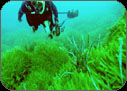 NARRATOR (HAYDN GWYNNE): Thirty years ago a small and rare tropical
plant was put into these tanks to grow. What came out was a monster.
Today it is a potential threat to seas and oceans across the world.
NARRATOR (HAYDN GWYNNE): Thirty years ago a small and rare tropical
plant was put into these tanks to grow. What came out was a monster.
Today it is a potential threat to seas and oceans across the world.
RACHAEL WOODFIELD (Marine Biologist): You could just tell as you
came up to it there was trouble. It has a real insidious sort of
creepy nature as if it's some sort of blob that's taking over at
the bottom.
NARRATOR: Nobody knows where it may strike next.
GREIG PETERS (California Regional Water Quality Control Board):
I don't believe that it's an exaggeration to say that this challenge
is my worst nightmare and to the degree that people understand,
it's their worst nightmare.
NARRATOR: This is the extraordinary story of how an insignificant
algae grew to become something many scientists believe is capable
of causing ecological damage across the globe. It's become known
as the killer algae.
GREIG PETERS: It's like out of a horror movie, but it's real.
NARRATOR: Along the Pacific coast of southern California lie some
of America's most popular holiday beaches. Thousands of people come
here every year to ride the waves. Just behind the beaches are a
series of lagoons, famous for water sports. It was here nine months
ago that a team of divers found something totally unexpected on
the seabed. It was a small plant they'd never seen before. They
decided to find out what it was.
RACHAEL WOODFIELD: I spent several days looking it up doing some
research on it and when I finally found a photo as the picture downloaded
onto my computer there was just a sinking feeling in my stomach.
NARRATOR: What marine biologist Rachael Woodfield had seen sent
her rushing back to the lagoon. As she dived she was aware that
if her suspicions were correct California faced a major problem.
RACHAEL WOODFIELD: At first glance it looks like it's a nice round
patch, but the more you investigate you see that deep down inside
the eel grass there are many fingers of it spreading out into the
eel grass sort of just creeping its way along the bottom.
NARRATOR: The American biologists knew that the plant had an awesome
reputation for taking over and destroying whole ecosystems.
ROBERT HOFFMAN (National Marine Fishery Service): We're assuming
the worst case scenario that if we don't control it it's going to
completely overtake this lagoon and if we're wrong I'd rather be
wrong, over-estimating the impact than under-estimating it.
NARRATOR: The lagoon is directly linked to the sea. Their biggest
fear was that it would escape into the Pacific and take over the
entire Californian coast. A large area of the lagoon was cordoned
off by the police, but no one knew how to destroy the plant, or
stop it spreading. It had turned into California's biggest marine
pollution scare for decades, yet this whole dramatic situation might
have been avoided. In the early 1990s a European biologist had predicted
just such a problem, but nobody at the time had listened to him.
It all began twelve years ago, thousands of miles away, in Monaco.
Here one day, French marine biologist Alexandre Meinesz went diving
in the Mediterranean. Meinesz is an expert on the marine life of
the Mediterranean. He knew that among the dozens of plants that
live in it there is one key plant that is fundamental to the sea's
ecosystem. It normally covers large areas of the seabed. It's a
dark, grey/green sea grass called possidonia. Possidonia is a plant
which provides food and shelter for a huge variety of fish and invertebrates,
but that day as Alexandre Meinesz dived, nothing was as he expected
it to be.
PROF. ALEXANDRE MEINESZ (University of Nice-Sophia Antipolis)):
The water was very clear. The sun was shining and the visibility
was good. Then I saw straightaway that the seabed was bright green.
I said to myself this isn't possible, there shouldn't be any brilliant
green seaweed here.
NARRATOR: Where Meinesz had expected to find the usual variety of
Mediterranean sea life all he could see for hundreds of metres was
a dense and bright green mat of weed he'd never seen before. Everything
was smothered in it.
ALEXANDRE MEINESZ: I went deeper, to the bottom. It was still there.
Then I went to the west and to the east and it was still there as
well. I was really astonished at the size and extent of the algae.
It struck me as being supernatural.
NARRATOR: As he studied the extraordinary new plant he realised
it was a giant variant of a tropical algae called caulerpa taxifolia
yet how could a tropical plant survive in the colder waters of the
Mediterranean?
ALEXANDRE MEINESZ: I did not understand how such a vigorous tropical
algae could withstand the cold and survive and not just that, could
spread. That was something extraordinary.
NARRATOR: He decided to try and find out what was going on. Back
in the laboratory he compared the taxifolia with other specimens
of the same family of algae from around the world.
ALEXANDRE MEINESZ: I have a few specimens that I collected myself
several decades ago in the Red Sea and here is Tahiti in Polynesia.
They are all small, whatever depth they come from not very long,
not very wide and the runners are always very thin, so I realised
straightaway that what was growing in the Mediterranean was something
absolutely exceptional, that had never been seen before.
NARRATOR: This new plant was bigger, tougher and more vigorous than
any other specimen of caulerpa and it normally lived thousands of
miles away in the Tropics.
ALEXANDRE MEINESZ: It's a giant in comparison with what can be found
in tropical seas. I realised that it was different from anything
else in the world. I was absolutely astonished. It was something
strange. I did some more research but everything confirmed my first
impression. It was an alien. Something abnormal, supernatural, was
beginning to develop in the Mediterranean.
NARRATOR: It was growing so fast and densely it was swamping the
dark green native possidonia. There was something else too. The
coastal waters of the Mediterranean are normally home to some 600
species of animals and plants, yet the seabed around the mysterious
new algae was almost devoid of other marine life.
ALEXANDRE MEINESZ: I immediately felt that the whole Mediterranean
was in danger. This was a very adaptable plant. It seemed able to
alter the ecology of large areas of the sea.
NARRATOR: It seemed like something out of science fiction. What
was a gigantic tropical algae doing flourishing in the Mediterranean?
Yet on the surface life went on as normal. When Meinesz tried to
raise the alarm nobody took much interest. He realised he needed
better scientific evidence that the algae was damaging the sea's
marine life. He took his concerns to a colleague along the coast
in Marseilles. Charles-Francois Boudouresque is one of France's
leading experts on Mediterranean animal life.
PROF. CHARLES-FRANCOIS BOUDOURESQUE (University of the Mediterranean,
Marseilles): Alexandre Meinesz telephoned me several times to say
he'd made an incredible discovery. He asked me to come to Nice to
see it. I said yes, yes, but later. It took him a year to persuade
me to come and see the colonies of caulerpa taxifolia.
NARRATOR: When he saw it Boudouresque was also shocked by the invasion.
He immediately agreed to investigate whether the algae was harming
the sea's animal life. The animal he chose as a test case was the
sea urchin which lives on plants and is easy to observe in the laboratory.
He set up a simple experiment.
CHARLES-FRANCOIS BOUDOURESQUE: Here is an urchin that has been fed
on native Mediterranean algae. The mouth normally faces downwards
and we turn it over. We put it with its mouth facing upwards. We
know that a sea urchin that is in good health takes about one minute
to turn back over again, to return to its natural position.
NARRATOR: Almost immediately the urchin began to put out little
suckers, wave its spines and struggle to turn itself over. In less
than a minute it had completed the manoeuvre.
CHARLES-FRANCOIS BOUDOURESQUE: There, what an athlete. It's a very
good athlete.
NARRATOR: In another jar Boudouresque had urchins fed exclusively
on the new algae.
CHARLES-FRANCOIS BOUDOURESQUE: These urchins have been fed for a
long time on caulerpa taxifolia. We do the same experiment with
them. We turn them over and measure the time they take to right
themselves.
NARRATOR: The time they took to turn over crept up from two minutes,
to five, to twenty. Boudouresque suspected the urchins were finding
the taxifolia inedible and were starving to death. After a month
on an exclusive diet of taxifolia the turning over time had reached
30 minutes. It soon became clear that some even preferred to die
rather than eat the algae. The findings were very disturbing. If
the new algae took over the Mediterranean would other animals which
feed on plants react in the same way? Would the whole food chain
be disrupted? What, the French researchers wondered, was the plant's
secret weapon that stopped the urchins eating it? Meinesz sent samples
to a number of European labs specialising in plant toxins. At the
Max Planck Institute in Germany they began analysing the chemical
composition of the caulerpa samples. The findings were unexpected.
Many plants employ a chemical defence mechanism to ward off predators,
but most use a variety of different toxins in relatively small quantities.
The mysterious new algae turned out to be different.
DR. GEORG POHNERT (Max Planck Institute for Chemical Ecology, Jena):
It is very special because caulerpa taxifolia is nearly entirely
relying on one component, that it is basing its whole chemical defence
on. Usually plants use a multitude of different components that
have all different target animals. Caulerpa taxifolia uses another
strategy. It uses only one component, but this component is produced
in a very high amount.
NARRATOR: It was the sheer concentration of the toxin in the plant
that marked it out as something very unusual. The toxin is called
caulerpenine and the concentration was higher than in any other
algae Pohnert had ever analysed.
GEORG POHNERT: The amount of toxin in the Mediterranean species
is really surprisingly high for me as a chemist. It's a very powerful
and very special defence mechanism. That might be why caulerpa spreads
in the Mediterranean very effectively.
NARRATOR: Pohnert discovered that although the toxin was not lethal
to humans or animals, it made the plant almost totally inedible
and if nothing would eat it there was nothing to stop the algae's
advance. If it took over, the Mediterranean's animal life would
be forced to flee or starve to death. Alexandre Meinesz now believed
he was dealing with not just any invasive plant, but an exceptionally
harmful and vigorous organism. As the algae continued to spread,
growing at twice the speed of indigenous plants, he worried that
the situation could rapidly get out of control unless something
was done to stop it. There was one hope. The colony of algae lay
directly under the walls of one of Europe's most prestigious marine
research and conservation organisations: the Monaco Oceanographic
Museum. Meinesz felt sure the Museum would help him. It would take
money, resources and government involvement, but Meinesz was confident
the Museum would be able to persuade the French authorities to eradicate
the algae before it spread further. He was in for a shock. The Museum
is run by Professor Francois Doumenge, one of France's most influential
marine biologists. He is Director of an institution which, for nearly
a century, has championed oceanographic conservation and preserved
the riches of the sea in a series of palatial galleries. Meinesz
approached the Museum with his concerns, but the Museum's Director
had a very different view of the situation. He simply didn't believe
the invasion of caulerpa taxifolia was dangerous or unnatural.
PROF. FRANCOIS DOUMENGE (Director, Monaco Oceanographic Museum):
The development of tropical species in the Mediterranean is an old
story. Some species date back to the opening of the Suez Canal and
are now well known. So there have been tropical species in the Mediterranean
since the end of the 19th century.
NARRATOR: Doumenge argued that algae like taxifolia are constantly
moved around the world by sea currents and frequently lie dormant
in the water for years until a temperature change brings them to
life.
FRANCOIS DOUMENGE: More and more in my opinion it is likely that
there has always been a small and dispersed stock of dormant tropical
species in the Mediterranean and as the Mediterranean warms up and
becomes more tropical they start growing again. It's well known
that the Mediterranean has experienced changes in level and temperature
over time.
NARRATOR: Doumenge suggested Meinesz was worrying about nothing.
The growth of the taxifolia was not a danger, merely a sign of the
evolving character of the Mediterranean Sea.
FRANCOIS DOUMENGE: Eight to ten thousand years ago the sea was 120
metres lower than it is now and three to five degrees cooler, so
the Mediterranean should be seen as a basin which changes very rapidly
on the geological timescale. Its current state is simply an intermediate
state, a transitory phase. It's in this context that we should be
looking at the caulerpa.
NARRATOR: Doumenge passed on his thoughts to the French Ministry
of the Environment who breathed a sigh of relief. If the algae was
not dangerous but part of a pattern of global change there was not
much the French government could be expected to do against such
a fundamental, natural occurrence. But not everybody was convinced.
Alexandre Meinesz was still alarmed by what he'd found and the impact
it was having on the seabed. He'd spent years studying caulerpa
in the wild and he was sure the invasion was not natural.
ALKEXANDRE MEINESZ: I was sure I wasn't making a mistake. I had
seen something very strange. I immediately draft a report that I
sent to the top authority, but I did not even receive an acknowledgement.
I thought even if they don't believe me, they could have sent an
outside expert to come and have a look, even just to come and check
I wasn't talking nonsense, but no, absolutely nothing.
NARRATOR: Over the next 18 months the algae spread, as Meinesz had
feared it might. In 1990 there were sightings at Cap Martin, four
kilometres east of Monaco, and at Toulon, almost 200 kilometres
in the opposite direction. By late 1991 there were some dozen patches
of the algae dotted along the French Riviera.
ALEXANDRE MEINESZ: It confirmed all my fears. The algae was beginning
to spread. I could no longer keep quiet. I absolutely had to tell
the media to try to make the people aware of it. It was an alien.
Nobody before had ever described anything which grew so large, vigorously
and densely.
NARRATOR: Local newspapers picked up the story. There were alarming
and lurid headlines. The green menace. Ecological crime. Mutant
algae. The plant now acquired a new name: the killer algae. By the
early 1990s, with the press finally involved, the French Ministry
of the Environment stepped in. It sent a research ship to the affected
area of the Mediterranean to see what was going on. At long last
there was official recognition that something might be wrong. The
man in charge of the government's research effort was marine biologist
Thomas Belsher. Belcher sent down divers to chart the taxifolia
beds.
DR. THOMAS BELSHER (French Research Institute for Marine Development):
The progress of caulerpa taxifolia can be followed by an underwater
video camera which is a few metres above the seabed and each time
we see some caulerpa we mark it. This allows us to make accurate
maps of the observations.
NARRATOR: Almost immediately Belsher found that Meinesz, if anything,
had underestimated the size of the infestation and the rate it was
growing.
THOMAS BELSHER: Our estimate suggested the spread of the caulerpa
was greater than Alexandre Meinesz had observed at the same spot
a few months earlier. It was obvious that this population of caulerpa
taxifolia was still there and was growing very rapidly.
NARRATOR: Belsher's divers investigated further. It was, as Meinesz
had already observed, bigger, faster growing and denser than any
algae ever seen before. Belsher's maps revealed that the Mediterranean
seabed was being transformed faster than at any time in recent history.
THOMAS BELSHER: We had never seen an alga introduced into a marine
ecosystem that had grown so quickly. At the end of one or two years
instead of having a very colourful seabed we had nothing in some
places except a green lawn, like a golf course.
NARRATOR: The seriousness of the situation was reinforced by other
researchers who now established that fish populations around the
invasive taxifolia beds were measurably falling. In some places
fish numbers had dropped by up to 50%. Fish, like urchins, appeared
to find the taxifolia too toxic to eat. The French authorities,
still only half convinced this was a problem they could do anything
about, commissioned a series of small-scale experimental eradictions.
It soon became clear that destroying the plant was going to be much
more difficult than anybody had expected. Divers were sent down
to dig up patches of algae by hand, but it was like trying to trim
a football pitch with a pair of scissors.
ALEXANDRE MEINESZ: This algae is very difficult to eradicate. You
can see that the roots are as fine as hair and have fruits that
may give rise to new plants, so to eliminate it by hand you have
to remove much more than what you see. You have to remove everything
underneath as well - the mud, the sand - because there might be
little bits not visible to the eye.
NARRATOR: They tried freezing it to death with blocks of dry ice.
It was never a match for the scale of the problem. They even tried
sucking it up with an underwater vacuum cleaner. The trials quickly
showed that it would take an army of divers many years to make an
impact on the algae. By 1994 new sightings showed that the taxifolia
had spread even further, yet there was something very puzzling about
the way it was spreading. It was not just expanding into the neighbouring
seabed, it was leaping from one bit of coast to another, establishing
new colonies hundreds of miles apart. Meinesz knew that if the authorities
were to slow its spread they needed to understand what lay behind
this apparently erratic pattern of growth, but there were those
who still believed he was worrying about nothing. The Director of
the Monaco Museum, Francois Doumenge, continued to suggest Meinesz
was over-reacting.
FRANCOIS DOUMENGE: In my opinion if we'd taken time to consider
the problem, if we'd tackled it with greater scientific calmness
and not incidentally concluded that it was a catastrophe, we'd have
realised there was not much to worry about.
ALEXANDRE MEINESZ: My feeling was that I had to continue my investigations.
I had to continue to convince people of the problem. It was a question
of time. Something could perhaps still be done. I had to study its
biology more closely, study its dynamics more closely in order to
see whether there was still time to do something.
NARRATOR: Meinesz went back to the lab. He suspected the key to
understanding the plant's erratic spread lay in knowing how it reproduced.
ALEXANDRE MEINESZ: What we wanted to know right at the start is
how this species reproduces. You have to take a little bit of juice
that is in this caulerpa, put it on the slide and look at it under
a microscope.
NARRATOR: The sticky juice of the taxifolia contains microscopic
particles called gametes or reproductive cells. These are normally
male and female and act like sperm and egg.
ALEXANDRE MEINESZ: Theoretically you should find two types of gametes,
reproductive organs inside the juice. The gametes are very small.
They measure five microns. The male gamete is the same size as the
female gamete, but there is a small difference - the female gamete
has a red dot, a stigma.
NARRATOR: Meinesz studied slides of the juice of the taxifolia looking
for the red dot that identifies the female gamete. He couldn't find
a single female gamete.
ALEXANDRE MEINESZ: We looked in vain for female gametes on the specimens
from the Mediterranean. There were no female gametes, so no fusion
between the two gametes, no sexual reproduction.
NARRATOR: There could be only one explanation. The taxifolia in
the Mediterranean was spreading not through sexual reproduction,
but by a process known as vegetative reproduction. It's a form of
cloning. It was an important breakthrough that finally made sense
of the strange spread of the taxifolia. It meant that any tiny fragment
of the algae separated from the main plant contained all the genetic
material necessary to grow an exact replica of the parent plant
to create a clone. It's as if a piece of human hair, or a flake
of skin dropped on the ground could grow into a complete human being.
Meinesz now realised that it would only take an infinitesimally
small fragment of the taxifolia picked up by the anchor of one of
the thousands of boats that criss-cross the sea to start a new colony
of plants hundreds of miles away. By 1997 a new map of the colonies
of the algae seemed to confirm this hypothesis. it had jumped further
along the coasts of France and Italy, it had even leapt across to
the coast of Croatia. It was eight years since Meinesz had first
raised the alarm. Now nowhere in the Mediterranean seemed safe.
ALEXANDRE MEINESZ: It was really sad to see and slightly infuriating
because it's a question of time. Time matters in these affairs.
When a species begins to invade you have to act now.
NARRATOR: But even as the new figures were being assimilated there
was a dramatic discovery which was to throw new light on the algae's
origins and confirm Meinesz's fears that there was something very
unnatural about the plant. It happened here at the University of
Geneva. Olivier Jousson is a specialist in DNA sampling. He realised
the only way to prove whether the gigantic taxifolia in the Mediterranean
was a natural invasion was to trace its origins. If he could match
its DNA to the DNA of any tropical taxifolia then the theory of
the Monaco Museum that it had naturally drifted in from the Tropics
was probably right.
OLIVIER JOUSSON (University of Geneva): I realised that the main
problem with caulerpa was that nobody knew where it had come from.
NARRATOR: He set about processing dozens of samples of taxifolia
from all over the world, including the Red Sea and areas of the
Pacific. Nothing matched. Each time the DNA fingerprint was slightly
different from the Mediterranean strain. It was a mystery. Eventually
there was only one strain left to try. It was a perfect match, but
this was not a wild plant; it had been bred by humans. It was a
sample of caulerpa taxifolia taken from an aquarium tank. For years
a very peculiar strain of caulerpa taxifolia has been used to decorate
tropical fish tanks. It appeared that it was this human bred, artificial
strain which had escaped into the Mediterranean.
OLIVIER JOUSSON: The fact that these two are identical in our opinion
means that they are the same plant. The strain that exists in the
Mediterranean and the strain that exists in aquaria are the same.
NARRATOR: Jousson's discovery proved, beyond reasonable doubt, that
the taxifolia in the Mediterranean had not drifted in from the Tropics.
Monaco's argument that what was happening was part of a natural
cycle of change in the sea did not hold up. It wasn't long before
people also realised that if the findings were right the most obvious
source of the alien invasion was the one place that was certain
it had come from elsewhere: the Monaco Oceanographic Museum. The
Museum was known to have had taxifolia in its tropical tanks and
was also directly above the site of the first known infestation.
Yet to suggest that the Museum was, albeit unwittingly, responsible
carried huge political and scientific implications. It meant the
Institute had somehow unknowingly allowed material from its aquarium
tanks to get into the sea. Worse, the most likely time for all this
to have happened was in the early 1980s when the Museum had been
run by a man with an international reputation for marine research:
Jacques Cousteau. For years he'd been the father of French marine
biology, a hero of marine conservation. The irony was that to accuse
the Monaco Museum of even accidentally releasing a rogue alga into
the sea was to hold some of the most famous names in marine conservation
responsible for what many now regarded as an ecological disaster.
The Museum flatly denied any link between the taxifolia in its tanks
and the taxifolia below its walls and questioned the validity of
the DNA findings.
FRANCOIS DOUMENGE: I think that the tests that were performed didn't
use either the safest or best known methods. What we need for an
accurate answer is much more detailed, much finer genetic studies,
using a much bigger range of samples than was practical before.
NARRATOR: Doumenge's was a controversial point of view. Even Jacques
Cousteau, when he later found out about the issue, told the French
Minister of Environment that there might be cause for concern, but
with so much taxifolia in the sea the exact source of the original
infestation had become less important. Scientists now realised that
wherever the aquarium breed had come from they were dealing with
an extremely invasive plant. It was also remarkably adaptable. In
the aquaria it had developed a new and distinctive DNA fingerprint
and changed its characteristic so it could survive in cooler water.
ALEXANDRE MEINESZ: I ask myself a question that in my opinion was
really incomprehensible: how can this algae, which only lives in
the Tropics where it's always 20 degrees, withstand winters when
it's 13 degrees? How could it stay alive?
NARRATOR: A search for an answer lay in tracing the aquarium plant
to its original source. The trail led back from Monaco, through
France, to Germany and a zoo in Stuttgart. Here, during the 1970s,
aquarium staff at the Wilhelmina Zoo had made a curious discovery.
At the time people everywhere had been trying to find a plant that
could be used to decorate tropical fish tanks. The world's leading
aquaria imported wild specimens from the four corners of the globe,
but nothing seemed to survive in the artificial environment of a
tank, but then at the Wilhelmina Zoo, something unexpected happened.
A newly imported strain of wild caulerpa taxifolia from the Pacific
suddenly blossomed and flourished. It rapidly turned into the Zoo's
wonder plant. At the time nobody asked how, or why, it had suddenly
flourished. Now they did.
ALEXANDRE MEINESZ: The question of the nature of this algae gave
me a lot of food for thought and there are only two hypothesis.
First hypothesis: someone selects a bunch of caulerpa in the wild
which is slightly abnormal, more resistant to the cold, and it is
this one that is grown in an aquarium and find its way into the
Mediterranean.
NARRATOR: In other words, a collector in the 1970s had, by accident,
selected an unusually big and robust sample of the plant in the
wild and it was this exceptional plant which had been grown in the
Stuttgart Zoo, but there was also a second possibility.
ALEXANDRE MEINESZ: The second hypothesis: something happens in the
aquarium to modify the plants. For some reason there is a change
in its genetic structure, a mutation, a change in the chromosomes.
It could be one of several things.
NARRATOR: Aquarium tanks use chemicals and lights to artificially
recreate the natural balance of the sea. Could this man-made brew
have caused the original wild strain to change, or mutate, into
a more invasive plant than its wild cousin? To this day nobody has
ever solved the mystery. The discovery was anyway rapidly overtaken
by a new concern. Throughout the 80s and 90s the German-bred algae
had been sent to aquaria around the world. It had become the most
popular aquatic plant on earth. It was everywhere. If it could escape
from one tank and survive, it could escape from others, and if it
could flourish in the Mediterranean it could flourish in dozens
of other seas. The super algae that Alexandre Meinesz had warned
France about twelve years before was now potentially a world problem.
California, with a huge trade in exotic plants, was always a likely
victim. Ironically after the genetic discoveries in Europe, the
US Department of Agriculture had listed caulerpa taxifolia as a
noxious weed and banned sales and imports, but the country's aquaria
already housed huge quantities of it. It was only a matter of time
before some of it escaped into the wild. Last year this is just
what happened. Caulerpa taxifolia was found in a coastal lagoon
in southern California.
ROBERT HOFFMAN: Could have been simply a case of where the individual
was cleaning his aquarium in his front yard, in his, in, in the
street and as, and he had the algae in the aquarium and, and pieces
of it floated down the gutter, got into the storm drain and then
were just discharged into the lagoon because there is a, there is
a, a storm drain outlet right here, very close to where the infestation
is.
NARRATOR: The Americans, determined to avoid the Mediterranean experience,
knew they had to act fast. Within weeks they'd settled on a radical
campaign of eradication. The chosen weapon was chlorine which kills
everything in its path. The chlorine is pumped down through a pipe
from tanks on the surface into a tarpaulin which has been spread
over the algae and held down at the sides with pegs and sandbags.
Everything under the tarpaulin is killed - plants, fish, crustaceans.
It's a price the Americans are willing to pay.
GREIG PETERS: No matter what level, how harsh the chemical response
is, if we're effective it's hard to believe that that could be as
bad as not being effective and having a whole coastline smothered
by this algae.
NARRATOR: The chlorine, with an approximate strength of household
bleach, acts almost immediately. Within hours the taxifolia is dead.
It's an extreme solution, but it seems to be working in California.
In Europe, however, after 15 years the infestation of taxifolia
has spread too far. Poison is simply impractical and the scale of
the destruction of wildlife would be completely unacceptable. Here
an even more radical solution is now being considered. It's more
controversial than poison, it's more drastic than most people will
accept. It's a tiny tropical slug, the only known creature in the
world that kills taxifolia as it eats it. At the University of Nice,
Meinesz stumbled on it by accident.
ALEXANDRE MEINESZ: I heard from an American Professor in Florida
who told me there was a slug that fed exclusively on caulerpa. To
begin with I didn't take him very seriously. I couldn't believe
that these little slugs could make much difference to the enormous
amount of caulerpa we've got here. Then, by accident, we imported
some of them in a bunch of caulerpa from the Caribbean, so we began
studying them and looking at their potential as a biological weapon
against caulerpa taxifolia and we have a few hopes.
NARRATOR: The slug is unique in producing an enzyme which enables
it to eat the plant and neutralise the toxin.
ALEXANDRE MEINESZ: What is extraordinary is the way these slugs
eat the caulerpa. They don't chew it as we eat salad. They make
a small hole and suck out the juice.
NARRATOR: It's like a vampire sucking out the juice and leaving
a dying husk. By the time the slug has finished its meal the plant
is dead and the toxin has been neutralised. Meinesz's plan is to
release thousands of these tropical slugs into the sea to attack
the taxifolia beds, but it's not nearly as straightforward as it
sounds. The French authorities are understandably wary of introducing
yet another alien species into the Mediterranean and have so far
refused permission to test the slugs in open water, yet Meinesz
is sure the slug has evolved such a specialised and exclusive dependence
on taxifolia it won't attack anything else.
ALEXANDRE MEINESZ: All the studies we've done tell us that there
would be no danger if these little slugs were released into the
Mediterranean.
NARRATOR: It could be that this small creature is all that separates
the Mediterranean from massive environmental damage, yet it would
be the ultimate irony if the sea were saved from caulerpa taxifolia
only to be decimated in turn by a tiny slug called elysia subornata.
Back to 'Killer Algae' programme page
Further information
|

