Destination Mars
BBC2 9.00pm Thursday 18th January 2001
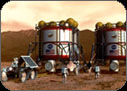 Mars is back on the agenda. The latest
images sent back from the Red Planet have revealed tantalising evidence
that there may indeed be life on Mars. There is now a pressing case
for the first manned mission to the planet - one that could take
place in the next twenty years. In the second of two special programmes
on Mars, Horizon traces the course of the planned journey
to Mars. It will be one of the most challenging trips humanity has
ever undertaken - 96 million miles across the solar system.
Mars is back on the agenda. The latest
images sent back from the Red Planet have revealed tantalising evidence
that there may indeed be life on Mars. There is now a pressing case
for the first manned mission to the planet - one that could take
place in the next twenty years. In the second of two special programmes
on Mars, Horizon traces the course of the planned journey
to Mars. It will be one of the most challenging trips humanity has
ever undertaken - 96 million miles across the solar system.
It’s a dangerous and risky gamble. Robots may have made the trip
but sending humans will stretch technological expertise to the limit.
The mission will take two and a half years - six months to reach
Mars, eighteen months on the planet, and six months to return to
Earth. The first crew, a handful of men and women, will live in
a cramped, dark space craft, vulnerable to a whole host of life-threatening
problems.
Without gravity, the human body designed for life on Earth, will
gradually disintegrate. Daily cosmic workouts will only partly help.
Muscles and bones will waste away. Radiation from deep space will
constantly tear through the astronauts' bodies, leaving them vulnerable
to cancer later in life. Unpredictable solar flares could 'zap'
the spacecraft, crippling the crew with radiation sickness - or
even death.
Psychologically, it will demand steely mental endurance; the Mars
pioneers will have to deal with the isolation of deep space, far
away from the familiarities of Earth. In a form of sensory deprivation,
the everyday experiences of wind or grass will disappear, to be
replaced by the experience of floating in a 'tin can'. Communication
with Earth will be difficult, at times taking up to 20 minutes for
a reply. Months of freeze-dried food will take its toll. Cooped
up with no privacy, depression or even nervous breakdowns are a
distinct possibility.
A medical emergency would be catastrophic. So far away from Earth,
evacuation is not an option. Even something as common as appendicitis
could be devastating - surgery in zero gravity is yet to be fully
conquered. And 48 million miles from Earth, there is no help on
hand if a fault causes a technical melt-down.
But for those willing to take the risks, the potential reward will
be huge and seductive. The incredible experience of being the first
human to take a small step on the Red Planet will spur many to volunteer.
But like all explorers, they will be gambling with their lives.
Further information
Transcript
 


|

