Moon Children
BBC2 9:00pm Tuesday 4th April 2000
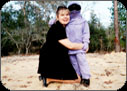 NARRATOR (DILLY BARLOW): The sun is the source of all life on Earth but the
sun, it can be deadly. This child has a very rare and potentially
fatal disease. A few minutes in the sun would set off a chain of
events that could kill him, yet he holds the key to one of the biggest
problems in medicine. The search to understand what is wrong with
these children has revolutionised our understanding and treatment
of cancer. 4-year-old Logan Williams lives in sunny Florida, but
spends most of her life indoors.
NARRATOR (DILLY BARLOW): The sun is the source of all life on Earth but the
sun, it can be deadly. This child has a very rare and potentially
fatal disease. A few minutes in the sun would set off a chain of
events that could kill him, yet he holds the key to one of the biggest
problems in medicine. The search to understand what is wrong with
these children has revolutionised our understanding and treatment
of cancer. 4-year-old Logan Williams lives in sunny Florida, but
spends most of her life indoors.
STEVE WILLIAMS: Logan.
LOGAN WILLIAMS: What?
STEVE: Ready to go outside honey?
NARRATOR: She can only go outside with extreme protection.
(ACTUALITY CHAT BETWEEN STEVE AND LOGAN WILLIAMS)
MICHELLE WILLIAMS: Logan always had beautiful skin from the time
she was born.
(ACTUALITY CHAT BETWEEN STEVE AND LOGAN WILLIAMS)
MICHELLE WILLIAMS: Then when she got to be about 9 or 10 months
old we started noticing just a redness. She always looked like she
had a suntan and her skin was just real dry. When I really knew
something was wrong was she had 4 spots on her head, she had 3 on
her forehead and one up here and they had grew and they were changing
colours and I was like something just that's not normal. Her paediatrician
at the time kept telling us there's nothing wrong with her, just…
STEVE WILLIAMS: Just keep an eye on them and if they get bigger
let me know and…
NARRATOR: Her spots were skin cancer. When she was 2 Logan was
finally diagnosed with xeroderma pigmentosum, or XP, a rare disease
when any exposure to ultraviolet light leads to skin cancer and
even death.
LOGAN WILLIAMS: That's freezing.
STEVE WILLIAMS: It's for your own good.
LOGAN: Daddy.
STEVE: (INAUDIBLE REMARK)
NARRATOR: Logan needs total protection. Cody Lloyd was diagnosed
with XP when he was 3. His mother was told he was unlikely to survive
to adulthood and might never be able to go outside again.
JENNIFER KEITH: I was very depressed and I thought well if he
can't go outside neither will I and so for about 6 months I just
stayed in, in the house, I wouldn't leave. I stayed in with him
and this was something I couldn't stop.
NARRATOR: Cody's few brief years of sun exposure as a baby have
left a catalogue of damage. Almost his entire face is cancerous.
JENNIFER KEITH: All of the surgeries have been primarily on his
face. We've not had any other spots removed, just his face and…
Show me, you show me the spots honey.
CODY LLOYD: There, there, there, behind the…(TALKING TOGETHER)
right by the ear right there.
JENNIFER: Behind that ear.
CODY: Behind the ear right there.
(ACTUALITY CHAT)
NARRATOR: XP affects just one in 250,000 people. The tragic inheritance
of a defective gene, passed on by two seemingly normal parents.
Steve and Michelle had no idea they carried this gene.
MICHELLE WILLIAMS Before we knew that there was a lot of pointing
fingers. It was like I wonder if he did it, or I wonder if I did
it, or…
STEVE WILLIAMS: The blame game.
MICHELLE: So we played that for a little while until somebody
said oh no, it's both of your faults, you both carry it. Then it
was just something that we had to work through which was hard.
NARRATOR: Somehow just one defective gene causes this devastating
and irreversible susceptibility to skin cancer. For the sufferers
XP means a lifetime spent in shadow or at night, but the study of
a handful of people with XP has unearthed a key genetic mechanism
that reveals why cancers start to grow and it helps explain why
1 in 3 children is likely to develop cancer later in life, why millions
of people a year succumb to this disease. This story of discovery
began over 40 years ago. In the early 1960s Henry Lynch was pioneering
research into hereditary cancer.
DR HENRY LYNCH (Creighton University, Omaha): Application of basic
genetic information in medicine can, in many cases, prove to be
gratifying to both physician and patient.
NARRATOR: Lynch believed there were strong genetic factors in
cancer, but he was a lone voice. Most doctors found the idea hard
to accept.
HENRY LYNCH: I kept saying it's got to be and I would get up at
meetings and get very, very emotional because I knew, I just knew
that there was a hereditary basis for certain cancers.
NARRATOR: The highest medical authorities of the time had a different
view.
ARCHIVE FILM NARRATOR: Dr. Frank Rauscher is Director of the National
Cancer Institute.
DR FRANK RAUSCHER (Director, National Cancer Institute): Cancer
is essentially an induced disease from the outside. It means it's
something we do, we eat, we drink, we smoke.
NARRATOR: People believed that cancer was caused solely by external
carcinogens like cigarette smoke or radiation. Lynch was sure that
genes were involved too but what Lynch couldn't find out was how
genes caused cancer. That's when 13-year-old Jeff Markway came to
him for treatment. Jeff had the severest form of skin cancer malignant
melanoma.
JEFF MARKWAY: I had a tumour in my right arm about the size of
a golf ball and I remember bringing, coming in to my mother and
moving my thumb and this thing was going up and down inside the
arm and the, Mom immediately rushes you to the doctor and oh, it
was identified as a cyst possibly and they decided to try to drain
the cyst and when they opened the arm up they found out it wasn't
a cyst, but it was a, a malignant tumour.
NARRATOR: It wasn't just that Jeff had cancer. Lynch was amazed
to find that Jeff and most of his family had the same disorder,
XP: Patrice, Kathleen and the twins Phil and Greg.
HENRY LYNCH: There were actually 5 of 7 siblings that manifested
this disease. Now I want to put this in perspective. It's exceedingly
rare disorder, exceedingly rare, and to find 5 members of a family
was most remarkable.
NARRATOR: The Markways disease was clearly genetic. Lynch's treatment
helped them to survive, but he also launched the family into a lifetime
of medical research. Their cells became an invaluable research tool.
MICK MARKWAY: They came in gangbusters, I mean there was probably
4 or 5 doctors that came in.
JEFF MARKWAY: I would say it was an entourage of about 5 or 6
people and the intent was to get blood and biopsies of the entire
family.
PHIL MARKWAY: They started with the oldest and worked their way
to the youngest. They took us in the room, we were isolated, they
took pictures of your upper torso they did skin biopsies, they took
blood samples. I was glad that I was the youngest.
JEFF MARKWAY: Each of us took our turns climbing up on the kitchen
counter for the biopsies. Some were done with Novocane, some were
done without. That was an exciting experience having a chunk of
skin cut off me. Hair, biopsies, blood samples. They took pieces
of me that I thought nobody would want to take a piece of.
NARRATOR: The hair, skin and blood samples from the Markways were
carefully stored until their genetic secrets could be unravelled.
JEFF MARKWAY: And they packed them on ice and came in and disappeared
just as fast as they came in and what came of that I don't think
we heard a thing.
KATHLEEN MARKWAY: No, we never did. We didn't.
JEFF: No, no. I'm not sure we would have understood anyway.
NARRATOR: What came of it would revolutionise our understanding
of cancer, but the role of the faulty XP gene was revealed by a
completely different area of science. The development of the atomic
bomb ushered in a new era for science and brought with it a new
set of problems. Radiation caused appalling mutations and cancers,
but scientists had no idea how. Then came another remarkable discovery:
the structure of DNA.
MAN: Now DNA is the stuff of heredity that carries us all through
our lives, makes us what we are, regulates our brains and bodies.
It's a rather elegant molecule, I think one might almost say a beautiful
molecule.
NARRATOR: DNA is the genetic material for life. It seemed likely
that radiation must affect it, but still no-one knew exactly how
so in 1963 biophysicist Richard Setlow was employed by the Atomic
Energy Commission to find out. He started very simply, studying
the effect on bacteria of ultraviolet radiation. RICHARD SETLOW
(BROOKHAVEN NATIONAL LABORATORY): Ultraviolet was used because it
was very easy to get sources of ultraviolet and they weren't particularly
harmful to people, whereas sources of ionising radiation were much
more harmful, much more difficult to use.
NARRATOR: When he irradiated bacteria with ultraviolet he expected
their DNA to be damaged and the cells to die, but to his enormous
surprise they survived.
RICHARD SETLOW: Cells responded in strange ways. They didn't always
die. Sometimes they recovered, but no-one knew why.
NARRATOR: Setlow had made a fundamental discovery. The DNA in
these cells was damaged by ultraviolet, but repaired itself. He
realised that enzymes in the cell cut out the damaged piece and
replaced it with new, undamaged DNA. This was why the cell survived.
RICHARD SETLOW: The analogue is plastic surgery. If you see a
lesion a plastic surgeon cuts it out and splices up other skin cells
so that the lesion isn't there, so what the resistant cells were
doing was, in a sense, plastic surgery at the DNA level.
NARRATOR: So DNA was able to survive radiation damage. Built into
the bacteria was a genetic mechanism allowing them to recover from
environmental attack but would human cells respond the same way,
was our DNA also this tough? 1,000 miles away in San Francisco young
biophysicist James Cleaver was trying to find out.
PROF. JAMES CLEAVER (University of California, San Francisco):
In the 60s I joined a new lab that was here in San Francisco which
is a radiation biology lab funded to investigate the effects of
radiation in humans, in man.
NARRATOR: Like Setlow, Cleaver was using ultraviolet radiation
to damage DNA in human cells. Once irradiated, lots of small, black
speckles were visible in the cells. The speckles marked new segments
of DNA. Cleaver thought they had replaced the DNA damaged by ultraviolet,
but others weren't so sure.
JAMES CLEAVER: It was hard to convince people that what we were
seeing was a real patch rather than some totally deranged piece
of chemistry and this was the problem we had. How can you prove
that the patching we could see was important.
NARRATOR: To prove that the cells were surviving because of DNA
repair Cleaver needed to find cells that died under UV to see if
they had DNA patches. Without these cells he was stuck. His breakthrough
came from an unexpected source.
JAMES CLEAVER: I saw an article in the local newspaper about a
genetic disease involved in cancer and in sensitivity to sunlight
and that's when I made the connection. Here is what we want. Nature's
made it. It's a disease, it's got genetics, is a mutant, it's UV
sensitive, let's, let's have a look.
NARRATOR: The article he read described Henry Lynch's study of
a family with no tolerance to ultraviolet light the Markways.
HENRY LYNCH: When I talked to my colleague Jim Cleaver his, his
ideas at the time were just absolutely revolutionary and I latched
on and it was through Jim that I became intensively interested and
it didn't take me very long to get cells into his laboratory from
these very willing patients.
NARRATOR: For Lynch at last he had found someone who could help
unlock the secrets of the Markway cells. For Cleaver it meant he
could immediately test his idea. If he was right these UV-sensitive
cells would not be able to repair their DNA. Once irradiated there
should be no patches to be seen.
JAMES CLEAVER: We took these cells and we did exactly the same
experiments as we did on normal cells.
NARRATOR: In normal cells he had seen black dots where he thought
the DNA had been patched. In the XP cells there was nothing.
JAMES CLEAVER: Lo and behold, no patch so this really was I think
a very, very formative moment.
NARRATOR: In one simple experiment Cleaver had proven that humans
repair damage to their DNA and he discovered what was wrong with
the Markways. Cleaver had revealed the mechanism that causes the
inescapable susceptibility to skin cancer in XP. When sunlight hits
the skin our DNA is damaged. Normally that damage is repaired, but
in XP patients their repair is defective. The damage can't be reversed
and starts to build up. Eventually it affects cell division leading
to cancer. Because they can't repair their damaged DNA patients
with XP are 2,000 times more likely to get skin cancer than the
rest of us.
JAMES CLEAVER: Here we have a sun-sensitive, genetic disease and
they don't patch the DNA, so the patching must be a productive repair
that prevents cancer in normal individuals and a failure of this
process in xeroderma patients leads to their sun-induced cancer.
CODY LLOYD: How black is crow?
JENNIFER KEITH: Pretty black.
NARRATOR: Cody has to be completed protected from all UV. If he
isn't the resultant cancers could be fatal.
JENNIFER KEITH: Since he was diagnosed we have absolutely protected
him 100% to our ability, but that's the nature of the illness. It
changes the molecules of the DNA and once they've,. you know, changed
from normal you can't return 'em to that, you can't ever bring them
back to where they were. No-one really unless they were living with
it would realise how much UV is involved in car lights, headlights,
street lights, you know, basically every grocery store I've been
in has ultraviolet lights. Doctors' offices have ultraviolet lights.
NARRATOR: Cody has a specially designed suit that is 99% UV proof
which gives him a degree of freedom.
STEVE WILLIAMS: Are you ready? Even with the suit, you know, we're
still limited. We can't go too far away from home 'cos then we've
got to turn around and come right back so she can take the suit
off, you know, in a safe area to get something to eat or use the
bathroom or what-not.
NARRATOR: Protection is the only way to reduce the risk of cancer.
JEFF MARKWAY: Basically as a child it was stay out of the sun
Jeff and through my life it's been stay out of the sun Jeff, you
know, get indoors, put your sunblock on, where's your hat, so xeroderma
pigmentosum became a lifestyle if you would. It was a way of living.
NARRATOR: The Markways still live a strict life. They always wear
sun-block, even indoors, and only go out at dusk and surviving cancer
has become part of their lives. They each have 3 or 4 tumours removed
from their skin every year. So when Greg Markway developed melanoma
in 1991 they thought little of it. He died 6 months later.
JEFF MARKWAY: With Greg I think we all thought he was going to
pull through because we always have. His loss was hard on all of
us. I think we, we basically have been told that we're going to
die so many times in so many words not, you know, stay out of the
sun or else you know, that you, you just don't think about it. You
know, the fact that it happened to Greg took the wind out of our
sails and we saw it happen.
NARRATOR: Meanwhile, James Cleaver was keenly researching his
finding. In XP he discovered that DNA repair protects us from ultraviolet
radiation and skin cancer, but he took the idea one step further.
He thought DFNA repair was involved in all cancers, that it was
the genetic component protecting us from all carcinogens.
JAMES CLEAVER: In retrospect it was more radical a notion than
I thought I had at the time. It just seemed like a logical interpretation
of some simple experiments and so I thought right, let's write it
up, make a paper for Nature and I remember I drafted the paper and
my supervisor and the director and the other faculty dragged me
in and said you can't say this, I mean you can't say cancer is caused
by these genes because this is such a radical notion.
NARRATOR: In the late 60s thinking that all cancers had the same
genetic mechanism was an idea ahead of its time.
JEFF MARKWAY: There was a doctor who came to me and said, you
know, we're going to make a major discovery with this, we may find
a cure for cancer with this. You know, you get kind of pumped up
and you're thinking oh this is, this is wonderful, you know, we're,
we're, we are, and I wasn't necessarily thinking of myself, I was
just thinking wow, cancer, cure, terrific, you know and then nothing,
we heard nothing. It was quiet. Went on with our lives.
NARRATOR: For the next 25 years DNA repair became the domain of
a small number of dedicated but obscure researchers.
RICHARD KOLODNER University of California, San Diego): DNA repair
didn't really generate as much excitement as one would have predicted
because xeroderma pigmentosum is a very rare disease as, for example,
compared to the 4 major cancers that kill people in the Western
world - lung cancer, prostate cancer, breast cancer and colon cancer.
NARRATOR: The giant field of cancer research slowly came to accept
that genes were involved in some cancers, but linking them with
DNA repair seemed ludicrous - until the finding of Richard Kolodner,
a world expert on DNA repair in yeast.
RICHARD KOLODNER: I didn't initially think I was working on cancer.
I thought I was working on yeast and I proceeded for probably 20
years never really thinking I was studying a human disease.
NARRATOR: But in 1993 Kolodner noticed something that would finally
bring genes, DNA repair and cancer research together.
RICHARD KOLODNER: We were just merrily working along trying to
understand how DNA repair worked in yeast when one day two papers
were published in a journal called Science.
NARRATOR: The articles described a breakthrough discovery. A gene
had been linked to a major cancer - colon cancer. This was a huge
development, but the cancer researchers couldn't explain how the
gene worked. In the DNA of the colon cancer Kolodner recognised
a familiar pattern - the colon cancer gene was the same as his gene
for DNA repair.
RICHARD KOLODNER: We were absolutely floored by these two papers
'cos we figures that the gene that caused the inherited susceptibility
to colon cancer had to be a DNA mismatch repair gene.
NARRATOR: Kolodner's finding was dynamite. It catapulted DNA repair
into the big league of cancer research and once researchers started
looking they found it everywhere. Breast, lung, testicular and ovarian
cancer all have underlying DNA repair defects.
RICHARD KOLODNER: Now it seems like every type of cancer is relayed
in some type of DNA repair defect and that there are huge numbers
of laboratories all over the world working on DNA repair and its
relationship to cancer.
NARRATOR: Scientists now think that DNA repair is the basic mechanism
that underlies most cancer. DNA repair explains why some people
succumb to cancer while the rest of us can survive a lifetime of
smoke or sun. There is a whole system of DNA repair processes which
protect our bodies from cancer, but when they go wrong that's when
we become vulnerable to carcinogens. A hunch about XP 30 years ago
has revolutionised what we now know about cancer.
HENRY LYNCH: It's a great feeling these days to be in the believability
category because early on they really thought I was crazy.
RICHARD SETLOW: It's obvious now what's going on. Damage to DNA
causes mutations, mutations cause cancer.
JAMES CLEAVER: Xeroderma was the first disease that linked all
these things together so it's really just extremely satisfying and,
and fascinating how these things have developed over the years.
NARRATOR: For the Markways the struggle with cancer has continued.
JEFF MARKWAY: Surgeries, operations, I've probably had hundreds
and I've had numerous melanomas, I usually know what they look like
and find them and, and have them surgically removed as quickly as
possible. My dermatologist tends to be a little aggressive and she
always wants to take off a little more than I care to have taken
off, but that's part of living and it's part of my living anyway.
JENNIFER KEITH: Cody's skin is still suffering effects from when
he was initially exposed. It's an accumulative effect from any time
he's ever been exposed to halogen lights or any time he was ever
exposed to a car light that flashed by.
NARRATOR: Cody, too, faces regular check-ups to catch his cancers
early.
DR HUGH GLOSTER: Here's what I wrote down before, may forehead
so you've got that one. Front of his left ear we got that one.
CODY LLOYD: Back.
HUGH: The right side of his nose and behind his right ear.
JENNIFER KEITH: And I guess…
HUGH: The other one behind his right ear that one, no I mean…
NARRATOR: The cancers have to be removed, but the visible ones
are sometimes only the tip of the iceberg.
JENNIFER KEITH: …he's a real artist.
HUGH GLOSTER: That's right. Let me look at your nose one more
time. We've had problems with Cody in the past in removing a skin
cancers because sometimes we'll remove the main skin cancer and
we'll check the edges of it and we've gotten that one skin cancer
out, but then we've run into another one that we couldn't even see
with our naked eye yet.
NARRATOR: Despite 30 years of study, the treatment for XP has
not changed but for other cancer patients research from XP might
bring huge benefits. Tumours are notoriously hard to destroy. Chemotherapy,
a standard treatment, has unpleasant side-effects and in 90% of
cases the cancers become resistant, all because cancer cells have
a particularly insidious trait.
BILL HINES: Apparently cancer cells are intelligent. When the
chemo destroys 'em they repair themselves.
NARRATOR: Police attorney Bill Hines was diagnosed with kidney
cancer in 1993. He's been fighting against it ever since.
MAN: That was very good.
NARRATOR: But despite numerous treatments the cancer has grown
back. It's spreading through his body. Bill is being treated by
Dr. Stanton Gerson in Cleveland.
DR STANTON GERSON (Case Western Reserve University, Cleveland):
Here's the heart. There's a, a little lump there. He also has a
lump in the middle of his, in the middle of his lungs and then there's
another small lump in the top of the remaining kidney. Now there
should be two kidneys on both sides, but of course he's already
had this one removed because this is where the cancer started and
this represents a small tumour that's now still come back in the
remaining kidney.
NARRATOR: Bill's been on chemo-therapy, but as so often happens
his cancer has grown resistant. There are 2 options: to increase
the dose of chemo, which would increase the side-effects, or try
to attack the cause of the resistance itself.
STANTON GERSON: We've been trying to figure out why cancer becomes
so resistant to chemotherapy because normal cells aren't resistant
and normal cells never become resistant to chemotherapy in fact,
so there's something special about tumour cells.
NARRATOR: Ironically, what's making the cancer cells resistant
to chemo is what protects normal cells from cancer - DNA repair.
The tumour cells have their own very strong repair system which
mends the damage done by chemotherapy and the cancer keeps on growing.
Gerson thinks he can overcome the resistance in Bill's cancer cells
by targeting their DNA repair, so he's trying out a drug, benzylguanine,
to do just that.
STANTON GERSON: Benzylguanine is a very special and particular
drug. It can completely wipe out that whole mechanism of DNA repair.
NARRATOR: Gerson gives the benzylguanine first to destroy DNA
repair in the cancer cells. Then he gives the chemo. The assault
on the tumour is much more effective. It's only a trial at the moment,
but results from the lab have been encouraging.
STANTON GERSON: We actually started out with mouse experiments
in which we inoculated a small number of human tumour cells on the
flank of a nude mouse. This mouse was treated with benzylguanine
to inhibit DNA repair and then the chemotherapy. The tumours failed
to grow at all. If we give the chemotherapy alone the tumours grow
just like this as if we hadn't given them any chemotherapy. I think
it's pretty obvious that if you had a malignancy and had a cancer
you'd just as soon look like this mouse than this mouse.
NARRATOR: Gerson believes the new drug will make chemotherapy
10 times more effective. If it works it will improve treatment for
thousands with cancer.
STANTON GERSON: We have learned so much in the last 5 or 7 years
that our approach to understanding cancer, our approach to treating
cancer is completely different than it was 5 years ago. We can walk
into a patient's room and say if I give you this dose of benzylguanine
we will completely inhibit this DNA repair process and allow the
chemotherapy to be much more effective.
BILL HINES: When I sit up and lean over to do something then it
hits right here.
NARRATOR: After several weeks of treatment Bill is responding
well. His cancer is now less of a threat.
STANTON GERSON: His tumour is still there. We haven't gotten rid
of it, but it's certainly no longer growing which I find remarkable
for someone who's been through so many different types of treatment
and frankly has failed so many different types of treatment.
BILL HINES: No question or doubt in my mind had I not been referred
to Dr. Gerson I wouldn't be here.
NARRATOR: The knowledge of DNA repair is keeping Bill's cancer
under control. If the trial is successful cancer patients everywhere
could benefit. All this from the study of XP.
BILL HINES: 5 years from now hopefully we'll hit the Lottery and
be retired. Practically doing the same thing we're doing now. I
don't think I want to retire. I've got too much damage left to do.
NARRATOR: While knowledge from XP is improving chemotherapy, it
is still of little use to Cody. Because XP makes him so vulnerable
chemotherapy could kill him. It's crucial that Cody regularly has
his cancers removed before they spread. These operations are saving
his life, but even here the UV levels of the lights have to be checked.
WOMAN: Just measuring. .1 on the UVA and zero on the UVB.
NARRATOR: Because of his early exposure the cancers will keep
on coming. Cody faces a lifetime of surgery, but at least it means
he will live a long and full life.
(ACTUALITY OPERATION CHAT)
This regular surgery is a harsh treatment. The ideal would be
to stop the cancers from building up in the first place, a treatment
that would be easier on a small child.
HUGH GLOSTER: What I hope in the future is that science will develop
some sort of a, a cream that can treat the skin cancers early and
prevent them from developing.
NARRATOR: XP patients have been hoping for a gentler treatment
for a long time.
KATHLEEN MARKWAY: 20 years ago they said there's a new cream coming
out that you can put on a pre-cancerous area and it will alleviate
you having to have surgery. None of the doctors had it, nobody knew
about it. I don't know who even started it, but it had to be someone
that was involved in it at the time, but it never ever filtered
down into our hands.
NARRATOR: Now Daniel Yarosh a biotechnologist in Long Island is
developing a new cream. He thinks he will succeed where others have
failed.
DANIEL YAROSH (AG Dermatics): The goal of the treatment is to
alleviate the effects of sun exposure that these patients have already
experienced. In many cases they continue to develop skin cancers
even after they'd taken protective measures and it's because of
the residual damage in their skin which they've been unable to repair.
NARRATOR: His idea is a cream to mimic the enzyme that the XP
gene isn't producing. This would repair the DNA before damage leads
to cancer.
DANIEL YAROSH: Of course once the enzyme is liberated into the
cell this is a DNA repair enzyme. It knows what to do. It finds
the DNA, it binds to DNA and it surveys DNA for damage so we had
complete confidence that if we could get the enzyme into the cell
that the enzyme would do its job and repair the damage.
NARRATOR: His lab is one of the few working on a treatment for
XP, but Yarosh is also interested in a much broader question.
DANIEL YAROSH: If you introduced super enzymes into normal people
would you be able to enhance their repair? At the time this was
not known. In fact we had a running bet in our laboratory - a bet
which I now I recall I haven't collected - but it turns out that
yes, one can increase and speed up even normal repair.
NARRATOR: This might give Yarosh's idea the push it needs to succeed.
XP is only a tiny fraction of a much larger and more demanding market.
DANIEL YAROSH: The types of skin lesions and skin cancers that
develop in XP are quite similar to what happens in the general population
except it happens to normal people at a much later age so XP is
in fact a time-lapse photograph of what happens to us as we age
and that is why we think that agents which can help XP patients
have direct application to helping the general population.
NARRATOR: A frightening 1 in 6 of us is likely to develop skin
cancer. A successful DNA repair cream could dramatically reduce
this number, so a treatment for XP may now happen because of its
benefit to millions of sun-worshippers. For XP children the cream
would alleviate years of surgery, but what Cody's parents would
really like is something more permanent.
JENNIFER KEITH: We are very hopeful for a cure. That is our most
fervent prayer that Cody will be able to walk outside and be with
his brothers in the sun. That's what we hope for.
NARRATOR: The only way to cure this inherited disease would be
to replace the defective gene: gene therapy.
JAMES CLEAVER: I know that the xeroderma families are very interested
in this idea of being able to deliver back to the skin the genes
that are missing, but delivering genes has turned out to be much
more difficult technically than I think any of us appreciated.
DANIEL YAROSH: This of course is a long-term goal of many scientists
to find a way to deliver corrective genes. I personally think we're
at least two Nobel Prizes away from the techniques that will allow
us to do that.
NARRATOR: A cure for XP may be years away, but despite this, Logan's
parents have decided to have another baby.
MICHELLE WILLIAMS: There's a 1 in 4 chance that our next one will
have it and that's something that we talked about for 2 years.
STEVE WILLIAMS: 2, 2 or 3.
MICHELLE: The more and more we talked about it we decided Logan's
happy, we're a happy family, it's not going to change our lives
any and we know what to do to protect the next child.
NARRATOR: If the new baby also has XP for the time being she,
too will have to live like Logan, wear full protection or stay out
of the sun.
MICHELLE WILLIAMS: So we're excited, the next one's due in April.
NARRATOR: In 40 years XP has provided a remarkable catalogue of
scientific breakthroughs. The study of cells from a handful of sufferers
has revolutionised the understanding, prevention and treatment of
cancer. This research has so far been slow to feed back to the patients
themselves, though the future may hold more promise. For the family
whose cells began the story the results are welcome, but may come
too late to affect them.
JEFF MARKWAY: We were always told that something good was going
to come from this. We may find a cure for the problem that you have,
we may be able to help your family and that's been the basis for
us doing this from the very beginning.
PHIL MARKWAY: We hoped for the best, we hope for a cure, but we
didn't dwell on it and we moved on with our lives. We always thought
positively.
KATHLEEN MARKWAY: Over the years I've had a call from the doctor
here, a doctor there saying may we ask you some questions or would
you fill out a questionnaire and I never ever would hear back from
them after I do that either. They would never tell me what they
were doing. It's that type of thing, so research is its own little
world which I understand, but you don't become part of it.
NARRATOR: If you would like more information on the issues in
tonight's programme please call the BBC Action Line on
Back to Moon
Children programme page.
 


| 
