Breath of Life
BBC2 9:30pm Thursday 13th January 2000
 PRODUCER'S NOTES by Jemima Harrison
We first heard about living donor lung transplants - or live-lung
transplants as they are also called - while making a film about
heart transplants at Harefield Hospital last year. This still-experimental
procedure sounded extraordinary: take a person with end-stage lung
disease; remove their lungs and replace them with a lobe from each
of two relatives who love them enough to put their own lives in
danger.
Only six operations had ever been done in the UK, all but one
by renowned surgeon Professor Sir Magdi Yacoub at Harefield, and
the procedure was riddled with ethical considerations. The operation
involves asking perfectly healthy people to undergo major surgery
- something which many doctors believe contravenes the Hippocratic
Oath. At best, the donors suffer from permanently impaired lung-function;
at worst, they might die. And for what? Only three of the recipients
have so far survived the operation and they all faced an uncertain
future - transplanted lungs are prey to a nasty, degenerative disease
called obliterative bronchiolitis which kills patients within, on
average, just five years.
Clearly, it would make a challenging film which raised big questions about how medical progress creates as many dilemmas as it resolves. But how on earth do you ask a family going through something so traumatic to allow a film crew to document the whole process?
The first step was to talk to Fran Duncan-Skingell, cystic fibrosis nurse consultant at the Royal Brompton - Harefield's "sister" hospital and the UK's biggest cystic fibrosis centre. Fran is the first point of contact for many cystics and their families - a mine of information, support and strength for many of those who are born with this terrible disease. CF sufferers are especially suited to live-lung transplantation because they are often physically small. A single lobe (we each have five lobes - three on the right; two on the left) from a normal, healthy relative is enough to replace an entire CF lung.
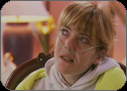
Fran told us about Sheila Batchelor, a 36-year-old cystic whom she admired tremendously. Like so many, Sheila had showed enormous courage and determination, particularly in continuing to work in her marketing job even when she was desperately sick. But now she was on 24-hour oxygen and being cared for full-time by her husband Martin. Without a transplant, she probably only had weeks to live. Making the situation even more poignant was that Sheila's sister, Ann, had died from CF in 1974 at the age of 15 and that her donors would be Sheila's brother and sister - Damian and Josephine Loughran.
Fran was certain Sheila would say "no" to being filmed. But to our surprise Sheila agreed. The family had only found out about the possibility of a live lung transplant by chance and Sheila thought such a film would help inform others about the procedure.
The rest of the family was less keen. They were all too aware that Sheila might not make it through the operation. After meeting them all and asking us a lot of searching questions, they went along with Sheila's wishes but it was tough for them. An intensely private family, having their lives documented at such a traumatic time was incredibly difficult. We gave them as many safeguards as we could, including telling them that they could ask us to put down the camera at any time. But every filming day was marked by the need to make judgment calls about what was reasonable to ask them to do. We got it right most of the time, but not always. In intensive care just after he came out of theatre, a still-groggy Damian lifted his head and told us, most succintly, to "F- off".
Filming the operation itself took considerable planning and we used two crews to capture as much as we could. Producer Geoffrey Smith and I had worked on medical films before, so weren't squeamish about the surgery but the whole team was awestruck by the process which involved three, staggered operations in three parallel theatres. At one point, all three siblings were on the table at the same time, leaving us filled with how awful it must have been for their parents, Mary and Harry, waiting anxiously outside.
In the days that followed, we filmed when we could and, when we couldn't, visited the hospital every day. Sheila remained sedated and on a ventilator - oblivious to the passing of, first, her 37th birthday and, two days later, her 10th wedding anniversary. We all followed her progress on the monitors which recorded her every heartbeat and breath, and willed her to improve.
Damian and Josephine were shaken by how much they hurt post-operatively and they had to stay in hospital much longer than anticipated. They talked to us when they could bear it, transparent with pain but determined to fulfil their commitment to have the event recorded so others could learn from it. Knowing how private they both are, it was a truly impressive display of altruism - usually the first quality to evaporate in the face of physical and emotional adversity. But perhaps we shouldn't have been surprised - they had already made a huge sacrifice.
Three weeks after the operation it became clear that Sheila was deteriorating fast and, in the early hours of the morning, she finally lost her fight for life, the family at her side. There was no question of filming that night. But we lingered at Harefield until dawn - unsure of the protocol but feeling it important to be there; not as film-makers but as human beings who were privileged to have been allowed to witness the tremendous courage and love that informs the whole family. It is hard to imagine not being on hugging terms with them for years to come.
It was impossible not to become emotionally involved - as, indeed, was also true of the medical team at Harefield, particularly the intensive care nurses. There was a veil of sadness over the hospital and we all felt for Damian who, a few hours after his sister died, had to have a chest-drain reinserted - an intensely painful procedure.
At the outset, we had told the family that, should Sheila die, the decision whether or not to show their story would rest with them. How else could it be? We decided to leave them alone for a few weeks, to see how they felt about it. But in the end they came to us and said they wanted to proceed. They felt it was what Sheila would have wanted and, despite the sad outcome, there were still positive aspects to their story. Both Damian and Josephine feel they were right to try to save their sister. And what sustains the family now is the knowledge that the promise offered by the operation transformed Sheila's spirits in the weeks leading up to it. For the first time in months, she had hope.
Most of all, the family wants the film to highlight the organ donor shortage that made a live-lung transplant Sheila's only option. They also want other people who are considering the operation to know exactly what it entails - for good and bad - and they want people to know about cystic fibrosis and how a cure can't come too soon.
Breath of Life is a tribute to the whole family - to parents Harry and Mary, to Damian, Josephine and their partners Elisabeth and Keith; to Sheila's husband, Martin and, of course, to Sheila herself . To them, from all of us, thank you.
JEMIMA HARRISON - ASSOCIATE PRODUCER
Back to Breath of Life programme page.
|

